
ANTHROPOMETRIC AND PHYSIOLOGICAL PROFILE AND BLOOD LACTATE CONCENTRATIONS IN UNIVERSITY TAEKWONDO ATHLETES FROM BARRANQUILLA, COLOMBIA
PERFIL ANTROPOMÉTRICO, FISIOLÓGICO Y CONCENTRACIONES DE LACTATO EN TAEKWONDISTAS UNIVERSITARIOS DE BARRANQUILLA, COLOMBIA


Everardo Manuel Sánchez Puche, Jorge Navarro Beltrán, Yainer Villa Pertuz, Edelberto Rafael Redondo Reynoso, Christian Ovalle
ANTHROPOMETRIC AND PHYSIOLOGICAL PROFILE AND BLOOD LACTATE CONCENTRATIONS IN UNIVERSITY TAEKWONDO ATHLETES FROM BARRANQUILLA, COLOMBIA
Cultura, Ciencia y Deporte, vol. 21, no. 68, 2026, 10.12800/ccd.v21i68.2499
Universidad Católica San Antonio de Murcia
Everardo Manuel Sánchez Puche a
Universidad Simón Bolívar, Colombia
Jorge Navarro Beltrán
Universidad Simón Bolívar, Colombia
Yainer Villa Pertuz
Universidad de la Guajira, Colombia
Edelberto Rafael Redondo Reynoso
Universidad de la Guajira, Colombia
Christian Ovalle
Universidad Tecnológica del Perú, Perú
Received: 30 April 2025
Accepted: 13 November 2025
Abstract: Taekwondo, a martial art that has become an Olympic sport, is a combination of technique, strategy, and physical strength. In Barranquilla, its practice in the university context faces challenges related to physiological and biochemical evaluation. This study investigates the analysis of lactate, a byproduct of anaerobic metabolism, as a fundamental indicator for improving athletic performance. Thirteen university taekwondo practitioners participated, selected under rigorous criteria and evaluated through two lactate threshold tests: traditional incremental and minimum lactate. The results underscore the importance of adapting specific methods to taekwondo, given its explosive and non-cyclical nature, in order to accurately represent its physiological requirements. This approach seeks to establish scientific foundations that help design personalized training programs, improve anaerobic lactic capacity, and strengthen technical and tactical performance in a competitive environment. In this way, research in non-cyclical sports is promoted, favoring local and regional athletic advancement with innovative methodologies adapted to the Caribbean region.
Keywords: Lactate threshold, incremental test, minimal lactate test, Bandal Chagi kick, anaerobic metabolism.
Resumen: El taekwondo, un arte marcial transformado en deporte olímpico, es una integración técnica, de estrategia y potencia física. En Barranquilla, su práctica en el contexto universitario enfrenta retos vinculados a la evaluación fisiológica y bioquímica. Este estudio investiga el análisis de lactato, un subproducto del metabolismo anaeróbico, como indicador fundamental para mejorar el rendimiento deportivo. Participaron 13 taekwondistas universitarios, elegidos bajo criterios rigurosos y evaluados a través de dos pruebas de umbral de lactato: incremental tradicional y lactatomínimo. Los resultados subrayan la importancia de adaptar métodos específicos al taekwondo, dada su naturaleza explosiva y no cíclica, para representar con precisión sus requerimientos fisiológicos. Este enfoque busca establecer fundamentos científicos que ayuden a diseñar entrenamientos personalizados, mejorar la capacidad anaeróbica láctica y reforzar el rendimiento técnico-táctico en un entorno competitivo. De esta forma, se fomenta la investigación en deportes no cíclicos, favoreciendo el avance deportivo local y regional con metodologías innovadoras y adaptadas a la región Caribe.
Palabras clave: Umbral de lactato, test incremental, test de lactatomínimo, patada Bandal Chagi, metabolismo anaeróbico.
Introduction
Taekwondo (TKD), a combat sport rooted in martial arts, was featured as a demonstration sport in the 1988 Seoul Olympic Games and became an official medal sport in the 2000 Sydney Games. It transcends the boundaries of physical competition by integrating discipline, precision, technique, and tactical skill (Heugas et al., 2007). In the universities in Barranquilla, where sport is a crucial factor for the all-round development of young individuals, analyzing the physiological profiles of athletes is essential to optimize their performance. Lactate threshold (LT) in athletes, characterized by rapid movements, dynamic spins, and technical and tactical combinations, require a balance between anaerobic power and aerobic capacity. Studying their physiological and biochemical characteristics is crucial as they are required to have a high level of physical fitness, strength, power, agility, and endurance.
Taekwondo athletes undergo intensive training and participate in competitions that demand significant physical and mental effort. During these activities, anaerobic metabolism is activated, resulting in the production of lactate. Blood lactate is a key physiological marker that reflects the body’s response to anaerobic exercise. Lactate accumulation may be associated with muscle fatigue and can negatively impact athletic performance. However, the ability to efficiently clear lactate and recover rapidly is crucial for maintaining performance and endurance levels during Taekwondo competitions (Trybulski et al., 2026).
Aerobic capacity is essential for phosphocreatine resynthesis and lactate clearance during and after competition both fundamental for sustaining the technical and tactical intensity required in combat. This capacity is commonly measured using the lactate threshold (LT) (Aravena et al., 2020), which is considered a key indicator of aerobic fitness. However, traditional methods for assessing LT, such as the incremental test (IT) and the maximal lactate steady state (MLSS) test (Garcia-Tabar & Gorostiaga, 2018), are typically based on cyclical movements, which limits their specificity for sports like TKD, which rely on dynamic, non-cyclical actions (López-Laval et al., 2021).
High-intensity practice sessions of TKD result in the accumulation of lactate in blood, a key metabolic byproduct that affects athletic performance. This phenomenon, although often perceived negatively, is a natural part of physical exertion. Lactate acts as a marker of fatigue, and also as an indicator of adaptation to training. In Barranquilla, where tropical climatic conditions pose additional challenges, the ability of TKD athletes to manage and clear lactate becomes particularly relevant, especially during recovery periods between rounds and training sessions (Yılmaz, 2021).
TKD is practiced in more than 182 countries worldwide (World Taekwondo Federation, 2023); however, its practice at the local level and within specific settings such as universities requires a context-specific approach. The competitions, organized in two-minute rounds with a one-minute rest, require athletes to balance physical skills and psychological strategies. Thus, preparation involves the development of power and speed, and the enhancement of aerobic capacity, which is essential for processes such as phosphocreatine resynthesis and efficient lactate clearance. Despite being a combat sport with a rich tradition and a prominent place in the Olympic games, TKD has received limited attention in physiological research. Research has predominantly focused on sports involving cyclical movements, such as swimming and cycling, leaving a significant disparity in the literature regarding non-cyclical sports. This underscores the necessity to develop specific methodologies that take into account the characteristic movement patterns of TKD and its unique physiological demands.
In Barranquilla, research on physiological profiling of TKD athletes is limited, particularly within university settings. Current assessment methods, such as the minimum lactate test MLT, offer practical advantages;It helps identify the point at which metabolism shifts from aerobic to anaerobic, which is key to planning workouts and assessing an athlete's condition, in addition, lower cost, rapid application, useful for estimating anaerobic capacity without invasive equipment. However, they have not been systematically validated for TKD-specific movements. Thus, studies that adapt and validate these methods in local contexts, considering the environmental conditions and characteristics of the athletes, are required (Garcia-Tabar & Gorostiaga, 2018). In this context, the LT is a key parameter for assessing aerobic capacity in TKD athletes. However, traditional methods for determining LT, such as the IT and MLT, were originally designed for cyclical sports. The validity of these methods in disciplines such as TKD, where movement specificity is essential to accurately reflect the sport’s demands, requires verification.
Therefore, in this study we aimed to address this disparity by analyzing blood lactate concentrations in university-level TKD athletes from Barranquilla, Colombia. In addition, we wished to examine how advances in sports physiology can be applied to optimize training in university students by considering their blood lactate levels. Through specific tests for this sport discipline, we aimed to accurately identify the LT, providing tools to design training programs tailored to the requirements of local athletes. This approach aims to optimize athletic performance, and to establish a scientific foundation that may stimulate future research in sports with similar characteristics, both in the Caribbean region and at the national level.
Methods
This study was approved by the ethics committee of the Universidad de la Costa CUC and was conducted in accordance with the international ethical standards for research involving human subjects (Parums, 2024). Before participating, all volunteers gave their written informed consent. Sixteen athletes from the Barranquilla departmental taekwondo championship were invited to participate; of these, thirteen met the predefined inclusion criteria. An explanation based on methodological precedents and power analysis (β =.80, α =.05) was added (Table 1).
Variables Age, Weight, Height, BMI and Training Years

Note. BMI = Body Mass Index.
Selection of Participants
Inclusion criteria were established to select TKD athletes, ensuring a homogeneous group in terms of training level and experience. The inclusion criteria were age between 16-33 years; a minimum of two years of TKD experience; participation in the regional ASCUN championship; no use of nutritional supplements or ergogenic substances including anabolic-androgenic steroids; non-smoker status; normal blood pressure; no diagnosis of diabetes; and prior familiarization with the required exercises, having performed them at least once before the start of the study.
Test Preparation
Specific protocols were designed for lactate testing, namely the IT and MLT. In addition, controlled conditions such as proper hydration and ambient temperature were maintained to ensure accurate and reliable results. Data collection was conducted at the beginning of the competitive season, during which athletes trained regularly for 12 hours per week, distributed over five days. Participants were instructed to report to the laboratory under the following specific conditions: well-rested, properly hydrated, having refrained from intense physical activity in the previous 48 hours, and having fasted since 11:00 p.m. the night before. In addition, all tests were conducted during the same morning time window (7:30–11:00 a.m.) under controlled temperature conditions at 23 °C. The trials were performed on separate days, one week apart, to prevent interference with the results.
Test Execution
LT was identified by visual inspection of the lactate curve; this method was used in two tests, viz. the traditional IT and MLT. The order of the tests was randomly assigned. Two investigators with extensive training in biochemistry and exercise physiology independently evaluated the curves. In the IT test, the LT was set at the intensity prior to a pronounced and sustained increase in blood lactate relative to the workload. For the MLT test, LT corresponded to the intensity associated with the lowest observed lactate concentration.
Incremental Test (IT)
Participants performed kicks in 2-minute blocks, gradually increasing intensity, while heart rate and lactate concentrations were monitored using blood samples. The rhythm of the kicks was controlled with a digital metronome (D'Accord®), and the test continued until voluntary exhaustion or until the established rhythm could no longer be maintained.
MLT
A one-minute maximal effort was performed, and blood lactate samples were collected during a defined recovery period to assess the body’s physiological response. Lactate concentrations were measured using an electrozymatic device (Lactate Plus Sport, USA), and heart rate was monitored with a pulsometer (Polar® Accurex Plus, Finland). This methodological approach ensured the validity and reliability of the assessment of the variables under study.
Statistical Analyses
The Shapiro–Wilk test was used to check the normality of the data. Data within the normal range were compared using the paired-samples t-test. Conversely, data that did not fall within the normal range were compared using the Mann–Whitney U test. Additionally, the Bland–Altman method was applied (Bridge et al., 2009) to verify compliance methods. Statistical significance was set at a p< .05.
Results
Anthropometric Profiling
Analysis of the results presented in Table 1 revealed data concerning the age, weight, height, body mass index (BMI), and training experience (in years) of university-level Taekwondo athletes from Barranquilla. The age of the participants was 22.2 ± 2.4 years, and their mean body weight was 61.0 ± 13.7 kg, with a maximum of 76.9 kg and a minimum of 36.2 kg. The group had a mean height of 162.0 ± 10.6 cm and a BMI of 23.1 ± 4.0, with values ranging from 17.6 to 28.1, classifying the group within the normal BMI category.
The data related to Σ6PL (mm): fat mass (%) and muscle mass (%) of university Taekwondo athletes of Barranquilla. A Σ6PL of 85.77 mm ± 34.45 is observed, with a maximum Σ6PL of 136 mm and a minimum Σ6PL of 29 mm. Regarding fat mass, the group averaged 29.97% ± 6.6 mm, ranging from 20.17% to 39.97%, indicating high fat mass levels that exceed the ideal standards for combat sports, where lower body fat may enhance performance. Muscle mass was 29.70 ± 8.12%, with values ranging from 16.84% to 40.28%, suggesting low muscle mass levels in the group, which may compromise the strength and power required for optimal Taekwondo performance.
The group of university Taekwondo athletes from Barranquilla consisted of 13 participants, with a slight predominance of females over males. The female sex comprised seven participants, representing 53.8% of the group, and male sex corresponded to six participants, representing 46.2% of the group.
Table 2 BMI distribution among the Taekwondo athletes shows that 53.8% were classified as overweight, 30.8% as having normal weight, and 15.4% as underweight. These findings indicate a predominance of overweight status, which may negatively impact athletic performance, underscoring the necessity for strategies to optimize weight management and body composition. According to the ∑6PL classification, 61.6% of the Taekwondo athletes were classified as overweight (Grades I and II), whereas only 15.4% presented values within the adequate range. These results indicate an excess of subcutaneous fat in the majority of the group, emphasizing the necessity for targeted strategies to improve their physical conditioning. The distribution of fat mass shows that 53.8% of the Taekwondo athletes have very high amounts, 15.4% have high amounts and only 30.8% have acceptable amounts of fat. These results show a predominance of excessive body fat, which highlights the importance of optimizing nutritional and training strategies.
Frequency of BMI, ∑6PL, Fat Mass and Muscle Mass
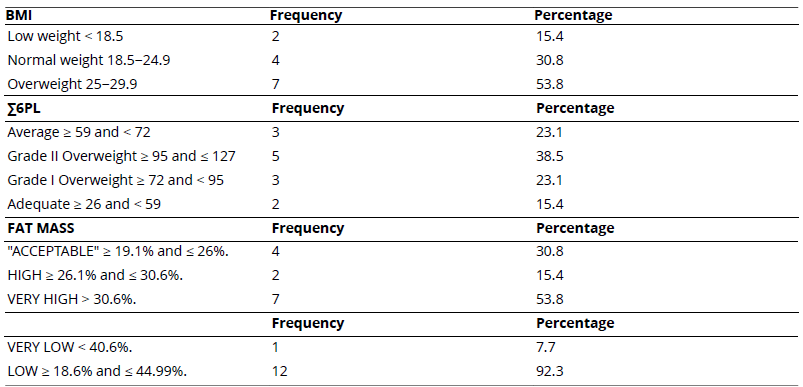
Note. BMI = Body Mass Index − Σ6PL (mm) = Sum of six skinfolds mm.
Physiological Profiling and Lactate Concentrations
Analysis of the results presented in Table 3 reveals data on stage (kicks/min), power output (watts), heart rate, and lactate levels in university Taekwondo athletes from Barranquilla. In this regard, the group of 13 Taekwondo athletes showed an average of 7 ± 3.9 kicks/min, a power output of 135 ± 66 watts, a heart rate of 146 ± 17 bpm, and a blood lactate concentration of 14 ± 4 mmol/L. These values reflect a remarkable variability in the measurements obtained.
Stage Variables (Kick*min), Watts, Heart Rate and Lactate Levels

Note. Stage (kick*min) = Stage kick per minute.
Table 4 shows that 46.2% of the Taekwondo athletes achieved 120 kicks per minute, whereas the rest presented lower frequencies. In terms of power output, 46.2% of the participants exhibited low levels (90 watts), whereas 23.1% exhibited normal (150 watts) and high levels (250 watts). Regarding lactate levels, 84.6% of the participants exhibited very high values (>8.1 mmol/L), whereas 46.2% showed heart rates above 140 bpm, indicating higher physical exertion.
Stage Frequency (Kick*min), Watts, Heart Rate and Lactate Levels
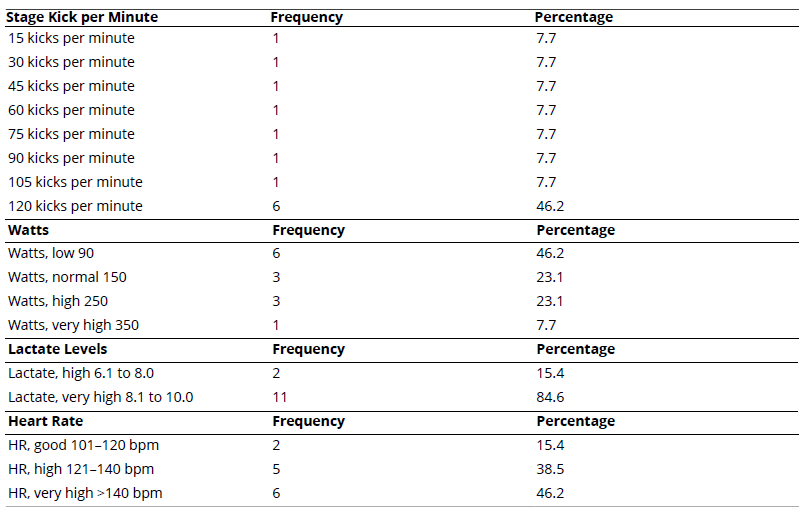
Figure 1 The blue curve indicates that, with increasing load, the lactate concentration increases exponentially, reaching a maximum point near 199 W. This may represent the LT, the point at which lactate production exceeds clearance, indicating a progressive shift toward anaerobic metabolism. The red line shows a linear increase in beats with higher load, highlighting the direct relationship between physical demand and cardiovascular response.
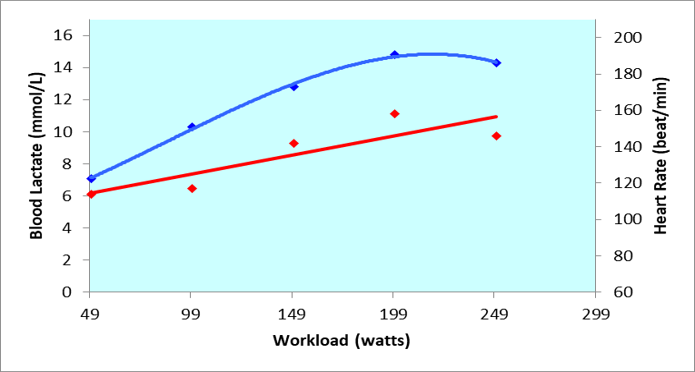
Figure 1
Relationship Between Workload (in Watts) and the Subject's Physiological Responses
Note. Blood lactate concentration (mmol/L, blue line) and heart rate (beats per minute, red line) for a single participant on different days.
Figure 2 If LT occurs at medium loads (approximately 99–149 watts), it indicates a good aerobic capacity for the sport. High lactate levels (14–16 mmol/L) suggest that the subject has good tolerance to anaerobic stress, which is important in explosive sports such as Taekwondo. The linear relationship between HR and load indicates a healthy cardiovascular response, without irregularities.
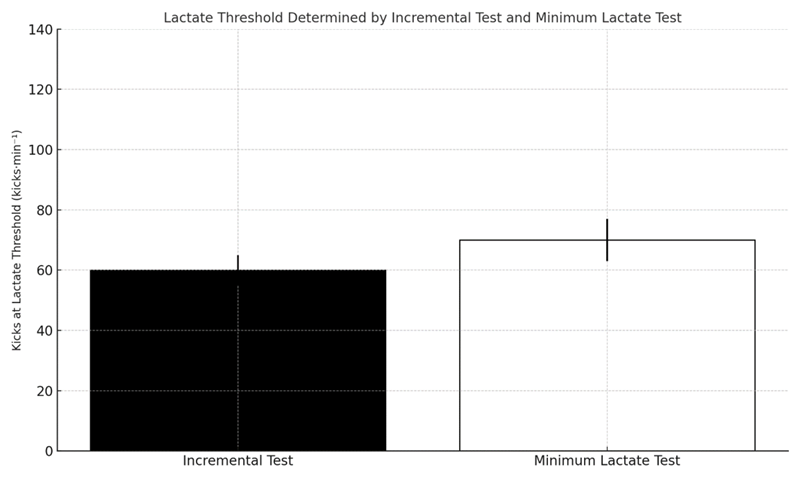
Figure 2
Absence of Differences (p>.05) in Lactate Threshold Determined Using the Incremental Test (n = 13) and Minimum Lactate Test (n = 8), Using the Specific Taekwondo Bandal Chagi Kick
Identification of the Lactate Threshold (LT) for a Single Participant on Different Days

Note. T1 = Time 1. T2 = Time 2. T3 = Time 3. T4 = Time 4. T5 = Time 5.
Figure 3 Lactate concentration (blue): Shows a significant increase to 199 W, followed by a slight decrease to 249 W. Heart rate (red): Increases progressively with workload but appears to plateau at the final measurement point. Borg scale (green): Indicates that the perceived stress increases proportionally to the load, with a maximum of 16 at 249 W.
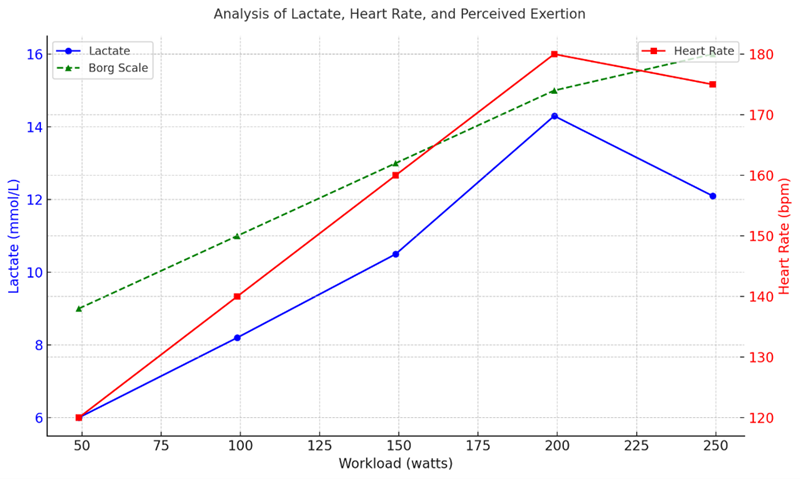
Figure 3
Lactate Levels, Heart Rate, and Perceived Exertion (Borg Scale) as a Function of Workload (Watts) for a Single Participant on Different Days
Figure 4 Lactate concentration increases progressively with the intensity of effort, reflected in kicks/minute. At low intensity levels, aerobic metabolism predominates; however, as intensity increases, lactate levels rise significantly, marking a greater dependence on anaerobic metabolism. The aerobic threshold (2–4 mmol/L) signals the transition to mixed metabolism, whereas the anaerobic threshold (>4 mmol/L) indicates excessive lactate production. In recovery, lactate reduction is moderate, reflecting the body's efficiency in its clearance. Heart rate and perceived exertion scale (Borg) aligned with changes in lactate concentration, showing consistency between physiological and subjective variables.
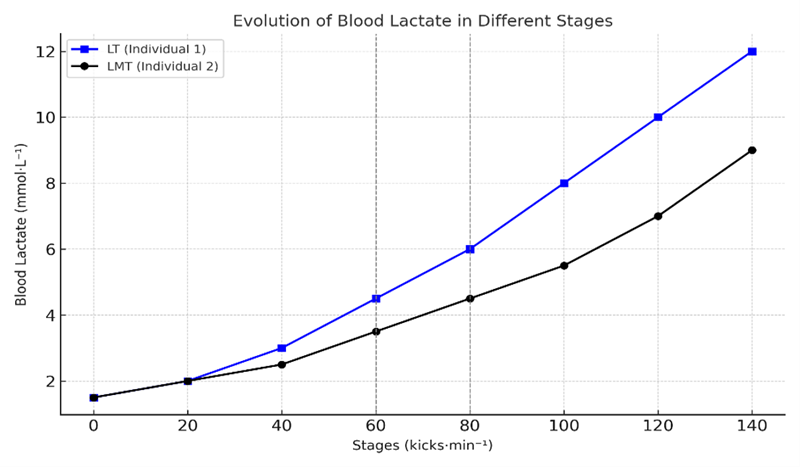
Figure 4
Lactate Threshold (60 Kicks-min-1) Determined Using IT and MLT for two Participants on Different Days
Note. Maximum lactate concentration ([La]) after 7 min of passive recovery from maximum intensity kicks performed for 1 min.
In relation to the MLT, the analysis reveals significant differences between the IT and the MLT in kicks at the lactate threshold. In the IT, athletes averaged 55 ± 10 kicks/minute, whereas in the MLT they reached 85 ± 15 kicks/minute, exhibiting a relative increase of 54.5% in the MLT. This reflects the technical specificity of the MLT, which allows for more efficient performance. The lower variability in the IT indicates uniformity in overall capabilities, whereas the MLT highlights individual differences in technical economy.
Discussion
In Taekwondo, anthropometric profiling is critical and influences athletic performance, particularly in this type of discipline, where agility, speed, and power are essential components of the sport. The relationship between body composition and lactate levels in Taekwondo athletes has been the focus of recent research, which has shown that an adequate proportion of muscle mass and a low body fat percentage can contribute to enhanced performance and a more efficient anaerobic metabolic response.
In a study conducted by Agopyan et al. (2022) the body composition of elite Taekwondo athletes and its relationship with lactate levels during competitions was analyzed. The results of this study showed that athletes with a higher percentage of muscle mass and a lower percentage of fat showed lower post-competition lactate levels, suggesting greater efficiency in energy utilization and better recovery capacity. This finding aligns with the premise that optimal body composition can enhance performance in high-intensity sports, such as Taekwondo, where lactate production is inevitable in explosive efforts.
In another relevant study, Ojeda–Aravena et al. (2021) investigated the relationship between body composition and lactate response in Taekwondo athletes during a specific training protocol. The authors found that athletes with a higher proportion of lean mass had lower lactate levels, and showed faster recovery between training sets. This highlights the importance of body composition in immediate performance, as well as in the ability to recover and maintain a high level of performance throughout training sessions and competitions.
Our findings regarding fat and muscle mass were compared with previous research that has analyzed the relationship between body composition and performance in combat sports. For example, studies by Agopyan et al. (2022) and Ojeda–Aravena et al. (2021) have shown that a lower percentage of fat tissue, as well as a higher muscle mass, are positively correlated with better performance in Taekwondo. Also, it is important to discuss how our findings, which indicate that elevated fat mass and reduced muscle mass, could indicate areas of significant improvement for athletes.
The findings of this study are consistent with those of a previous study that has examined lactate levels in athletes from various disciplines. A study by Bridge et al. (2014) examined the lactate response in Taekwondo competitors and revealed that lactate concentrations increased markedly during competitions, indicating activation of anaerobic metabolism. This evidence supports the idea that Taekwondo, being a high-intensity and short-duration sport, elicits a physiological reaction characterized by lactate generation. In addition, other research on similar disciplines has demonstrated the relevance of lactate as an indicator of performance and recovery capacity.
Liu et al. (2023) analyzed the relationship between exercise intensity, emotional state, and perceived exertion at different times of day. They found that lactate concentrations were linked to subjective perception of exertion during physical activity, suggesting that lactate may affect the subjective experience of physical exertion.
Similarly, lactate concentrations have been associated with the subjective experience of exertion during high-intensity exercise, suggesting that lactate may play a role in the perception of physical regulation (Bridge et al., 2014).
As for Taekwondo athletes, Seo et al. (2019) conducted an analysis on the physiological responses of female competitors during training and competitions. They found that lactate levels increased significantly after an intense training session, indicating activation of anaerobic metabolism and lactate production in response to physical exertion. This evidence underscores the relevance of examining lactate concentrations in TKD athletes from the Atlantic region. By understanding the fluctuations in lactate levels in response to training and competition, it is possible to develop more effective and individualized training strategies aimed at optimizing performance and recovery in female athletes (Wang et al., 2023).
Our main finding confirms the feasibility of identifying LT through specific tests for TKD. In addition, the intensity of LT was analogous in both protocols applied. Therefore, any of these methods may be employed to enhance the assessment and prescription of TKD training. To our knowledge, this is the first study to examine specific protocols for analyzing LT in TKD competitors.
LT identification is the most common method for assessing aerobic capacity by determining the response of lactate concentrations to exercise (Ribeiro et al., 2004). The IT has been linked to the reference methodology among aerobic capacity diagnostic protocols known as MLSS. Also, the intensity obtained from MLT can estimate MLT and its protocol has been validated (Billat et al., 2004). However, the exercises in these tests are always cyclical. To change this paradigm and take into account the specificity principle, a particular kick was used to evaluate lactate concentrations. LT was achieved in both tests, so that specific tests are presented as a promising alternative for evaluation in TKD.
We could not find any analysis in the scientific literature that measured LT through specific movements in TKD competitors. Due to the scarcity of prior research, our findings cannot be directly compared; however, in line with this study, one investigation successfully employed a specific sport-related movement to determine the minimum lactate intensity in Judo (Bacon & Kern, 1999). Despite the limited literature on LT in TKD, there are studies that contribute to clarifying the physiological responses of TKD during competitions or simulated matches.
One study examined HR variations and blood lactate concentration during a simulated TKD competition across three weight categories. The mean HR response was 160 beats-min-1 (86% HR) and the lactate concentration during competition was 3.35 mmol-L-1. Although the authors did not evaluate LT, they concluded that the lactate concentration was close to LT, probably because of the standard LT value of 4 mmol-L-1 suggested by other authors (Heller et al., 1998). However, the LT defined by a fixed lactate concentration was established in pedestrianism. Discrepancies in the type of exercise may alter the context for TKD movements, thereby preventing such generalizations. Our HR values showed similarities between the IT and MLT tests (i.e., HR at LT and HRmax), demonstrating good agreement between the protocols, which appear to match the 80% of the estimated HRmax for the age of students practicing TKD recreationally while performing two different beginner techniques (single arm and arm and leg techniques).
Therefore, training should incorporate exercise sets that effectively stimulate both aerobic and anaerobic metabolism. The protocols applied in this study are considered appropriate, as the LT provides adequate information regarding energy metabolism and the intensity of a specific training session. Furthermore, while heart rate recovery depends on aerobic metabolism and can be optimized through proper assessment and prescription of sport-specific training, our preliminary work on lactate LT in TKD testing appears promising. Regarding the intensity obtained with IT and MLT, we found equivalent values with both LT kicks (Figure 2) and maximal kicks. This finding validates that both protocols are effective in identifying LT. This evidence is essential for evaluating and prescribing training for athletes, who must prepare for six to seven fights in a single day. Unfortunately, we have not found any studies that have evaluated LT in a specific movement for TKD with which we could compare our data. However, by analogy, our LT results in relation to peak intensity were 60% and 70% for IT and MLT, respectively.
Conclusions
These studies highlight the necessity for coaches and trainers to consider body composition as a key component in the design of training programs for Taekwondo athletes. Regular assessment of body composition, along with monitoring of lactate levels, can provide valuable information to personalize training regimens and optimize athletic performance. In addition, future research should focus on the implementation of nutritional and training interventions aimed at improving the body composition of athletes, which could result in a reduction of lactate levels and improvement in the capacity to perform Taekwondo.
We concluded that it is feasible to recognize LT in both the IT and the minimal lactate test, both designed specifically for TKD, using the crescent kick (Bandal Chagi kick). In addition, there is no variation in LT intensity between the two proposed methods. Therefore, we confirmed our original hypothesis that LT can be estimated in TKD-specific assessments.
The findings of this research showed clear patterns in the lactate levels of TKD athletes from the Atlantic region. During intense training, a marked reduction in lactate levels was observed in contrast to resting values. This finding suggests that anaerobic metabolism was activated during physical activity, resulting in an accumulation of lactate in the blood of athletes.
In particular, it was determined that lactate levels reached their maximum in the highest intensity stage of training, coinciding with the sequences of explosive and fast movements characteristic of Taekwondo. This is in agreement with previous research that has shown that high-intensity and short-duration activities, typical of Taekwondo, induce a physiological response marked by lactate production.
In addition, the recovery capacity of the athletes after intense exercise was evaluated. We observed that lactate levels gradually decreased during the recovery period, indicating effective clearance of accumulated lactate from the blood. This ability of rapid recovery is crucial for athletes to maintain consistent performance during competitions and recover adequately between training sessions (Haddad et al., 2017).
These findings underscore the relevance of monitoring the lactate levels of TKD athletes from the Atlantic region. By understanding each competitor's physiological lactate profile, coaches and sports professionals can develop more effective and personalized training strategies. Further, this knowledge may help identify areas for improvement in athletes’ physical conditioning and anaerobic endurance, which could potentially result in enhanced performance in Taekwondo competitions.
This study has certain limitations. The sample size was relatively small and limited to Taekwondo athletes from the Atlantic region, which may affect extrapolation to other geographical contexts. In addition, longitudinal studies are recommended to enable long-term monitoring of lactate levels and their relationship to athletic performance in Taekwondo.
Ethics Committee Statement
The authors declare that this study was reviewed and approved by the Research Ethics Committee of the University of the Coast, Barranquilla, Colombia, under approval code Act No. 002, dated March 28, 2025. All participants signed an informed consent form prior to their inclusion in the study, ensuring compliance with the ethical principles established in the Declaration of Helsinki (2013) and national and international regulations on research involving human subjects. The confidentiality, autonomy, and well-being of the participating university athletes were respected at all times.
Conflict of Interest
The authors of this manuscript declare no financial, academic, or personal conflicts of interest that could influence the results or interpretation of this research. The study was conducted for purely scientific purposes, without external funding that could compromise its objectivity.
Funding
This research did not receive specific external or institutional funding. The costs associated with the development of the study were borne by the authors and participating institutions, within the framework of their academic and independent research activities.
Acknowledgments
The authors express their sincere gratitude to:
Simón Bolívar University (Barranquilla, Colombia) for its institutional support, including the professional English translation of the manuscript and coverage of the article processing charge in the journal Cultura, Ciencia y Deporte.
The Corporación Universitaria de la Costa (CUC), especially its directors and taekwondo coaching staff, for providing access to its facilities and athletes for this study.
The coaches and physical trainers of both institutions for their active collaboration during the tests and evaluations.
The participating athletes, whose commitment made this research possible.
Authors’ Contribution
Conceptualization: E.M. Sánchez Puche, J. Navarro Beltrán; Methodology: E.M. Sánchez Puche, Y. Villa, C. Ovalle; Validation: J. Navarro Beltrán, E. Redondo Reynoso; Formal Analysis: Y. Villa, C. Ovalle; Research: All authors; Resources: E.M. Sánchez Puche, E. Redondo Reynoso; Data Curation: Y. Villa, C. Ovalle; Drafting: E.M. Sánchez Puche, J. Navarro Beltrán; Revision and Editing: All authors; Visualization: Y. Villa, C. Ovalle; Supervision: E. Redondo Reynoso; Project Management: E.M. Sánchez Puche; Fundraising: Not applicable (as indicated in the funding section). All authors have reviewed, approved, and agree with the final version of the manuscript submitted for publication.
Data Availability Statement
The raw data generated and analyzed during this study are available upon reasonable request to the corresponding author, Everardo Manuel Sánchez Puche. Email: everardo.sanchez@unisimon.edu.co. Due to ethical and privacy considerations related to informed consent from participants, anthropometric, physiological, and lactate concentration data have not been deposited in a public repository. However, access to anonymized data will be provided for verification or meta-analysis purposes, subject to prior evaluation of the request and compliance with the confidentiality protocols established by the Corporación Universitaria de la Costa CUC Barranquilla, Colombia.
References
Agopyan, A., Yesilcimen, T., Gocmez, H., Ozturk, B., Gulesce, S., Bulut, T., & Ramazanoğlu, N. U. S. R. E. T. (2022). Comparison of kinanthropometric profiles of elite Turkish taekwondo players with or without medals in European championships. International Journal of Morphology, 40(1), 68-74. https://doi.org/10.4067/S0717-95022022000100068
Aravena Tapia, D. E., Roman Barrera, V., Da Silva Santos, J. F., Franchini, E., Valdés Badilla, P., Orihuela, P., & Herrera Valenzuela, T. (2020). High-intensity interval training improves specific performance in taekwondo athletes. Revista de Artes Marciales Asiáticas, 15(1), 4-13. https://doi.org/10.18002/rama.v15i1.6041
Bacon, L., & Kern, M. (1999). Evaluating a test protocol for predicting maximum lactate steady state. The Journal of Sports Medicine and Physical Fitness, 39(4), 300-308. https://www.minervamedica.it/en/journals/sports-med-physical-fitness/article.php?cod=R40Y1999N04A0300
Billat, V., Sirvent, P., Lepretre, P. M., &Koralsztein, J. P. (2004). Training effect on performance, substrate balance and blood lactate concentration at maximal lactate steady state in master endurance-runners. European Journal of Physiology, 447(6), 875-883. https://doi.org/10.1007/s00424-003-1215-8
Bridge, C. A., Ferreira da Silva Santos, J., Chaabène, H., Pieter, W., & Franchini, E. (2014). Physical and physiological profiles of taekwondo athletes. Sports Medicine, 44(6), 713-733. https://doi.org/10.1007/s40279-014-0159-9
Bridge, C. A., Jones, M. A., & Drust, B. (2009). Physiological responses and perceived exertion during international taekwondo competition. International Journal of Sports Physiology and Performance, 4(4), 485-493. https://doi.org/10.1123/ijspp.4.4.485
Garcia-Tabar, I., & Gorostiaga, E. (2018). Blood lactate concentration as a predictor of maximal lactate steady state. Frontiers in Physiology, 9, 1034.
Haddad, M., Stylianides, G., Djaoui, L., Dellal, A., & Chamari, K. (2017). Session-RPE method for training load monitoring: Validity, ecological usefulness, and influencing factors. Frontiers in Neuroscience, 11, 612. https://doi.org/10.3389/fnins.2017.00612
Heller, J., Peric, T., Dlouha, R., Kohlikova, E., Melichna, J., & Novakova, H. (1998). Physiological profiles of male and female taekwon-do (ITF) black belts. Journal of Sports Sciences, 16(3), 243-249. https://doi.org/10.1080/026404198366768
Heugas, A. M., Nummela, A., Amorim, M. A., & Billat, V. (2007). Multidimensional analysis of metabolism contributions involved in running track tests. Journal of Science and Medicine in Sport, 10(5), 280-287. https://doi.org/10.1016/j.jsams.2006.07.013
Liu, H., Liang, J., Wang, K., Zhang, T., Liu, S., & Luo, J. (2023). Mood status response to physical activity and its influence on performance: Are chronotype and exercise timing affect? International Journal of Environmental Research and Public Health, 20. https://doi.org/10.3390/ijerph20042822
López-Laval, I., Mielgo-Ayuso, J., Terrados, N., & Calleja-GonzÁlez, J. (2021). Evidence-based post exercise recovery in combat sports: a narrative review. The Journal of Sports Medicine and Physical Fitness, 61(3), 386–400. https://doi.org/10.23736/S0022-4707.20.11341-0
Ojeda-Aravena, A., Herrera-Valenzuela, T., Valdés-Badilla, P., Cancino-López, J., Zapata-Bastias, J., & García-García, J. M. (2021). Effects of 4 Weeks of a Technique-Specific Protocol with High-Intensity Intervals on General and Specific Physical Fitness in Taekwondo Athletes: An Inter-Individual Analysis. International Journal of Environmental Research and Public Health, 18(7), 3643. https://doi.org/10.3390/ijerph18073643
Parums, D. (2024). Editorial: The 2024 Revision of the Declaration of Helsinki and its Continued Role as a Code of Ethics to Guide Medical Research. Medical Science Monitor: International Medical Journal of Experimental and Clinical Research, 30. https://doi.org/10.12659/msm.947428
Ribeiro, L., Malachias, P., Junior, P., & Baldissera, V. (2004). Lactate and glucose minimum speeds and running performance. Journal of Science and Medicine in Sport, 7(1), 123-127. https://doi.org/10.1016/s1440-2440(04)80051-3
Seo, M.-W., Song, J. K., Jung, H. C., Kim, S.-W., Kim, J.-H., & Lee, J.-M. (2019). The associations of vitamin d status with athletic performance and blood-borne markers in adolescent athletes: A cross-sectional study. International Journal of Environmental Research and Public Health, 16(18), 3422. https://doi.org/10.3390/ijerph16183422
Trybulski, R., Kużdżał, A., Kawczyński, A., Klich, S., Muracki, J., & Clemente, F. M. (2026). Postexercise physical recovery methods for combat sports: A scoping review. International Journal of Sports Medicine, 47(01), 3-23. https://doi.org/10.1055/a-2615-3553
Wang, X., Soh, K. G., Samsudin, S., Deng, N., Liu, X., Zhao, Y., & Akbar, S. (2023). Effects of high-intensity functional training on physical fitness and sport-specific performance among the athletes: A systematic review with meta-analysis. PLoS One, 18(12), 295531. https://doi.org/10.1371/journal.pone.0295531
World Taekwondo Federation (2023). Global participation and impact of taekwondo. https://www.worldtaekwondo.org
Yılmaz, D. S. (2021). Content analysis of some doctoral thesis studies carried out in turkey on the branch of taekwondo in the field of sports sciences. European Journal of Physical Education and Sport Science, 7(4). https://doi.org/10.46827/ejpe.v7i4.4010
Author notes
a Correspondence: Everardo Manuel Sánchez Puche, everardo.sanchez@unisimon.edu.co
Additional information
Short title: Profile of Taekwondo Athletes in Barranquilla: Anthropometric, Physiological, and Lactate Levels
How to cite this article: Sánchez Puche, E. M., Navarro Beltrán, J., Villa Pertuz, Y., Redondo Reynoso, E. R. & Ovalle, C. (2026). Anthropometric and physiological profile and blood lactate concentrations in university taekwondo athletes from Barranquilla, Colombia. Cultura, Ciencia y Deporte, 21(68), 2499. https://doi.org/10.12800/ccd.v21i68.2499


