
SELECTION OF KEY PERFORMANCE VARIABLES THROUGH PRINCIPAL COMPONENT ANALYSIS AND THEIR BEHAVIOR IN CONSECUTIVE HANDBALL MATCHES
SELECCIÓN DE VARIABLES CLAVE DEL RENDIMIENTO MEDIANTE ANÁLISIS DE COMPONENTES PRINCIPALES Y SU COMPORTAMIENTO EN PARTIDOS CONSECUTIVOS DE BALONMANO


Joan F. Hernández-Benavides, Carlos David Gómez-Carmona, Juan Carlos Gutiérrez-Vargas, José Alexis Ugalde-Ramírez, José Pino-Ortega, Randall Gutiérrez-Vargas, Daniel Rojas-Valverde
SELECTION OF KEY PERFORMANCE VARIABLES THROUGH PRINCIPAL COMPONENT ANALYSIS AND THEIR BEHAVIOR IN CONSECUTIVE HANDBALL MATCHES
Cultura, Ciencia y Deporte, vol. 21, no. 68, 2026, 10.12800/ccd.v21i68.2362
Universidad Católica San Antonio de Murcia
Joan F. Hernández-Benavides
Universidad Nacional de Costa Rica, Costa Rica
Carlos David Gómez-Carmona a
Universidad de Alicante, España
Universidad de Extremadura, España
Universidad de Zaragoza, España
Juan Carlos Gutiérrez-Vargas
Universidad Nacional de Costa Rica, Costa Rica
José Alexis Ugalde-Ramírez
Universidad Nacional de Costa Rica, Costa Rica
José Pino-Ortega
Universidad de Murcia, España
Randall Gutiérrez-Vargas
Universidad Nacional de Costa Rica, Costa Rica
Daniel Rojas-Valverde
Universidad Nacional de Costa Rica, Costa Rica
Universidad Nacional de Costa Rica, Costa Rica
Received: 25 November 2024
Accepted: 18 September 2025
Abstract: This study aimed to analyze spatiotemporal and mechanical workload variables during consecutive handball matches using unstructured data mining. Twenty-eight national-level handball players participated in matches on two consecutive days, monitored using an ultra-wideband tracking system. Acceleration, deceleration, and high-speed variables were grouped using principal component analysis (PCA). Results revealed five different principal components for each match, except for the second match, which yielded six components. The PCA identified that variables related to acceleration, deceleration, and high-speed actions are crucial for understanding handball players' profiles, with the first principal component (PC1) explaining 49.2% of the variance. Differences were observed across most variables grouped in the PC1 between both competition days, finding higher values in the second day with effect sizes ranged from moderate to large (d = -0.31 to -0.79). This research provides valuable data on high-intensity mechanical and workload variables in handball, demonstrating how principal component analysis can be used to optimize performance in handball athletes. The findings offer practical implications for coaches and practitioners in designing training programs that consider these high-intensity physical demands characteristic of modern handball.
Keywords: Data mining, physical demands, external load, team sports, monitoring.
Resumen: Este estudio tuvo como objetivo analizar las variables de carga espaciotemporal y mecánica durante partidos consecutivos de balonmano utilizando minería de datos no estructurada. Veintiocho jugadores de balonmano de nivel nacional participaron en partidos durante dos días consecutivos, monitorizados mediante un sistema de seguimiento de banda ultra ancha. Las variables de aceleración, desaceleración y alta velocidad se agruparon utilizando análisis de componentes principales (PCA). Los resultados revelaron cinco componentes principales diferentes para cada partido, excepto el segundo partido que arrojó seis componentes. El PCA identificó que las variables relacionadas con aceleración, desaceleración y acciones de alta velocidad son cruciales para comprender los perfiles de los jugadores de balonmano, con el primer componente principal (PC1) explicando el 49.2% de la varianza. Se observaron diferencias en la mayoría de las variables agrupadas en el PC1 entre ambos días de competición, encontrando valores más altos en el segundo día con tamaños del efecto que oscilaron entre moderados y grandes (d = -0.31 a -0.79). Esta investigación proporciona datos valiosos sobre variables mecánicas y de carga de alta intensidad en balonmano, demostrando cómo el análisis de componentes principales puede utilizarse para optimizar el rendimiento en atletas de balonmano. Los hallazgos ofrecen implicaciones prácticas para entrenadores y profesionales en el diseño de programas de entrenamiento que consideren estas demandas físicas de alta intensidad características del balonmano moderno.
Palabras clave: Minería de datos, demandas físicas, carga externa, deportes de equipo, monitorización.
Introduction
Due to modern competitive sports dynamics, congested fixture periods have increased while recovery time for athletes has decreased (Clemente et al., 2020; Pino-Ortega et al., 2019). These congested schedules are particularly found during international (e.g., World Championships, European Championships) and national tournaments (e.g., final phase of the league, cup competitions) where teams compete on consecutive days. In team sports, this dynamic can significantly impact athlete performance since they only have 24-48 hours for recovery and regeneration between competitions, leading to high accumulated workload during match periods (Clemente et al., 2020; Garcia et al., 2022). This situation compromises future game demands and may cause a decline in players' technical, cognitive, and physical performance (Yuan et al., 2023).
High-intensity actions are fundamental in team sports, considering crucial game movements and actions (e.g., high-intensity runs, sprints, accelerations) (Harper et al., 2019). Basketball, handball, futsal, and soccer are characterized by an intermittent profile with high-intensity phases alternating with relatively low-demand recovery periods (Taylor et al., 2017). Additionally, unlimited substitutions influence match demands and maintain high intensity throughout the game (Waldron & Highton, 2014). Specifically, handball involves numerous movements characterized by rapid changes in direction, velocity, and jumps, combining endurance, strength, and speed qualities (Wagner et al., 2019).
Handball athletes are expected to perform short-distance runs at maximum intensity, often with directional changes, known as "repeated sprint ability" (Daneshfar et al., 2018). The sport demands high physiological (internal load) and physical (external load) requirements during both training and competition (Kniubaite et al., 2019). Therefore, monitoring and controlling these loads is crucial to provide optimal information for team benefit, better understand player demands, and reduce injury rates (Halson, 2014). Research emphasizes the importance of obtaining this data to maximize performance through internal and external load indicators and generate appropriate training content (Font et al., 2021; Wagner et al., 2019).
Several factors can influence a player's physical load, including playing positions, where wing players experience higher movement intensity during play, defenders face more collision incidents, and center players undergo more directional changes (González-Haro et al., 2020). Additionally, technical-tactical movements show higher intensity in the first half compared to the second half, with winning teams demonstrating greater demands in directional changes and movements (Michalsik et al., 2013). Furthermore, stops, direction changes, and one-on-one situations represent the highest-intensity actions during matches (Póvoas et al., 2012).
For identifying key performance variables and reducing complex datasets to their most meaningful components, principal components analysis (PCA) has emerged as a valuable tool in sports science (Witte et al., 2010). PCA has proven particularly effective across various team sports for identifying crucial performance indicators and workload patterns (Pino-Ortega et al., 2021; Rojas-Valverde et al., 2020, Rojas-Valverde et al., 2021). In handball specifically, where multiple physical and tactical demands converge, PCA can help identify which combinations of variables best explain player performance and workload patterns.
Based on the presented evidence and the notable variation in current handball competition dynamics, it is relevant to characterize and analyze the behavior of external load variables related to high-intensity actions (accelerations, decelerations, and high-speed actions) in this sport. Therefore, this study has two objectives: (1) to identify the most relevant spatiotemporal and mechanical load variables during consecutive handball matches using PCA, and (2) to compare the behavior of these variables between consecutive matches.
Materials and Methods
Study Design and Experimental Protocol
This research employed a cross-sectional design to analyze acceleration, deceleration, and high-speed variables during consecutive handball matches (Hernández-Sampieri et al., 2014). Data were collected over two consecutive days of competition, with two matches played per day (total of four matches) from four national-level teams (Team A, Team B, Team C and Team D) as shown in Figure 1. All matches were played at the Universidad Nacional of Costa Rica facilities following official International Handball Federation (IHF) rules and were officiated by certified referees. Each match consisted of two 25-minute periods with a 10-minute half-time break, for a total duration of 60 minutes.
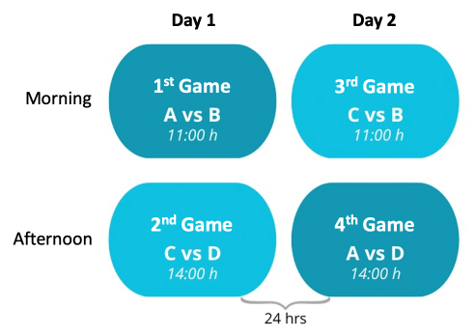
Figure 1
Experimental Protocol Design Showing the two-day Tournament Structure
Note. Fourteams (A, B, C, D) competed over consecutive days with matches 1-2 on Day 1 and matches 3-4 on Day 2, with 24-hour recovery period between competition days.
Participants
Twenty-eight national-level handball players (age: 23.4 ± 3.2 years; range: 18-30 years; experience:6.7 ± 2.9 years) from four Costa Rican first division teams participated in this study. Playing positions were distributed as follows: goalkeepers (n=4), wings (n=9), back court players (n=10), and pivots (n=5). All participants met the following inclusion criteria: (a) active handball player status, (b) availability for both match days, (c) signed informed consent, and (d) absence of injuries that could compromise participant integrity.
The study was approved by the Scientific Ethics Committee of the Universidad Nacional of Costa Rica (Reg. Code: CECUNA-P008) and conducted in accordance with the Declaration of Helsinki (World Medical Association, 2013). All participants provided written informed consent after being informed about the potential benefits and risks of their participation. Participant data were handled confidentially using coded identifiers to maintain anonymity.
Materials and Procedures
Data were collected using an ultra-wideband (UWB) tracking system. The system setup consisted of: (1) six antennas positioned around the court for player tracking, with two antennas along the midfield line (one on each side) and four antennas in each court corner, (2) antennas mounted on tripods at a three-meter height, (3) system activation, and (4) calibration of each antenna according to X and Y coordinates following established protocols (Bastida-Castillo et al., 2018).
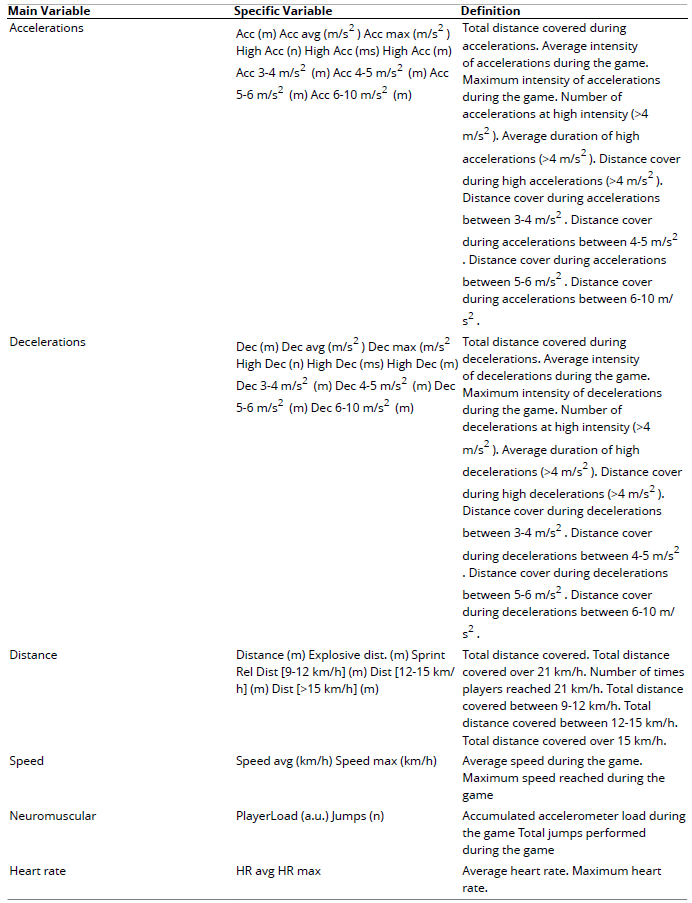
Each participant was equipped with an Inertial Measurement Unit device (WIMUPro™, RealTrack Systems, Almería) to record external load variables including distance covered, jumps, directional changes, impacts, and accelerometry data. The WIMU devices registered at 100 Hz for microsensors and at 20 Hz for UWB positioning. Internal load was registered by a heart rate chest band (HRM, Garmin, Kansas) that send the data to the WIMU devices through Ant+ (Molina-Carmona et al., 2018) with a sampling frequency of 4 Hz. The WIMU devices were positioned on the back between the second and fourth thoracic vertebrae using a specialized neoprene vest. This protocol was implemented before each match. Post-match, devices were removed, placed in charging stations for subsequent matches, and data were transferred to the WIMU software (SPro™, RealTrack Systems, Almería) and exported to Excel format. The analyzed variables are presented in Table 1.
Analyzed Variables that Were Selected Through Principal Component Analysis
Statistical Analysis
Data were expressed as mean and standard deviation (M[SD]). Data normality was verified using the Shapiro-Wilk test. Unstructured data mining was performed through principal component analysis (PCA) to extract representative variables from a larger variable set. PCA reduces the number of variables and correlates extracted data, simplifying complex datasets (Witte et al., 2010). Variables were selected using maximum average time-related values for between-match comparisons. Raw data were scaled and centered using Z-scores to avoid individual variation patterns and potential measurement fluctuations. The Z-score was calculated as follows (McLean et al., 2010): Z Score=((Player^' score-Player^' s average))/(Player^' standard deviation).
Spatiotemporal and mechanical variables (acceleration, deceleration, and high-speed) were grouped using PCA following methodological guidelines for sports science research (Rojas-Valverde et al., 2020). Variables with zero variance were excluded. PCA suitability was confirmed through Kaiser-Meyer-Olkin values (KMO = 0.62-0.67) and Bartlett's sphericity test (p< .05) (Kaiser, 1960). Eigenvalues >1 were considered for PC extraction, and orthogonal rotation (Varimax) was selected to identify high correlations between components (Rojas-Valverde et al., 2020). PC loadings >0.6 were considered for extraction, and only the highest factorial load was retained when cross-loading between PCs occurred (Kaiser, 1960). All PCA data were reported following specific sports science research protocols (Pino-Ortega et al., 2021).
Mean comparisons were performed using independent measures t-tests for each variable grouped within PC1 of each match. The t-factor value was presented, and Cohen's d was used to quantify effect sizes (ES) as follows: <.01, trivial; >.01, small; >.06, moderate; and >.14, large (Cohen, 1988). Hypotheses were tested with alpha set at p< .05. All data were analyzed using the Statistical Package for Social Sciences (SPSS v22.0, IBM Corp, Chicago, IL, USA).
Results
The study's PCA viability was confirmed through the Kaiser-Meyer-Olkin (KMO) sampling adequacy measure. Analysis revealed KMO values of 0.6 (p< .01) for the first match, 0.5 (p< .01) for the second match, 0.7 (p< .01) for the third match, and 0.6 (p< .01) for the fourth match, indicating viable PCA application. This was further supported by significant Bartlett's sphericity test results (p< .05). Figure 2 illustrates the PCA results for each match. Five principal components were extracted for all matches except the second match, which yielded six components. The variance explained by the first principal component (PC1) varied across matches: 49.2% for Match 1, 47.7% for Match 2, 47.7% for Match 3, and 41.3% for Match 4. The total explained variance ranged from 82% to 90% across all matches.
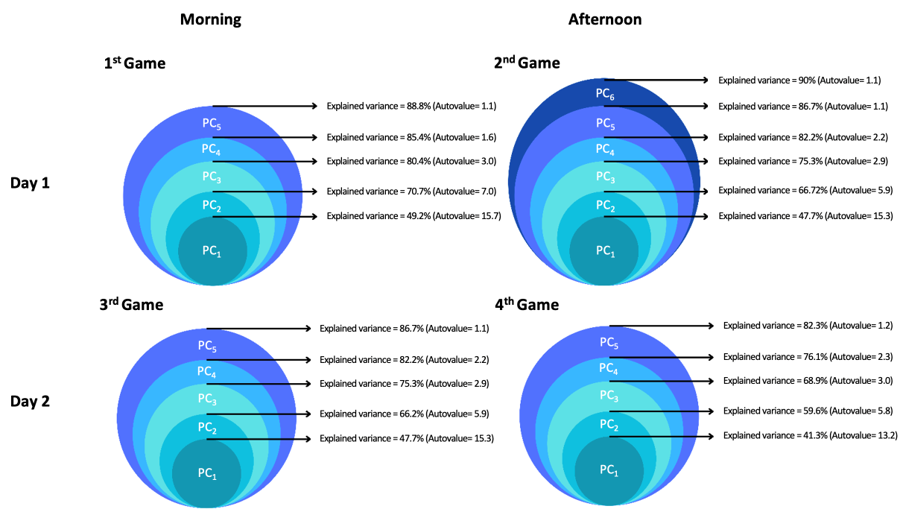
Figure 2
Explained Variance for Each Principal Component by Match and Competition day
The variables grouped within each match's PC1 demonstrated consistent patterns. PC1 explained 10 variables in Match 1, 13 variables in Match 2, 11 variables in Match 3, and 14 variables in Match 4. PC1 consistently explained the highest percentage of variance (41.3-49.2%) and primarily comprised variables related to accelerations, decelerations, and high-speed actions. Figure 3 shows the varimax rotated component matrix by match, where the bars represent the percentage of variance explained by each principal component (PC) across the four matches.
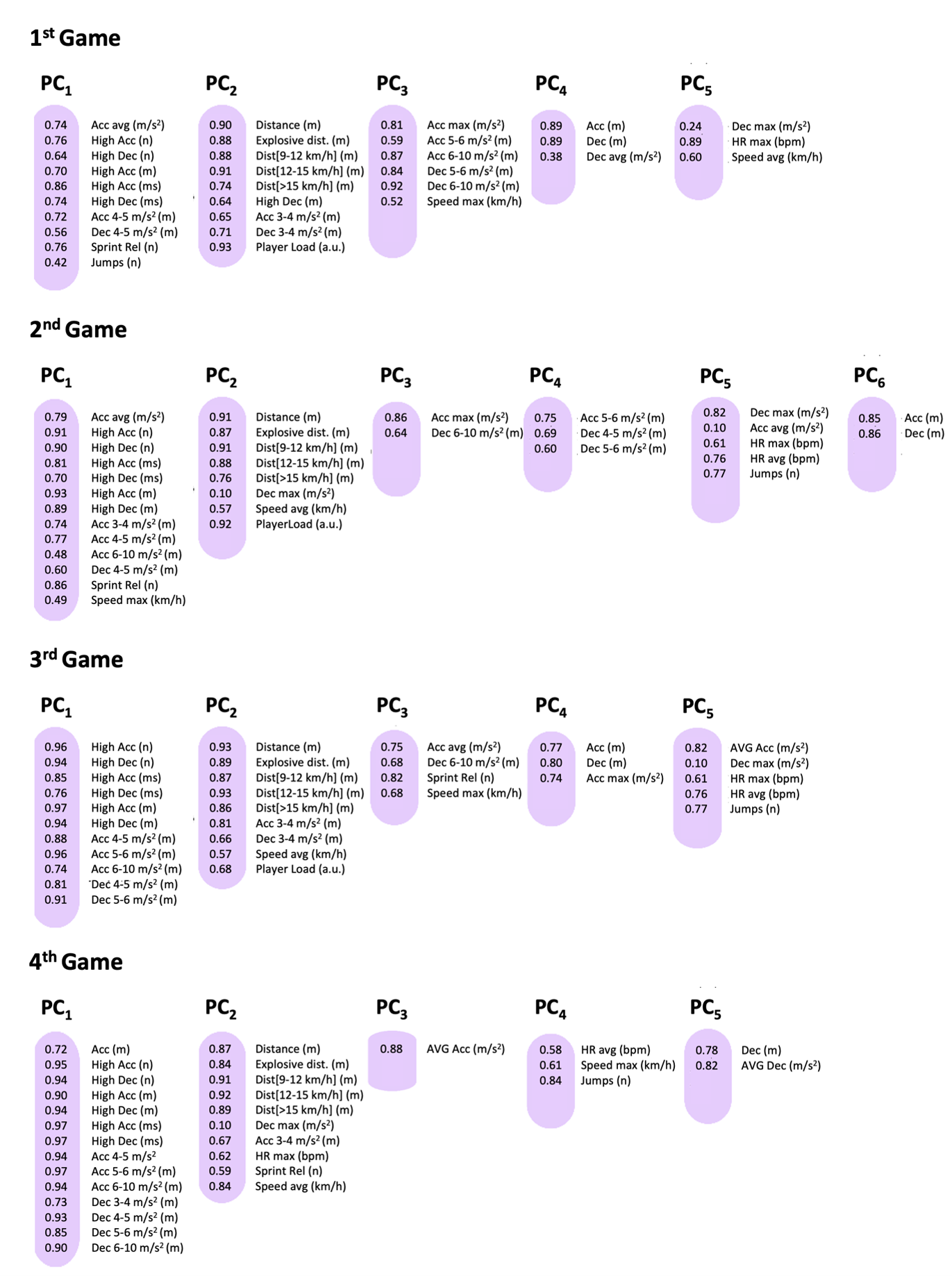
Figure 3
Varimax Rotated Component Matrix by Match
Following the PCA, a comparison was conducted between Day 1 (Matches 1-2) versus Day 2 (Matches 3-4). This grouping was based on different player participation between competition days. Analysis revealed higher values in 15 out of 18 variables grouped in PC1 across matches (see Table 2). Effect sizes by Cohen's d ranged from moderate to large for most variables, particularly those related to high-intensity actions.
Descriptive and Inferential Analysis in the Selected Variables Through PCA Between Competition Days
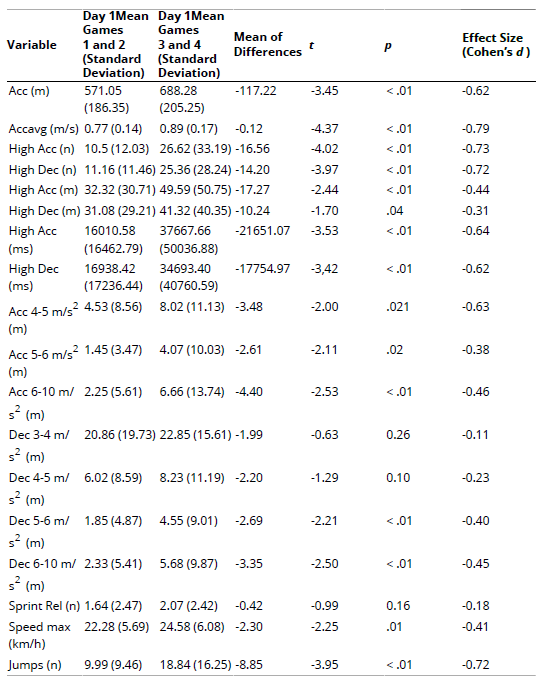
Note Acc: accelerations; Dec: decelerations; AVG: average; MAX: maximum.
Discussion
The analysis of workload demands during matches is crucial for controlling variables related to fatigue, performance, and recovery in consecutive games, particularly in sports with congested schedules like handball. This study aimed to analyze spatiotemporal and mechanical load variables during consecutive handball matches using unstructured data mining. Our main findings revealed three key aspects: (1) variables related to acceleration, deceleration, and high-speed actions are essential for understanding handball players' profiles, with the first principal component explaining approximately 49.2% of the variance across matches, (2) five principal components were extracted for most matches, with total explained variance ranging from 82% to 90%, and (3) despite only 24 hours of recovery between competition days, players showed significantly higher values in most variables grouped in PC1, particularly in acceleration, high-intensity actions, and deceleration patterns.
Principal Component Analysis
The use of Principal Component Analysis (PCA) has proven to be an effective method for reducing and correlating complex datasets in team sports (Witte et al., 2010). Our findings showed that most variables were grouped in PC1 for each match, explaining between 41.3-49.2% of the variance, particularly those related to acceleration, deceleration, and high-speed actions. This data reduction technique has gained significant attention in sports science for its ability to identify key performance indicators and workload patterns (Rojas-Valverde et al., 2021).
A systematic review by Pino-Ortega et al. (2021) analyzed PCA applications across different team sports, revealing consistent patterns in identifying key performance indicators. In rugby, researchers identified ten principal components, with possession metrics and quick ball movement emerging as significant predictors of match success (Parmar et al., 2018). Similarly, futsal studies extracted three principal components, with high-intensity variables determining match workload demands (Rico-González et al., 2021). These findings align with our results in handball, suggesting that high-intensity actions are crucial across different invasion team sports.
The analysis of PCA applications in basketball showed that the first principal component was primarily explained by accelerations and distances, while in soccer, three distinct components emerged: acceleration-deceleration patterns (PC1), displacement velocity (PC2), and inertial demands (PC3) (Castellano et al., 2025; Ibáñez et al., 2025). However, handball's unique characteristic of unlimited substitutions and frequent attack-defense transitions might explain why our PC1 captured a broader range of variables compared to other team sports. This comprehensive grouping of high-intensity variables in PC1 reflects handball's intermittent nature and the importance of multidirectional movements in both offensive and defensive phases.
Beach handball research has provided particularly relevant comparisons, offering insights into a closely related sport modality. Three PCAs were identified for workload assessment in male and female players, with PC1 related to displacements, high-speed actions, and physiological demands (Gómez-Carmona et al., 2023). These findings strongly support our results, where high-intensity mechanical actions consistently emerged as key variables in the first principal component, highlighting the importance of these actions in handball variants.
This synthesis across team sports demonstrates that while high-intensity actions are consistently important, their specific manifestation varies by sport. The higher variance explained by our PC1 (41.3-49.2%) compared to other team sports suggests that handball might have a more integrated relationship between different high-intensity actions, possibly due to its unique game structure and substitution rules.
Differences Between Competition Days in Congested Schedule
Our analysis revealed higher values in 15 out of 18 variables grouped in PC1 during the second day of competition, challenging the traditional understanding of fatigue-related performance decline during congested schedules. These findings contrast with previous research on congested fixtures in team sports, where performance typically decreases due to limited recovery time (Julian et al., 2021). However, handball's unique characteristics may provide insights into these unexpected results.
The structure of modern handball presents distinctive features that could explain the maintenance or even improvement of high-intensity performance despite limited recovery time. Unlike other team sports, handball allows unlimited substitutions, enabling coaches to implement sophisticated rotation strategies that help maintain high-intensity performance levels (García-Sánchez et al., 2023). This substitution flexibility creates alternating periods of effort and recovery within the same match, potentially mitigating fatigue accumulation during congested schedules.
High-intensity actions are crucial for player profiles in handball, though their manifestation varies significantly by playing position and tactical role (Póvoas et al., 2012). For instance, backcourt players exhibit fewer accelerations but higher high-speed demands, while wing players demonstrate higher sprint frequencies during matches (González-Haro et al., 2020; Luteberget & Spencer, 2017). These position-specific demands align with our PCA findings, where variables related to different movement intensities emerged as key components.
The sport's inherent structure of alternating attack and defense phases provides natural micro-recovery periods, which becomes particularly relevant during congested fixtures. Research has shown that well-managed defensive-offensive transitions can serve as strategic recovery moments (Wagner et al., 2019). This unique aspect of handball is reflected in the movement patterns observed: from 103 game actions analyzed in previous research, approximately 60% consisted of directional changes and stops (Póvoas et al., 2012), highlighting the intermittent nature of handball-specific efforts.
Furthermore, match outcome appears to influence these physical demands, with winning teams typically displaying higher indices of relative distance, high-intensity actions, and velocity changes compared to losing teams (González-Haro et al., 2020). This suggests that maintaining high-intensity performance capabilities, even during congested fixtures, might be crucial for competitive success in modern handball. Additionally, psychological factors may contribute to these findings. Tournament progression often enhances competitive motivation and psychological momentum, which have been shown to influence performance across consecutive matches (den Hartigh et al., 2016). Research on handball players demonstrates that psychological constructs such as self-confidence and motivational level significantly influence performance outcomes and competitive behavior (Reigal et al., 2020). The psychological momentum from successful performances, combined with increased familiarity with opponents and tactical adjustments, might facilitate enhanced physical output that temporarily overrides typical fatigue patterns. This phenomenon, where success breeds further success through enhanced self-efficacy and sustained effort, has been documented across various competitive contexts and may explain the increased high-intensity performance observed during the second competition day (Ives et al., 2020).
Limitations and Future Research Directions
This study presents certain limitations that should be acknowledged. First, the scarcity of handball-specific PCA studies makes direct comparisons challenging, although this opens avenues for future research. Second, the sample size (n=28) and exclusive focus on male players limit the generalizability of our findings. Additionally, our findings may not be generalizable to other competitive levels, and longitudinal studies are needed to confirm these results across multiple seasons. Furthermore, potential seasonal or training phase effects were not considered, as data collection occurred during a specific tournament period. Future studies should consider larger samples including both sexes and different competitive levels. In addition, they should examine physical demands during congested tournaments, as our study only collected data over two consecutive days. Also, investigations could focus on relating PCA findings with performance indicators, fatigue indices, technical-tactical aspects, and position-specific profiles.
Conclusions
The present study provides valuable insights into the spatiotemporal and mechanical workload variables during consecutive handball matches through unstructured data mining analysis. Three main conclusions emerge from our findings: First, Principal Component Analysis effectively identified key performance variables, with the first component explaining approximately 49% of the variance and predominantly comprising acceleration, deceleration, and high-speed actions. Second, despite only 24 hours of recovery between matches, players maintained or even increased their high-intensity performance, challenging traditional assumptions about fatigue in congested schedules. Third, the comprehensive grouping of variables in PC1 reflects handball's unique characteristics, where the combination of unlimited substitutions and attack-defense transitions allows for sustained high-intensity performance. Finally, these findings contribute to the current understanding of handball-specific demands and provide evidence that modern handball's tactical complexity and rule structure might enable better performance maintenance during congested fixtures.
Our findings provide valuable information for coaches and practitioners during congested schedules (e.g., World or European Championships, final phases, or national cup competitions) in handball. Training sessions should prioritize the integration of high-intensity actions (accelerations, decelerations, and sprints) within tactical contexts, particularly focusing on attack-defense transitions that replicate match demands. Load monitoring should emphasize tracking acceleration-based variables identified in PC1, while implementing rotation strategies that take advantage of handball's unlimited substitution rule. Coaches should develop position-specific training programs that reflect the identified movement patterns and implement tactical strategies that optimize the use of substitutions to maintain high-intensity performance during congested fixtures. These insights can guide injury prevention strategies by monitoring key variables for fatigue and implementing progressive loading programs that prepare players for the identified high-intensity demands.
Ethics Committee Statement
The research was conducted following the guidelines outlined by the Declaration of Helsinki and was approved by the Scientific Ethical Committee: UNIVERSIDAD NACIONAL OF COSTA RICA (Reg. Code CECUNA-P008).
Conflict of Interest
None of the authors has a conflict of interest to declare, and all authors were involved in the study design, data collection and interpretation, and contributed to the writing of the manuscript. This manuscript is original and not previously published, nor is it being considered elsewhere until a decision is made as to its acceptability by the Cultura, Ciencia y Deporte journal.
Acknowledgments
Authors acknowledge the predisposition to collaborate with this study to all participants.
Funding
No funding was received for the present study.
Authors’ Contribution
Conceptualization J.F.H-B. & D.R-V; Methodology J.C.G-V, R.G-V & J.P-O; Software C.D.G-C & A.U-R; Validation , J.C.G-V, R.G-V & J.P-O; Formal Analysis J.F.H-B, C.D.G-C, A.U-R & D.R-V; Investigation J.F.H-B, C.D.G-C, A.U-R & D.R-V; Resources J.C.G-V, R.G-V & J.P-O; Data Curation J.F.H-B, C.D.G-C, A.U-R & D.R-V; Writing – Original Draft J.F.H-B, C.D.G-C, A.U-R & D.R-V; Writing – Review & Editing J.C.G-V, R.G-V & J.P-O; Visualization C.D.G-C, A.U-R & D.R-V; Supervision J.C.G-V, R.G-V & J.P-O; Project Administration R.G-V & D.R-V. All authors have read and agreed to the published version of the manuscript.
Data Availability Statement
State where the data supporting the reported results can be found, including links to public databases. In cases where they are not available due to privacy or ethical restrictions, a data availability statement is required: Data available upon request from the corresponding author carlosdavid.gomez@unizar.es
References
Bastida-Castillo, A., Gómez-Carmona, C. D., Hernández Belmonte, A., & Pino-Ortega, J. (2018). Validez y fiabilidad de un dispositivo inercial (WIMU PRO TM) para el análisis del posicionamiento en balonmano. E-Balonmano.com: Revista de Ciencias del Deporte, 14(1), 9-16. http://ojs.e-balonmano.com/index.php/revista/article/view/383
Castellano, J., Bellmunt, S., Resta, R., Del Campo, R. L., & Casamichana, D. (2025). Multivariate analysis of teams’ physical performances in official football matches in La Liga 2023–24. Biology of Sport, 42(3), 169-176. https://doi.org/10.5114/biolsport.2025.146784
Clemente, F., Silva, R., Arslan, E., Aquino, R., Castillo, D., & Mendes, B. (2020). The effects of congested fixture periods on distance-based workload indices: A full-season study in professional soccer players. Biology of Sport, 38(1), 37-44. https://doi.org/10.5114/biolsport.2020.97068
Cohen, J. (1988). Statistical power analysis for the behavioral sciences (2nd ed). Erlbaum Associates.
Daneshfar, A., Gahreman, D. E., Koozehchian, M. S., Amani Shalamzari, S., Hassanzadeh Sablouei, M., Rosemann, T., Knechtle, B., & Nikolaidis, P. T. (2018). Multi Directional Repeated Sprint Is a Valid and Reliable Test for Assessment of Junior Handball Players. Frontiers in Physiology, 9. https://doi.org/10.3389/fphys.2018.00317
Den Hartigh, R. J., Van Geert, P. L., Van Yperen, N. W., Cox, R. F., & Gernigon, C. (2016). Psychological momentum during and across sports matches: Evidence for interconnected time scales. Journal of Sport and Exercise Psychology, 38(1), 82-92. https://doi.org/10.1123/jsep.2015-0162
Font, R., Karcher, C., Reche, X., Carmona Dalmases, G., Tremps, V., & Irurtia, A. (2021). Monitoring external load in elite male handball players depending on playing positions. Biology of Sport, 38(3), 475–481. https://doi.org/10.5114/biolsport.2021.101123
Garcia, G. R., Gonçalves, L. G. C., Clemente, F. M., Nakamura, F. Y., Nobari, H., Bedo, B. L. S., Azevedo, A. M., Guerra, M. A., & Aquino, R. (2022). Effects of congested fixture and matches’ participation on internal and external workload indices in professional soccer players. Scientific Reports, 12(1). https://doi.org/10.1038/s41598-022-05792-w
García-Sánchez, C., Navarro, R. M., Karcher, C., & de la Rubia, A. (2023). Physical demands during official competitions in elite handball: A systematic review. International Journal of Environmental Research and Public Health, 20(4), 3353. https://doi.org/10.3390/ijerph20043353
Gómez-Carmona, C. D., Rojas-Valverde, D., Rico-González, M., De Oliveira, V. C., Lemos, L., Martins, C., Nakamura, F. Y., & Pino-Ortega, J. (2023). Crucial workload variables in female-male elite Brazilian Beach Handball: An exploratory factor analysis. Biologyof Sport, 40(2), 345-352. https://doi.org/10.5114/biolsport.2023.114285
González-Haro, P. J., Carmona, C. D., Bastida-Castillo, A., Rojas-Valverde, D., Gómez-López, M., & Pino-Ortega, J. (2020). Analysis of playing position and match status related differences in external load demands on amateur handball: A case study. Revista Brasileira de Cineantropometria & Desempenho Humano, 22, e71427. https://doi.org/10.1590/1980-0037.2020v22e71427
Halson, S. L. (2014). Monitoring training load to understand fatigue in athletes. Sports Medicine, 44(2), 139-147. https://doi.org/10.1007/s40279-014-0253-z
Harper, D. J., Carling, C., & Kiely, J. (2019). High-intensity acceleration and deceleration demands in elite team sports competitive match play: a systematic review and meta-analysis of observational studies. Sports Medicine, 49, 1923-1947. https://doi.org/10.1007/s40279-019-01170-1
Hernández-Sampieri, R., Fernández-Collado, C., & Baptista-Lucio, P. (2014). Metodología de la investigación. McGrawHill.
Ibáñez, S. J., Rico-González, M., Gómez-Carmona, C. D., & Pino-Ortega, J. (2025). Physical Workload Patterns in U-18 Basketball Using LPS and MEMS Data: A Principal Component Analysis by Quarter and Playing Position. Sensors, 25(19), 6253. https://doi.org/10.3390/s25196253
Ives, J. C., Neese, K., Downs, N., Root, H., & Finnerty, T. (2020). The effects of competitive orientation on performance in competition. The Sport Journal, 41(2), 5. https://thesportjournal.org/article/the-effects-of-competitive-orientation-on-performance-in-competition/#more-6860
Julian, R., Page, R. M., & Harper, L. D. (2021). The effect of fixture congestion on performance during professional male soccer match-play: a systematic critical review with meta-analysis. Sports Medicine, 51, 255-273. https://doi.org/10.1007/s40279-020-01359-9
Kaiser, H. F. (1960). The application of electronic computers to factor analysis. Educational and Psychological Measurement, 20(1), 141-151. https://doi.org/10.1177/001316446002000116
Kniubaite, A., Skarbalius, A., Clemente, F. M., & Conte, D. (2019). Quantification of external and internal match loads in elite female team handball. Biology of Sport, 36(4), 311-316. https://doi.org/10.5114/biolsport.2019.88753
Luteberget, L. S., & Spencer, M. (2017). High-Intensity Events in International Women’s Team Handball Matches. International Journal of Sports Physiology and Performance, 12(1), 56-61. https://doi.org/10.1123/ijspp.20150641
McLean, B. D., Coutts, A. J., Kelly, V., McGuigan, M. R., & Cormack, S. J. (2010). Neuromuscular, Endocrine, and Perceptual Fatigue Responses During Different Length Between-Match Microcycles in Professional Rugby League Players. International Journal of Sports Physiology and Performance, 5(3), 367-383. https://doi.org/10.1123/ijspp.5.3.367
Michalsik, L. B., Aagaard, P., & Madsen, K. (2013). Locomotion characteristics and match-induced impairments in physical performance in male elite team handball players. International Journalof Sports Medicine, 34(7), 590599. https://doi.org/10.1055/s-0032-1329989
Molina-Carmona, I., Gómez-Carmona, C., Bastida-Castillo, A., & Pino-Ortega, J. (2018). Validez del dispositivoinercial WIMU PRO para elregistro de la frecuenciacardiacaen un test de campo. SPORT TK-Revista EuroAmericana de Ciencias del Deporte, 7(1), 81-86. https://hdl.handle.net/10201/57181
Parmar, N., James, N., Hearne, G., & Jones, B. (2018). Using principal component analysis to develop performance indicators in professional rugby league. International Journal of Performance Analysis in Sport, 18(6), 938-949. https://doi.org/10.1080/24748668.2018.1528525
Pino-Ortega, J., Rojas-Valverde, D., Gómez-Carmona, C. D., Bastida-Castillo, A., Hernández-Belmonte, A., García-Rubio, J., Nakamura, F. Y., & Ibáñez, S. J. (2019). Impact of Contextual Factors on External Load During a Congested-Fixture Tournament in Elite U’18 Basketball Players. Frontiers in Psychology, 10, 1100. https://www.frontiersin.org/articles/10.3389/fpsyg.2019.01100
Pino-Ortega, J., Rojas-Valverde, D., Gómez-Carmona, C. D., & Rico-González, M. (2021). Training design, performance analysis, and talent identification—A systematic review about the most relevant variables through the principal component analysis in Soccer, Basketball, and Rugby. International Journal of Environmental Research and Public Health, 18(5), 2642. https://doi.org/10.3390/ijerph18052642
Póvoas, S. C. A., Seabra, A. F. T., Ascensão, A. A. M. R., Magalhães, J., Soares, J. M. C., & Rebelo, A. N. C. (2012). Physical and physiological demands of elite team handball. Journal of Strength and Conditioning Research, 26(12), 3365-3375. https://doi.org/10.1519/JSC.0b013e318248aeee
Reigal, R. E., Vázquez-Diz, J. A., Morillo-Baro, J. P., Hernández-Mendo, A., & Morales-Sánchez, V. (2020). Psychological profile, competitive anxiety, moods and self-efficacy in beach handball players. International Journal of Environmental Research and Public Health, 17(1), 241. https://doi.org/10.3390/ijerph17010241
Rico-González, M., Arcos, A., Rojas-Valverde, D., & Pino-Ortega, J. (2021). A Principal Component Analysis in futsal according to game halves: A case study of an amateur futsal cup final. RICYDE. Revista Internacional de Ciencias Del Deporte, 17(63), 88-101. https://doi.org/10.5232/ricyde2021.06307
Rojas-Valverde, D., Pino-Ortega, J., Gómez-Carmona, C. D., & Rico-González, M. (2020). A Systematic Review of Methods and Criteria Standard Proposal for the Use of Principal Component Analysis in Team’s Sports Science. International Journal of Environmental Research and Public Health, 17(23), 8712. https://doi.org/10.3390/ijerph17238712
Rojas-Valverde, D., Pino-Ortega, J., & Rico-González, M. (2021). Data Mining in Team Sports: The Case of Principal Component Analysis. In The Use of Applied Technology in Team Sport (pp. 199-215). Routledge.
Taylor, J. B., Wright, A. A., Dischiavi, S. L., Townsend, M. A., & Marmon, A. R. (2017). Activity demands during multi-directional team sports: a systematic review. Sports Medicine, 47, 2533-2551. https://doi.org/10.1007/s40279-017-0772-5
Yuan, R., Sun, H., Soh, K. G., Mohammadi, A., Toumi, Z., & Zhang, Z. (2023). The effects of mental fatigue on sport-specific motor performance among team sport athletes: A systematic scoping review. Frontiers in Psychology, 14, 1143618. https://doi.org/10.3389/fpsyg.2023.1143618
Waldron, M., & Highton, J. (2014). Fatigue and pacing in high-intensity intermittent team sport: an update. Sports medicine, 44, 1645-1658. https://doi.org/10.1007/s40279-014-0230-6
Wagner, H., Fuchs, P., Fusco, A., Fuchs, P., Bell, J. W., & von Duvillard, S. P. (2019). Physical performance in elite male and female team-handball players. International Journal of Sports Physiology and Performance, 14(1), 60-67. https://doi.org/10.1123/ijspp.2018-0014
Witte, K., Ganter, N., Baumgart, C., & Peham, C. (2010). Applying a principal component analysis to movement coordination in sport. Mathematical and Computer Modelling of Dynamical Systems, 16(5), 477-488. https://doi.org/10.1080/13873954.2010.507079
World Medical Association. (2013). World Medical Association Declaration of Helsinki: Ethical Principles for Medical Research Involving Human Subjects. JAMA, 310(20), 2191-2194. https://doi.org/10.1001/jama.2013.281053
Author notes
a Correspondence: Carlos D. Gómez-Carmona, carlosdavid.gomez@ua.es
Additional information
Short title: Key Performance Variables in Consecutive Handball Matches
How to cite this article: Hernández-Benavides, J. F, Gómez-Carmona, C. D., Gutiérrez-Vargas, J. C., Ugalde-Ramírez, A., Pino-Ortega, J., Gutiérrez-Vargas, R. & Rojas-Valverde D. (2026). Selection of key performance variables through principal component analysis and their behavior in consecutive handball matches. Cultura, Ciencia y Deporte, 21(68), 2362. https://doi.org/10.12800/ccd.v21i68.2362


