
ACTIVA-MENTE PROJECT: PROTOCOL FOR A STUDY TO EVALUATE THE EFFECTIVENESS OF INCLUDING PHYSICALLY ACTIVE LESSONS THROUGH CO-TEACHING
PROYECTO ACTIVA-MENTE: PROTOCOLO DE UN ESTUDIO PARA EVALUAR LA EFECTIVIDAD DE LA INCLUSIÓN DE CLASES FÍSICAMENTE ACTIVAS MEDIANTE CODOCENCIA


José María Pulido-Gil, Raúl Muñoz-González, Abel Ruiz-Hermosa, Héctor Moreno-Casado, David Sánchez-Oliva
ACTIVA-MENTE PROJECT: PROTOCOL FOR A STUDY TO EVALUATE THE EFFECTIVENESS OF INCLUDING PHYSICALLY ACTIVE LESSONS THROUGH CO-TEACHING
Cultura, Ciencia y Deporte, vol. 21, no. 67, 2026, 10.12800/ccd.v21i67.2444
Universidad Católica San Antonio de Murcia
José María Pulido-Gil a
University of Extremadura, España
Al-Qazeres Secondary Education Institute, Regional Government of Extremadura, España
Raúl Muñoz-González
University of Extremadura, España
Abel Ruiz-Hermosa
University of Castilla-La Mancha, España
University of Castilla-La Mancha, España
Héctor Moreno-Casado
Al-Qazeres Secondary Education Institute, Regional Government of Extremadura, España
David Sánchez-Oliva
University of Extremadura, España
Received: 27 February 2025
Accepted: 12 September 2025
Abstract: This paper describes and justifies the methodology of the ACTIVA-MENTE project, designed to evaluate the effectiveness of an intervention program based on the inclusion of physically active lessons through co-teaching among secondary education students. This is a quasi-experimental study involving 1,200 secondary school students (aged 12–17) from 10 schools in Extremadura (Spain). Control groups (25 classes) and experimental groups (50 classes) are assigned in each school. The experimental groups carry out a 26-week intervention consisting of one weekly physically active lesson, jointly designed and delivered by physical education teachers and subject-specific teachers. The effects on physical activity levels, physical fitness, sedentary behavior, and motivational and academic variables are evaluated using repeated measures ANOVA. Interviews and focus groups are conducted to explore students' and teachers' perceptions. The program is expected to help reduce sedentary behavior in schools, improve health and academic indicators, and promote more active, sustainable, and collaborative educational environments. As the first institutionalized program of its kind in Spain, its potential for transfer and social impact are especially significant, with real possibilities for expansion to other educational contexts.
Keywords: Adolescents, co-teaching, physically active learning, school intervention.
Resumen: El presente trabajo tiene como objetivo describir y justificar la metodología de estudio del proyecto ACTIVA-MENTE, encaminado a evaluar la efectividad de un programa de intervención basado en la inclusión de clases físicamente activas mediante la codocencia en estudiantes de Educación Secundaria. Se trata de un estudio cuasi-experimental en el que participan 1.200 estudiantes de secundaria (12-17 años) de 10 centros educativos en Extremadura (España). En cada centro educativo, se asignarán grupos control (25 clases) y grupos experimentales (50 clases). Los grupos experimentales llevan a cabo una intervención con una duración de 26 semanas, consistente en la integración de una clase físicamente activa semanal, diseñada e impartida conjuntamente por docentes de Educación Física y de la materia de referencia. Se evalúan los efectos en niveles de actividad física, condición física, comportamiento sedentario, variables motivacionales y académicas mediante ANOVA de medidas repetidas. Asimismo, se incluyen entrevistas y grupos focales para conocer la percepción del alumnado y profesorado. Se espera que el programa contribuya a reducir el sedentarismo escolar, mejorar indicadores de salud y académicos y fomentar entornos educativos más activos, sostenibles y colaborativos. Al tratarse del primer programa institucionalizado de este tipo en España, su potencial de transferencia y su impacto social son especialmente relevantes, con posibilidades reales de extensión a otros contextos educativos.
Palabras clave: Adolescents, aprendizaje físicamente activo, co-docencia, intervención escolar.
Introduction
Reducing the prevalence of overweight and obesity during childhood and adolescence is one of the greatest challenges of the 21st century in economically developed countries (WHO, 2022). Among the multiple environmental factors that predict these conditions are physical activity (PA) levels and sedentary behaviors (Hruby et al., 2016). In this regard, it is worth noting that the World Health Organization (WHO) recommends that young people aged 5 to 18 accumulate at least 60 minutes of moderate-to-vigorous PA per day. However, globally, 81% of adolescents do not meet these recommendations (Guthold et al., 2020), while in Spain these values reach 77.2% (Zapico et al., 2023). According to the WHO (2024), physical inactivity increases the risk of cardiovascular diseases, type 2 diabetes, dementia, and certain types of cancer, such as breast and colon cancer.
One element that significantly contributes to student inactivity is the time spent sedentary during the school day. Specifically, a study of 1,504 Spanish children and adolescents concluded that they spend between 65% and 85% of the school day in sedentary behaviors (Grao-Cruces et al., 2019). Furthermore, only 5.5% of students comply with international recommendations to accumulate at least 30 minutes of moderate or vigorous PA during the school day, as reported in the same study. As with inactivity, sedentary behavior has been consistently associated with increased risk of all-cause mortality, as well as cardiovascular and metabolic diseases (Katzmarzyk et al., 2019). In this context, schools have been identified as strategic settings for promoting healthy habits (Cassar et al., 2019; Grao-Cruces, Sánchez-Oliva, et al., 2023). Current legislation also justifies and supports increasing PA in educational contexts. For instance, the Spanish Organic Law 3/2020 (2020) defines as an educational aim the acquisition of cultural behaviors related to motor development and the consolidation of healthy lifestyle habits. Moreover, its forty-sixth additional provision emphasizes that “the authorities shall promote the daily practice of sport and physical exercise by students during the school day (…) reducing sedentary behavior”.
A possible strategy is the implementation of interventions aimed at increasing PA levels during the school day. In this regard, the Creating Active Schools (CAS) Framework (Daly-Smith et al., 2020) highlights the importance of addressing such interventions from a whole-school perspective, beyond being solely a Physical Education department initiative. Teacher training and capacity-building are crucial to developing different initiatives, including active breaks, physically active lessons (PAL), active recess, or active commuting to school.
The present program focuses on the implementation of PALs, which consist of incorporating PA during academic lessons in any subject other than Physical Education (Watson et al., 2017). This approach reduces students’ sedentary time without cutting instructional time. Previous studies have shown the effectiveness of PALs in improving health-related outcomes, such as increased PA levels, reduced sedentary behavior, and improved physical fitness (Norris et al., 2020), although evidence in secondary education remains scarce. Furthermore, a recent study also demonstrated the effectiveness of this methodology in improving time-on-task, both during the PAL itself and in the subsequent academic lesson (González-Pérez et al., 2025).
Recent research highlights the importance of designing school interventions that are context-sensitive, integrating PA not only as an objective but also as a meaningful pedagogical tool. In this regard, Jago et al. (2023) stress the need to rethink traditional models of school interventions by incorporating more flexible and adaptive approaches that respond to the real characteristics and limitations of schools. Moreover, Mavilidi et al. (2022), through a meta-analysis, showed that highly integrated and curriculum-relevant movement strategies generate particularly positive effects on memory, self-control, and academic performance. This supports the theoretical basis of the co-teaching approach of the present study, in which movement is not regarded as an interruption but as a pedagogical tool embedded in the teaching–learning process.
Although co-teaching is still rarely used in the Spanish context (OECD, 2020), the challenge of connecting subject-matter knowledge with the didactic and methodological expertise needed to deliver lessons through PA leads us to consider the tandem of the subject teacher and the Physical Education teacher as the most suitable for designing and implementing PALs. The benefits of teacher collaboration have been widely reported (Chanmugam & Gerlach, 2013; Fernández Enguita, 2020), being one of the factors that generates broad consensus in educational research. In our case, co-teaching is understood as a shared instructional practice carried out by two or more teachers who plan, design, implement, and evaluate lessons together in the same physical space and for a set period. Several studies highlight its positive outcomes (López Hernández et al., 2021) and the benefits and effectiveness of this strategy with students experiencing learning difficulties, making it particularly suitable for this program (Torres, 2023).
Among the strengths of this study, the initiative incorporates elements of implementation science, a discipline that seeks to improve the adoption, integration, and sustainability of evidence-based interventions in real-world contexts. Given the applied nature of this project, key dimensions such as fidelity of delivery, adaptability to diverse educational contexts, and active teacher involvement in the design and delivery of PALs have been considered. This perspective is especially useful to increase the feasibility and impact of the program in real school contexts, as proposed in relevant publications in the field (Cassar et al., 2019).
Therefore, the aim of this study is to describe the methods and rationale of the ACTIVA-MENTE program, designed to examine the effectiveness of integrating movement and physical exercise into the educational setting through PALs developed via co-teaching. The program will evaluate effects on students’ physical and psychological health indicators, academic performance, and interpersonal relationships to reduce classroom conflict, as well as students’ and teachers’ perceptions of the benefits, barriers, limitations, and usefulness of the program. Several hypotheses are proposed regarding the effects of the intervention. First, it is expected that students in the intervention group will experience a significant increase in PA levels during the school day and a reduction in sedentary behavior compared to the control group, as observed in previous PAL-based interventions (Norris et al., 2020). Second, the intervention is expected to have positive effects on physical fitness and self-reported health indicators, in line with findings from other studies conducted with adolescents (Watson et al., 2017). Third, improvements are anticipated in motivational variables, school engagement, and perceived learning among participating students, consistent with previous research that has highlighted higher student involvement in active learning contexts (Abella et al., 2018; González-Cutre et al., 2016). Finally, it is expected that perceptions collected through interviews and focus groups will reveal a generally positive assessment of the program by both students and teachers, although organizational and methodological barriers may also emerge, similar to those described in the literature on the implementation of such interventions (Teslo et al., 2023; Chalkley et al., 2024).
Materials and Methods
Study Design
ACTIVA-MENTE (protocol registered in ClinicalTrials.gov: NCT06590103) is a quasi-experimental study involving 10 public secondary schools in Extremadura (Spain), selected through Instruction 8/2024 of the Regional Ministry of Education according to the following criteria: (i) schools located in urban/rural areas, (ii) from the provinces of Badajoz/Cáceres, (iii) with/without previous experience in integrating movement into academic lessons, and (iv) with/without priority educational attention status. School management teams were contacted and informed about the details of the project, to which they voluntarily agreed to participate. The study protocol was approved by the Bioethics and Biosafety Committee of the University of Extremadura. Figure 1 presents a graphical summary of the methodological aspects of the study.
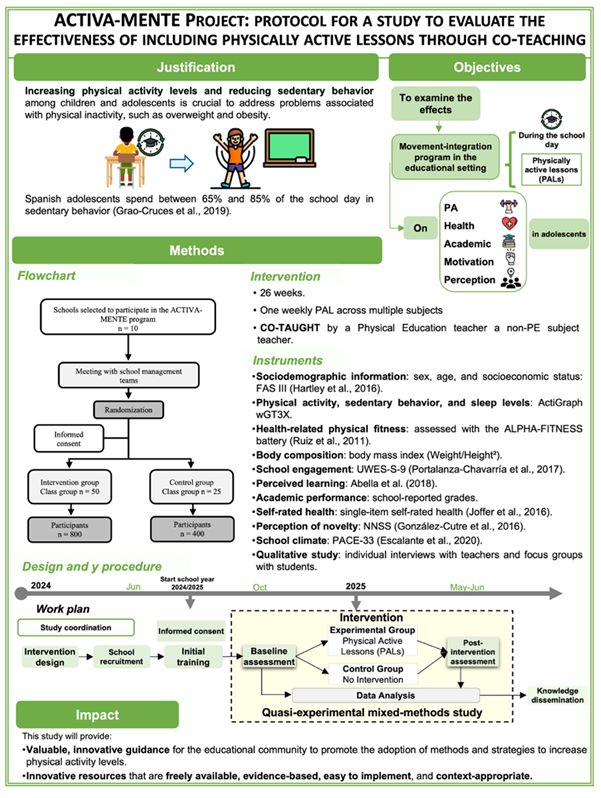
Figure 1
Methodology of the ACTIVA-MENTE Program Effectiveness Study
Participants
Participants are adolescents aged 12–17 years, apparently healthy, enrolled in the 10 participating schools. Inclusion criteria for students were: (i) enrolment in any grade of compulsory secondary education, and (ii) absence of physical disability or health conditions limiting PA practice. Families were informed about the study objectives and inclusion criteria and provided informed consent for their children’s participation.
The recruitment process was designed to obtain a total sample of 1,200 participants, approximately 800 in the intervention group and 400 in the control group, distributed across 75 classes. This distribution ensures detection of small effect sizes, particularly for the primary outcome variable (moderate-to-vigorous PA during the school day). Based on the review by Norris et al. (2020), an effect size smaller than 0.1 was expected; therefore, the sample was estimated with an alpha error of 0.001 and a statistical power of 95%, considering an experimental dropout rate of up to 25% (GPower 3.1.9.4, Düsseldorf, Germany).
A total of 70 teachers also participate, selected by convenience from those teaching in the intervention groups. Of these, 18 are Physical Education specialists, and the remainder teach the following “non-motor” subjects: Spanish Language and Literature, Mathematics, English, Geography and History, Biology and Geology, and Art. All participated voluntarily, signed informed consent, and received 12 hours of in-person and online training on the PAL methodology.
Procedure
The intervention started in October 2024, lasts 26 weeks, and is based on integrating PA (locomotor movements, jumps, games, sports activities, circuits, etc.) into academic lessons of the non-motor subjects mentioned above. One 55-minute PAL per week is delivered in the intervention classes. This frequency was defined as a viable and sustainable option in the current educational context, allowing for gradual integration of movement into the classroom without overloading teachers. Recent studies suggest that even low-frequency interventions can generate meaningful improvements when implemented with an active and collaborative pedagogical orientation (Norris et al., 2020; Teslo et al., 2023; Chalkley et al., 2024). PALs are delivered in spaces that enable movement and are co-taught by the non-motor subject teacher and the Physical Education teacher.
The design of PALs follows a co-creation process: the non-motor subject teacher specifies subject-specific competencies, core knowledge, timing, and assessment criteria, while the Physical Education teacher proposes methodology, activities, grouping strategies, spaces, and teaching materials. The resulting product is the physically active lesson, jointly delivered by both teachers. Examples of tasks to build PALs can be found in Annex II as well as in the book coordinated by Grao-Cruces et al. (2023).
To ensure fidelity and proper implementation, the research team maintains continuous contact with participating teachers, providing technical and pedagogical support throughout the intervention. Monitoring includes periodic observations, unstructured interviews, and collection of teacher records and evidence. Additional support strategies include: (i) initial teacher training; (ii) provision of materials, methodological proposals, and digital resources via shared virtual platforms; (iii) regular collection of practical evidence (photos, videos, teaching materials); and (iv) qualitative interviews with teachers, students, and school leaders to assess execution and integration. This methodological approach is consistent with other recent multicomponent school interventions to promote PA from a systematic and contextualized perspective, such as the MOVESCHOOL study (Bandera-Campos et al., 2025).
During the intervention period, the control group receives standard academic lessons with no methodological modifications or PA integration that could alter their usual PA levels during school hours. At the end of the program, researchers will provide the control group with access to the PALs implemented in the intervention, if they wish to adopt them.
This program is supported institutionally by the regional education authority, which assigned specific resources to participating schools. Each school received the incorporation of a Physical Education teacher with a partial workload (9 hours per week) devoted exclusively to coordinating, co-designing, and implementing PALs. This measure ensured program feasibility, facilitated teacher collaboration, and reinforced monitoring and fidelity. The administration also promoted initial training for participating teachers and provided virtual spaces for technical and pedagogical support throughout the process.
Instruments and Measurements
Variables of interest are assessed in both the intervention and control groups at baseline (September 2024) and at the end of the project (May–June 2025), except for qualitative instruments (interviews and focus groups), which are used only in the final evaluation. Measurements are conducted in each school by the study authors, except for student surveys, which are supervised by participating teachers following detailed researcher instructions.
Socioeconomic status. This variable is assessed using the Spanish-adapted version of the Family Affluence Scale III (FAS III) (Hobza et al., 2017). The scale consists of six questions related to the purchasing power of students’ families. Each question is scored on a categorical scale, and the sum of the six items produces an aggregate index ranging from 0 to 13.
PA levels, sedentary behavior, and sleep. These variables are measured using accelerometry in a subsample of approximately 150 students from four participating schools. Participants wear an Actigraph accelerometer (Actigraph GT3X+, Inc., Pensacola, FL, USA) on the non-dominant wrist for eight consecutive full days (including sleep), except during water-based activities. Raw triaxial acceleration is recorded at 100 Hz and aggregated using 5-second epochs. Data processing is performed with the GGIR package in R, following protocols validated in adolescent samples (Migueles et al., 2017).
Health-related physical fitness. Health-related physical fitness is assessed using the ALPHA-FITNESS battery (Ruiz et al., 2011). Three tests are included: (i) the 20-m shuttle run test to evaluate cardiorespiratory fitness; (ii) the handgrip strength test to assess isometric upper-body strength, using a validated adjustable-grip manual dynamometer (TKK 5101 Grip D; Takei, Tokyo, Japan), with 2 trials performed with each hand; and (iii) the standing long jump test to measure lower-body explosive strength, with 2 trials performed.
Body composition. Body mass index (BMI) is used. Weight is measured with participants barefoot and wearing light clothing on an electronic scale (SECA 861; range, 0.05 to 130 kg; accuracy, 0.05 kg). Height is measured in the Frankfurt plane with a telescopic stadiometer (SECA 225; range, 60 to 200 cm; accuracy, 1 mm). Each measurement is taken twice, and the mean of the two is recorded. BMI is calculated as weight/height squared (kg/m²). Both the physical fitness tests and the body composition assessment are conducted in a subsample of approximately 420 students from 4 schools.
Self-rated health. Assessed using a single-item self-rated health question that categorizes health as “excellent” (5), “very good” (4), “good” (3), “fair” (2), and “poor” (1) (Joffer et al., 2016).
School engagement. Evaluated with the UWES-S-9 engagement scale (Chavarría et al., 2017). This instrument comprises nine items covering three dimensions—vigor, absorption, and dedication. Each dimension is represented by three items, rated on a Likert-type scale from “never” (0 points) to “always” (6 points).
Perceived learning. Assessed with the questionnaire developed by Abella et al. (2018). It comprises 8 items measuring two dimensions: “perceived learning” (items 1–4) and “satisfaction with learning” (items 5–8). Students rate their agreement with each item on a five-point Likert scale, where “1” indicates “strongly disagree” and “5” indicates “strongly agree.”
Academic performance. Evaluated using school-reported grades in the subjects in which PALs are implemented, at the initial evaluation and at the third evaluation (September and June).
Perception of novelty. Assessed with the Novelty Need Satisfaction Scale (NNSS; González-Cutre et al., 2016). Students rate their agreement with five statements on a five-point Likert scale from “1” (“strongly disagree”) to “5” (“strongly agree”).
School climate. Assessed with the Perception of School Climate by Students scale (PACE-33; Mateos et al., 2020). For this study, four indicators are used: Student–Teacher Relationships (4 items), Physical Safety (4 items), Group Cohesion (4 items), and Methodological Resources (3 items). Participants indicate their agreement with each item on a five-point Likert scale, where “1” indicates “strongly disagree” and “5” “strongly agree.”
Teachers’ and students’ perceptions of PAL implementation. To obtain qualitative information on program implementation—and to understand perceived benefits, barriers, limitations, usefulness, opportunities for improvement, and future implementation—semi-structured individual and group interviews are conducted with students and teachers. In each school, five teachers involved in and familiar with the program will be selected. In addition, a separate interview is conducted with the school principal. Student focus groups are composed of 6–8 students per class, selected to ensure heterogeneity. These interviews are semi-structured, last approximately 30 minutes each, and are audio-recorded for subsequent analysis.
Data Analysis
Quantitative analyses will be conducted using IBM SPSS Statistics v23.0. Descriptive statistics and bivariate correlations among study variables will be estimated. Differences by sex and socioeconomic descriptors will be analyzed using paired-sample t-tests. Main effects of the intervention will be tested using repeated-measures ANOVA, with group (control vs. experimental) as the between-subjects factor and time (pre vs. post) as the within-subjects factor.
Qualitative data from semi-structured interviews and focus groups will be analyzed using NVivo software (Jackson & Bazeley, 2019). Content analysis will follow a two-phase approach: a deductive phase to identify information relevant to study objectives, and an inductive phase to capture teachers’ and students’ experiences, thoughts, and reflections related to PALs (Hsieh & Shannon, 2005).
Discussion
This manuscript presents the protocol of a study that seeks to test the effectiveness of an intervention program based on the inclusion of physically active lessons (PALs) during the school day on PA levels, physical fitness, and academic and motivational indicators among students in compulsory secondary education. It also examines school organization and the benefits, difficulties, advantages, and limitations of implementing this program as perceived by teachers and students in a real educational context.
The ACTIVA-MENTE project arises from the need to implement effective measures to reduce the high levels of sedentary behavior reported in recent epidemiological studies. Global studies have warned of a worrying rise in overweight/obesity rates among children and adolescents. Although the growth of childhood obesity has a multifactorial etiology, there is no doubt that schoolchildren’s lifestyles play a fundamental role.
In response to this situation, various professional groups in physical education and sport have, for several years, called for the inclusion of a third weekly Physical Education class (Uddin et al., 2020). However, implementing this measure would entail reducing the instructional time of another subject—an issue that is critical and debatable from multiple perspectives. Therefore, given the low likelihood that a third hour of Physical Education will become a reality, it is necessary to implement public policies capable of putting in place school programs aimed at reducing the high levels of sedentary behavior recorded during the school day. In this regard, PALs have emerged as a methodological strategy that reduces sedentary time without decreasing instructional time in academic subjects.
Although much ground remains, the benefits of this methodology have been widely demonstrated across studies. Specifically, the systematic review by Norris et al. (2020) showed that PAL interventions increase PA levels in class and across the school day, and improve time-on-task, without reducing academic performance.
The ACTIVA-MENTE program represents a clear and deliberate commitment by the education authority to innovate in teaching by integrating movement into academic contexts. The allocation of specific human resources (Physical Education teachers with a partial workload), teacher training, and institutional support are key to facilitating implementation. Beyond health benefits, such initiatives reinforce the pedagogical value of PALs as a useful and transferable methodology for teachers of different subjects. PALs enable the introduction of active, collaborative, and contextualized dynamics that can foster learning, attention to diversity, and student motivation, thereby contributing to more inclusive and meaningful teaching. In this sense, institutionalization of the project, the use of a co-teaching-based methodology, and a long-duration intervention constitute an important novelty compared with similar studies conducted previously.
From an applied perspective, this study can provide relevant guidance for the development of education policies that integrate movement as a pedagogical tool in curricular contexts. The active involvement of participating schools and the co-design process of PALs among teachers from different areas have made it possible to adapt the intervention to the real characteristics of school environments, thereby promoting acceptance and sustainability. In addition, the study’s approach is framed within the principles of implementation science, insofar as it considers not only the effectiveness of the program but also explores its operational feasibility, fidelity of delivery, and contextual conditions that may influence its effectiveness. This approach generates useful and transferable knowledge for future institutional scale-up efforts. If the results confirm the expected benefits of this pioneering program—designed in coordination with the education authority and contextualized in real schools—it could provide a solid foundation for extension to other autonomous communities, where integrating movement into the classroom is understood as a strategic investment in students’ physical, emotional, and academic well-being.
Strengths and Limitations
This study has the following strengths: (i) it is conducted with a large sample of secondary-school students—an educational stage for which there is less research than in primary and pre-primary education; (ii) PALs are co-designed and delivered autonomously by the non-motor subject teacher and the Physical Education teacher, adapting to the real educational context and increasing the likelihood of continued long-term implementation; (iii) the study design will provide new evidence allowing for greater control of the internal validity of the results; and (iv) the mixed-methods approach, combining quantitative and qualitative data, will yield practical and comprehensive information, helping to avoid potential biases associated with Likert-type questionnaire responses.
On the other hand, certain limitations must also be acknowledged: (i) the study results may be influenced by the specific school context and by participant characteristics (environment, student body, facilities and materials, etc.); (ii) continuation of the intervention over the long term may be compromised without the collaboration of the Physical Education teacher in PAL design, given the preparation time required; (iii) despite the research team’s efforts, the magnitude of the intervention makes effective supervision of program fidelity and correct implementation challenging; (iv) the non-random allocation of participating schools may introduce selection bias that could affect the results; and (v) teacher effects in implementation may substantially influence variability in outcomes across classes and schools.
Future research should include longitudinal studies to evaluate maintenance of effects in the medium and long term, explore the impact of different intervention intensities and frequencies, and analyze in greater detail the role of teachers as implementation agents. It is also especially relevant to incorporate conceptual frameworks that allow for analysis of program scalability and sustainability. In this regard, the RE-AIM model (Reach, Effectiveness, Adoption, Implementation, Maintenance) offers a useful structure for evaluating the real-world impact of educational interventions (Glasgow et al., 1999). Integrating this framework in subsequent phases of the ACTIVA-MENTE program would facilitate analysis of reach, institutional adoption, implementation fidelity, and long-term maintenance. Recent experiences illustrate its applicability, such as the Break4Brain project (Arenas et al., 2024) and the TransformUs protocol (Koorts et al., 2023), both conducted in real school settings. Adopting this approach would help strengthen the program’s scalability, transferability, and sustainability and guide future policy decisions.
Despite the limitations noted, adapting the proposed intervention to each educational context—while respecting its characteristics and pedagogical autonomy—will provide valuable and innovative guidance for the educational community to promote and implement methods and strategies aimed at increasing time spent in PA during the school day. Likewise, innovative, evidence-based resources and materials will be generated that are easy to implement and adaptable to real learning conditions.
Conclusions
This article describes the methodology for evaluating the effects of the ACTIVA-MENTE program, which integrates PALs during the secondary-school day through a co-teaching approach. The aim is to determine the effects of the intervention on PA levels and sedentary time, as well as on academic, cognitive, health, and motivational indicators; and to examine teachers’ and students’ perceptions of the advantages, benefits, difficulties, and limitations of program implementation. This quasi-experimental study seeks to provide valuable and enriching information for the educational community, promoting the use of sustainable methodologies and strategies over time that can improve students’ academic outcomes and quality of life.
Ethics Committee Statement
The study was conducted in accordance with the Declaration of Helsinki and was approved by the Bioethics and Biosafety Commission (CBB) of the University of Extremadura (registration code 128/2024, October 3, 2024).
Conflict of Interest Statement
The funding bodies or institutions had no influence on the study design, data analysis, or interpretation of the results. Authors’ declarations of interest: none.
Funding
Although the ACTIVA-MENTE Project is an institutional programme of the General Secretariat for Education of the Regional Government of Extremadura (Spain), which funds the hiring of the teaching staff participating in it, this research received no funding
Authors' Contribution
Conceptualization DSO & JMPG; Methodology HMC, DSO, JMPG, RMG & ARH; Formal Analysis DSO & JMPG; Writing – Original Draft JMPG & RMG; Writing – Review & Editing ARH; Supervision DSO. All authors have read and agreed to the published version of the manuscript.’
Data Availability Statement
The data that support the findings of this study are available on request from the corresponding author jmpulido@unex.es
Acknowledgements
To the teachers participating in the ACTIVA-MENTE Project, for their generous commitment and their ongoing pursuit of methodologies that enhance teaching and learning processes and contribute to their students’ physical and emotional well-being.
To IES Al-Qazeres and its leadership team, for their trust and for believing in the methodological approach that gave rise to the ACTIVA-MENTE Project.
To the General Secretariat for Education of the Regional Government of Extremadura, for its firm commitment to this educational programme, its institutional support, and the funding for the recruitment of teaching staff that has made co-teaching and the development of the ACTIVA-MENTE Project possible.
References
Abella, V., Aüsín, V., Delgado, V., Hortigüela, D., & Solano, H. J. (2018). Determinantes de la calidad, la satisfacción y el aprendizaje percibido de la e-formación del profesorado universitario. Revista Mexicana de Investigación Educativa, 23(78), 733–760. https://www.scielo.org.mx/pdf/rmie/v23n78/1405-6666-rmie-23-78-733.pdf
Arenas, D., Bodi-Torralba, M., Oliver, A., Cantallops, J., Ponseti, F. J., Palou-Sampol, P., Collado, J. A., Flórez, I., Galvez-Pol, A., Terrasa, J. L., Sitges, C., Sánchez-Azanza, V., López-Penadés, R., Adrover-Roig, D., & Muntaner-Mas, A. (2024). Effects of active breaks on educational achievement in children with and without ADHD: study protocol and rationale of the Break4Brain project. Frontiers Psychol, 15, 1451731. https://doi.org/10.3389/fpsyg.2024.1451731
Bandera-Campos, F. J., Grao-Cruces, A., Camiletti-Moirón, D., Martín-Acosta, F., Muñoz-González, R., González-Pérez, M., Ruiz-Hermosa, A., Vaquero-Solís, M., Padilla-Moledo, C., & Sánchez-Oliva, D. (2025). Effectiveness of a multicomponent intervention to promote physical activity during the school day: Rationale and methods of the MOVESCHOOL study. Frontiers in Public Health, 13, 1565914. https://doi.org/10.3389/fpubh.2025.1565914
Cassar, S., Salmon, J., Timperio, A., Naylor, P. J., Van Nassau, F., Contardo Ayala, A. M., & Koorts, H. (2019). Adoption, implementation and sustainability of school-based physical activity and sedentary behaviour interventions in real-world settings: A systematic review. International Journal of Behavioral Nutrition and Physical Activity, 16(1), 120. https://doi.org/10.1186/s12966-019-0876-4
Chanmugam, A., & Gerlach, B. (2013). A co-teaching model for developing future educators’ teaching effectiveness. International Journal of Teaching and Learning in Higher Education, 25(1), 110–117. https://files.eric.ed.gov/fulltext/EJ1016491.pdf
Chalkley, A. E., Routen, A. C., Harris, J., & Sherar, L. B. (2024). Finding the sweet spot of physically active learning: A need for co-ownership by public health and education. Journal of School Health, 148, 104695. https://doi.org/10.1016/j.tate.2024.104695
Chavarría, C. A. P., Hinestroza, M. P. G., & Oliva, E. J. D. (2017). Propiedades de la Utrecht Work Engagement Scale (uwes-s 9): Análisis exploratorio con estudiantes en Ecuador. Innovar, 27(64), 145–156. https://doi.org/10.15446/innovar.v27n64.62374
Daly-Smith, A., Quarmby, T., Archbold, V. S. J., Corrigan, N., Wilson, D., Resaland, G. K., Bartholomew, J. B., Singh, A., Tjomsland, H. E., Sherar, L. B., Chalkley, A., Routen, A. C., Shickle, D., Bingham, D. D., Barber, S. E., Sluijs, E. V., Fairclough, S. J., & McKenna, J. (2020). Using a multi-stakeholder experience-based design process to co-develop the Creating Active Schools Framework. International Journal of Behavioral Nutrition and Physical Activity, 17(1), 13. https://doi.org/10.1186/s12966-020-0917-z
Fernández Enguita, M. (2020). Del aislamiento en la escuela a la codocencia. Participación Educativa, 7(10), 15–32. https://dialnet.unirioja.es/servlet/articulo?codigo=7459309&info=resumen&idioma=ENG
Fundación Gasol. (2023). Informe preliminar estudio PASOS 2022. https://www.gasolfoundation.org
Glasgow, R. E., Vogt, T. M., and Boles, S. M. (1999). Evaluating the public health impact of health promotion interventions: The RE-AIM framework. America Journal of Public Health, 89(9), 1322–1327. https://doi.org/10.2105/AJPH.89.9.1322
González-Cutre, D., Sicilia, Á., Sierra, A. C., Ferriz, R., & Hagger, M. S. (2016). Understanding the need for novelty from the perspective of self-determination theory. Personality and Individual Differences, 102, 159–169. https://doi.org/10.1016/j.paid.2016.06.036
González-Pérez, M., Sánchez-Oliva, D., Martín-Acosta, F., Ruiz-Hermosa, A., Camiletti-Moirón, D., & Grao-Cruces, A. (2025). A mixed-methods approach of the effect of physically active learning on time-on-task in the secondary education class: The ACTIVE CLASS study. Learning and Instruction, 97, 102091. https://doi.org/10.1016/j.learninstruc.2025.102091
Grao-Cruces, A., Camiletti-Moirón, D., & Sánchez-Oliva, D. (2023). Aprendizaje físicamente activo: Fundamentos teóricos y estrategias prácticas para la materia de matemáticas en 1. y 2. de ESO. Dykinson SL.
Grao-Cruces, A., Sánchez-Oliva, D., Sevil-Serrano, J., Sánchez-López, M., Sánchez-Miguel, P. A., Camiletti-Moirón, D., García-Calvo, T., & Castro-Piñero, J. (2023). Centros educativos promotores de actividad física: Estrategias basadas en la evidencia científica. Revista Española de Educación Física y Deportes, 437(3), 37–51. https://doi.org/10.55166/REEFD.V437I3.1111
Grao-Cruces, A., Sánchez-Oliva, D., Segura-Jiménez, V., Cabanas-Sánchez, V., Martínez-Gómez, D., Rodríguez-Rodríguez, F., Moreno, L. A., & Castro-Piñero, J. (2019). Changes in compliance with school-based physical activity recommendations in Spanish youth: The UP&DOWN longitudinal study. Scandinavian Journal of Medicine and Science in Sports, 29(4), 554–565. https://doi.org/10.1111/sms.13355
Guthold, R., Stevens, G. A., Riley, L. M., & Bull, F. C. (2020). Global trends in insufficient physical activity among adolescents: a pooled analysis of 298 population-based surveys with 1·6 million participants. The Lancet Child and Adolescent Health, 4(1), 23–35. https://doi.org/10.1016/S2352-4642(19)30323-2
Hobza, V., Hamrik, Z., Bucksch, J., & De Clercq, B. (2017). The family affluence scale as an indicator for socioeconomic status: Validation on regional income differences in the Czech Republic. International Journal of Environmental Research and Public Health, 14(12), 1540. https://doi.org/10.3390/ijerph14121540
Hruby, A., Manson, J. A. E., Qi, L., Malik, V. S., Rimm, E. B., Sun, Q., Willett, W. C., & Hu, F. B. (2016). Determinants and consequences of obesity. American Journal of Public Health, 106(9), 1656–1662. https://doi.org/10.2105/AJPH.2016.303326
Hsieh, H. F., & Shannon, S. E. (2005). Three approaches to qualitative content analysis. Qualitative Health Research, 15(9), 1277–1288. https://doi.org/10.1177/1049732305276687
Jackson, K., & Bazeley, P. (2019). Qualitative data analysis with NVivo. Sage.
Jago, R., Salway, R., House, D., Beets, M. W., Lubans, D. R., Woods, C. B., & de Vocht, F. (2023). Rethinking children's physical activity interventions at school: A developmental perspective. Frontiers in Public Health, 11, 1149883. https://doi.org/10.3389/fpubh.2023.1149883
Joffer, J., Jerdén, L., Öhman, A., & Flacking, R. (2016). Exploring self-rated health among adolescents: A think-aloud study. BMC Public Health, 16(1), 156. https://doi.org/10.1186/s12889-016-2837-z
Katzmarzyk, P. T., Powell, K. E., Jakicic, J. M., Troiano, R. P., Piercy, K., & Tennant, B. (2019). Sedentary behavior and health: Update from the 2018 physical activity guidelines advisory committee. Medicine and Science in Sports and Exercise, 51(6), 1227–1241. https://doi.org/10.1249/MSS.0000000000001935
Koorts, H., Timperio, A., Lonsdale, C., Ridgers, N. D., Lubans, D. R., Della Gatta, J., Bauman, A., Telford, A., Barnett, L., Lamb, K. E., Lander, N., Lai, S. K., Sanders, T., Arundell, L., Brown, H., Wilhite, K., & Salmon, J. (2023). Scaling up a school-based intervention to increase physical activity and reduce sedentary behaviour in children: Protocol for the TransformUs hybrid effectiveness-implementation trial. BMJ open, 13(10), e078410. https://doi.org/10.1136/bmjopen-2023-078410
Ley Orgánica 3/2020, de 29 de diciembre, por la que se modifica la Ley Orgánica 2/2006, de 3 de mayo, de Educación, Bolteín Oficial del Estado, 340 (2020). https://www.boe.es/eli/es/lo/2020/12/29/3/con
López Hernández, A., Buckingham Reynolds, L. R., & Custodio Espinar, M. (2021). Attention to diversity in higher education: A Co-teaching experience. Transformación universitaria. Retos y oportunidades. https://repositorio.comillas.edu/xmlui/handle/11531/62590
Mateos, N. E., Palacios, E. G., Fernández-Zabala, A., & Antonio-Agirre, I. (2020). Internal structure, reliability and invariance across gender using the multidimensional school climate scale pace-33. International Journal of Environmental Research and Public Health, 17(13), 4800. https://doi.org/10.3390/ijerph17134800
Mavilidi, M. F., Pesce, C., Benzing, V., Schmidt, M., Paas, F., Okely, A. D., & Vazou, S. (2022). Meta-analysis of movement-based interventions to aid academic and behavioral outcomes: A taxonomy of relevance and integration. Educational Research Review, 37, 100478. https://doi.org/10.1016/j.edurev.2022.100478
Migueles, J. H., Cadenas-Sanchez, C., Ekelund, U., Delisle Nyström, C., Mora-Gonzalez, J., Löf, M., Labayen, I., Ruiz, J. R., & Ortega, F. B. (2017). Accelerometer data collection and processing criteria to assess physical activity and other outcomes: A systematic review and practical considerations. Sports Medicine, 47(9), 1821–1845. https://doi.org/10.1007/S40279-017-0716-0
Norris, E., van Steen, T., Direito, A., & Stamatakis, E. (2020). Physically active lessons in schools and their impact on physical activity, educational, health and cognition outcomes: A systematic review and meta-analysis. British Journal of Sports Medicine, 54(14), 826–838. https://doi.org/10.1136/bjsports-2018-100502
Ruiz, J. R., España Romero, V., Castro Piñero, J., Artero, E. G., Ortega, F. B., Cuenca García, M., Jiménez Pavón, D., Chillón, P., Girela Rejón, J. M., Mora, J., Gutiérrez, A., Suni, J., Sjöstrom, M., & Castillo, M. J. (2011). Batería alpha-fitness: Test de campo para la evaluación de la condición física relacionada con la salud en niños y adolescentes. Nutrición Hospitalaria, 26(6), 1210–1214. https://scielo.isciii.es/pdf/nh/v26n6/03_articulo_especial_02a.pdf
Teslo, S., Jenssen, E. S., Thurston, M., Mandelid, M. B., Resaland, G. K., Chalkley, A. E., & Tjomsland, H. E. (2023). It's the journey, not the arrival that matters: Teachers' perceptions of their practice after participating in a continuing professional development program in physically active learning. Teaching and Teacher Education, 136, 104377. https://doi.org/10.1016/j.tate.2023.104377
Torres, E. O. (2023). Dificultades para el diseño y la aplicación de sesiones de co-docencia del profesorado de tecnología en formación. REDU. Revista de Docencia Universitaria, 21(1), 71–82. https://doi.org/10.4995/REDU.2023.19189
Uddin, R., Salmon, J., Islam, S. M. S., & Khan, A. (2020). Physical education class participation is associated with physical activity among adolescents in 65 countries. Scientific Reports, 10(1), 1–10. https://doi.org/10.1038/s41598-020-79100-9
Watson, A., Timperio, A., Brown, H., Best, K., & Hesketh, K. D. (2017). Effect of classroom-based physical activity interventions on academic and physical activity outcomes: A systematic review and meta-analysis. International Journal of Behavioral Nutrition and Physical Activity, 14(1). https://doi.org/10.1186/s12966-017-0569-9
World Health Organization. (2022). Global status report on physical activity 2022. https://www.who.int/teams/health-promotion/physical-activity/global-status-report-on-physical-activity-2022
World Health Organization. (2024, June 26). Nearly 1.8 billion adults at risk of disease from not doing enough physical activity. https://www.who.int/es/news/item/26-06-2024-nearly-1.8-billion-adults-at-risk-of-disease-from-not-doing-enough-physical-activity
Zapico, A. G., Aparicio-Ugarriza, R., Quesada-González, C., Gómez, S. F., Wärnberg, J., Medrano, M., Gusi, N., Aznar, S., Marín-Cascales, E., González-Valeiro, M. A., Serra-Majem, L., Pulgar, S., Tur, J. A., Segu, M., Fíto, M., Homs, C., Benavente-Marín, J. C., Sánchez-Gómez, J., Jiménez-Zazo, F., … González-Gross, M. (2023). Lifestyle behaviors clusters in a nationwide sample of Spanish children and adolescents: PASOS study. Pediatric Research, 94(6), 2077–2084. https://doi.org/10.1038/s41390-023-02710-2
Author notes
a Correspondence: José María Pulido-Gil, jmpulido@unex.es
Additional information
Short title: ACTIVA-MENTE Project: Physically Active Lessons Through Co-teaching
How to cite this article: Pulido-Gil, J.M., Muñoz-González, R., Ruiz-Hermosa, A., Moreno-Casado, H. & Sánchez-Oliva, D. (2026). ACTIVA-MENTE project: protocol for a study to evaluate the effectiveness of including physically active lessons through co-teaching. Cultura, Ciencia y Deporte, Cultura, Ciencia y Deporte, 21(67), 2444. https://doi.org/10.12800/ccd.v21i67.2444


