
IMPACT OF A FIVE-WEEK INTERNATIONAL TOUR ON THE STROKE SPEED, MUSCLE POWER AND BODY COMPOSITION IN YOUNG CHILEAN FEMALE TENNIS PLAYERS
IMPACTO DE UNA GIRA INTERNACIONAL DE CINCO SEMANAS EN LA VELOCIDAD DE LOS GOLPES, POTENCIA MUSCULAR Y COMPOSICIÓN CORPORAL EN JÓVENES TENISTAS CHILENAS


Pablo Luna-Villouta, Carlos Matus-Castillo, Carol Flores-Rivera, Cristian Martínez Salazar, Miguel Alarcón-Rivera, César Faúndez-Casanova, Marcelo Castillo-Retamal, Jaime Vásquez-Gómez, Claudio Hernández-Mosqueira, Marcelo Paredes-Arias, Rodrigo Vargas-Vitoria
IMPACT OF A FIVE-WEEK INTERNATIONAL TOUR ON THE STROKE SPEED, MUSCLE POWER AND BODY COMPOSITION IN YOUNG CHILEAN FEMALE TENNIS PLAYERS
Cultura, Ciencia y Deporte, vol. 21, no. 67, 2026, 10.12800/ccd.v21i67.2332
Universidad Católica San Antonio de Murcia
Pablo Luna-Villouta a
Universidad de Concepción, Chile
Carlos Matus-Castillo
Universidad Católica de la Santísima Concepción, Chile
Carol Flores-Rivera
Universidad Andres Bello, Chile
Cristian Martínez Salazar
Universidad de La Frontera, Chile
Miguel Alarcón-Rivera
Universidad Santo Tomás, Chile
César Faúndez-Casanova
Universidad Católica del Maule, Chile
Marcelo Castillo-Retamal
Universidad Católica del Maule, Chile
Jaime Vásquez-Gómez
Universidad Católica del Maule, Chile
Claudio Hernández-Mosqueira
Universidad del Bío-Bío, Chile
Marcelo Paredes-Arias
Instituto Profesional Duoc UC, Chile
Rodrigo Vargas-Vitoria
Universidad Católica del Maule, Chile
Received: 10 October 2024
Accepted: 21 July 2025
Abstract: Currently, young female tennis players participate in international tournaments away from home, which can affect their performance. The study aimed to analyze changes in body composition, stroke speed, and muscle power after a five-week international tour in young Chilean female tennis players. The sample consisted of thirty young female players (16.2±0.7). Body weight, height, skinfolds and body perimeters were measured. Body fat percentage and skeletal muscle mass (SMM) were calculated. Service speed, forehand and backhand strokes were monitored with a speed radar (Pocket Radar®). Muscle power was evaluated with horizontal jump (HJ), countermovement jump (CMJ), and medicine ball throw (MBT). The results show decreases in SMM and body fat (p<.01; d= 0.89 and 0.75). In muscular power, there was a loss in MBT, CMJ, and HJ (p<.01; d= 0.59 to 0.98). In addition, the speed of serve, forehand, and backhand decreased (p<.01; d= 1.16, 0.27, and 0.46, respectively). We conclude that, after a five-week international tour, there is a significant decrease in serve speed, forehand, backhand, MBT, CMJ, and HJ, and a loss in body fat and SMM.
Keywords: Tennis, women, groundstrokes, speed serve, muscle power..
Resumen: (16.2 ±0.7 años). (Pocket Radar®). Los resultados muestran, disminuciones en SMM y grasa corporal (p<.01; d= 0.89 y 0.75). En potencia muscular, hubo perdidas en MBT, CMJ y HJ (p<.01; d= 0.59 a 0.98). Además, disminuyó la velocidad del servicio, derecho y revés (p<.01; d= 1.16, 0.27 y 0.46, respectivamente).
Palabras clave: Tenis, mujeres, golpes de fondo, velocidad del servicio, potencia muscular.
Introduction
Tennis is a widely practiced sport at both recreational and competitive levels, in junior and adult categories (Morais et al., 2024). In fact, the number of competitors at the junior level is double that of the adult professional circuit (Kovalchik & Reid, 2017). Participation in international tournaments generally begins around age 14, for both women and men, although the number of female players is higher at this stage (Fleming et al., 2023). Furthermore, female tennis players often reachpeak performance at a younger age than male players (Kovalchik & Reid, 2017).
Tennis is currently considered a dynamic and complex racket sport due to the high demands placed on numerous physical components, such as agility, speed, strength, and muscular power, along with specialized technical skills like service and groundstrokes (Fernandez-Fernandez et al., 2009; Li & Wang, 2023; Luna-Villouta et al., 2022; Rodríguez-Cayetano et al., 2022). Each match intermittently requires a display of high power and speed in different types of shots and movements around the court (Luna-Villouta et al., 2023; Rodríguez-Cayetano et al., 2022), in points that last approximately 8 to 10 seconds and average 10 shots per point (Fernandez-Fernandez et al., 2009). Matches last approximately 1.5 hours, during which players perform around 500 high- and maximum-intensity efforts (Kovalchik & Reid, 2017; Smekal et al., 2001). In women's matches, rallies are longer and involve more exchanges of shots, although with less power compared to men's matches (Reid et al., 2016). Analyzing these parameters has been identified as a key factor in differentiating the most successful players and is essential for training programs, fitness assessment, and injury prevention (Lambrich& Muehlbauer, 2023; Luna-Villouta et al., 2024; Parpa et al., 2023).
Thus, in recent years, tennis has been considered an explosive sport, characterized by the high speeds achieved by athletes in their strokes and serves (Fernandez-Fernandez et al., 2009; Ulbricht et al., 2016). In this context, the serve has been identified as a key element for achieving sporting success (Fernández-García et al., 2019; Fett et al., 2020; Keller et al., 2021), with significant relationships reported between the speed and accuracy of the serve and the ability to win more points and matches on the men's and women's circuits, as well as among junior players (Bilić et al., 2023; Fitzpatrick et al., 2019; Gillet et al., 2009). Additionally, groundstroke speed has been identified as a key factor differentiating elite tennis players, who can hit with greater power and accuracy than sub-elite players (Landlinger et al., 2012). This underscores the importance of ball speed in tennis competition (Bilić et al., 2023). Therefore, the ability to generate higher shot speeds, along with the capacity to sustain these high values throughout matches, could be a significant factor for players to improve their performance and reach higher competitive levels (Colomar et al., 2020).
Additionally, it has been reported that young female tennis players currently participate in a greater number of national and international competitions compared to the beginning of the last decade, sometimes playing up to two consecutive matches per day (in morning and afternoon or evening sessions) as part of the regular competition schedule for singles, in qualifying rounds, main draws, and doubles (Gallo-Salazar et al., 2019; Luna-Villouta et al., 2024). Furthermore, multi-week trips are a defining characteristic of junior tennis development, which means they are away from their training facilities for extended periods and, on many occasions, without the direct supervision of their coaches (Kovacs et al., 2007; Murphy et al., 2015). This situation can lead to changes in various parameters of athletic performance and increase the risk of injury (Luna-Villouta et al., 2023, 2024; Murphy et al., 2015; Ojala & Häkkinen, 2013).
In general, research on the effect of international tours longer than four weeks on athletic performance has reported significant changes in body composition (Luna-Villouta et al., 2023, 2024), along with significant decreases in 5, 10, and 20 m sprints (Luna-Villouta et al., 2023, 2024; Murphy et al., 2015), muscle power (Luna-Villouta et al., 2024; Murphy et al., 2015; Ojala & Häkkinen, 2013), agility (Luna-Villouta et al., 2023, 2024; Murphy et al., 2015), aerobic capacity (Murphy et al., 2015), and serve speed (Gallo-Salazar et al., 2019; Martin et al., 2016).
Studies on the effects of training and competition in women's tennis are still limited, as they have primarily focused on male players (Deng et al., 2023). However, biological differences between men and women (e.g., menstrual cycle and hormonal profiles) make it inappropriate to apply findings from the same study to both male and female athletes (Hughes et al., 2023). In fact, in the reviewed studies, only Murphy et al. (2015) and Luna-Villouta et al. (2024) included young female tennis players in their research on the changes and effects of tournament succession on physical performance and body composition, highlighting the lack of research on this topic in women.
Based on the background above, the study aimed to analyze changes in body composition, stroke speed, and muscle power after a five-week international tour in young Chilean female tennis players. In addition, changes in these variables were analyzed according to players' national rankings.
Materials and Methods
Design
Observational, cross-sectional, and descriptive-comparative study.
Participants
The sample was selected using non-probability convenience sampling and consisted of 30 young Chilean female tennis players, aged 15 to 16 years (16.2 ± 0.7). The selection included the top players in the Chilean Junior Women's Tennis Ranking, although several declined to participate for various reasons (lack of response, injuries, vacations, travel, etc.). Measurements were taken one week before (pre-tour) and one week after (post-tour) a five-week international tour that included Grade 2 tournaments of the South American Tennis Confederation (COSAT), held in Colombia (2 weeks), Ecuador (2 weeks), and Argentina (1 week). The players played an average of 5 matches per week, all on clay courts.
All the players belonged to tennis clubs in Santiago (Chile). The inclusion criteria were: (1) declaring female gender; (2) being between 15 and 16 years old; (3) have competed in international tournaments in the last 18 months; (4) have a ranking between number 1 and 50 in the Chilean Tennis Federation (FETECH) ranking according to their age category; (5) complete the five-week COSAT international tour. The exclusion criteria were as follows: (1) failure to complete the evaluations and (2) presenting an injury or pain that affected the evaluation results, reported by the player or coaching staff.
Procedure
For the data collection process, authorization was first requested from the tennis club directors through a letter outlining the study's objective and procedures. Informed consent was then obtained from the parents or guardians of each player, which included the study's objective and characteristics. Finally, the players' participation was confirmed through assent, in accordance with the principles of the Declaration of Helsinki for research involving human subjects (World Medical Association, 2013). Furthermore, the Scientific Ethics Committee of Universidad San Sebastián (Chile) approved the study (Resolution Code: 51-2018-20).
Data collection took place in the mornings during March and April 2024, before any training sessions, at an ambient temperature between 14° and 19° Celsius. All measurements were taken at the players' sports clubs. An experienced evaluator performed anthropometric and body composition assessments, applying the protocols described by Marfell-Jones et al. (2012). Height (cm) was measured using a stadiometer graduated in millimeters (Seca 220, Hamburg, Germany), and body weight was measured using a 50-g precision mechanical scale (Seca 700, Hamburg, Germany). Skinfolds of the triceps brachial, anterior thigh, and medial calf were measured on the right side of each tennis player using a skinfold caliper (Harpenden®, Baty International Ltd., West Sussex, UK). Arm, thigh, and calf perimeters were also measured on the right side of the body using a metallic anthropometric tape (Lufkin® Metallic, Medina, OH, USA). All circumference measurements were taken at the midline of the corresponding body segment. Anthropometric measurements were taken two or three times when the difference between the first and second values exceeded 0.5 cm in height, 0.05 kg in body weight, 1% in perimeters, and 5% in skinfolds. The mean of all measurements was used for data analysis. The technical error of the measurements ranged from 0.20% to 0.70%.
Body fat percentage was calculated using the equation: Body Fat (%) = 0.610 (triceps + calf) + 5.1 (Slaughter et al., 1988). Skeletal muscle mass (SMM) was calculated using the equation SMM (kg) = height × ((0.0064 × corrected circumference for upper arm2) + (0.0032 × corrected circumference for thigh2) + (0.0015 × corrected circumference for calf2) + (2.56 × 0) + (0.136 × age)) (Poortmans et al., 2005). Biological maturation was determined using the peak growth velocity acceleration (APHV) with the equation APHV (level) = -7.709133 + [0.0042232 × (age × height)] (Moore et al., 2015).
Stroke velocity and muscle power were measured on outdoor clay tennis courts following anthropometric assessments. The players wore training sportswear (shorts, t-shirt, and tennis shoes). All assessments were conducted by three experienced evaluators who had been previously trained in the protocols used. All tests were administered before and after the 5-week international tour. Muscle power tests were performed twice, and the best results were used for statistical analysis. For stroke speed, each player performed eight attempts, with the three bests being recorded. The average of these three attempts was used for comparison. The tests began after a 20-minute warm-up, which included joint mobility exercises, movement in different directions, acceleration drills, reaction speed exercises, and stretching. Players then practiced various stroke types (serve, forehand, and backhand), finishing with maximum speed strokes. The structure of the measurements was as follows: first, the muscle power tests were evaluated in the following order: medicine ball throw (MBT), horizontal jump, and CMJ; second, stroke speed was measured, starting with the serve, then the forehand, and finally the backhand.
Instruments
Medicine Ball Throw (MBT). This was performed according to the protocol described by Sánchez-Pay et al. (2021). Players, holding a 2 kg medicine ball in their dominant hand, stood with their feet parallel and slightly apart. After bringing the ball to the side and behind their head with their hand, bending their knees, they threw it forward as far as possible without crossing the line with their feet. A Stanley Power Lock® millimeter tape measure (USA) was used to measure distance.
Horizontal Jump (HJ). This was performed following the recommendations of Vanhelst et al. (2016). Each player stood behind a line marked on the ground, with their feet parallel and slightly apart. After a swing of the arms and a bending of the knees, they had to push off powerfully and jump forward as far as possible. The participants had to land with their feet together and remain upright. The distance was measured between the takeoff line and the heels upon landing or to the part of the body that landed closest to the takeoff point. A Stanley Power Lock® millimeter tape was used to measure the distance.
Countermovement Jump (CMJ). The players performed the jump with both legs, starting from a standing position with their hands on their hips. They then flexed their knees to a self-selected depth and jumped as high as possible. The height reached on each jump was controlled with the Globus Ergo Jump® platform (Bosco System), following the recommendations of Bosco and Padulles (1994).
Serve speed test. This was performed according to the protocol described by Sánchez-Pay et al. (2021). Right-handed players had to serve from the deuce or deuce court, and left-handed players from the advantage court. They executed 8 serves at maximum speed, with new balls (Dunlop® ATP Championship, UK), all towards the center line, with 10 seconds of rest between serves. To be valid, serves had to land in the service box. The speed of each serve was measured using a standard radar (Pocket Radar®, California, USA), positioned 4 m behind the server, in the center of the baseline, aligned with the height at which the serves landed, and pointing toward the center of the court.
Forehand and backhand stroke speed test. This was performed following the recommendations of Hernández-Belmonte & Sánchez-Pay (2021). A tennis coach with 12 years of experience tossed balls from the center of the court toward the opposite side of the player, with the balls landing approximately 0.5 m from the sidelines and baseline. The players first executed 8 forehand strokes and then 8 backhand strokes. Only strokes that landed in a 2 m diameter target zone located in a straight line on the ground at the opposite side of the court were considered valid for data analysis. Each player used new balls (Dunlop® ATP Championship, UK). The speed of each stroke was measured using a standard radar (Pocket Radar®, California, USA), located 4 m behind the player, on the baseline, and aligned with the height of the target zone of the stroke.
Statistical Analysis
Statistical analysis was performed with SPSS IBM Corp. statistical software version 17.0 (IBM®, Somers, NY, USA). The Shapiro-Wilk test established the normal distribution of the variables. Descriptive statistics are presented using mean, standard deviation (SD), and 95% confidence interval (95% CI). Differences between pre- and post-tour measurements were determined using the t-testfor related samples. Effect Size (ES) for the differences found between the two measurements was calculated with Cohen's d (Cohen, 2009), interpreted as follows: <0.20 very small; 0.20–0.49 small; 0.50–0.79 moderate; >0.80 large (López-Martín &Ardura-Martínez, 2023). Additionally, pre- and post-tour changes were analyzed according to the Chilean national ranking oftennis players, dividing them into two groups: “national ranking 1–20” (players ranked between number 1 and 20) and “national ranking 21–50” (players ranked between number 21 and 50). The significance level used was p<.05.
Results
Table 1 shows the mean, SD, 95% CI, percent difference, t-test, and ES established by Cohen's d for the pre- and post-tour comparison of anthropometric and body composition measurements. In the post-tour tests, the tennis players showed significant decreases in ∑3 perimeters (p<.05), SMM, ∑3 skinfolds, and body fat (p<.01), with a “small” ES in ∑ 3 perimeters (d=0.21), a “moderate” ES in ∑3 skinfolds and body fat (d= 0.76; 0.75), and a “large” ES in SMM (d=0.89). There were no significant differences (p>.05) in body weight, height, and APHV.
Pre- and Post-Tour Body Composition and Anthropometric Measurements
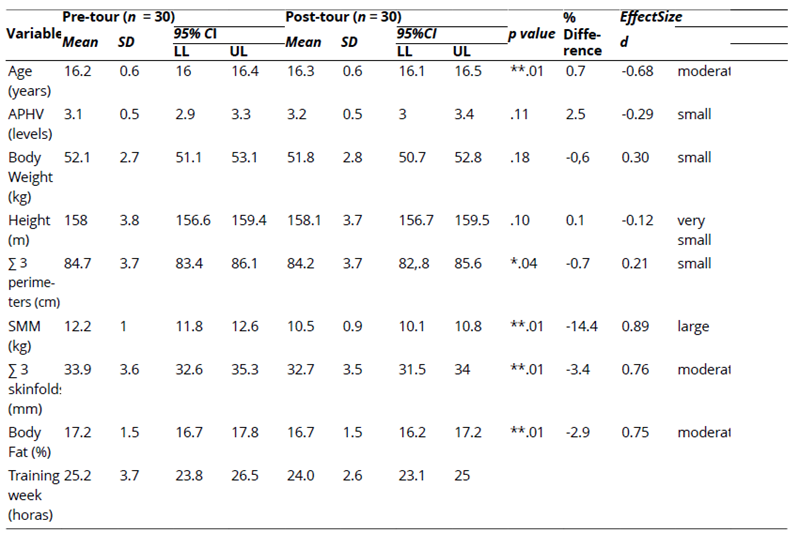
Note. APHV- peak growth velocity acceleration; SMM- skeletal muscle mass; *p< .05; **p< .01
Table 2 presents the mean, SD, 95% CI, % difference, t-test, and ES with Cohen's d for the pre- and post-tour comparison of stroke speed and muscle power. In the post-tour measurement, a significant decrease was observed in serve speed, forehand, and backhand (p<.01), with “large” ES in the serve (d=1.16) and “small” in the forehand (d=0.27) and backhand (d=0.46). In the muscle power, a significant reduction was also found after the tour in MBT (p<.01; ES: large, d=0.98), CMJ (p<.01; ES: large, d=0.86), and HJ (p<.01; ES: moderate, d=0.59).
Pre- and Post-Tour Stroke Speed and Muscle Power
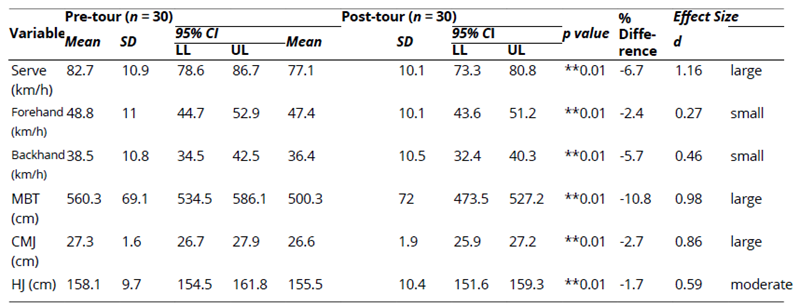
Note. MBT- Medicine ball throw; CMJ-Countermovement jump; HJ-Horizontal jump; *p< .05; **p< .01
Table 3 shows the mean values, SD,CI 95%, %difference, t-test, and ES (Cohen's d) for the pre- and post-tour comparison of body composition, stroke speed, and muscle power measurements in the “national ranking 1-20” and “national ranking 21-50” groups. Both groups showed a significant decrease (p<.01) with “large” ES in SMM (d= 1.28-1.63) and body fat (d=.81-0.88). In stroke speed, both groups reported a significant decrease in serve speed (p<.01) with “large” ES (d=1.12) in the “national ranking 1-20” group and “moderate” ES in the “national ranking 21-50” group (d=0.66). A significant loss was also observed in the backhand (p<0.01) with “moderate” ES in both groups (d=0.40-0.45). However, only the “national ranking 21-50” group showed a significant decrease in the forehand (p<.05) with “large” ES (d=0.92). Finally, both groups showed significant losses in MBT and CMJ (p<.01) with “moderate” to “large” ES (d= 0.45 to 1.69), as well as in HJ (p<.05; d=0.25 and 0.75).
Body Composition, Stroke Speed, and Muscle Power by National Ranking
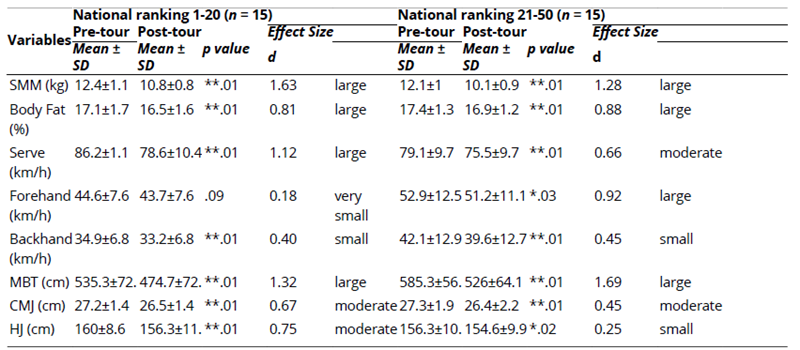
Note. SMM- skeletal muscle mass; MBT- Medicine ball throw; CMJ-Countermovement jump; HJ-Horizontal jump; *p< .05; **p< .01
Discussion
The study aimed to analyze changes in body composition, stroke speed, and muscle power in young Chilean female tennis players following a 5-week international tour. The results indicate that, after the international tour, the players showed decreases in ∑3 perimeters (p<.05; ES: small), SMM (p<.01; ES: large), ∑3 skinfolds, and body fat (p<.01; ES: moderate). Additionally, losses were observed in MBT (p<.01; large ES), CMJ (p<.01; ES: large), and HJ (p<.01; ES: moderate). Regarding stroke speed, decreases were recorded in all measurements, including serve (p<.01; ES: large), forehand, and backhand (p<.01; ES: moderate). In measurements based on national ranking, both groups of players showed significant losses in body composition (p<.01; ES: large), muscle power (p<.01 to 0.02; ES: small to large), and stroke speed (p<.01 to 0.03; ES: moderate to large), except for the forehand in the “national ranking 21-50” group (p<.05).
Post-tour measurements demonstrated significant decreases in the speed of all strokes (p<.01; d=0.27 to 1.16), although only the “national ranking 21-50” group showed a decrease in forehand speed (p<.05; d=0.92). These losses are consistent with the findings of Ojala and Häkkinen (2013), who reported that serve speed decreased significantly before the third match of a three-day tournament compared to the first. Other studies have shown that neuromuscular fatigue from long matches or consecutive-day matches reduces serve speed (Gallo-Salazar et al., 2019; Martin et al., 2016). Specifically, in the present study, the most significant loss of speed was observed in the serve (d=1.16; ES: large), a stroke that plays a decisive role in the game plan and in the drive to win points during matches (Bilić et al., 2023; Fernández-García et al., 2019; Fett et al., 2020; Fitzpatrick et al., 2019; Gillet et al., 2009). It should be noted that hitting a fast first serve offers a high percentage of points won, and that, in addition, on the second serve, it increases the chances of winning points, as it reduces the opponent's reaction time, along with making the ball more difficult to control on the return (Mecheri et al., 2016). Therefore, a decrease in stroke speed can affect the athletic development of female tennis players, as hitting with greater power has been reported as a characteristic of elite tennis players (Landlinger et al., 2012).
Following the international tour, significant losses (p<.01) were reported in all muscle power tests (CMJ, MBT, and HJ) with “moderate” to “large” ES (d= 0.59 to 0.98). These findings are consistent with similar studies suggesting that a five-week interruption of regular training is sufficient to significantly reduce muscle power (Kovacs et al., 2007; Luna-Villouta et al., 2024; Murphy et al., 2015). These results indicate that participation in consecutive, highly demanding tournaments leads to a high accumulation of neuromuscular fatigue, which is associatedwith impaired physical performance in explosive tasks in young tennis players and affects their ability to maintain the pace of play (Gallo-Salazar et al., 2017). Therefore, preparation for intense tournaments and prolonged travel away from training centers should focus on high-intensity, intermittent training, focusing on agility, speed, strength, and muscle power, which can help mitigate performance declines and meet the demands of challenging competitions (Barber-Westin et al., 2010; Fernandez-Fernandez et al., 2016; Gallo-Salazar et al., 2017; Murphy et al., 2015).
In post-tour assessments, the young female tennis players showed significant decreases in body fat and muscle mass (p<.01; d= 0.75 and 0.89, respectively). These results are consistent with the effects of a six-week international tour on young male tennis players, who showed significant losses in body fat and muscle tissue measurements (Luna-Villouta et al., 2023). However, these findings differ somewhat from a similar study conducted on Chilean junior female players, who reported a decrease in muscle mass, but unlike this study, they showed an increase in fat tissue and skinfolds, along with higher body weight values (Luna-Villouta et al., 2024). Additionally, body composition has been reported to be particularly sensitive to training loads in young tennis players (Sanchis-Moysi et al., 2011).Similarly, it is indicated that the hormonal profile plays a crucial role in adaptation to training and athletic competition (Findlay et al., 2020; Giménez-Blasi et al., 2022; Juillard et al., 2024), affecting body composition, with direct effects on muscle tissue and fat mass (Hansen & Kjaer, 2014; Malina et al., 2004; Sims et al., 2023). This highlights the complex trajectory in the development of body composition during adolescence in young athletes, influenced by various factors such as maturation, growth, nutrition, training, and competition (Lloyd et al., 2014; Malina & Geithner, 2011).
From a practical standpoint, it seems necessary to pay attention to preparation for multi-week international tours, focusing on neuromuscular and high-intensity training, particularly on strength and power, considering the variable and intermittent nature of the game, as well as the specific muscle involvement (Baiget, 2011), with the aim of maintaining athletic performance and successfully navigating prolonged competitions and travel (Barber-Westin et al., 2010; Gallo-Salazar et al., 2017; Luna-Villouta et al., 2024). Regarding power, speed, and accuracy of the serve have been shown to improve significantly after appropriate physical training (Deng et al., 2023). It also seems appropriate to develop training guidelines for non-competition days between championships (Luna-Villouta et al., 2023), along with specific recovery routines, such as the use of a foam roller, static stretching, and joint mobility exercises (Gallo-Salazar et al., 2017; Mohr et al., 2014), in addition to guidelines for balanced nutrition and adequate hydration with sports drinks between matches (Brink-Elfegoun et al., 2014). Therefore, our results offer valuable information for coaches when planning training and, especially, multi-week trips to international championships. Likewise, it is necessary to explore interventions that can improve the results in the variables evaluated.
This study has some limitations. The first is the absence of a control group, made up of players of a similar competitive level who did not participate in the international tour, which would have allowed us to rule out the influence of unmeasured physical, biological, or mental factors. Other limitations include the homogeneity of the tennis players evaluated in terms of age, gender, and race. Among the study's strengths is the scarcity of similar follow-up studies for both male and female tennis players. Furthermore, the use of reliable, readily applicable measurements enables replicating these assessments on multiple occasions and/or with larger groups.
Conclusions
Based on the findings of this study, we concluded that, after a five-week international tour, the young female tennis players showed a significant decrease in serve speed, forehand, backhand, MBT, CMJ, and HJ. In addition, reductions in body fat and SMM were recorded. These results highlight the need to prioritize physical and technical training on all aspects related to stroke speed and muscle power before and during international tours to improve athletic performance. Similarly, the value of monitoring the specific variation of each parameter studied is underscored, as this can provide a deeper understanding of the level of change for each player.
Ethics Committee Statement
The study was conducted in accordance with the Declaration of Helsinki and was approved by the Ethics Committee: Universidad San Sebastián, Chile (USS 51-2018-20; January 9, 2019).
Conflict of Interest Statement
The authors declare no conflict of interest.
Funding
This research received no funding.
Acknowledgements
We thank all the athletes and their coaches for their participation in the project.
Authors' Contribution
Conceptualization, P.L.-V., C.M.-C., C.M.S., M.A.-R., M.C.-R. R.V.V. and C.F.-R.; Methodology, P.L.-V., C.M.-C., C.M.S., M.P.-A., C.F.-C., J.V.-G., and R.V.-V.; Validation P.L.-V., M.A.-R., M.C.-R., C.F.-R., C.M.-C. and C.M.S.; Formal Analysis, P.L.-V., J.V.-G., C.F.-C., M.A.-R., C.H.-M. and C.F.-R.; Investigation P.L.-V., M.P.-A., C.F.-R., M.A.-R., C.H.-M. and R.V.-V.; Resources, P.L.-V., M.P.-A., C.M.S., C.M.-C., R.V.V, M.C.-R., C.F.-C. and C.F.-R.; Data Curation, P.L.-V., C.M.-C., J.V.-G., C.F.-C., C. H.-M. and R.V.-V.; Writing—Original draft preparation, P.L.-V., C.M.-C., C.M.S., M.A.-R., C.H.-M., M.P.-A., and R.V.-V.; Writing—Review and Editing, P.L.-V., C.M.-C., C.F.-R., M.A.-R., C.H.-M., M.C.-R., C.F.-C., J.V.-G. and R.V.-V. Visualization P.L.-V., C.M.-C., C.H.-M., M.C.-R., C.F.-C., C.M.S, M.A.-R. and R.V.V.; Supervision, P.L.-V., C.M.-C., C.M.S., C.F.-C., M.C.-R., J.V.-G. and R.V.-V.; Project Administration, P.L.-V., M.P.-A. and R.V.V. All authors have read and agreed to the published version of the manuscript.
Data Availability Statement
Data available upon request from the corresponding author pabloluna@udec.cl
References
Baiget, E. (2011). Metodología del entrenamiento de la resistencia específica en el tenis de competición. Revisión y propuesta. Cultura, Ciencia y Deporte, 6(16), 45-54. https://doi.org/10.12800/ccd.v6i16.34
Barber-Westin, S. D., Hermeto, A. A., & Noyes, F. R. (2010). A six-week neuromuscular training program for competitive junior tennis players. Journal of Strength and Conditioning Research, 24(9), 2372-2382. https://doi.org/10.1519/JSC.0b013e3181e8a47f
Bilić, Z., Sinković, F., Barbaros, P., Novak, D., & Zemkova, E. (2023). Exercise-induced fatigue impairs change of direction performance and serve precision among young male tennis players. Sports, 11(6), 111. https://doi.org/10.3390/sports11060111
Bosco, C., & Padulles, J. (1994). La valoración de la fuerza con el test de Bosco. Paidotribo.
Brink-Elfegoun, T., Ratel, S., Leprêtre, P.-M., Metz, L., Ennequin, G., Doré, E., Martin, V., Bishop, D., Aubineau, N., Lescuyer, J.-F., Duclos, M., Sirvent, P., & Peltier, S. L. (2014). Effects of sports drinks on the maintenance of physical performance during 3 tennis matches: A randomized controlled study. Journal of the International Society of Sports Nutrition, 11(1). https://doi.org/10.1186/s12970-014-0046-7
Cohen, J. (2009). Statistical power analysis for the behavioral sciences (2. ed., reprint). Psychology Press.
Colomar, J., Baiget, E., & Corbi, F. (2020). Influence of strength, power, and muscular stiffness on stroke velocity in junior tennis players. Frontiers in Physiology, 11, 196. https://doi.org/10.3389/fphys.2020.00196
Deng, N., Soh, K. G., Abdullah, B., Huang, D., Sun, H., & Xiao, W. (2023). Effects of physical training programs on female tennis players’ performance: A systematic review and meta-analysis. Frontiers in Physiology, 14. https://www.frontiersin.org/articles/10.3389/fphys.2023.1234114
Fernandez-Fernandez, J., De Villarreal, E. S., Sanz-Rivas, D., & Moya, M. (2016). The effects of 8-week plyometric training on physical performance in young tennis players. Pediatric Exercise Science, 28(1), 77-86. https://doi.org/10.1123/pes.2015-0019
Fernandez-Fernandez, J., Sanz-Rivas, D., & Mendez-Villanueva, A. (2009). A review of the activity profile and physiological demands of tennis match play. Strength & Conditioning Journal, 31(4), 15-26. https://doi.org/10.1519/SSC.0b013e3181ada1cb
Fernández-García, Á. I., Blanca-Torres, J. C., Hernández-García, R., & Torres-Luque, G. (2019). Análisis de las variables estadísticas relacionadas con el servicio en tenis masculino de alto rendimiento en categoría junior y absoluto. Cultura, Ciencia y Deporte, 14(42), 289-295. https://doi.org/10.12800/ccd.v14i42.1342
Fett, J., Ulbricht, A., & Ferrauti, A. (2020). Impact of physical performance and anthropometric characteristics on serve velocity in elite junior tennis players. Journal of Strength and Conditioning Research, 34(1), 192-202. https://doi.org/10.1519/JSC.0000000000002641
Findlay, R. J., Macrae, E. H. R., Whyte, I. Y., Easton, C., & Forrest, L. J. (2020). How the menstrual cycle and menstruation affect sporting performance: Experiences and perceptions of elite female rugby players. British Journal of Sports Medicine, 54(18), 1108-1113. https://doi.org/10.1136/bjsports-2019-101486
Fitzpatrick, A., Stone, J. A., Choppin, S., & Kelley, J. (2019). Important performance characteristics in elite clay and grass court tennis match-play. International Journal of Performance Analysis in Sport, 19(6), 942-952. https://doi.org/10.1080/24748668.2019.1685804
Fleming, J. A., Field, A., Lui, S., Naughton, R. J., & Harper, L. D. (2023). The demands of training and match-play on elite and highly trained junior tennis players: A systematic review. International Journal of Sports Science & Coaching, 18(4), 1365-1376. https://doi.org/10.1177/17479541221102556
Gallo-Salazar, C., Del Coso, J., Barbado, D., Lopez-Valenciano, A., Santos-Rosa, F. J., Sanz-Rivas, D., Moya, M., & Fernandez-Fernandez, J. (2017). Impact of a competition with two consecutive matches in a day on physical performance in young tennis players. Applied Physiology, Nutrition, and Metabolism, 42(7), Article 7. https://doi.org/10.1139/apnm-2016-0540
Gallo-Salazar, C., Del Coso, J., Sanz-Rivas, D., & Fernandez-Fernandez, J. (2019). Game activity and physiological responses of young tennis players in a competition with two consecutive matches in a day. International Journal of Sports Physiology and Performance, 14(7), 887-893. https://doi.org/10.1123/ijspp.2018-0234
Gillet, E., Leroy, D., Thouvarecq, R., & Stein, J.-F. (2009). A notational analysis of elite tennis serve and serve-return strategies on slow surface. The Journal of Strength & Conditioning Research, 23(2), 532-539. https://doi.org/10.1519/JSC.0b013e31818efe29
Giménez-Blasi, N., Latorre, J. A., Martínez-Bebia, M., Sáenz, M., Cantero, L., López-Moro, A., Jimenez-Casquet, M. J., Conde-Pipo, J., & Mariscal-Arcas, M. (2022). Menstrual Cycle and Sport: Effects on the performance and metabolism of the athlete woman. Retos. Nuevas Tendencias en Educación Físicas, Deportes y Recreacióm, 46, 565-572. https://doi.org/10.47197/retos.v46.94614
Hansen, M., & Kjaer, M. (2014). Influence of sex and estrogen on musculotendinous protein turnover at rest and after exercise. Exercise and Sport Sciences Reviews, 42(4), 183-192. https://doi.org/10.1249/JES.0000000000000026
Hernández-Belmonte, A., & Sánchez-Pay, A. (2021). Concurrent validity, inter-unit reliability and biological variability of a low-cost pocket radar for ball velocity measurement in soccer and tennis. Journal of Sports Sciences, 39(12), 1312-1319. https://doi.org/10.1080/02640414.2020.1868090
Hughes, W., Healy, R., Lyons, M., Nevill, A., Higginbotham, C., Lane, A., & Beattie, K. (2023). The effect of different strength training modalities on sprint performance in female team-sport athletes: A systematic review and meta-analysis. Sports Medicine, 53(5), 993-1015. https://doi.org/10.1007/s40279-023-01820-5
Juillard, E., Douchet, T., Paizis, C., & Babault, N. (2024). Impact of the menstrual cycle on physical performance and subjective ratings in elite academy women soccer players. Sports, 12(1), 16. https://doi.org/10.3390/sports12010016
Keller, M., Kuhn, Y.-A., Lüthy, F., & Taube, W. (2021). How to serve faster in tennis: The influence of an altered focus of attention and augmented feedback on service speed in elite players. The Journal of Strength & Conditioning Research, 35(4), 1119-1126. https://doi.org/10.1519/JSC.0000000000002899
Kovacs, M. S., Pritchett, R., Wickwire, P. J., Green, J. M., & Bishop, P. (2007). Physical performance changes after unsupervised training during the autumn/spring semester break in competitive tennis players. British Journal of Sports Medicine, 41(11), 705-710. https://doi.org/10.1136/bjsm.2007.035436
Kovalchik, S. A., & Reid, M. (2017). Comparing matchplay characteristics and physical demands of junior and professional tennis athletes in the era of big data. Journal of Sports Science & Medicine, 16(4), 489-497. https://www.ncbi.nlm.nih.gov/pmc/articles/PMC5721178/
Lambrich, J., & Muehlbauer, T. (2023). Effects of athletic training on physical fitness and stroke velocity in healthy youth and adult tennis players: A systematic review and meta-analysis. Frontiers in Sports and Active Living, 4. https://www.frontiersin.org/articles/10.3389/fspor.2022.1061087
Landlinger, J., Stöggl, T., Lindinger, S., Wagner, H., & Müller, E. (2012). Differences in ball speed and accuracy of tennis groundstrokes between elite and high-performance players. European Journal of Sport Science, 12(4), 301-308. https://doi.org/10.1080/17461391.2011.566363
Li, Y., & Wang, J. (2023). Measurement index system of specific physical training for tennis athletes. Revista Brasileira de Medicina Do Esporte, 29(3), e2022_0668. https://doi.org/10.1590/1517-8692202329012022_0668
Lloyd, R. S., Oliver, J. L., Faigenbaum, A. D., Myer, G. D., & De Ste Croix, M. B. A. (2014). Chronological age vs. biological maturation: Implications for exercise programming in youth. Journal of Strength and Conditioning Research, 28(5), 1454-1464. https://doi.org/10.1519/JSC.0000000000000391
López-Martín, E., & Ardura-Martínez, D. (2023). El tamaño del efecto en la publicación científica. Educación XX1, 26(1), 9-17. https://doi.org/10.5944/educxx1.36276
Luna-Villouta, P., Contreras, L. V., Salazar, C. M., Valderrama, J. F., Matus-Castillo, C., Flores-Rivera, C., Paredes-Arias, M., & Vargas-Vitoria, R. (2024). Changes in body composition and physical performance after a six-week international tour in young chilean female tennis players. Sports, 12(3), 78. https://doi.org/10.3390/sports12030078
Luna-Villouta, P., Paredes-Arias, M., Flores-Rivera, C., Hernández-Mosqueira, C., Vásquez-Gómez, J., Matus-Castillo, C., Zapata-Lamana, R., Faúndez-Casanova, C., Jofré Hermosilla, N., Villar-Cavieres, N., & Vargas-Vitoria, R. (2023). Effects of a six-week international tour on the physical performance and body composition of young chilean tennis players.International Journal of Environmental Research and Public Health, 20(2), 1455. https://doi.org/10.3390/ijerph20021455
Luna-Villouta, P., Leao Ribeiro, I., Faúndez-Casanova, C., Vásquez-Gómez, J., Flores-Rivera, C., & Vitoria, R. V. (2022). Intra-rater and intraday test-retest reliability for physical performance tests in young Chilean tennis players. Cultura, Ciencia y Deporte, 17(53), 89-97. https://doi.org/10.12800/ccd.v17i53.1853
Malina, R. M., Bouchard, C., & Bar-Or, O. (2004). Growth, maturation, and physical activity (2nd ed). Human Kinetics.
Malina, R. M., & Geithner, C. A. (2011). Body composition of young athletes. American Journal of Lifestyle Medicine, 5(3), Article 3. https://doi.org/10.1177/1559827610392493
Marfell-Jones, M. J., Stewart, A. D., & de Ridder, J. H. (2012). International standards for anthropometric assessment. International Society for the Advancement of Kinanthropometry. http://hdl.handle.net/11072/1510
Martin, C., Kulpa, R., Ezanno, F., Delamarche, P., & Bideau, B. (2016). Influence of playing a prolonged tennis match on shoulder internal range of motion. The American Journal of Sports Medicine, 44(8), 2147-2151. https://doi.org/10.1177/0363546516645542
Mecheri, S., Rioult, F., Mantel, B., Kauffmann, F., & Benguigui, N. (2016). The serve impact in tennis: First large-scale study of big Hawk-Eye data. Statistical Analysis and Data Mining: The ASA Data Science Journal, 9(5), 310-325. https://doi.org/10.1002/sam.11316
Mohr, A. R., Long, B. C., & Goad, C. L. (2014). Effect of foam rolling and static stretching on passive hip-flexion range of motion. Journal of Sport Rehabilitation, 23(4), 296-299. https://doi.org/10.1123/jsr.2013-0025
Moore, S. A., Mckay, H. A., Macdonald, H., Nettlefold, L., Baxter-Jones, A. D. G., Cameron, N., & Brasher, P. M. A. (2015). Enhancing a somatic maturity prediction model. Medicine & Science in Sports & Exercise, 47(8), 1755-1764. https://doi.org/10.1249/MSS.0000000000000588
Morais, J. E., Kilit, B., Arslan, E., Soylu, Y., & Neiva, H. P. (2024). Effects of a 6-week on-court training program on the International Tennis Number (ITN) and a range of physical fitness characteristics in young tennis players. Frontiers in Sports and Active Living, 6. https://doi.org/10.3389/fspor.2024.1304073
Murphy, A. P., Duffield, R., Kellett, A., & Reid, M. (2015). The relationship of training load to physical-capacity changes during international tours in high-performance junior tennis players. International Journal of Sports Physiology and Performance, 10(2), 253-260. https://doi.org/10.1123/ijspp.2014-0038
Ojala, T., & Häkkinen, K. (2013). Effects of the tennis tournament on players’ physical performance, hormonal responses, muscle damage and recovery. Journal of Sports Science & Medicine, 12(2), 240-248. https://www.ncbi.nlm.nih.gov/pmc/articles/PMC3761840/
Parpa, K., Michaelides, M., Petrov, D., Kyrillou, C., & Paludo, A. C. (2023). Relationship between physical performance, anthropometric measurements and stroke velocity in youth tennis players. Sports, 11(1), 7. https://doi.org/10.3390/sports11010007
Poortmans, J., Boisseau, N., Moraine, J.-J., Moreno-Reyes, R., & Goldman, S. (2005). Estimation of total-body skeletal muscle mass in children and adolescents. Medicine & Science in Sports & Exercise, 37(2), 316-322. https://doi.org/10.1249/01.MSS.0000152804.93039.CE
Reid, M., Morgan, S., & Whiteside, D. (2016). Matchplay characteristics of Grand Slam tennis: Implications for training and conditioning. Journal of Sports Sciences, 34(19), 1791-1798. https://doi.org/10.1080/02640414.2016.1139161
Rodríguez-Cayetano, A. R., Martín, Ó. M., Merchán, F. H., & Muñoz, S. P. (2022). Carga interna y externa en el tenis de competición: Comparación de tres tipos de entrenamiento. Retos. Nuevas Tendencias en Educación Física, Deportes y Recreación, 44, 534-541. https://doi.org/10.47197/retos.v44i0.90583
Sánchez-Pay, A., Ramón-Llin, J., Martínez-Gallego, R., Sanz-Rivas, D., Sánchez-Alcaraz, B. J., & Frutos, S. (2021). Fitness testing in tennis: Influence of anthropometric characteristics, physical performance, and functional test on serve velocity in professional players. PLoS ONE, 16(11), e0259497. https://doi.org/10.1371/journal.pone.0259497
Sanchis-Moysi, J., Dorado, C., Arteaga-Ortiz, R., Serrano-Sanchez, A. J., & Calbet, J. A. (2011). Effects of training frequency on physical fitness in male prepubertal tennis players. The Journal of Sports Medicine and Physical Fitness, 51(3), 409-416. https://www.minervamedica.it/en/journals/sports-med-physical-fitness/article.php?cod=R40Y2011N03A0409
Sims, S. T., Kerksick, C. M., Smith-Ryan, A. E., Janse de Jonge, X. A. K., Hirsch, K. R., Arent, S. M., Hewlings, S. J., Kleiner, S. M., Bustillo, E., Tartar, J. L., Starratt, V. G., Kreider, R. B., Greenwalt, C., Rentería, L. I., Ormsbee, M. J., VanDusseldorp, T. A., Campbell, B. I., Kalman, D. S., & Antonio, J. (2023). International society of sports nutrition position stand: Nutritional concerns of the female athlete. Journal of the International Society of Sports Nutrition, 20(1). https://doi.org/10.1080/15502783.2023.2204066
Slaughter, M. H., Lohman, T. G., Boileau, R. A., Horswill, C. A., Stillman, R. J., Loan, M. D. V., & Bemben, D. A. (1988). Skinfold equations for estimations of body fatness in children and youth. Human Biology, 60(5), Article 5. https://www.jstor.org/stable/41464064
Smekal, G., von Duvillard, S. P., Rihacek, C., Pokan, R., Hofmann, P., Baron, R., Tschan, H., & Bachl, N. (2001). A physiological profile of tennis match play. Medicine and Science in Sports and Exercise, 33(6), 999-1005. https://doi.org/10.1097/00005768-200106000-00020
Ulbricht, A., Fernandez-Fernandez, J., Mendez-Villanueva, A., & Ferrauti, A. (2016). Impact of fitness characteristics on tennis performance in elite junior tennis players. Journal of Strength and Conditioning Research, 30(4), 989-998. https://doi.org/10.1519/JSC.0000000000001267
Vanhelst, J., Béghin, L., Fardy, P. S., Ulmer, Z., & Czaplicki, G. (2016). Reliability of health-related physical fitness tests in adolescents: The MOVE Program. Clinical Physiology and Functional Imaging, 36(2), 106-111. https://doi.org/10.1111/cpf.12202
World Medical Association. (2013). World Medical Association Declaration of Helsinki: Ethical Principles for Medical Research Involving Human Subjects. JAMA, 310(20), 2191-2194. https://doi.org/10.1001/jama.2013.281053
Author notes
a Correspondence: Pablo Luna-Villouta, pabloluna@udec.cl
Additional information
Short title: Impact of an International Tour on Young Female Tennis Players
How to cite this article: Luna-Villouta, P., Matus-Castillo, C., Flores-Rivera, C., Martínez Salazar, C., Alarcón-Rivera, M., Faúndez-Casanova, C., Castillo-Retamal, M., Vásquez-Gómez, J., Hernández-Mosqueira, C., Paredes-Arias, M. & Vargas-Vitoria, R. (2026). Impact of a five-week international tour on the stroke speed, muscle power and body composition in young Chilean female tennis players. Cultura, Ciencia y Deporte, 21(67), 2332. https://doi.org/10.12800/ccd.v21i67.2332


