
COMPARATIVE ANALYSIS OF PHYSICAL AND PHYSIOLOGICAL PROFILES IN ELITE JUNIOR AND PROFESSIONAL CYCLISTS
ANÁLISIS COMPARATIVO DE PERFILES FÍSICOS Y FISIOLÓGICOS EN CICLISTAS DE ÉLITE JÚNIOR Y PROFESIONAL


Fernando Rocha, Ana Conceição, M. Isidoro, Daniel Marinho, Pedro Forte, D. Torres, Hugo Louro
COMPARATIVE ANALYSIS OF PHYSICAL AND PHYSIOLOGICAL PROFILES IN ELITE JUNIOR AND PROFESSIONAL CYCLISTS
Cultura, Ciencia y Deporte, vol. 21, no. 67, 2026, 10.12800/ccd.v21i67.2310
Universidad Católica San Antonio de Murcia
Fernando Rocha a
Sport Sciences School of Rio Maior, Portugal
Ana Conceição
Research Center in Sports Science, Health and Human Development, Portugal
University of Beira Interior, Portugal
M. Isidoro
Sport Sciences School of Rio Maior, Portugal
Daniel Marinho
Research Center in Sports Science, Health and Human Development, Portugal
University of Beira Interior, Portugal
Pedro Forte
Research Center in Sports Science, Health and Human Development, Portugal
Higher Institute of Educational Sciences of the Douro, Portugal
Instituto Politécnico de Bragança, Portugal
D. Torres
Sport Sciences School of Rio Maior, Portugal
Hugo Louro
Sport Sciences School of Rio Maior, Portugal
Research Center in Sports Science, Health and Human Development, Portugal
Received: 01 September 2024
Accepted: 21 July 2025
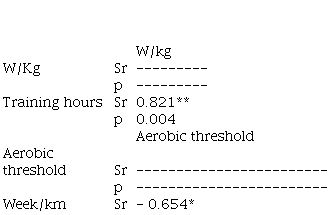
Abstract: The aim of this study was to compare the profile of junior high-level cyclists with senior professional cyclists relating to the physical and physiological fitness. Two male groups (juniors and professionals), each with 10 athletes (n = 20), carried out a five-minute effort levels test of increment in watts, starting at 150 watts and increasing 50 watts at each level until 450 watts. At the end of each five minutes, blood samples, heart rate, pedaling cadence, perceived subjective effort, and maximal power were collected. The variable W/kg showed no statistically significant differences between juniors and professionals. For lactate, differences were found between junior professionals for levels of 200 W (U = 13.00; p = 0.005), 250 W (U = 13.50; p = 0.006), and 300 W (U = 8.50; p = 0.002). For the aerobic threshold, the M-W test (U = 17.50; p = 0.015) detected differences. As for the anaerobic threshold, significant differences were found between groups (U = 3.50; p < 0.001). Analyzing average training intensity as measured by average heart rate, the same difference remains between groups (U = 10.00; p = 0.003). For the correlations in the junior group, it was found that there is a strong and significant correlation (r = 0.821; p = 0.004) between the performance determinant W/Kg and the number of hours of training, as well as a moderate and inverse correlation between the aerobic threshold and the number of kilometers performed per week (r = -0.654; r = 0.002). There were no correlations between variables in the group of professionals. Significant differences were observed in aerobic and anaerobic thresholds, lactate accumulation, and heart rate responses, reinforcing the physiological gap between junior and professional cyclists. We conclude that the juniors in this sample still have lower physiological performance than their professional peers, and the variable that does not show differences between the two groups is the pedaling cadence. These findings emphasize the need for targeted training programs tailored to junior cyclists, focusing on improving their physiological thresholds to facilitate a smoother transition to professional levels.
Keywords: Cycling, exercise thresholds, levels, physiological performance.
Resumen: El objetivo de este estudio fue comparar el perfil de ciclistas de nivel junior y profesional en relación con la condición física y fisiológica. Dos grupos masculinos (juniors y profesionales) cada uno con 10 atletas (n = 20) realizaron una prueba de cinco minutos de niveles de esfuerzo de incremento en vatios, comenzando en 150 vatios y aumentando 50 vatios en cada nivel hasta los 450 vatios. Al final de cada cinco minutos, se recogieron muestras de sangre, frecuencia cardíaca, cadencia de pedaleo, esfuerzo subjetivo percibido y potencia máxima. La variable W/kg no mostró diferencias estadísticamente significativas entre juniors y profesionales. Para el lactato, se encontraron diferencias entre los junior-profesionales para niveles de 200 W (U = 13,00; p = 0,005), 250 W (U = 13,50; p = 0,006) y para 300 W (U = 8,50; p = 0,002). Para el umbral aeróbico, el test M-W (U = 17,50; p = 0,015) detectó diferencias. En cuanto al umbral anaeróbico, se encontraron diferencias significativas entre grupos (U = 3,50; p < 0,001). Analizando la intensidad media del entrenamiento medida por la frecuencia cardíaca media, se mantiene la misma diferencia entre grupos (U = 10,00; p = 0,003). Para las correlaciones en el grupo junior, se encontró que existe una correlación fuerte y significativa (r = 0,821; p = 0,004) entre el determinante de rendimiento W/Kg y el número de horas de entrenamiento, así como una correlación moderada e inversa entre el umbral aeróbico y el número de kilómetros realizados por semana (r = -0,654; r = 0,002). No hubo correlaciones entre variables en el grupo de profesionales. Se observaron diferencias significativas en los umbrales aeróbicos y anaeróbicos, la acumulación de lactato y las respuestas de la frecuencia cardíaca, lo que refuerza la brecha fisiológica entre ciclistas jóvenes y profesionales. Concluimos que los juniors de esta muestra aún presentan un rendimiento fisiológico inferior al de sus pares profesionales, y la variable que no muestra diferencias entre ambos grupos es la cadencia de pedaleo. Estos hallazgos enfatizan la necesidad de contar con programas de entrenamiento específicos adaptados a los ciclistas jóvenes, centrados en mejorar sus umbrales fisiológicos para facilitar una transición más suave a los niveles profesionales.
Palabras clave: Ciclismo, niveles, rendimiento fisiológico, umbrales de ejercicio.
Introduction
A critical aspect of youth training in cycling revolves around the development of a structured model to equip young cyclists for the challenges of professional cycling (Bergeron et al., 2015). This preparation often involves selecting specific variables to measure training load and intensity, aiming for physiological adaptations that facilitate performance improvements (Bergeron et al., 2015). Coaches and young cyclists, around the age of 17, begin to contemplate the transition to professional levels, highlighting the importance of predicting future performance in long-term sports development (Bergeron et al., 2015). Comparisons between junior and professional cyclists are common, shedding light on the progression from youth to elite levels (Bergeron et al., 2015). Research has shown that heavy strength training can enhance running and cycling performance, particularly in well-trained female athletes, by improving the cycling economy and reducing physiological strain during submaximal work (Vikmoen et al., 2017). Furthermore, the effects of strength training on cycling performance have been investigated with attention to potential differences between male and female cyclists (Vikmoen & Rønnestad, 2021). Understanding the impact of strength training on cycling performance is crucial for optimizing training programs tailored to individual needs and physiological differences (Vikmoen & Rønnestad, 2021). Moreover, longitudinal studies have indicated that alterations in pulmonary oxygen kinetics during exercise in competitive youth cyclists are linked to changes in the balance between microvascular oxygen distribution and muscular oxygen utilization, suggesting a trainable on-kinetic response in youth athletes (Hovorka et al., 2022). Additionally, the importance of performance in youth competitions as a predictor of future success in cycling has been highlighted, emphasizing the role of continued participation and success at the youth level in shaping athletes' physical and biological development (Mostaert et al., 2021). While previous research has examined various physiological aspects of professional cyclists, limited studies have directly compared elite juniors and professionals under a structured protocol, making this study a novel contribution to talent development strategies in cycling.
To develop an effective training program, it is essential to conduct evaluations to assess the athlete's capabilities in their specific sport (Haugen et al., 2021). These evaluations provide crucial data for tailoring individualized training prescriptions and optimizing the practical application of the results (Haugen et al., 2021). Selecting the appropriate training load is emphasized as a fundamental aspect of the training process, requiring a deep understanding of the athlete's current condition, the nature of their specialty, and the personalized objectives set forth (Kraemer & Ratamess, 2004). Research by Costa, Nakamura & Oliveira (2007) highlighted the importance of structured training programs by revealing that a significant number of Brazilian road and cross-country cyclists lack a formalized training regimen (Chorley & Lamb, 2020). The study indicated that only a minority of athletes undergo evaluations, and fewer utilize the results to guide their training, underscoring the need for a more systematic approach to training program development (Chorley & Lamb, 2020). Moreover, individualizing training prescriptions has been acknowledged as a key factor in enhancing athletic performance and ensuring optimal training outcomes (Cardinale & Varley, 2017). By tailoring training programs to individual physiological responses and needs, improvements in performance and overall physical conditioning can be achieved (Cardinale & Varley, 2017). Understanding the unique responses of athletes to standardized training programs is crucial, as factors such as training status, recovery capacity, and individual variations can significantly impact training effectiveness (Szyszka et al., 2022). By considering individual differences and responses to training stimuli, coaches and practitioners can better optimize training programs to elicit desired physiological and performance adaptations (Szyszka et al., 2022).
Recent studies have emphasized the importance of evaluating power-to-weight ratios and anaerobic power peaks in young cyclists as indicators of well-developed aerobic and anaerobic systems, reflecting the demanding physiological nature of cycling Fornasiero et al. (2017). Additionally, research has indicated that the time spent in specific training zones by youth and junior cyclists during stage races is similar to that of professional cyclists, highlighting the comparable physiological demands of their races and the relationship between exercise load and race duration (Hargens & Vico, 2016; Li et al., 2016). Physiological parameters such as aerobic threshold, ventilatory threshold, and variables like watts, heart rate, maximal oxygen consumption, and lactate concentrations have been recognized as valuable predictors of performance in long-duration exercise (Vanhatalo et al., 2011). Furthermore, factors such as power associated with blood lactate profiles, chronological age, and peak height velocity play a crucial role in determining race outcomes, underscoring the significance of physiological tests in measuring performance predictors and guiding training prescription and monitoring (Rønnestad et al., 2020). Moreover, individualized physiological testing has been recommended to optimize training effects and performance outcomes in cyclists (Lee et al., 2002). By customizing training programs based on individual physiological responses and performance predictors, coaches can improve training effectiveness and facilitate performance enhancements (Hug et al., 2010). The interplay between physiological parameters, performance predictors, and training effects is essential for developing tailored training programs that address the unique needs and responses of each athlete (Macaluso & Vito, 2003). Understanding these differences is crucial for developing training programs that prepare young cyclists for professional competition.
Regarding the abovementioned information. This study aims to understand the differences in the fitness profile of young cyclists, who are 16-17 years old, like the juniors, compared to the seniors’ professional cyclists. Intends to verify if elite junior cyclists have physical (weight, % Body fat; number of hours and km per week in training) and physiological (blood lactate concentrations, aerobic and anaerobic threshold, pedaling cadence, heart rate, and weight/watts ratio) performance values, similar to professional cyclists during a specific protocol. Thus, it was hypothesized that elite junior cyclists would exhibit similar power-to-weight ratios but lower physiological thresholds compared to professionals. The results will provide insights into training adaptations required for junior cyclists to reach professional standards, aiding coaches in optimizing training plans.
Material and Methods
Participants
The sample was composed of two groups (juniors and professionals), each with 10 athletes (n = 20). The professional cyclists were aged 26.40 ± 3.98 years and the juniors 16.70 ± 0.48 years. Both groups regularly participated in high-level professional competitions and high-level junior competitions. To avoid cumulative fatigue, subjects were asked not to perform high-intensity training or any competitions two days before the tests (Gardner et al., 2004). Informed consent was provided to all subjects explaining the risks and benefits of the study. The Ethics Committee of the seeding Institution gave their approval on all the procedures which were under the Helsinki Declaration.
Procedures
Instrumentation
The tests were performed individually for each subject. Each cyclist used their bike, so there was no need for adjustments since the measurements were already adequate for their height, which led to the use of various bikes of different brands. All athletes used the roller (Tacx Flow, Wassenaar, Holland), which automatically reads the watts of the pedaling cadence of each cyclist in real time. Anthropometric data (body mass and height) were collected using a Tanita (BC-50) brand scale. The % body fat mass was assessed by measuring six skin folds with the Skinfold Caliper Slim Guide Plicometer (Ref knf-7804). We also used a Lactate Pro meter (Arkray Factory, Inc, Shiga, Japan) for lactate collection. The lactate concentration and heart rate are widely recognized indicators of endurance performance, with previous studies demonstrating their reliability in assessing aerobic and anaerobic thresholds in cyclists (Billat, 1996; Pallarés et al., 2016). Lastly, for the subjective effort scale, a table from 0 to 10 was used which indicated the value corresponding to the fatigue that the athlete was feeling at the moment that the question was asked. The highest number corresponded to the highest fatigue level.
Maximum Discontinuous Test
Athletes were instructed to maintain their dietary intake before the test. The protocol started after the adaptation period, with a 6-minute progressive test set at 150 W initial load and 50 W increases at each round/level (Amann et al., 2006). The last cycle was performed at maximum intensity, leading to exhaustion in some athletes, if they reached maximum aerobic power. The test was discontinuous, and recovery intervals were set at one recovery between each plateau. During recovery, the athletes were advised to relax as much as they could without being allowed to drink water or ingest mineral salts.
The power of each round was controlled by the subject and the supervising technician on the Tackx equipment monitor, placed on the handlebars of the bicycle, which simultaneously gave instant and average information of the power produced by the cyclist on the Garmin 500 monitor. Each stage included a one-minute passive recovery period to prevent excessive fatigue accumulation. The test was terminated when cyclists were unable to maintain a cadence above 60 rpm, reached an RPE of 10, and had a maximal heart rate plateau.
Evaluation Procedures
Before the tests were performed, it was important to certify that all athletes had the correct intake of carbohydrates so that they could perform without energy breakdowns at the time of the physical evaluation. According to Flynn et al. (2020), the recommended dose is 1.6 g kg-1 so that the athletes can arrive with the necessary freshness indexes for the physical test. For that, the athletes were instructed to record their dietary intake for the 48 hours preceding the test, and compliance was monitored through a standardized questionnaire completed before testing. In the 48 hours before, athletes had two soft training sessions with about 2 hours of moderate training, to guarantee the predisposition of the body to the maximum effort test. On the day, primarily was taken anthropometric measurements, collecting the percentage of fat mass with an adipometer, of all the subjects divided by age group. The protocol used was the Yuhasz protocol, which recommends measuring the 6 skinfolds, corresponding to crural, geminal, subscapular, and suprailiac, and secondly, setting, the weight measurement with the athletes barefoot and only with their cycling shorts on. After that, the physical evaluation began with a warm-up of ten minutes. This warm-up protocol was set at 85-95 cadence comfortably in zone 1 just to cause mild muscle activation and increase body temperature. The physical evaluation started with a 150w plateau during the defined time of five minutes. After five minutes, it was collected the respective values to be analyzed, which are: pedaling cadence, blood lactate, rating perceived exertion, weight-power ratio, and maximum anaerobic power. Then, increased the power up to 200w with the same procedure and with the same collections. The only difference between all the levels was the collection of blood lactate. In the first level, it was not collected because it was still very low intensity for the level of the athletes (Pallarés et al., 2016) and there wasn’t an accumulation of any lactic acid, so it was decided to start the collection of blood lactate in the second level at 200w. The same procedure was repeated until the 450w plateau. This last step didn't coincide with the end of the test so that all physiological values could decrease, especially heart rate and blood pressure. The athletes continued pedaling for ten minutes before being allowed to finish the test and go to the locker room.
Blood Lactate
The earlobe was disinfected with alcohol and cotton, and after drying it, the earlobe was lanced with a OneTouch SureSoft disposable lancet (LifeScan Inc, Issy-les-Moulineaux, France). With the lactate reactive strip (Arkray Factory, Inc, Shiga, Japan) already inserted into the Lactate Pro analyzer (Arkray Factory, Inc, Shiga, Japan) (Pyne et al., 2000), the lobe was lightly pressed until a small drop of blood formed, which was collected through the reactive strip. When the blood sample fills the required space indicated on the reactive strip, the equipment starts the analysis, which lasts 60 seconds. Once the collection was done, the earlobe was cleaned to not leave any traces of sweat
Rating Perceived Exertion Scale (RPE)
The Rating of the Perceived Exertion Scale (RPE) was measured using the Subjective Effort Perception Scale developed by Robertson (1988), which is considered a valid and reliable instrument to assess the level of physical effort during continuous aerobic exercise (Birk & Birk, 1987; Borg e Linderholm, 1967; Gamberale, 1972). Then, the Borg’s Scale was developed to allow individuals to subjectively self-assess their intensity of exertion. In the present study, the modified scale (0 to 10) was used according to the ACSM (2005) with the standardized instructions that were given to the subjects. During data collection, the instructions given to each cyclist were: at the end of each step, we will ask you to pay attention to the level of fatigue that you are feeling, and then you will indicate on a scale from 0 to 10 which value corresponds your level of fatigue. The 0 corresponds to low fatigue and 10 to extreme fatigue. Try not to underestimate or overestimate it.
Pedaling Cadence
Pedaling cadence varies from cyclist to cyclist. In the past, heavy cadence was associated with being synonymous with high speed, which is not true according to Lucia, Hoyos & Chicharro (2001). The preferred cadence of cyclists is around 90 rpm and this was also confirmed by Chavarren & Calbet (1999) that the ideal cadences were around 95 -100 rpm. However, Lance Armstrong and Frome have applied this theory by applying high-pedaling cadences (Belli & Hintzy, 2002). Anyway, some cyclists feel much better with lower pedaling cadences because it’s slightly more efficient due to their lower heart rate. In this protocol, each cyclist was able to use the cadence that was most favorable to them as long as the watts were added. This decision was according to Hansen and Rønnestad (2017), where no reference model for cyclists’ pedaling cadence exists and should be varied and customized to the athlete's best comfort.
Statistical Analysis
The normality of the variables was verified according to the Shapiro-Wilk. As normality was not assumed for all variables and given the size of the sample by group (n = 10), it was used the non-parametric techniques: the Mann-Whitney test for the differences between the variables in the two groups and the Correlation of Spearman to verify correlations between the variables of physiological performance with the remaining ones. Z-criterion statistics were applied for preparing individual performance Z-score radar plots and used for comparison of the physical and physiological variables between two athletes falling under the same category. The significance level was established at p<0.05.
Results
Table 1 shows the variables that characterize the sample regardless of performance in the protocol/test. We found that the two groups showed differences between them, except for weight, body fat percentage, and weight/watts ratio. For age, years of training, hours of training per week, and total kilometers cycled per week, there is a statistical difference between the two groups (p < 0.001). When analyzing average training intensity as measured by average heart rate, the same difference remains between groups (U = 10.00; p = 0.003).
Differences Between Variables That Characterize Each Sample, for Juniors and Professional Seniors
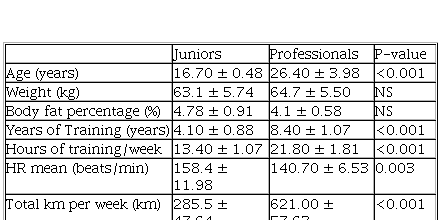
All values are expressed as means ± standard deviation. Significance for p < 0.05 for juniors Vs professionals. NS – not significant
There were no differences in the cadence generated between the two groups of athletes for any of the loads selected at each level. It should be noted that juniors did not engage in the two last levels (400 W and 450W) due to volitional fatigue. The average cadence with which the professional athletes finished the test was 99.63 rev/min.
Heart Rate (beat/min) as a function of load (Watts)
For the levels of 400 W and 450W, only the professional group was able to carry out the test. The last level, 450 W, was achieved by the group of professionals with values of 187.5 bat/min (Figure 1). It was identified differences in HR recorded between professional -junior groups for test levels up to 350 W (150 W, U = 8.50; p = 0.002; 200 W, U = 9.00; p = 0.002; 250 W, U = 11.00; p = 0.004; 300 W, U = 8.50; p = 0.002 and for 350 W, U = 8.00; p = 0.002).
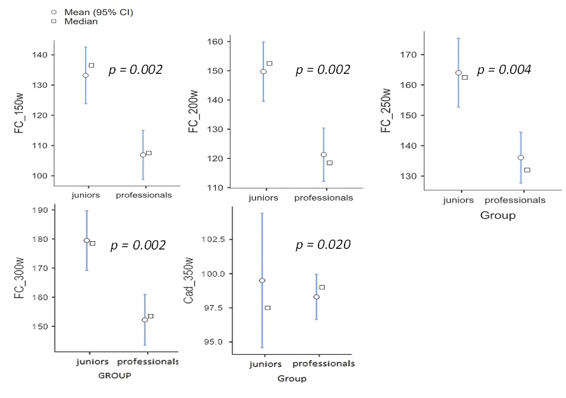
Figure 1
Differences in Heart Rate Values According to Different Loads (Watts)
The RPE varied between 1,5 and 10 for junior and professional cyclists. However, juniors reached the maximal perceived effort near 350 W and the professional cyclists reached 10 at 450W. Significant differences were found between groups (Figure 2). However, the levels of 400 W and 450 W were only performed by the group of professionals with RPE values of 9 and 10 respectively (on a scale of 1-10).
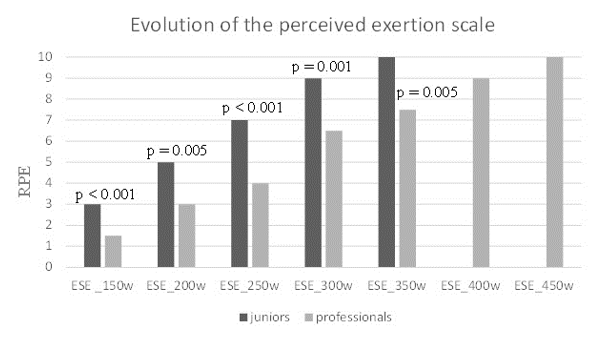
Figure 2
RPE Distribution During the Seven Test Stages. Distributions With Different Letters are Significantly Different According to the Kruskal-Wallis Test
Regarding the lactate concentrations (Figure 3), it only started to be worth noting from the power at 200 W. In this stage the values were above 1 and 3 mmol/dl for professional and junior cyclists, respectively. At 300 W, the junior cyclists were 7.54 (± 1.74 mmol/dl) and the professional cyclists 4.30 (± 1.50 mmol/dl). According to the means comparisons, we recorded differences in lactate values between the groups for the three potency levels: 200 W (U =13.00; p = 0.005), 250 W (U = 13.5; p = 0.006) and 300 W (U = 8.5; p = 0.002).
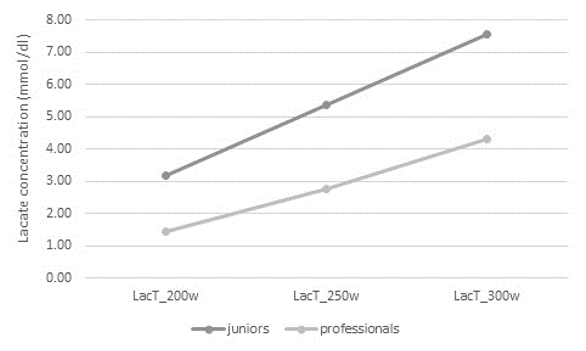
Figure 3
Lactate Evolution as a Function of Power Levels in Both Sample Groups
The aerobic and anaerobic thresholds were found to have significant differences in both groups. So, for the aerobic threshold, we obtained a test result that juniors were 136 bpm and professionals were 130 bpm (U = 17.50; p = 0.015), and for the anaerobic threshold juniors were 184 bpm and professionals were 169 bpm (U = 3.50; p < 0.001)
The associative analysis revealed significant associations for the junior group, and it is presented in Table 2. It is important to highlight the absence of correlations between variables in the group of professionals.
Correlation Between the Variables That Determine Physiological Performance (w/kg, Aerobic Threshold, Number of Hours of Training, and Total Kilometers per Week) n= 10
*p < 0.05; **p < 0.001
In order to demonstrate the operability of the collection of these variables, the Z-criterion statistics were used to design Z-score radar plots based on five physical and physiological components (total of kilometers per week, lactate by the 300 watts level, power measured by the watts kilogram ratio, aerobic threshold and anaerobic threshold both measure through heart rate) that are relevant to success in cycling.
The results of the Z-score individual radar plots of two junior cyclists are presented in Table 3 and Figure 4.
Individual Z-Scores of two Junior Cyclists Measures in SD

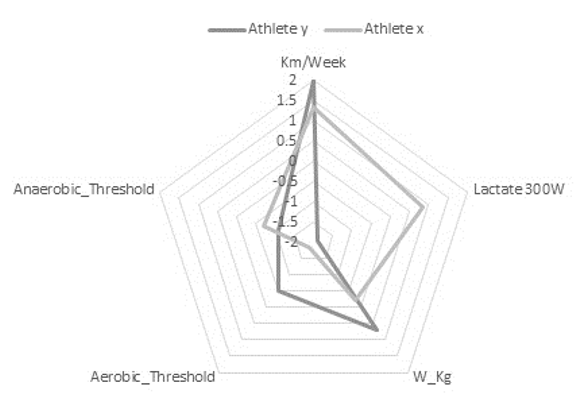
Figure 4
Z-Score Radar Plot Physiological Profile of two Junior Cyclists
We can verify that for both athletes’ groups, the kilometers per week they perform above the group mean. However, to reach lactate values in the 300 watts, it seems that athlete X may end exercise earlier due to higher lactate concentration. In terms of power, athlete Y can generate more power (better than athlete X and the whole group), and for the anaerobic threshold, although, for both athletes, the aerobic and anaerobic threshold happens earlier than their peers.
Discussion
Theoretically, senior professional cyclists are superior both in terms of anaerobic and aerobic threshold and in terms of weight/power ratio. The purpose of this study was to verify if junior athletes from a particular cycling club have a physical and physiological condition that can somehow be able to compete with professional athletes. The primary finding was that junior athletes have the potential for the development of functional capacities, although they still don’t have the same physiological responses as professional athletes, which will result in different high-level performances.
The age at which athletes reach their biological and physical peak typically falls between 20 and 35 years across various sports disciplines Maldonado-Martín et al. (2016). Recent studies have delved into the fundamental physical attributes of modern sports, emphasizing the significance of aerobic and anaerobic systems and the role of the lactic acid system during physical exertion (Mirizio et al., 2021). Understanding the age at which athletes in endurance sports, such as cycling, peak is crucial for devising effective career development plans (Rønnestad et al., 2014). Research has indicated that the peak performance age in endurance sports, particularly cycling, has remained relatively consistent between 36 and 38 years (Pan et al., 2022). Notably, junior athletes are suggested to potentially achieve comparable performances to professional athletes, indicating the importance of early career development and training optimization (Sunde et al., 2010). Physiological parameters such as aerobic threshold, ventilatory threshold, and variables like watts, heart rate, maximal oxygen consumption, and lactate concentrations have been identified as valuable predictors of performance in endurance activities (Brouwers et al., 2012). The integration of physiological tests to measure performance predictors and guide training prescription has been recommended to enhance training effects and optimize athletic performance (Fornasiero et al., 2017). By tailoring training programs based on individual physiological responses and performance predictors, coaches can improve training effectiveness and facilitate performance enhancements (Lentillon‐Kaestner, 2011). Understanding the interplay between physiological parameters, performance predictors, and training effects is essential for developing tailored training programs that address the unique needs and responses of each athlete (Gitelman et al., 2020). These studies underscore the importance of understanding the age of peak performance in endurance sports, optimizing training programs based on physiological parameters, and utilizing performance predictors to enhance the overall development and success of athletes.
The results of the study revealed notable differences between groups in various variables, including years of training, cycling hours per week, and total kilometers cycled per week. Professional cyclists exhibited a longer duration of training (8.4 years), higher weekly cycling hours (21.8), and more kilometers per week (621 km/week) compared to their junior counterparts. These differences suggest that professional cyclists are likely to achieve superior physiological performances due to the well-established principle that the body responds to physical exercise by undergoing physiological adaptations. This advantage in physiological performance among professionals can be attributed to their extensive training experience and the greater distances covered during training sessions. Despite the disparity in delivered power between professional and junior cyclists, no significant differences were observed. This finding can be elucidated by considering factors such as training experience and age, where juniors are approaching adulthood and may not exhibit substantial maturation differences compared to professionals. Professional cyclists' ability to generate higher power outputs can be attributed to their accumulated training experience (8 years for professionals compared to 4 years for juniors), increased weekly training hours (21 hours for professionals versus 13 hours for juniors), and greater weekly distance covered (621 km for professionals versus 286 km for juniors). Regarding the intensity of the workout per week, groups were evaluated by the average heart rate of training, and it was possible to verify that the two groups, juniors and professionals rolled to 77.9% and 72.6% of their maximum heart rate. Despite the two groups cycling equally in Zone 1 (70% -80% HRmax) (Lucía et al., 1999; Lucía et al., 2001), age has been a factor in the differences between groups in younger ages. Again, the physiological differences that allow higher intensity in professional cyclists are mostly explained by the training experience (Svendsen et al., 2018; Gallo et al, 2022; Marín-Pagán et al., 2021).
Another important variable associated with this modality is cadence. In the present study, the cadence was not indicated, which means that each athlete chose the most comfortable cadence to complete the protocol or at least to cycle for as long time as possible. The lack of significant difference in cadence may be attributed to individual biomechanical preferences, where elite cyclists, regardless of experience level, naturally select an optimal cadence to maximize efficiency (Lucía et al., 2001). The literature refers to the professional athletes pedaling technique as being very soft and professional cyclists usually spin the pedals very quickly compared to most recreational cyclists. A good example of this is Lance Armstrong, whose typical pedaling cadence was around 95-100 rpm, compared with the 80 rpm, which is more typical for the medium/recreational cyclist (Stebbins et al., 2014). The results showed that cadence was equal to or higher than 90 rpm in both groups. According to Emanuele et al. (2012), cyclists tend to choose a cadence very close to the “optimal cadence”, concluding that this choice is easier to reduce peripheral fatigue. It’s still possible to verify that as the load (watts) increases, the cadence also increases. The option for a higher cadence depends on several factors, such as the aerobic fitness level, the reduction of the force applied to the pedals, and the minimum muscle fatigue associated with exercise periods lasting less than 15 minutes (Vercruyssenetal, 2009). The protocol applied in this study had a total duration maximum of 15 minutes, suitable for cadences in the order of 90-100 RPM, as we observed either in juniors or professionals. Pedaling close to your maximum capacity without accusing muscle fatigue, as well as low lactate values, is a condition that is associated with professional athletes. In this study, it was measured the lactate for the 200W, 250W, and 300W showed that effectively, in these three different levels, there were significant differences between juniors and professionals. Armstrong & McManus (2010), state that lactate in response to exercise is related to maturation rates. In the final phase of each level, it was possible to assume that cadence varies between 93 rpm for juniors and 97 rpm for professionals, which puts these juniors on a level of excellence. With that known, considering the lactate relative to the relative power (w/kg) and considering the work of Millán et al. (2009) for the 300 W, the athletes of this sample hold high superior values. This small difference may indicate that the athletes of these studies have different workout routines, even though the lactate variable is the one to present more differences between juniors and professionals. The lower level of lactate that is presented in professional athletes shows the capacity they remove lactate concentrations and their efficiency. The well-trained athletes are very efficient and export less lactate to blood as they eliminate higher quantities directly from the muscle that produces lactate.
The heart rate analysis reveals that juniors have always presented values greater than professionals, determining that they reach the aerobic threshold (AT) estimated by heart rate around 150 W (66.8% HR max) while the professionals reach the next level, at 200 w (67.7% HR max). As for the anaerobic threshold (AnT), differences remain for the same load difference: juniors at 300 W (90.5% HR max) and professionals at 350 W (87.2% HR max). This difference emphasizes that although both groups are working within the same heart rate range, either at the AT or AnT, juniors work with less than 50 W compared to professionals. The correlation between the number of kilometers performed per week with AT reveals that the AT is reached with lower heart rate values when the number of kilometers per week is higher. This may indicate that juniors train in heart rate regimes that allow the increase in the capillaries and develop the body's ability to improve the metabolism of fatty acids, allowing an increase in the intensity of the workout without increasing lactate level (Conte & Conte, 2012).
Lastly, the analyses of RPE results presented those juniors cyclists rated higher levels of exertion than those reported by the professionals. It’s possible to affirm that RPE increases in the two groups over the test in proportion to the load increment (watts). This is expected because increasing the load will require more effort (Perez-Landaluce et al., 2002). The results also prove the difference in the perception of exertion from the skeletal muscles as well as the cardiorespiratory system between juniors and professionals. It is known that this perception is influenced by an etiological agent, which decreases the tissue pH causing muscle fatigue (Nakamura et al. 2005). The lactate concentration showed that at 300W level, juniors approximately reached 8mmol/L of lactate with a considered maximum perceived exertion (near 10) while professionals for the same level of intensity have reached 4 mmol/L of lactate and rated perceived exertion close to intense. The perceived exertion is significantly higher in the junior group, most likely because HR is superior in the same group and higher HR is associated with higher levels of RPE (Rodríguez-Marrovo et al., 2012). In world junior champions, a case study showed that at 4 mmol/L of lactate corresponded to 240 W of load (Rønnestad et al., 2019). Again, the differences with the current study may be explained by the cyclist's levels and training experience.
The progression from junior to professional cycling involves substantial physiological adaptations. The higher anaerobic thresholds in professionals indicate superior metabolic efficiency, which is likely a result of years of structured training and accumulated race experience (Svendsen et al., 2018). Developing such adaptations at earlier stages through tailored endurance and strength training programs could facilitate smoother transitions into professional competition. Training interventions should prioritize increasing aerobic efficiency in junior cyclists by incorporating high-intensity interval training and periodized endurance blocks. Additionally, resistance training could improve the power-to-weight ratio, a key determinant of cycling performance at the professional level (Rønnestad et al., 2014).
For athletes and coaches, this work reinforces the need to profile several performance determinants, as well as the need for an early monitoring process of junior athletes, to better understand the adaptations of these athletes to optimize training stimulation. Also emphasizes that compiling data on individual measurements, such as anthropometrical, physiological, and those regarding performance, allows the construction of a normative data that will help in decisions about how the athlete should be trained, and what necessary instructions should coaches give to athletes during competition, considering their fitness status, operationalized, in this example, by the z-score. However, it is important to highlight the following limitations: Although the sample size is limited (n=20), the findings provide valuable insights into performance differences but generalizations should not be made; additionally, the variability in pre-test compliance and the use of different bicycle brands could have influenced results; the lack of cadence control might hinder precise comparisons between athletes, as different cadences can influence performance and physiological responses. Future research should consider larger cohorts to enhance generalizability, standardize equipment, and implement more rigorous pre-test monitoring to ensure data consistency.
Conclusion
In conclusion, junior athletes still do not have the same physiological values of the variables that determine performance as their professional peers. Although anthropometrically they are close, the training routines are much more extensive and intense in professionals, which dictates the differences. We also know that it is not just physiological factors that determine sports performance. Success is the result of a complex web of interactions between the biological, psychological, and social. This study highlights key physiological disparities between elite junior and professional cyclists, emphasizing the importance of targeted training regimens in youth cycling. Future research should explore long-term adaptations in junior cyclists transitioning to professional levels.
Ethics Committee Statement
The Ethics Committee of the seeding Institution gave their approval on all the procedures, which were under the Helsinki Declaration.
Conflict of Interest Statement
The authors declare that there is no conflict of interest
Funding
This work was supported by national funds (FCT—Portuguese Foundation for Science and Technology) under the project UIBD/ DTP/04045/2020.
Authors’ Contribution
Conceptualization R.F. & L.H.; Methodology T.D.; Software I.M.; Validation D.A.M, C.A. & P.F.; Formal Analysis R.F.; Investigation R.F.; Resources L.H.; Data Curation T.D., I.M.; Writing – Original Draft R.F.; Writing – Review & Editing C.A., I.M., D.A.M., P.F., T.D., L.H.; Visualization C.A.; Supervision L.H., C.A.; Project Administration L.H., C.A.; Funding Acquisition L.H., D.A.M. All authors have read and agree with the published version of the manuscript.
Data Availability Statement
Data available upon request from the corresponding author: fernandopsrocha@gmail.com
References
Amann, M., Subudhi, A. W., & Foster, C. (2006). Predictive validity of ventilatory and lactate thresholds for cycling time trial performance. Scandinavian Journal of Medicine & Science in Sports, 16(1), 27–34. https://doi.org/10.1111/j.1600-0838.2004.00424.x
Armstrong, J., & Mcmanus, A. M. (2010). The elite young athlete. Karger Medical and Scientific Publishers. https://doi.org/10.1159/isbn.978-3-8055-9551-3
Belli, A. & Hintzy, F. (2002). Influence of pedalling rate on the energy cost of cycling in humans. European Journal Applied Physiology, 88(2), 158-162. https://doi.org/10.1007/s00421-002-0674-5
Billat L. V. (1996). Use of blood lactate measurements for prediction of exercise performance and for control of training. Recommendations for long-distance running. Sports Medicine, 22(3), 157–175. https://doi.org/10.2165/00007256-199622030-00003
Birk, T. J., & Birk, C. A. (1987). Use of ratings of perceived exertion for exercise prescription. Sports Medicine, 4(1), 1–8. https://doi.org/10.2165/00007256-198704010-00001
Borg G. (1970). Perceived exertion as an indicator of somatic stress. Scandinavian Journal of Rehabilitation Medicine, 2(2), 92–98. https://doi.org/10.2340/1650197719702239298
Chavarren, J., & Calbet, J. A. (1999). Cycling efficiency and pedalling frequency in road cyclists. European Journal of Applied Physiology and Occupational Physiology, 80(6), 555–563. https://doi.org/10.1007/s004210050634
Conte, L. P., & Conte, M. (2012). Comparação do desempenho aeróbio de ciclistas submetidos à restrição hídrica, hidratação e a suplementação de arginina. RBNE - Revista Brasileira De Nutrição Esportiva, 3(18). http://www.rbne.com.br/index.php/rbne/article/view/153
Emanuele, U., Horn, T., & Denoth, J. (2012). The relationship between freely chosen cadence and optimal cadence in cycling. International Journal of Sports Physiology and Performance, 7(4), 375–381. https://doi.org/10.1123/ijspp.7.4.375
Fermino, F. R., Ramirez, F., Oliveira, P. R., & Stella, S. G. (2005). Estudo Comparativo Entre Dois Diferentes Protocolos de Avaliação Para Ciclistas. Efdeportes.Com, 10(84). Disponível em: https://www.efdeportes.com/efd84/ciclista.htm
Flynn, S., Rosales, A., Hailes, W., & Ruby, B. (2020). Males and females exhibit similar muscle glycogen recovery with varied recovery food sources. European Journal of Applied Physiology, 120(5), 1131–1142. https://doi.org/10.1007/s00421-020-04352-2
Fornasiero, A., Savoldelli, A., Fruet, D., Boccia, G., Pellegrini, B., & Schena, F. (2017). Physiological intensity profile, exercise load and performance predictors of a 65-km mountain ultra-marathon. Journal of Sports Sciences, 36(11), 1287–1295. https://doi.org/10.1080/02640414.2017.1374707
Gallo, G., Filipas, L., Tornaghi, M., Garbin, M., Codella, R., Lovecchio, N., & Zaccaria, D. (2021). Thresholds Power Profiles and Performance in Youth Road Cycling. International Journal of Sports Physiology and Performance, 16(7), 1049–1051. https://doi.org/10.1123/ijspp.2020-0579
Gallo, G., Leo, P., Mateo-March, M., Giorgi, A., Faelli, E., Ruggeri, P., Mujika, I., & Filipas, L. (2022). Cross-sectional differences in race demands between junior, under 23, and professional road cyclists. International Journal of Sports Physiology and Performance, 17(3), 450-457. https://doi.org/10.1123/ijspp.2021-0256
Gardner, A. S., Martin, J. C., Martin, D. T., Barras, M., & Jenkins, D. G. (2007). Maximal torque- and power-pedaling rate relationships for elite sprint cyclists in laboratory and field tests. European Journal of Applied Physiology, 101(3), 287–292. https://doi.org/10.1007/s00421-007-0498-4
Gardner, A. S., Stephens, S., Martin, D. T., Lawton, E., Lee, H., & Jenkins, D. (2004). Accuracy of SRM and power tap power monitoring systems for bicycling. Medicine and science in sports and exercise, 36(7), 1252-1258. https://doi.org/10.1249/01.mss.0000132380.21785.03
Hansen, E. A., & Rønnestad, B. R. (2017). Effects of cycling training at imposed low cadences: A systematic review. International Journal of Sports Physiology and Performance, 12(9), 1127–1136. https://doi.org/10.1123/ijspp.2016-0574
Hawkins, S. A., & Wiswell, R. A. (2003). Rate and mechanism of maximal oxygen consumption decline with aging. Sports Medicine, 33, 877–888. https://doi.org/10.2165/00007256-200333120-00002
Helsen, W. F., Starkes, J. L., & Hodges, N. J. (1998). Team sports and the theory of deliberate practice. Journal of Sport and Exercise Psychology, 20(1), 12–34. https://doi.org/10.1123/jsep.20.1.12
Hunter, S. K., Stevens, A. A., Magennis, K., Skelton, K. W., & Fauth, M. (2011). Is there a sex difference in the age of elite marathon runners? Medicine and Science in Sports and Exercise, 43(4), 656–664. https://doi.org/10.1249/MSS.0b013e3181fb4e00
Lucía, A., Hoyos, J., Carvajal, A., & Chicharro, J. L. (1999). Heart rate response to professional road cycling: the Tour de France. International Journal of Sports Medicine, 20(3), 167–172. https://doi.org/10.1055/s-1999-970284
Lucía, A., Hoyos, J., & Chicharro, J. L. (2001). Preferred pedalling cadence in professional cycling. Medicine and Science in Sports and Exercise, 33(8), 1361–1366. https://doi.org/10.1097/00005768-200108000-00018
Mac Dougall, D., Wenger, A. & Green, J. (1990). Physiological testing of the high-performance athlete. Published for the Canadian Assocation of Sport Science.
Marín-Pagán, C., Dufour, S., Freitas, T. T., & Alcaraz, P. E. (2021). Performance profile among age categories in young cyclists. Biology, 10(11), 1196.
Menaspà, P., Rampinini, E., Bosio, A., Carlomagno, D., Riggio, M., & Sassi, A. (2012). Physiological and anthropometric characteristics of junior cyclists of different specialties and performance levels: Cycling speciality and ranking in juniors. Scandinavian Journal of Medicine & Science in Sports, 22(3), 392–398. https://doi.org/10.1111/j.1600-0838.2010.01168.x
Nakamura, F. Y., Gancedo, M. R., Silva, L. A., Lima, J. R.P., & Kokubun, E. K. (2005). Utilização Do Esforço Percebido Na Determinação Da Velocidade Crítica Em Corrida Aquática. Rev Bras Med Esporte, 11(1), 1-5. https://doi.org/10.1590/S1517-86922005000100001
Oliveira, V., Silva, H., & Espindola, F. (2001). Estimação do limiar anaeróbico por meio de regressão linear bissegmentada. Revista Brasileira de Medicina e Esporte, 2(5), 45-49.
Pallarés, J.G., Morán-Navarro, R., Ortega, J.F., Fernández-Elías, V.E., & Mora-Rodriguez, R. (2016). Validity and Reliability of Ventilatory and Blood Lactate Thresholds in Well-Trained Cyclists. PLOS ONE, 11(9), e0163389. https://doi.org/10.1371/journal.pone.0163389
Perez-Landaluce, J., Fernández-García, B., Rodriguez-Alonso, M., García-Herrero, F., García-Zapico, P., Patterson, A. M., & Terrados, N. (2002). Physiological differences and rating of perceived exertion (RPE) in professional, amateur and young cyclists. Journal of Sports Medicine and Physical Fitness, 42(4), 389-395.
Robertson, R. J., Goss, F. L., & Metz, K. F. (1998). Perception of physical exertion during dynamic exercise: a tribute to Professor Gunnar A. V. Borg. Perceptual and motor skills, 86(1), 183–191. https://doi.org/10.2466/pms.1998.86.1.183
Rodríguez-Marroyo, J. A., Pernía, R., Cejuela, R., García-López, J., Llopis, J., & Villa, J. G. (2011). Exercise Intensity and Load During Different Races in Youth and Junior Cyclists. Journal of Strength and Conditioning Research, 25(2), 511–519. https://doi.org/10.1519/JSC.0b013e3181bf4426
Rønnestad, B. R., Hansen, J., Stensløkken, L., Joyner, M. J., & Lundby, C. (2019). Case studies in physiology: temporal changes in determinants of aerobic performance in individual going from alpine skier to world junior champion time trial cyclist. Journal of Applied Physiology, 127(2), 306-311.
San-Millán, I., Stefanoni, D., Martinez, J. L., Hansen, K. C., D'Alessandro, A., & Nemkov, T. (2020). Metabolomics of Endurance Capacity in World Tour Professional Cyclists. Frontiers in physiology, 11, 578. https://doi.org/10.3389/fphys.2020.00578
Schulz, R., & Curnow, C. (1988). Peak Performance and Age Among Superathletes: Track and Field, Swimming, Baseball, Tennis, and Golf. Journal of Gerontology, 43(5), 113–120. https://doi.org/10.1093/geronj/43.5.P113
Stebbins, C. L., Moore, J. L., & Casazza, G. A. (2014). Effects of cadence on aerobic capacity following a prolonged, varied intensity cycling trial. Journal of sports science e medicine, 13, 114–119.
Svedahl, K., & MacIntosh, B. R. (2003). Anaerobic threshold: the concept and methods of measurement. Canadian journal of applied physiology = Revue canadienne de physiologie appliquee, 28(2), 299–323. https://doi.org/10.1139/h03-023
Svendsen, I. S., Tønnesen, E., Tjelta, L. I., & Ørn, S. (2018). Training, performance, and physiological predictors of a successful elite senior career in junior competitive road cyclists. International journal of sports physiology and performance, 13(10), 1287-1292.
Vercruyssen, F., & Brisswalter, J. (2010). Which factors determine the freely chosen cadence during submaximal cycling?. Journal of science and medicine in sport, 13(2), 225–231. https://doi.org/10.1016/j.jsams.2008.12.631
Zingg, M., Knechtle, B., Rüst, C. A., Rosemann, T., & Lepers, R.. (2013). Age and Gender Difference in Non-Drafting Ultra-Endurance Cycling Performance - the “Swiss Cycling Marathon”. Extreme Physiology e Medicine, 2(1), 18. https://doi.org/10.1186/2046-7648-2-18
Author notes
aCorrespondence: Fernando Rocha, fernandopsrocha@gmail.com
Additional information
Short title: Physiological Performance in Elite and Junior Cyclists Levels
How to cite this article: Rocha, F., Conceição, A., Isidoro, M., Marinho, D.A., Forte, P., Torres, D., Louro, H. (2024). Comparative analysis of physical and physiological profiles in elite junior and professional cyclists. Cultura, Ciencia y Deporte, 21(67), 2310. https://doi.org/10.12800/ccd.v21i67.2310


