
ANALYSIS OF ATHLETIC CLUBS MEMBERS' PERCEPTIONS OF PANDEMIC MANAGEMENT: VALIDATION OF A SCALE
ANÁLISIS DE LAS PERCEPCIONES DE LOS SOCIOS DE LOS CLUBES DE ATLETISMO SOBRE LA GESTIÓN DE LA PANDEMIA: VALIDACIÓN DE UNA ESCALA


Pablo Montoro Sanchís, Maria Huertas González-Serrano, Fernando García-Pascual, Cristian Gregori-Faus, David Parra-Camacho
ANALYSIS OF ATHLETIC CLUBS MEMBERS' PERCEPTIONS OF PANDEMIC MANAGEMENT: VALIDATION OF A SCALE
Cultura, Ciencia y Deporte, vol. 21, no. 67, 2026, 10.12800/ccd.v21i67.2207
Universidad Católica San Antonio de Murcia
Pablo Montoro Sanchís
University of Valencia, España
Maria Huertas González-Serrano
University of Valencia, España
Fernando García-Pascual
University of Valencia, España
Cristian Gregori-Faus a
University of Valencia, España
David Parra-Camacho
University of Valencia, España
Received: 27 April 2024
Accepted: 01 March 2025
Abstract: Sport users' perceptions of how the Coronavirus2019 situation was managed can provide valuable insights for sport managers, helping them to make better decisions both now and in the future. This research aims to conduct a preliminary validation of a scale that measures perceptions of how Coronavirus 2019 impact was managed by sports clubs, and to explore the relationship with the satisfaction and future intentions of sports club members. Using a quantitative approach, the Coronavirus Disease 2019-Related Measures scale was adapted. The sample consisted of 148 runners from athletic clubs in Valencia (Spain), through which exploratory, confirmatory and regression factor analyses were performed. The scale was composed of three dimensions: efficient management of Coronavirus 2019, inefficient management of Coronavirus 2019 and well-being at the training facility. Efficient management of Coronavirus 2019 by the sports club and club member satisfaction were significantly predictors of future intentions among club members. This study provides a valid and reliable tool for sports organisations to assess users' perceptions of Coronavirus 2019 management, as well as future pandemics. It also emphasizes the need for managers to be trained in the skills to effectively handle such crisis, as this management will influence users’ future behaviours.
Keywords: Sportsmanagement, sports clubs, COVID-19, running, scale validation.
Resumen: Las percepciones de los usuarios deportivos sobre cómo se gestionó la situación del Coronavirus 2019 pueden proporcionar una perspectiva valiosa para los gestores deportivos, ayudándoles a que tomen mejores decisiones tanto en la actualidad como en el futuro. Esta investigación tiene como objetivo realizar una validación preliminar de una escala que mide las percepciones Sobre cómo se gestionó el impacto del Coronavirus 2019 por parte de los clubes deportivos, y explorar la relación con la satisfacción y las intenciones futuras de los socios de los clubes deportivos. Utilizando un enfoque cuantitativo, se adaptó la escala Coronavirus Disease 2019-Related Measures. La muestra consistió en 148 corredores pertenecientes a clubes de atletismo de la ciudad de Valencia (España), mediante los cuales se realizaron análisis factoriales exploratorios, confirmatorios y de regresión. La escala estaba compuesta por tres dimensiones: gestión eficiente de del Coronavirus 2019, gestión ineficiente del Coronavirus 2019 y bienestar en el lugar de entrenamiento. La gestión eficiente del Coronavirus 2019 por parte del club deportivo y la satisfacción de los miembros del club fueron predictores significativos de las intenciones futuras de los miembros del club. Este estudio proporciona una herramienta válida y fiable para que las organizaciones deportivas evalúen las percepciones de sus usuarios sobre la gestión del Coronavirus 2019, así como de futuras pandemias. También enfatiza la necesidad de que los gestores reciban formación en las habilidades necesarias para gestionar eficientemente este tipo de crisis, ya que dicha gestión puede influir en los comportamientos futuros de sus usuarios
Palabras clave: Gestión Deportiva, Clubs deportivos, COVID-19, Correr, Validación de una escala.
Introduction
In December 2019, a new highly contagious coronavirus strain was identified in the city of Wuhan (China), which was named based on the type of virus and the year of its emergence, resulting in the named Coronavirus Disease 2019 (hereafter referred to as COVID-19). Following this discovery, the World Health Organization declared it as a global pandemic on March 11, 2020, urging governments worldwide to implement emergency public health measures. This emergency triggered the confinement of the world's population to their homes.
This quarantine period was found to negatively affect general behaviour, as well as sleep patterns and physical activity practice (Brooks et al., 2020). A daily reduction in step count of up to 38% was detected in European countries, with Spain standing out among them, while in South and North American countries, the reduction was approximately 15% (Fitbit, 2020).
This fact is concerning, as some researchers highlight the maintenance of physical activity and leisure activities as an excellent tool to fight against the psychological effects of confinement (Füzéki et al., 2020). Consequently, since the beginning of the pandemic, some studies have been published in different parts of the world, drawing attention to the importance of continuing to practice physical activity (Chen et al., 2020; Jiménez-Pavón et al., 2020; Wunsch et al., 2022).
This idea seems to have gained traction globally, as evidenced by the increase in home physical activity programs and the large number of participants worldwide (Andreu-Cabrera, 2020). Furthermore, Pitanga et al. (2020) emphasized that considering the benefits of physical activity for the cardiovascular, metabolic, and immune systems, and for mental health, outdoor physical activities during Covid-19 times should be considered an essential practice by the relevant authorities.
This environment led to a profound modification of sports organizations with unprecedented measures (Sanderson & Brown, 2020). During confinement, coaches had to maintain the relationship with their athletes, supporting them with physical conditioning protocols and ensuring frequent contact, and providing effective tools to help them deal with the uncertainty of this period (McShan & Moore, 2024).
Regarding the practice of some outdoor sports, specifically running, the study by DeJong et al. (2021) shows that after confinement and during the COVID-19 pandemic, training loads varied, with a higher volume of work, but at a lower intensity and with a higher risk of injury. Additionally, motivation for running decreased. However, for a period, uncertainty persisted regarding whether previous sport habits would resume t or if the pandemic would signal the beginning of a new era with novel lifestyles (Yeo, 2020). Consequently, the concept of “normality” has undergone a significant transformation, with a growing number of individuals now acknowledging that uncertainty constitutes a lasting aspect of human existence, shaped by simultaneous global crises (Smagacz-Poziemska et al., 2024).
Due to the confinement, and, therefore, the pause of physical activity outdoors, adaptability changes occurred regarding the endocrine, cardiorespiratory, and intermuscular systems, losing muscle mass, and increasing fat, which is a risk factor for injuries (Dres Walter & Bortolazzo, 2020).
In this sense, Mosqueira-Ourens et al. (2021) observed that, upon the return to training of runners after confinement due to the coronavirus, there was a gradual progression in training, performing at first fewer kilometres than in training before the pandemic. Moreover, these distances increased as the athletes became fitter. It is noteworthy that there was no great increase in injuries and pain when training, as most of the athletes surveyed had more than three years of experience. Also, a relationship was found between having done running before the pandemic and a lower sedentary lifestyle during confinement.
Therefore, Covid-19 has brought significant negative consequences for society, the economy, and the practice of sport and recreation (Byers et al., 2022). Examples have included the cancellation of major sporting events, and many recreational sports have had both economic and social implications (Parnell et al., 2022).
Indeed, Parnell et al. (2022) suggest that the implications for sports in general, and how sports and recreation are managed, should be considered in light of this pandemic. Along these lines, various authors (Escamilla-Fajardo et al., 2020; Hammerschmidt et al., 2021) point out that sports clubs have had to reinvent themselves to continue sports and social activities. This pandemic posed a major challenge on all sectors, especially the sports sector, which prevented many sports clubs from being able to use their facilities and carry out their activities (Alghafary et al., 2021).
Hence, maintaining a positive mood and high satisfaction levels among facility users or club members was considered in order to help to ensure retention and attract more people to the club (Álvarez-García et al., 2019). Because, at is it well known, perceived value, and its relationship with users’ satisfaction, is a great indicator to predict and comprehend users’ future behaviours between perceived value and user satisfaction (Einsle & Izquierdo, 2022) . Regarding the future intentions of post-covid running, Wen et al. (2021) argue that tourists after the pandemic will not choose places to travel with overcrowding, such as the examples of popular races where thousands of people participate. According to Seraphin (2021), it is of vital importance to base the organization of races and sporting events on health and safety in the face of contagion, so that they are perceived positively by athletes.
Covid-19 has brought the need for social distance, and in addition to having to telework from home, this has caused the increased use of technology (Einsle et al., 2024). In as well as an increased concern about health safety among runners, which could cause an impact on the future intentions of runners and their participation in races or sporting events (Maditinos et al., 2021), as well as their continued membership in sports clubs. For this reason, the need arises to analyse which variables can influence the future intentions of physical-sports practice of these athletes in the clubs to which they belong.
This study has three main objectives. The first is to carry out a preliminary validation of the scale measuring the perception on the management of the impact of COVID-19 by the clubs. The second is to analyse the perception of the runners belonging to athletic clubs in the city of Valencia regarding the management of the impact of COVID-19 on sports practice. Finally, the third objective is to analyse the relationship between the factors related to COVID-19 impact management by the clubs, runners' satisfaction with the management, and future intentions regarding their membership with the club and participation in training sessions organized by the entity.
This study contributes to the existing literature on sports management and COVID-19 in several ways. First, by proposing and validating a new instrument for sports managers to measure the perceptions of sports users, specifically those in sports clubs, on the COVID-19 management performed by the clubs. Secondly, by showing the variables that may influence members' intention to continue attending running sports clubs after the COVID-19 confinement. In this way, the most important aspects where sports managers should have an impact to improve the loyalty of their clients are highlighted.
Material and Methods
Participants
A total of 148 athletes from athletic clubs in the city of Valencia (Spain) were surveyed. The mean age of the participants was 41.90 (SD = 12.24), with 64.90% identifying as a male, 33.80% as a female, and 1.30% as non-binary. Most respondents had a university education (60.10%), followed by those with vocational education (20.90%) and those with secondary education (12.80%). additionally, half of the respondents indicated that they were employed (50.70%), followed by civil servants (17.60%). A smaller proportion represented those who were students (11.50%), self-employed (10.80%), unemployed (5.40%), or retired (4.10%).
In terms of sports habits, most respondents competed in popular races (81.80%), while only 18.20% indicated that they competed on track. The majority were federated (76.90%) and had been running for seven or more years (55.60%).
Instrument
The instrument consisted of 13 items adapted from the Coronavirus Disease 2019-Related Measures scale by Prado-Gascó et al. (2020), addressing various aspects related to the health emergency caused by COVID-19. The wording was modified to analyse the athletes' perception of their clubs' management of the incidences generated by COVID-19. The items were reviewed by four professors and researchers with expertise in sport management and organization to ensure their relevance to the study’s objectives. A scale measuring athletes’ future intentions regarding their association with the club was also included, consisting of four items adapted from the scale by Zeithaml et al. (1996), as well as an indicator measuring the degree of satisfaction with the club management of the COVID-19. The indicators of the scales assessing the management of clubs’ responses to COVID-19-related incidents and future intentions were evaluated on a five-point Likert scale, where 1 meant strongly disagree and 5 meant strongly agree. In contrast, the indicator of satisfaction with management was rated on a scale where 1 meant very dissatisfied and 10 meant very satisfied.
On the other hand, the questionnaire also included several sociodemographic variables (age, gender, education level, and occupation), as well as questions regarding athletes' sports habits (usual competition location, number of years of running, and whether they were federated).
Procedure
This study involved athletes who ran or ran track and field in clubs in the city of Valencia. To participate, the following inclusion criteria had to be met: being of legal age and practicing athletics or running continuously in a sports club in the city.
The sample collection procedure was carried out using an online survey conducted through the Lime Survey application licensed by University of Valencia. The survey was active for a period of two weeks in March 2021. To maximize the number of responses, participation was encouraged by offering a prize through a random draw among all athletes who completed the questionnaire. We also contacted the main athletics clubs in the city of Valencia and coaches of large athlete groups, which included both track and recreational runners. Social networks such as Instagram were also used to promote the survey through an account specialized in athletics in Valencia, as well as WhatsApp groups. Finally, an agreement was reached with a store specializing in running to display the survey in its physical location through a QR code. This store also served as the pickup point for the prizes awarded through the draw among all the survey participants.
The study protocol adhered to the principles of the Declaration of Helsinki and it was not necessary to obtain the approval of the Ethics Committee of the University of Valencia because according to the Ethics and Human Research Committee of the University of Valencia it is not necessary to obtain approval to conduct an opinion survey on a topic or issue, professional situation or satisfaction with certain issues.
However, it is mandatory to include a preamble in the survey with the information presented about the project (topic and purpose), the potential benefits that the information collected by the survey may bring, the willingness to participate, and the anonymous treatment of the data (Data Protection Act). Additionally, it is required to provide a contact person for further information and include a paragraph in which the respondent voluntarily accepts participation in the research and tacitly gives their consent by answering the survey. Thus, following these guidelines indicated by the Ethics and Human Research Committee of the University of Valencia to develop this type of research, all this information was included at the beginning of the questionnaire.
Statistical Analysis
The SPSS V.26, Factor, and EQS v6.4 programs were used for data analysis. The first program was used to extract the descriptive data of the variables under study and the multiple linear regression model. All three programs were used for the validity analysis of the perception scale on the management of COVID-19 impact by the clubs.
The validity of the factor structure of the scale on COVID-19 impact management was performed using the exploratory factor analysis technique (EFA) and confirmatory factor analysis (CFA). The EFA was performed following the recommendations of Lloret-Segura et al. (2014), using the maximum likelihood extraction method and direct oblimin rotation. To determine the number of factors, the implemented optimization procedure of parallel analysis was used (Ferrando & Lorenzo-Seva, 2018) , while to check the model fit, the Residual Mean Quadratic Root (RMQR) coefficients and the gamma or goodness-of-fit index (GFI) proposed by Tanaka and Huba (1989) were analysed. On the other hand, items with factor loadings lower than .40 or higher than this value in two or more factors were eliminated before performing the next EFA. Finally, the theoretical interpretability of the factor solution extracted from the EFA was checked, as well as the reliability of the extracted factors using Cronbach's alpha (Hair et al., 2019). Another indicator taken into account was the Generalized G-H Index to analyse the replicability of the factors derived from the EFA. The Kaiser Meyer Olkin (KMO) sample adequacy measures were also observed, as well as Bartlett's Sphericity test (BST).
The EFA was performed by applying the Robust Maximum Likelihood Estimation method, using statistics such as the χ2 of Satorra Bentler. For the evaluation of the overall fit, different goodness-of-fit indices recommended in the literature were used, such as the Chi-square significance and its robust correction offered by Satorra-Bentler (S-B χ²) (1994). In addition, other coefficients were calculated that allowed testing of the adequacy of the proposed models, such as the ratio of χ² and its degrees of freedom (χ2/df), with acceptable values being less than five (Byrne, 2013). In the same way, the coefficients of the robust goodness-of-fit indices of the proposed model, the Non-Normed Fit Index (NNFI), the Comparative Fit Index (CFI), and the Incremental Fit Index (IFI) were tested. For these indicators, values above .90 are considered a good fit (MacCallum & Austin, 2000). Finally, the root means squared error of approximation (RMSEA) is shown, with a score of less than .08 being considered a good fit (Browne & Cudeck, 1992).
The reliability of the scale was tested through Cronbach's alpha, composite reliability (CR), and average variance extracted (AVE). Likewise, convergent validity was analysed through the significance of the factor loadings (p < .05) in their respective dimension and the associated t-test values. To contrast discriminant validity, the method suggested by Fornell and Larcker (1981) was used, which consists of testing whether the square root of the AVE value of a given factor is greater than the correlation coefficients between the factor and any other factor of the proposed scale.
Finally, a multiple linear regression analysis was performed with the different dimensions extracted from the exploratory factor analysis and the indicator on the degree of satisfaction with the management of COVID-19 by the clubs, to find out which of these were the best predictors of future intentions.
Results
Descriptive Statistics
Table 1 shows the means, standard deviations, and the skewness and kurtosis values for each indicator of the variables under study: perception of the management of the impact of COVID-19 by the clubs, future intentions, and satisfaction. It can be observed that athletes gave positive evaluations to the indicators referring to the resources put in place by the club to deal with COVID-19 (M = 4.14; SD = 1.15), the information provided by the club about COVID-19 (M = 4.07; SD = 0.98) and the measures taken by the club (M = 4.26; SD = 0.97).
Descriptive Statistics of the Scale of Perception of COVID-19 Impact Management by Clubs
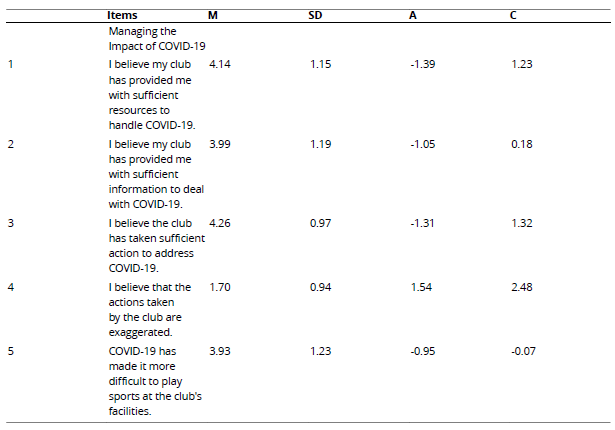
Descriptive Statistics of the Scale of Perception of COVID-19 Impact Management by Clubs
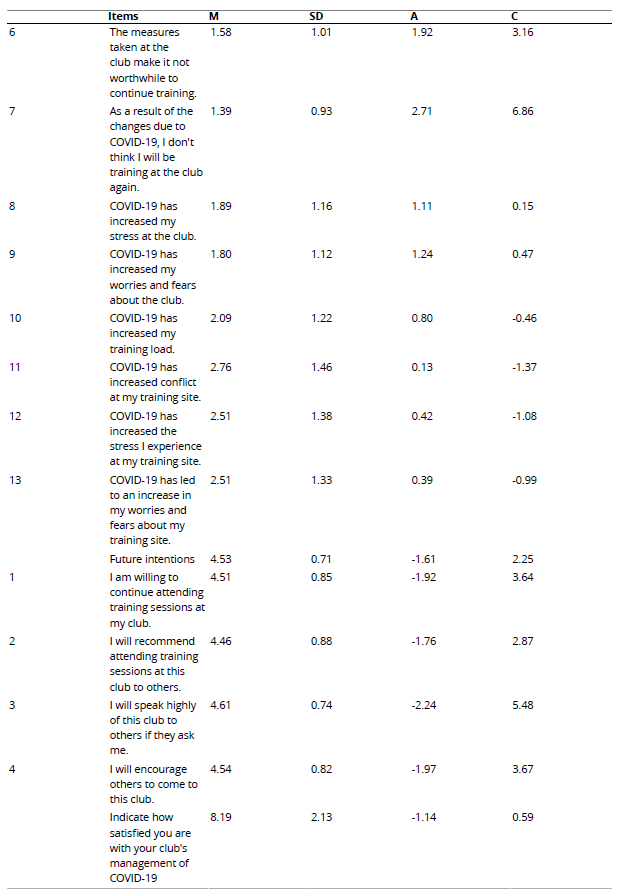
On the other hand, most respondents disagreed that the measures taken by the club were exaggerated (M = 1.70; SD = 0.94), that it was not worthwhile to continue training (M = 1.58; SD = 1.01), or that, as a consequence of COVID-19, they would not train at the club again (M = 1.80; SD = 1.12). A similar trend was observed in the values referring to a possible increase in stress suffered at the club (M = 1.89; SD = 1.16) or worries and fears regarding the club (M = 1.80; SD = 1.12).
Finally, concerning the training sessions, the majority indicated that they had not experienced an increase in the load, a rise in possible conflicts at the training facility, or the stress suffered during training.
In the case of future intentions, most of the indicators had values higher than four, indicating a positive trend in the athletes' assessments of attending training sessions, recommending attendance, or speaking positively about the club to others. Finally, it was observed that most athletes were satisfied with the club’s management of the situation generated by COVID-19 (M = 8.19; SD = 2.13).
The values of skewness and kurtosis were in most indicators within acceptable limits (< 3.0) to ensure a normal distribution of the data (Chou & Bentler, 1995).
Psychometric Properties
After testing the properties of the scale indicators on the athletes' perception of the management of the COVID-19 impact by the clubs, an EFA was performed to check the grouping of the indicators into different factors. This analysis, together with the CFA, allows the construct validity to be checked. The EFA was performed on the thirteen indicators of the scale.
The KMO measure of sampling adequacy and the BST test were considered, which indicates the proportion of the variance in the study variables that can be caused by the underlying factors. Higher values indicate that factor analysis can be useful with your data, while lower values indicate the opposite. In the study sample, the KMO value was .80 and the BST value of .745 indicated that the sample correlation matrix was not null (df = 45, p < .001) and the data were appropriate for EFA.
Parallel analysis suggested grouping the indicators into two factors. However, it was decided to also include the three-factor factorial solution as it presented a better theoretical interpretation and adequate model fit. In this factorial solution, three indicators that presented factor loadings below .40 or cross-loadings on two or more factors above .40 (items 4, 5, and 10) were eliminated. After eliminating the three indicators that did not meet the criteria, a new EFA was carried out, which made it possible to identify three differentiated factors. The factors were named: Covid-19 Efficient Club Management (items 1, 2, and 3), Covid-19 Inefficient Club Management (items 6, 7, 8, and 9), and Training Site Well-Being (items 11, 12, and 13). The factor names represent the content of the indicators in each dimension.
To check the fit of the final model, the RMSR coefficients and the gamma index or GFI were analysed, which showed values within the recommended cut-off points: RMCR = .03 (< .05); GFI = .99 (> .95). On the other hand, the Generalized G-H Index, showed values above .80 in the three factors detected by the EFA, indicating to possible good replicability of the dimensions in other studies (Ferrando & Lorenzo-Seva, 2018). The variance explained by the 10 items grouped in the three factors was 73.65%.
A CFA was then performed using maximum likelihood estimation with the robust Satorra-Bentler correction (S-B χ²). The initial theoretical model composed of the three factors and 10 indicators showed a good fit: significant chi-square (χ2 = 46.64, gl = 32, p < .05) with a value for the normed chi-square (χ2/df = 1.46) less than three and the RMSEA index showed a value of .041 (Confidence interval = .001-.077), lower than .08. Similarly, the remaining indices show a good fit of the model, as they presented values higher than .90: NNFI = .98, CRI = .98 and IFI = .98.
To analyse reliability, Cronbach's alpha, composite reliability (CR), and Average Variance Extracted (AVE) were examined, with values were adjusted to the parameters recommended in the literature: efficient Covid-19 club management (α = .92; CR = .92; AVE = .79), inefficient Covid-19 club management (α = .76; CR = .76; AVE = .46) and Well-being at the training site (α = .85; CR = .85; AVE = .66). Although the minimum value for CR, Cronbach's alpha considered adequate is .70 (Nunnally, 1995), and values above .50 are recommended for AVE (Bagozzi & Yi, 1988), some studies consider values above .40 adequate (Aldás, 2000). In the same line, Hatcher (1994), argues that if the reliability of the construct is acceptable, a marginally low AVE can be accepted. According to these criteria all factors met the minimum required values (see Table 2).
Factor Loadings (λ), Explained Variance (R2), Composite Reliability (CR), Average Variance Extracted (AVE), and Cronbach's Alpha (α) of the Scale Indicators
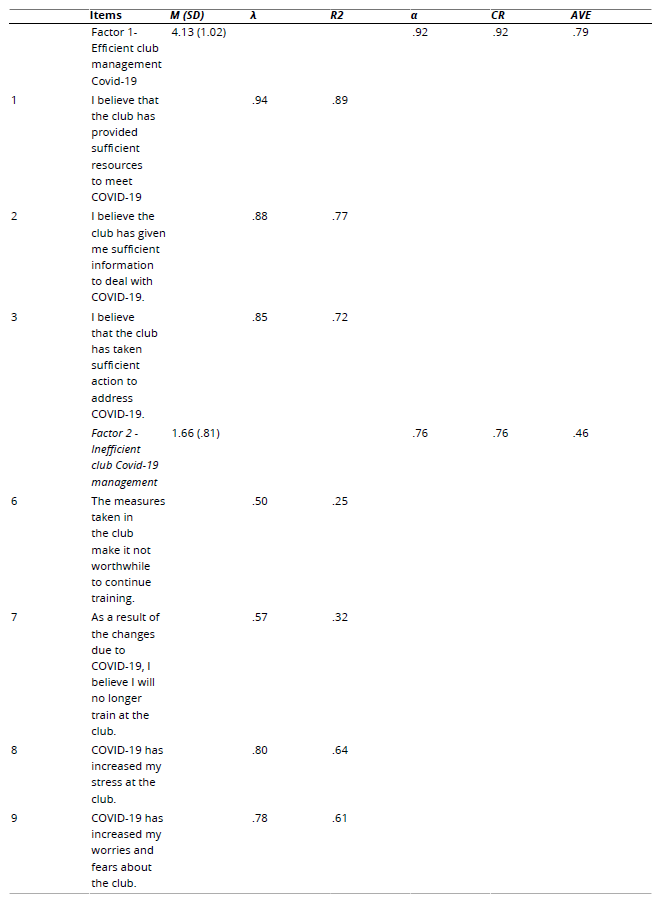
Factor Loadings (λ), Explained Variance (R2), Composite Reliability (CR), Average Variance Extracted (AVE), and Cronbach's Alpha (α) of the Scale Indicators
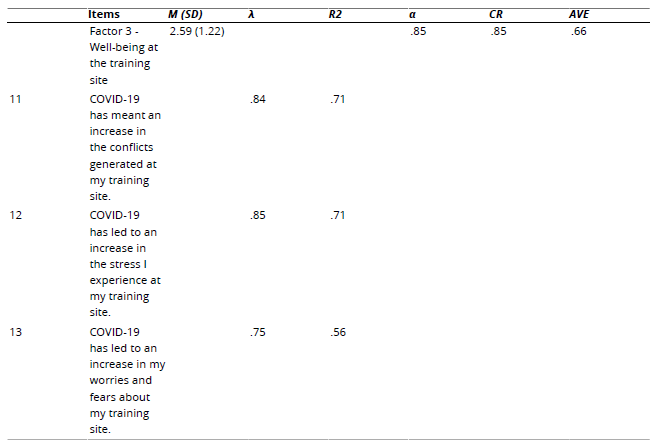
Convergent validity was tested using the t-test values associated with the factor loadings, which were greater than 3.29 (Hair et al., 2019) for each indicator in the factor to which they belong. The t-test values ranged from 3.76 to 16.68, meeting this criterion.
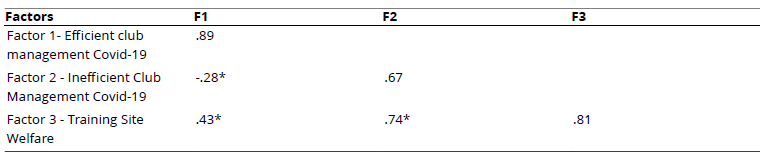
Regarding discriminant validity (see Table 3), it was found that the correlation between the three factors below .85 as recommended by Kline (2015). Additionally, it was observed that the square root of the AVE was greater than the correlation between each pair of factors, meeting the criterion of Fornell and Larcker (1981), except for the correlation between factors 2 and 3.
Correlations Between Pairs of Scale Factors and the Square Root of AVE on the Diagonal
Note. *statistically significant correlations (p < .01).
Relationship Between COVID-19 Impact Management, Satisfaction, and Future Intentions
Finally, a multiple linear regression analysis was performed using the three dimensions of the scale related to athletes' perception of the management of the impact of COVID-19 by the clubs and the degree of satisfaction with the club’s management of COVID-19 (independent variable). This analysis identifies which of these independent variables are the best predictors of the future intentions of the runners concerning their association with the club and participation in the training sessions organized by the entity (dependent variable).
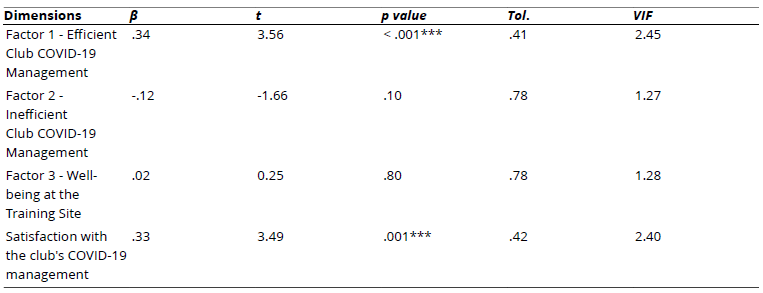
To include the independent variables, we checked that they were not collinear using the collinearity statistics (tolerance and VIF). The Durbin-Watson index showed a value of 2.06, indicating the assumption of independence of the variables taken as independent, concerning the dependent variables. As a result, a predictive model was obtained that explains 45% of the variance.
The results obtained show how the factor of efficient club COVID-19 management (ß = .34) and the degree of satisfaction with the club about COVID-19 management (ß = .33) significantly predict the future intentions of the runners in a positive sense (Table 4).
Coefficients of the Multiple Linear Regression Analysis Considering Runners' Future Intentions as the Dependent Variable
Note. R2 = .45; ΔR2 = .44; *** = p < 0.001; Durbin-Watson statistic = 2.06; Tol. = Tolerance; VIF = Variance Inflation Factor.
Discussion
It is important to know the perceptions of athletes about the management of Covid-19 in their clubs, as these may affect their satisfaction and intention to continue being members of the club. Both the future intentions and participations of runners in races or sporting events, as well as they continuity in sport clubs are uncertain (Maditinos et al., 2021). Lee and Lee, (2021), noted that the COVID-19 pandemic has had lifelong repercussions on traditional operating methods, especially in the service sector. Therefore, this crisis requires robust responses from organizations to combat the challenges they face while effectively adapting to the new normality to survive in the industry.
The findings of this study highlight the existence of three dimensions to measure such perceptions of sports users on the management of Covid-19 in clubs, which can help sports managers to make better decisions. Correct management of sports facilities, as well as the sports entity, is directly related to the possibility of increasing the number of people practicing physical sports activities in these facilities and clubs. For this reason, it is essential to carry out the necessary studies in sports centres to know the attitudes and opinions of users (Testa et al., 2023).
The first dimension of this scale is the perception of how well the club is being managed in terms of COVID-19. It is important to assess whether the decisions made have been appropriate by evaluating the actions taken, resources managed, and information provided to club members. Along these lines, the contingency theory proposes that aspects related to any circumstance should be identified so that the system can adapt to any eventuality (Lartey, 2020).
Therefore, identifying the resources that sports clubs have, as well as the possible ways to use them (measures) to adapt to the new normality, as well as the best way to communicate the measures to their members, can be of vital importance for the efficient management of COVID-19 in these organizations. According to Byers et al. (2022), the level of material reality is an important policy element that policies for COVID-19 management should consider. Hence, tangible actions taken by organizations should be based on the recommendations made to the relevant health agencies during the pandemic. Along these lines, sports club communities identified eight clusters of challenges related to returning to sports after COVID-19 closure, including club culture, health protocols, membership, facilities, and finances as the main ones (Staley et al., 2021). Therefore, considering all the challenges presented, managers of organizations should focus on consumer preferences to restructure their clubs and adapt to the new normality, always keeping their members informed of the changes.
The second dimension is the inefficient management of the club in terms of COVID-19. If users do not perceive that the measures taken in the club make it worthwhile to continue training or increase the stress, worries, and fears of the athletes, it may contribute to athlete dropout. One of the primary concerns for runners to return to training and sporting events is the fear of contagion (Maditinos et al., 2021; Seraphin, 2021). Moreover, after confinement, runners' motivations have shifted, with many now seeking disconnection and stress relief (DeJong et al., 2021). Therefore, the club management should take into account the opinion and preferences of the members when making decisions about the actions to be implemented. Failing to consider these opinions could result in decisions that are not perceived as appropriate by the members, thus increasing their stress levels, worries, and fears, and they may eventually decide to leave the club.
The third dimension is workplace well-being concerning COVID-19. Assessing the extent to which COVID-19 has impacted the well-being experienced at the training venue is another aspect for sports managers to consider (conflicts, stress, fears, and worries). Maintaining a high mood and good satisfaction among users who make use of facilities or are part of a club helps considerably to ensure permanence and attract more people to that club (Álvarez-García et al., 2019). Furthermore, DeJong et al. (2021) noted that runners' motivations during COVID-19 for running, in general, decreased and shifted from competition and socialization, stress relief, and leisure time occupation. Therefore, runners who perceive good levels of well-being in their club, free from perceptions such as fear, stress, and worry, may also be important for customer loyalty in the aftermath of this pandemic. The measures taken and resources invested in them should be in line with ensuring the health and safety of athletes and creating training environments where athletes feel safe. Ventilation or outdoor facilities, along with distancing and disinfection measures can be good strategies for this.
In terms of those variables most important to ensure the loyalty of running club members, which has also been one of the main challenges reported by sports clubs (Staley et al., 2021), efficient club management of COVID-19 proved to be a key variable. In this regard, it seems important to know the extent to which club sport consumers perceive that appropriate measures have been taken, and relevant resources have been used to manage the negative effects of COVID-19. Specifically, Wen et al. (2021) highlighted that runners would not attend overcrowded venues. Therefore, the importance of taking measures related to capacity is highlighted. In this line, the importance of considering the health and safety of athletes in races and sporting events is highlighted (Seraphin, 2021). Therefore, it seems that it is not so important the place or services offered by these clubs, but the security that is present in them regarding COVID-19. To this end, capacity control, maintaining the safety distance, and taking appropriate disinfection measures can be useful. But we must not forget the importance of keeping the members informed about the different measures and actions carried out by the club against COVID-19. To maintain such communication, social networks can be very useful (Annamalai et al., 2021; Hayes, 2022).
It is also important to maintain a high degree of satisfaction among the members of the running sports club regarding the management of COVID-19. Satisfaction has been a widely studied variable in the sport management literature, which has shown its direct and positive relationship with sports users' future intentions (García Pascual et al., 2019; Santini et al., 2021). These finding highlight that even in times of COVID-19, sports users’ satisfaction is particularly important. Therefore, managers of sports clubs should always keep in mind the importance of satisfying the needs of their customers. To this end, entrepreneurial orientation in sports clubs in times of crisis can be of great use (Escamilla-Fajardo et al., 2020; Hammerschmidt et al., 2021).
This study has a number of both theoretical and practical implications. Regarding the theoretical implications of the study, an instrument has been developed to measure the perceptions of sports consumers during COVID-19 in the sports domain. In addition, a contribution to the literature is made by presenting variables related to runners' intentions to remain in the club following the COVID-19 pandemic. It highlights how running club users' perceptions of efficient management in response to COVID-19, and their satisfaction with club’s management to COVID-19, are important variables.
As for the practical implications of the study, an evaluation tool was developed to help sports managers make better decisions regarding the management of COVID-19 or future crises that may arise. This tool not only helps sports managers enhance the management of sports clubs, positively influencing both member satisfaction and loyalty, but also provides a validated measurement instrument, allowing sport managers to objectively assess their users’ perceptions regarding any crisis management on any kind of sporting context by adapting the scale and manage their strategies based on the results obtained.
Additionally, the study highlights the importance of sports clubs implementing the necessary measures and using the necessary resources to deal with COVID-19 if they aim to build customer loyalty. However, it also underscores the need for sports club members to be sufficiently informed about the measures taken to manage COVID-19. Therefore, communication with members is a key aspect of sports management.
Conclusions
Sports clubs' consumers' perceptions about COVID-19 management are important for improving member satisfaction and achieving loyalty. Through the developed instrument, these perceptions can be measured by identifying three dimensions: (a) efficient Covid-19 club management, (b) inefficient Covid-19 Club management, and (c) well-being in the training facility. Managers of sports clubs should focus their attention primarily on improving their users' perception of efficient club management about COVID-19, as well as their satisfaction with it. This will enhance their runners' intentions to continue attending the sports club and, consequently, will have a direct impact on their loyalty to the club.
Finally, it should be noted that this study has several limitations. The first is the limited sample size, which is also specific to a particular sport. Therefore, future studies should replicate this research with a larger sample size including runners from different countries to cross-culturally validate this instrument. Additionally, it would also be interesting to replicate this study with sports clubs from other disciplines practiced both outdoors and indoors. Furthermore, this is a cross-sectional study, so it was not possible to verify whether members followed through on their intentions to continue attending the club. Therefore, future studies should consider analysing these variables using a longitudinal approach.
Ethics Committee Statement
The study protocol adhered to the principles of the Declaration of Helsinki, and approval from the Ethics Committee of the University of Valencia was not required because, according to the Ethics and Human Research Committee of this university, approval is not necessary to conduct an opinion survey on a topic or issue, professional situation, or satisfaction with certain matters.
Conflict of Interest Statement
The authors of this article declare that they have no competitive interests, commercial affiliations, or financial interests to disclose.
Funding
The authors declare that they received no financial support for the research, authorship, and/or publication of this article.
Authors’ Contribution
Conceptualization M.P. & G.F.; Methodology G.MH.; Validation P.D. & G.C.; Formal Analysis G.F.; Investigation G.F.; Data Curation G.MH.; Writing – Original Draft M.P.; Writing – Review & Editing G.C.; Supervision G.MH.; Project Administration P.D. Todos los autores han leído y están de acuerdo con la versión publicada del manuscrito.
Data Availability Statement
The data used for this research are available in the Figshare repository: https://doi.org/10.6084/m9.figshare.25160210.v1
References
Aldás, J. (2000). Problemas metodológicos de la evaluación de los modelos de exposición: especial referencia al caso español. In J. Bigné (Ed.), Temas de planificación de medios. ESIC.
Alghafary, N. A., Diabat, K. W., & Abuhawileh, M. A. H. (2021). The degree of availability of crisis management elements in the boards of directors of Jordanian football sport clubs in light of the coronavirus (COVID-19) pandemic. International Journal of Human Movement and Sports Sciences, 9(4), 781–790. https://doi.org/10.13189/saj.2021.090424
Álvarez-García, J., González-Vázquez, E., Del Río-Rama, M. de la C., & Durán-Sánchez, A. (2019). Quality in customer service and its relationship with satisfaction: An innovation and competitiveness tool in sport and health centers. International Journal of Environmental Research and Public Health, 16(20). https://doi.org/10.3390/ijerph16203942
Andreu Cabrera, E. (2020). Actividad física y efectos psicológicos del confinamiento por covid-19. Revista INFAD de Psicología. International Journal of Developmental and Educational Psychology, 2(1), 209–219. https://doi.org/10.17060/ijodaep.2020.n1.v2.1828
Annamalai, B., Yoshida, M., Varshney, S., Pathak, A. A., & Venugopal, P. (2021). Social media content strategy for sport clubs to drive fan engagement. Journal of Retailing and Consumer Services, 62. https://doi.org/10.1016/j.jretconser.2021.102648
Bagozzi, R. P., & Yi, Y. (1988). On the evaluation of structural equation models. Journal of the Academy of Marketing Science, 16(1), 74–94. https://doi.org/10.1007/BF02723327
Brooks, S. K., Webster, R. K., Smith, L. E., Woodland, L., Wessely, S., Greenberg, N., & Rubin, G. J. (2020). The psychological impact of quarantine and how to reduce it: rapid review of the evidence. The Lancet, 395(10227), 912–920.
Browne, M. W., & Cudeck, R. (1992). Alternative Ways of Assessing Model Fit. Sociological Methods & Research, 21(2), 230–258. https://doi.org/10.1177/0049124192021002005
Byers, T., Gormley, K. L., Winand, M., Anagnostopoulos, C., Richard, R., & Digennaro, S. (2022). COVID-19 impacts on sport governance and management: a global, critical realist perspective. Managing Sport and Leisure, 27(1–2), 99–107. https://doi.org/10.1080/23750472.2020.1867002
Byrne, B. M. (2013). Structural Equation Modeling with Mplus: Basic Concepts, Applications, and Programming. Routledge.
Chen, P., Mao, L., Nassis, G. P., Harmer, P., Ainsworth, B. E., & Li, F. (2020). Coronavirus disease (COVID-19): The need to maintain regular physical activity while taking precautions. Journal of Sport and Health Science, 9(2), 103–104. https://doi.org/10.1016/j.jshs.2020.02.001
Chou, C., & Bentler, P. (1995). Estimates and tests in structural equation modeling.
DeJong, A. F., Fish, P. N., & Hertel, J. (2021). Running behaviors, motivations, and injury risk during the COVID-19 pandemic: A survey of 1147 runners. PLoS ONE, 16(2). https://doi.org/10.1371/journal.pone.0246300
Dres Walter, A. D., & Bortolazzo, C. (2020). Impacto de la pandemia por covid-19 en los deportistas. Revista de La Asociación Médica Argentina, 133(4), 50–55.
Einsle, C. S., García-Fernández, J., & Escalera Izquierdo, G. (2024). TikTok video formats’ impact on user interaction – evidence from the Ocean Race. Managing Sport and Leisure, 30(5), 956–970. https://doi.org/10.1080/23750472.2024.2327506
Einsle, C. S., & Izquierdo, G. E. (2022). Modelo de impacto de redes sociales en atletas de un evento deportivo mediano. Revista Iberoamericana de Ciencias de La Actividad Física y El Deporte, 11(2), 58–76. https://doi.org/10.24310/RICCAFD.2022.V11I2.14150
Escamilla-Fajardo, P., Núñez-Pomar, J. M., Calabuig-Moreno, F., & Gómez-Tafalla, A. M. (2020). Effects of the COVID-19 pandemic on sports entrepreneurship. Sustainability, 12(20). https://doi.org/10.3390/su12208493
Ferrando, P. J., & Lorenzo-Seva, U. (2018). Assessing the Quality and Appropriateness of Factor Solutions and Factor Score Estimates in Exploratory Item Factor Analysis. Educational and Psychological Measurement, 78(5), 762–780. https://doi.org/10.1177/0013164417719308
Fitbit, R. (2020). The Impact Of Coronavirus On Global Activity. https://blog.fitbit.com/covid-19-global-activity/
Fornell, C., & Larcker, D. F. (1981). Evaluating Structural Equation Models with Unobservable Variables and Measurement Error. Journal of Marketing Research, 18(1), 39–50. https://doi.org/10.1177/002224378101800104
Füzéki, E., Groneberg, D. A., & Banzer, W. (2020). Physical activity during COVID-19 induced lockdown: Recommendations. Journal of Occupational Medicine and Toxicology, 15(1), 1–5. https://doi.org/10.1186/s12995-020-00278-9
García Pascual, F., Molina García, N., & Mundina Gómez, J. (2019). Influencia de la satisfacción y el valor percibido sobre el “Word of Mouth” en los usuarios de centros deportivos. SPORT TK-Revista EuroAmericana de Ciencias Del Deporte, 8(1), 29–36. https://doi.org/10.6018/SPORTK.362291
Hair, J. F., Black, W. C., Babin, B. J., & Anderson, R. E. (2019). Multivariate Data Analysis. Cengage Learning.
Hammerschmidt, J., Durst, S., Kraus, S., & Puumalainen, K. (2021). Professional football clubs and empirical evidence from the COVID-19 crisis: Time for sport entrepreneurship? Technological Forecasting and Social Change, 165. https://doi.org/10.1016/j.techfore.2021.120572
Hatcher, L. (1994). A Step-by-Step Approach to Using the SAS System for Factor Analysis and Structural Equation Modelling. SAS Institute. https://books.google.es/books?id=dqNku94w1dIC
Hayes, M. (2022). Social media and inspiring physical activity during COVID-19 and beyond. Managing Sport and Leisure, 27(1–2), 14–21. https://doi.org/10.1080/23750472.2020.1794939
Jiménez-Pavón, D., Carbonell-Baeza, A., & Lavie, C. J. (2020). Physical exercise as therapy to fight against the mental and physical consequences of COVID-19 quarantine: Special focus in older people. Progress in Cardiovascular Diseases, 63(3), 368–388. https://doi.org/10.1016/j.pcad.2020.03.009
Kline, R. B. (2015). Principles and Practice of Structural Equation Modeling. Guilford Publications.
Lartey, F. M. (2020). Chaos, Complexity, and Contingency Theories: A Comparative Analysis and Application to the 21st Century Organization. Journal of Business Administration Research, 9(1), 44–51. https://doi.org/10.5430/jbar.v9n1p44
Lee, S. M., & Lee, D. H. (2021). Opportunities and challenges for contactless healthcare services in the post-COVID-19 Era. Technological Forecasting and Social Change, 167. https://doi.org/10.1016/j.techfore.2021.120712
Lloret-Segura, S., Ferreres-Traver, A., Hernández-Baeza, A., & Tomás-Marco, I. (2014). El análisis factorial exploratorio de los ítems: una guía práctica, revisada y actualizada. Anales de Psicología, 30(3), 1151–1169. https://doi.org/10.6018/analesps.30.3.199361
MacCallum, R. C., & Austin, J. T. (2000). Applications of Structural Equation Modeling in Psychological Research. Annual Review of Psychology, 51(1), 201–226. https://doi.org/10.1146/annurev.psych.51.1.201
Maditinos, Z., Vassiliadis, C., Tzavlopoulos, Y., & Vassiliadis, S. A. (2021). Sports events and the COVID-19 pandemic: assessing runners’ intentions for future participation in running events–evidence from Greece. Tourism Recreation Research, 46(2), 276–287. https://doi.org/10.1080/02508281.2020.1847422
McShan, K., & Moore, E. W. G. (2024). Exploring How the COVID-19 Pandemic Impacted the Coach–Athlete Relationship for Travel Sport Coaches: A Qualitative Study. International Sport Coaching Journal, 1, 1–15. https://doi.org/10.1123/ISCJ.2023-0126
Mosqueira-Ourens, M., Sánchez-Sáez, J. M., Pérez-Morcillo, A., Ramos-Petersen, L., López-Del-amo, A., Tuimil, J. L., & Varela-Sanz, A. (2021). Effects of a 48-day home quarantine during the covid-19 pandemic on the first outdoor running session among recreational runners in spain. International Journal of Environmental Research and Public Health, 18(5). https://doi.org/10.3390/ijerph18052730
Nunnally, J. C. (1995). Teoría psicométrica. McGraw-Hill.
Parnell, D., Widdop, P., Bond, A., & Wilson, R. (2022). COVID-19, networks and sport. Managing Sport and Leisure, 27(1–2), 78–84. https://doi.org/10.1080/23750472.2020.1750100
Pitanga, F. J. G., Beck, C. C., & Pitanga, C. P. S. (2020). Should Physical Activity Be Considered Essential During the COVID-19 Pandemic? International Journal of Cardiovascular Sciences. https://doi.org/10.36660/ijcs.20200072
Prado-Gascó, V., Gómez-Domínguez, M. T., Soto-Rubio, A., Díaz-Rodríguez, L., & Navarro-Mateu, D. (2020). Stay at Home and Teach: A Comparative Study of Psychosocial Risks Between Spain and Mexico During the Pandemic. Frontiers in Psychology, 11. https://doi.org/10.3389/fpsyg.2020.566900
Sanderson, J., & Brown, K. (2020). COVID-19 and youth sports: Psychological, Developmental, and Economic Impacts. International Journal of Sport Communication, 13(3), 313–323. https://doi.org/10.1123/ijsc.2020-0236
Santini, F. D. O., Ladeira, W. J., Sampaio, C. H., Fagundes, A. F. A., & Henz, M. M. (2021). Satisfaction in sports: a meta-analytic study. Marketing Intelligence and Planning, 39(3), 408–423. https://doi.org/10.1108/MIP-01-2020-0004
Satorra, A., & Bentler, P. M. (1994). Corrections to test statistics and standard errors in covariance structure analysis. In Latent variables analysis: Applications for developmental research (pp. 399–419). Sage Publications, Inc. https://psycnet.apa.org/record/1996-97111-016
Seraphin, H. (2021). COVID-19: an opportunity to review existing grounded theories in event studies. Journal of Convention and Event Tourism, 22(1). https://doi.org/10.1080/15470148.2020.1776657
Smagacz-Poziemska, M., Borowski, M., Działek, J., & Łapniewska, Z. (2024). Post-crises (new) normality. Across social practices and speculative fictions. Futures, 155, 103292. https://doi.org/10.1016/J.FUTURES.2023.103292
Staley, K., Randle, E., Donaldson, A., Seal, E., Burnett, D., Thorn, L., Forsdike, K., & Nicholson, M. (2021). Returning to sport after a COVID-19 shutdown: understanding the challenges facing community sport clubs. Managing Sport and Leisure, 1–21. https://doi.org/10.1080/23750472.2021.1991440
Tanaka, J. S., & Huba, G. J. (1989). A general coefficient of determination for covariance structure models under arbitrary GLS estimation. British Journal of Mathematical and Statistical Psychology, 42(2), 233–239. https://doi.org/10.1111/J.2044-8317.1989.TB00912.X
Testa, L., Parra-Camacho, D., Gómez-Tafalla, A. M., Garcia-Pascual, F., & Duclos-Bastías, D. (2023). Local Impact of a Sports Centre: Effects on Future Intentions. Sustainability, 15(6), 5550–5550. https://doi.org/10.3390/SU15065550
Wen, J., Kozak, M., Yang, S., & Liu, F. (2021). COVID-19: potential effects on Chinese citizens’ lifestyle and travel. Tourism Review, 76(1), 74–87. https://doi.org/10.1108/TR-03-2020-0110
Wunsch, K., Kienberger, K., & Niessner, C. (2022). Changes in Physical Activity Patterns Due to the COVID-19 Pandemic: A Systematic Review and Meta-Analysis. International Journal of Environmental Research and Public Health, 19(4), 2250. https://doi.org/10.3390/ijerph19042250
Yeo, T. J. (2020). Sport and exercise during and beyond the COVID-19 pandemic. European Journal of Preventive Cardiology, 27(12), 1239–1241. https://doi.org/10.1177/2047487320933260
Zeithaml, V. A., Berry, L. L., & Parasuraman, A. (1996). The Behavioral Consequences of Service Quality. Journal of Marketing, 60(2), 31–46. https://doi.org/10.1177/002224299606000203
Author notes
Correspondence: Cristian Gregori-Faus, cristian.gregori@uv.es
Additional information
Short title: Perceptions of Pandemic Management
How to cite this article: Montoro, P., González-Serrano, M.H., García-Pascual, F., Gregori-Faus, C. & Parra-Camacho, D. (202X). Analysis of athletic clubs members' perceptions of pandemic management: validation of a scale. Cultura, Ciencia y Deporte, 21(67), 2207. https://doi.org/10.12800/ccd.v21i67.2207


