
UNDERSTANDING SOCCER FAN LOYALTY: THE ROLE OF REPUTATION, BRAND ASSOCIATIONS, AND FAN TRAITS IN ECUADOR
ENTENDIENDO LA LEALTAD DE LOS AFICIONADOS AL FÚTBOL: EL PAPEL DE LA REPUTACIÓN, LAS ASOCIACIONES DE MARCA Y LOS RASGOS DE LOS AFICIONADOS EN ECUADOR


Washington Macías, Katia Rodríguez, Danny Arévalo
UNDERSTANDING SOCCER FAN LOYALTY: THE ROLE OF REPUTATION, BRAND ASSOCIATIONS, AND FAN TRAITS IN ECUADOR
Cultura, Ciencia y Deporte, vol. 21, no. 67, 2026, 10.12800/ccd.v21i67.2204
Universidad Católica San Antonio de Murcia
Washington Macías a
Facultad de Ciencias Sociales y Humanísticas, Escuela Superior Politécnica del Litoral, Ecuador
Katia Rodríguez
Facultad de Ciencias Sociales y Humanísticas, Escuela Superior Politécnica del Litoral, Ecuador
Danny Arévalo
Facultad de Ciencias Sociales y Humanísticas, Escuela Superior Politécnica del Litoral, Ecuador
Received: 24 April 2024
Accepted: 29 June 2025
Abstract: This paper explores the factors influencing brand loyalty among soccer fans in Ecuador, drawing on organizational reputation, brand equity, and fan traits’ literature. The research uses a sample of 216 Ecuadorian soccer fans, an internet-based survey, and applies a Partial Least Squares Structural Equation Modeling (PLS-SEM) estimation. The study finds that three key factors significantly influence fan loyalty: team reputation, fan identification with the team, and sport involvement. Stadium atmosphere, a non-product related attribute, demonstrates a weak association with loyalty, potentially influenced by data collection during the COVID-19 pandemic when stadium attendance was restricted, which is a limitation of the study. Another limitation is the possible selection bias resulting from an Internet survey. While prior research in Latin America (e.g., Brazil and Peru) has examined loyalty and behavioral intentions from a narrower theoretical approach, the proposed model contributes by integrating concepts from organizational reputation, brand equity, and fan traits. Furthermore, this research is the first empirical investigations of its kind in the Ecuadorian context, nurturing Latin American sports marketing research. Managerially, the study suggests that soccer clubs should focus on building and maintaining a positive team reputation, fostering fan identification, and engaging fans through various sport-related domains to enhance loyalty.
Keywords: Brand loyalty, fan identification, sport involvement, stadium atmosphere, team reputation.
Resumen: Este trabajo explora los factores que influyen en la lealtad de los aficionados de equipos de fútbol en Ecuador, basándose en la literatura sobre reputación organizacional, asociaciones de marca y rasgos de los aficionados. La investigación utiliza una muestra de 216 aficionados ecuatorianos, una encuesta por Internet y estima ecuaciones estructurales por Mínimos Cuadrados Parciales (PLS-SEM, por sus siglas en inglés). El estudio concluye que tres factores clave influyen significativamente en la lealtad de los aficionados: la reputación del equipo, la identificación del aficionado con el equipo y el involucramiento con el deporte. El ambiente del estadio, un atributo no relacionado con el producto, muestra una débil asociación con la lealtad, posiblemente por la recogida de datos durante las restricciones de aforo en los estadios por la pandemia COVID-19, lo que constituye una limitación del estudio. Otra limitación es el posible sesgo de selección resultante de la encuesta por Internet. Mientras las investigaciones anteriores en América Latina (por ejemplo, Brasil y Perú) han examinado la lealtad y las intenciones de comportamiento desde un enfoque teórico más acotado, el modelo propuesto contribuye integrando conceptos de reputación organizativa, capital de marca y rasgos de los aficionados. Además, esta es la primera investigación empírica de este tipo en el contexto ecuatoriano, nutriendo la investigación del marketing deportivo latinoamericano. Para la gestión deportiva, el estudio sugiere que los clubes de fútbol deberían centrarse en construir y mantener una reputación positiva del club, fomentar la identificación de los aficionados e involucrarlos a través de diversos canales relacionados con el deporte para aumentar la lealtad.
Palabras clave: Ambiente del estadio, identificación del aficionado, involucramiento con el deporte, lealtad de marca, reputación del equipo.
Introduction
A study by Brand Finance (2022) shows that soccer is the most popular sport in six of eight countries surveyed (excluding China and the United States). Brazil, the only Latin American country included, reflects this trend with 40% of respondents citing soccer as their favorite sport and 65% following it. Similarly, Nielsen (2022) concluded that soccer is the world’s most popular sport, capturing the interest of 40% of the global population. The FIFA World Cup Qatar 2022 further supports this claim, with the opening match between Qatar and Ecuador attracting over 550 million viewers, and the final between Argentina and France reaching nearly 1.5 billion (FIFA, 2023).
Soccer's popularity requires management and marketing that innovate, improve product and service quality, and effectively engage fans to generate economic value for teams. In South America, CONMEBOL has reformed competition formats and entertainment standards to increase tournament competitiveness and revenue, resulting in record attendance, digital participation, and increased financial contributions to clubs and national teams (CONMEBOL, 2023). Nevertheless, many South American leagues continue to face structural and financial challenges, such as difficulties in paying salaries, taxes, and other basic expenses (Quispe & Rivera, 2018; Rosas, 2020; Larrea, 2024).
Soccer marketing in Ecuador varies depending on the size and success of the team (Rosas, 2020). Clubs with larger fan bases or more success, such as Barcelona, Emelec, Liga de Quito and Independiente del Valle, have more established marketing departments. Their main activities include sponsorship deals, stadium tickets promotions and season ticket sales. As a newer club, Independiente del Valle focuses on digital strategies to attract younger audiences. While top teams prioritize digital media, smaller clubs still rely on traditional outlets. Official merchandise is licensed but limited in variety, and teams hold pre-season events to showcase players and kits. Barcelona stands out for its international marketing, leveraging its “Noche Amarilla” event abroad (ESPN, 2024). Broadcast rights, managed by Liga Pro, are a major revenue stream, especially for smaller clubs that rely on them for over 70% of their budgets (Larrea, 2024). Despite these efforts, innovation in Ecuadorian soccer marketing is lacking, and financial constraints continue to limit the capacity of smaller teams. In this scenario, understanding fan attitudes and behavior becomes crucial, as fans are the primary consumers of soccer-related products and services.
One central concept in sports marketing is loyalty. For soccer teams, cultivating a loyal fan base is vital, as loyalty translates into actions like attending games, watching matches, and purchasing merchandise (Prado-Román et al., 2019). A loyal fan base can also justify better broadcasting deals, attract sponsors, and generate advertising revenue (Stevens & Rosenberger, 2012). Several studies show that loyalty is preceded by brand image and brand reputation (Nguyen & Leblanc, 2001; Da Rosa et al., 2014; Prado-Román et al., 2019), where both constructs are made up of various associations in the minds of fans and the general public.
Brand equity in sports is considered an emerging topic in the last decade (Rojas-Lamorena et al., 2022). Brand equity dimensions, such as brand awareness, associations or image, and loyalty are the basis for the perceived added value consumers achieve when interacting with a brand (Aaker, 1991; Keller, 1993; Yoo et al., 2000; Buil et al., 2013; Ansary & Hashim, 2018). Among these, brand associations are considered central (Keller & Brexendorf, 2019). Associations regarding a sports brand are classified into product-related attributes, non-product related attributes, and benefits (Gladden & Funk, 2002; Bauer et al., 2008). Product-related attributes are those related to the core product (soccer games in this study), such as squad perceived quality and performance on pitch. Non-product related attributes are external aspects of the core product that are relevant to its consumption and, consequently, influence perceptions of the club brand (although do not necessarily affect team performance, from the consumer’s perspective), such as management, club history and tradition, stadium, and regional provenance, among others. The benefits include symbolic and experiential benefits (Gladden & Funk, 2002; Bauer et al., 2008).
Sports team reputation, meanwhile, is defined as the collective perception of a club based on fans’ and stakeholders’ previous experiences (Jang et al., 2015). These perceptions include team performance, history, social commitment, spectator orientation, management quality and financial stability. As several of the associations that constitute brand image are included in the reputation construct, in this study we use reputation as one of the main variables, and we complement it with a non-product related attribute such as stadium atmosphere, and spontaneous associations that capture any other type of attribute, benefit or sensation evoked by the brand. This broader approach seeks to better reflect how the public perceives a sports brand.
There is also literature that relates loyalty with two fans’ traits widely studied in the sports arena, such as fan identification with the team (Gray & Wert‐Gray, 2012; Arroba-Jaroso et al., 2021) and involvement with the sport (Stevens & Rosenberger, 2012; Rosenberger III et al., 2019).
Few studies have examined these variables in Latin America. Da Rosa et al. (2014), in Brazil, found that team image positively influences psychological commitment, which in turn drives behaviors like attending games, consuming media, and buying merchandise. Rosenberger III et al. (2019) also analyzed the psychological factors influencing both behavioral and attitudinal loyalty in Brazil. In Peru, Quispe and Rivera (2018) found that identification, self-expression, and satisfaction impact intentions to attend matches, consume media, and purchase products, although they did not directly study attitudinal loyalty. Additionally, Harrolle et al. (2010) found that emotional reactions to teams were stronger predictors of loyalty among Latino baseball fans than among non-Latino fans, highlighting the need for research in the Latin American context to gain a better understanding of sports fans in this region. Despite these contributions, no study to date has integrated brand equity, reputation, and fan traits into a single model to explain loyalty, and even less so in the Ecuadorian case.
Given the importance of the described variables in achieving desired fan attitudes and behaviors that add value to soccer brands, and the lack of studies that comprehensively integrate these variables into a framework, the purpose of this research is to analyze the effects of reputation, other brand associations, and fan traits on brand loyalty, using a sample of Ecuadorian soccer fans. This research fills several gaps in the extant literature on the subject. First, as mentioned above, existing studies offer narrow perspectives to explain loyalty, while the present work proposes a model that integrates several relevant perspectives. Second, loyalty to sports clubs, and particularly soccer clubs, has been scarcely studied in the Latin American context. The present study aims to contribute to the sports literature in a country that shares realities with several Latin American countries, especially in terms of financial difficulties (Quispe & Rivera, 2018; Larrea, 2024). A comprehensive understanding of the drivers of fan loyalty can help clubs improve marketing efforts and stabilize revenues.
The remainder of this section presents the theoretical framework guiding this research.
Loyalty
Loyalty is defined as a strong commitment to consistently repurchase or continue patronizing a favored product or service in the future. This leads to a repeated pattern of choosing the same brand, even when external factors or marketing attempts might tempt a consumer to switch brands (Oliver, 1999). Thus, loyalty comprises both attitudinal and behavioral aspects. Behavioral definitions of sports fans’ loyalty refer to how individuals demonstrate their support for a particular sports team, based on observable actions. Some common behaviors of loyal sports fans include attendance at games, media content viewing and merchandise purchases (Biscaia et al., 2013). On the other hand, the attitudinal definition of fan loyalty is the psychological commitment of a fan to a team, understood as an internal attachment to the favorite team, which is also persistent over time (Bauer et al., 2008). Focusing on attitudinal loyalty enables us to avoid biased evaluations of fans who exhibit "spurious" loyalty during a team's success. When a team is successful, it typically attracts new fans who begin attending games or following the team through broadcast media. As long as the team remains successful, people are eager to attend games, buy team merchandise, and watch broadcasts. Nonetheless, when the team's performance declines, these fans often reduce their support for the team. The concept of spurious loyalty underscores the challenges of relying solely on behavioral indicators, especially when these indicators are observed over several years of outstanding team performance (Gladden & Funk, 2002). Taking this into account, this study adopts the attitudinal conceptualization of loyalty.
Reputation
In a general context, reputation has been defined as the aggregation of perceptions of how well organizational responses are meeting the demands and expectations of different stakeholders (Wartick, 1992, as cited in Nguyen & Leblanc, 2001). In the sport field, Jang et al. (2015) propose that these perceptions are related to:
-
Team Performance: The extent to which spectators evaluate the sports team's on-field performance and its correlation with the team's overall success.
-
Team history: How spectators perceive the overall accomplishments of the sports team and its historical success, encompassing achievements in both sports and business domains.
-
Team social commitment: The viewer's assessment of the sports team's dedication to fostering relationships and contributing to community development.
-
Spectator orientation: The extent to which the sports team prioritizes and demonstrates concern for their spectators.
-
Management quality: The viewer's evaluation of the sports team's managerial excellence and strategic foresight when compared to similar organizations.
-
Financial stability: The viewer's perspective on the financial robustness and profitability of the sports team.
Jang et al. (2015) conceptualization encompasses various stakeholders of a soccer team, such as the fans, investors, and society; in line with the organizational definition (Wartick, 1992). An organization that has been successful in building a strong reputation among the public, due to several satisfactory interactions, can contribute to build better attitudinal loyalty (Yousaf et al., 2020). A positive corporate reputation lends credibility to a brand's offerings and ultimately fosters customer loyalty through repeat engagement (Bartikowski & Walsh, 2011). In the service industry, Nguyen and Leblanc (2001) found that corporate image and reputation influence customer loyalty. In the sport setting, Yousaf et al. (2020) showed a significant and positive relationship between team reputation and re-engagement intention among Indian cricket fans. Therefore, we propose the following hypothesis:
H1: Team reputation is positively associated to team loyalty.
Other Brand Associations
Based on the Associative Network Model (ANM) (Teichert & Schöntag, 2010), brand associations are defined as the connections between the brand node and a variety of aspects that build brand image, such as product category, attributes, sensations, experiences, etc. (Ansary & Hashim, 2018; Keller & Brexendorf, 2019; Tasci, 2021). Several authors have recognized that brand associations are important bases underlying brand equity (Aaker, 1991; Farquhar, 1989; Keller & Brexendorf, 2019). Strong, favorable, and unique brand associations can enhance brand preference, differentiation against competitors, and other positive responses (Keller, 2001). Sürücü et al. (2019) show that brand image influences consumer´s brand equity in a broad sense. In the context of soccer, Biscaia et al. (2016) relate brand associations with behavioral intentions, such as attending matches, recommend team games to others, and purchase team products. Buil et al. (2013), and Bauer et al. (2008) in the sport setting, show that brand associations positively relate to brand loyalty, a dimension considered as the highest ranked within brand equity (Aaker, 1991; Kaynak et al., 2008; Macias et al., 2024). Among the associations related to a soccer team brand, its stadium is where the matches take place and is the place where the fans have experienced intense moments, whether good or bad, contributing to the team brand image (Gladden & Funk, 2002; Bauer et al., 2008; Kaynak et al., 2008). Kogoya et al. (2022) showed a positive correlation between the stadium atmosphere and spectator satisfaction at a mega sport event in India. Rosenbaum et al. (2018) argue that open and natural environments could contribute to people's sense of well-being and foster interactions, applying this approach to commercial settings. Consumers may be innately driven to patronize consumption venues with these characteristics in order to achieve well-being. Based on these arguments, fans who perceive the stadium environment as an open, green place where they can interact with others may develop an attitude toward following the team at its venue. Consequently, we hypothesized about stadium atmosphere and other brand associations:
H2: Stadium atmosphere is positively associated with team loyalty.
H3: Better brand associations are related to greater team loyalty.
Social Identification Theory
Tajfel coined the term social identity, which he defined as “that part of an individual’s self-concept which derives from his knowledge of his membership of a social group(s) together with the value and emotional significance attached to that membership” (Tajfel, 1981, p. 255). Deitz et al. (2012) explain that people make social classifications to position themselves and determine the social status of others within a social environment, and this process has a significant impact on their attitudes and behaviors.
People may have several social identities, including the one derived from being fan of a sport team. Fan identification is the perceived connectedness a fan has with a team, represented by the extent to which a fan believes the team is an extension of his or herself (Mael & Ashforth, 1992; Stevens & Rosenberger, 2012). It has been demonstrated that social identification with a team influences favorable fans’ cognitive, affective, and behavioral responses (Madrigal, 2000; Gwinner & Swanson, 2003). The sense of belonging to a team and the spaces of collective identification (matches, fan fests, teams’ museums, etc.) promote several favorable feelings, emotions, and interaction and consumption patterns among fans (Arroba-Jaroso et al., 2021). According to Yoshida et al. (2014), the more identified an individual is with the team, the more likely the individual acts in the team’s best interest, while less-identified individuals merely seek their benefits. Winand et al. (2021) explain that identified fans are more open to attending games even when their team is struggling, a behavior attributed to truly loyal fans. Empirically, Wang and Tang (2018) showed that fan identification influences a general construct of fan-based brand equity for baseball teams. Other researchers in the sport field have found that fan identification conducts to behavioral and attitudinal team loyalty (Stevens & Rosenberger, 2012; Argan & Özgen, 2019). Therefore, the next hypothesis is:
H4: Fan identification positively influences team loyalty.
Sport Involvement
Shank and Beasley (1998) defined sport involvement as ‘‘the perceived interest in and personal importance of sports to an individual’’ (p. 436). Highly involved consumers tend to develop more entrenched and committed attitudes toward a product or brand, making them less susceptible to persuasion or change (Coulter et al., 2003). The greater the involvement with sport, the greater participation in activities related to the sport and their favorite team, strengthening the emotional bond between the individual and the team (Bennett et al., 2009). Stevens and Rosenberger (2012) argue that fans with a high level of sport involvement demonstrate greater attitudinal loyalty to their preferred team and, in fact, exhibit behavioral expressions of loyalty, such as attending games, watching the team on TV, and spreading positive word-of-mouth. These authors demonstrate a positive relationship between fans’ involvement with rugby and a joint construct of attitudinal and behavioral loyalty to their team. In a previous study in Brazil (Rosenberger III et al., 2019), interest in soccer was found to be positively associated with behavioral loyalty. Based on these antecedents, we propose:
H5: Soccer involvement positively relates to team loyalty.
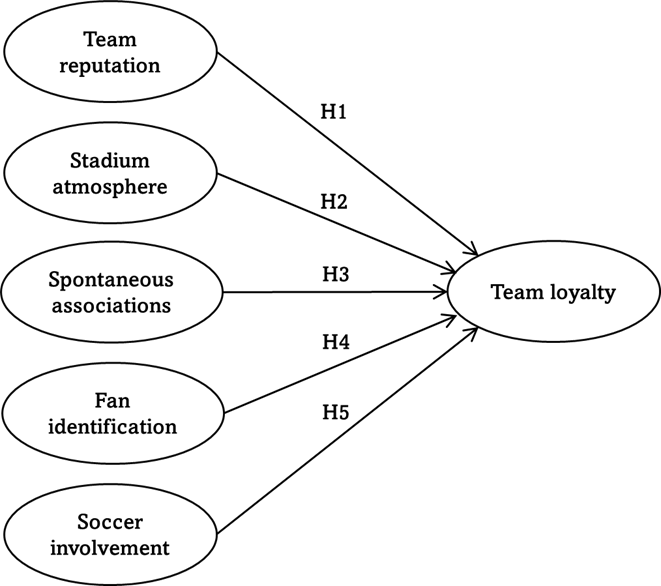
Figure 1
Conceptual Model
Materials and Methods
Sampling and Instrument
An unrestricted self-selective internet-based survey (Fricker, 2008) was used in the present study. This convenience sampling is justified considering the limitation to determining the sampling frame of soccer fans. The data were collected in June 2021 in Ecuador. A total of 222 responses were obtained. After removing observations with zero variance, 216 responses were used for the analysis, meeting the requirement for PLS-SEM estimation of 10 times the maximum number of arrowheads pointing to a latent variable within the path model (Hair et al., 2022). In this study, the minimum sample size should be 50 observations. Furthermore, the sample size is similar to other studies on Latin American fans (Da Rosa et al., 2014; Harrolle et al., 2010).
Most measurement scales were adapted from prior studies (Table 1). Loyalty (LOY) used four items from Yun et al. (2021) plus one new item on following the team regardless of league standing. Reputation (REP) included seven items from Yousaf et al. (2020). Fan identification (FANID) and involvement (INV) used five items each from Deitz et al. (2012) and Shank and Beasley (1998), respectively. One new item assessed stadium atmosphere (STA). All variables, except spontaneous associations (ASSO), were measured with Likert scales. ASSO was captured through an open-ended question and coded on a numerical scale using Rocklage and Fazio (2015) procedure (from 1=extremely negative to 5=extremely positive). Demographics included gender (Male = 1), income (≥ $751 = 1), and age (years).
Most measurement scales were adapted from prior studies (Table 1). Loyalty (LOY) used four items from Yun et al. (2021) plus one new item on following the team regardless of league standing. Reputation (REP) included seven items from Yousaf et al. (2020). Fan identification (FANID) and involvement (INV) used five items each from Deitz et al. (2012) and Shank and Beasley (1998), respectively. One new item assessed stadium atmosphere (STA). All variables, except spontaneous associations (ASSO), were measured with Likert scales. ASSO was captured through an open-ended question and coded on a numerical scale using Rocklage and Fazio (2015) procedure (from 1=extremely negative to 5=extremely positive). Demographics included gender (Male = 1), income (≥ $751 = 1), and age (years).
Constructs' Items, Reliability, and Convergent Validity
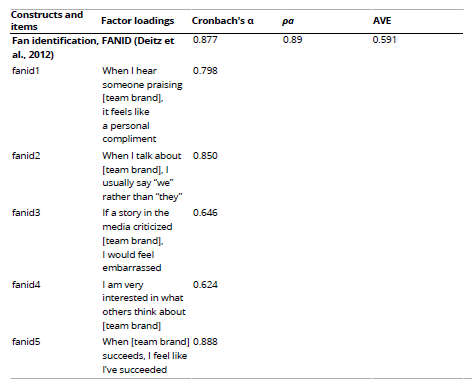
Constructs' Items, Reliability, and Convergent Validity
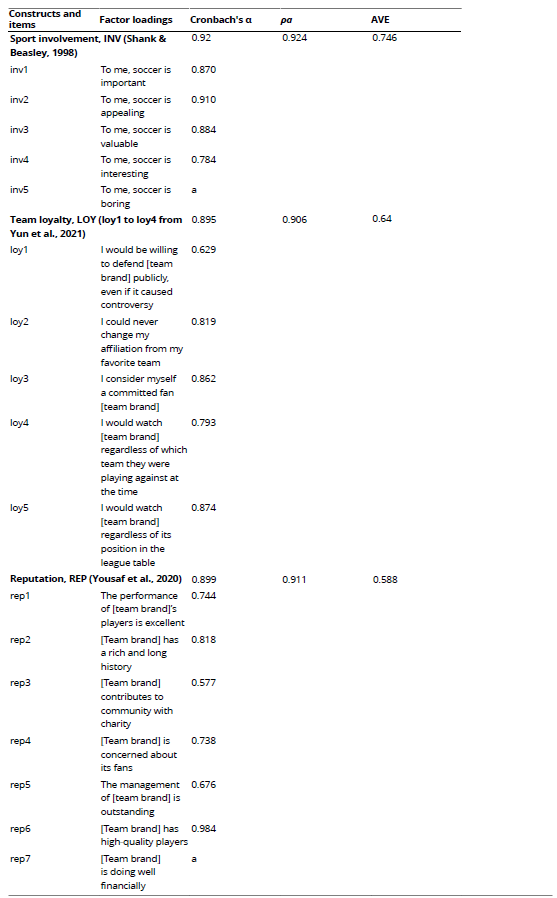
Constructs' Items, Reliability, and Convergent Validity
Note. a = Excluded due to low factor loadings.
Statistical Analysis
Measurement Model
Measurement scales’ internal consistency was evaluated using Cronbach’s alpha and Composite Reliability (ρa). Convergent validity was assessed via Average Variance Extracted (AVE), while discriminant validity was tested using the Heterotrait-Monotrait (HTMT) ratio, which outperforms the Fornell-Larcker criterion (Henseler et al., 2015). An analysis to detect common method bias (CMB) was also performed. Confirmation of the absence of CMB indicates that systematic bias associated with the data collection process has been minimized, ensuring the internal validity and reliability of the results.
Structural Model
To test the theoretical model (Figure 1), a structural equation model was estimated using Partial Least Squares (PLS) in SmartPLS 4 (Ringle et al., 2022). PLS is suitable for small samples and complex models with many latent variables (Hair, Risher et al., 2019). Structural model evaluation included coefficient significance, effect sizes, and model fit via R² and adjusted R². Predictive performance (Q²) was assessed using the PLSpredict procedure in SmartPLS 4.
Results
Measurement Model
Factor loadings should ideally exceed 0.7 (Hair, Risher et al., 2019). Most met this criterion (Table 1), while some were between 0.4 and 0.7 an acceptable range for maintaining content validity. Constructs with such loadings still showed good internal consistency, so it was not necessary to remove items. Loadings below 0.4 are unacceptable, so one item from sport involvement and one from reputation were dropped. Overall, the retained items ensured the reliability and validity of the constructs without compromising measurement quality.
Table 1 also shows the Cronbach's alpha and composite reliability (ρa) for the study constructs above the suggested threshold of 0.7 (Hair, Risher et al., 2019), confirming internal consistency. The AVE compares how much variance captured by the indicators is attributable to the construct they are intended to measure, relative to how much variance is due to measurement error. A high AVE (generally greater than 0.5) suggests that the construct has good convergent validity (Hair, Risher et al., 2019), a condition that was met for all constructs in this study.
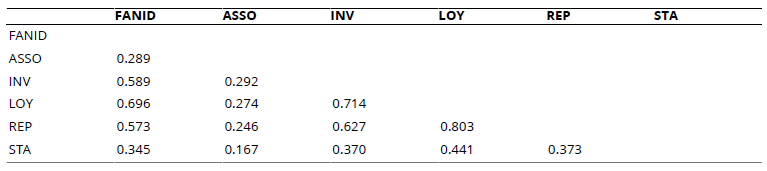
The HTMT ratios matrix compares correlations between indicators of different constructs (heterotrait correlations) with correlations between indicators of the same construct (monotrait correlations). For discriminant validity to be met, HTMT ratios below 0.85 are recommended (Henseler et al., 2015), a condition that was also met in this study (Table 2).
HTMT Ratios Matrix
For CMB assessment, the multicollinearity approach suggested by Kock (2015) was performed. The variance inflation factor (VIF) values were less than 3 for all constructs, so there are no multicollinearity problems among the study variables.
Structural Model
Table 3 reports the coefficients, their significance tests, and bootstrap confidence intervals (10,000 samples) for the exogenous and control variables in the model. Reputation, fan identification, and involvement are significant in explaining fan loyalty, supporting H1, H4, and H5, respectively. There is weak support for H2 since stadium atmosphere is only significant at the 0.10 level. Other spontaneous associations are not significant, not supporting H3. The control variables are also not significant. Hair, Risher et al. (2019) indicate that f 2 values of 0.02, 0.15, and 0.35 represent small, medium, and large effects of the exogenous latent variables, respectively. Values less than 0.02 indicate that there is no significant effect. In this case, reputation has a very large effect on loyalty, fan identification and sport involvement have near to medium effect, while the stadium atmosphere has a small effect. Other associations have no meaningful effect on loyalty (Table 4).
Path Coefficients
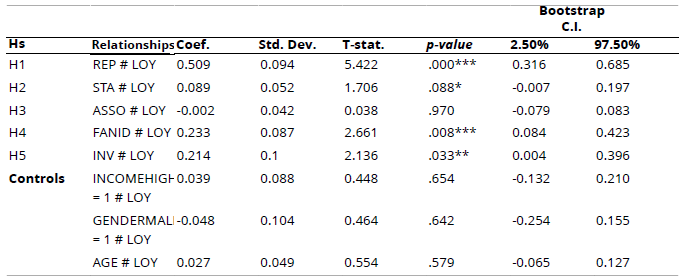
Note. * p < .10. ** p < .05. *** p < .01.
Effect Sizes

The model fit is good, as R 2 and adjusted R 2 are 0.77 and 0.76, respectively. Predictive power in the context of structural equation modeling refers to the ability of the PLS model to accurately predict future or unknown values of a dependent variable. In this sense, the value of Q2 = 0.63 indicates that the proposed model has significant predictive power on loyalty.
Discussion
Our study shows that three of the five exogenous variables — fan identification, sport involvement, and team reputation — significantly influence fan loyalty to soccer teams. These findings align with prior research. Stevens and Rosenberger (2012) found positive links from sport involvement and fan identification to loyalty among Australian rugby fans. Similarly, Quispe and Rivera (2018) reported that fan identification influenced loyal behaviors in Peruvian soccer fans, while Rosenberger III et al. (2019) confirmed a relationship between soccer interest and behavioral loyalty in Brazil. Argan and Özgen (2019) also found that Turkish soccer fans’ identification positively affected attitudinal and behavioral loyalty. A systematic review by Arroba-Jaroso et al. (2021) concluded that a strong sense of belonging leads to increased fan consumption, including attending matches, buying merchandise, and following teams on television or social networks. Regarding reputation, Yousaf et al. (2020) found a significant positive relationship between team reputation and re-engagement intentions of Indian cricket fans, a construct similar to team loyalty. Likewise, Rosenberger III et al. (2019) demonstrated a connection between team image and behavioral loyalty, using an image measurement closely aligned with our measure of reputation.
Balaji and Chakraborti (2015) suggested that stadium atmosphere could influence attendance and satisfaction with the sport event. Kogoya et al. (2022) showed that stadium atmosphere was positively correlated with spectator satisfaction at a mega sport event in India. However, in our study, there was weak support for H2 (STA → LOY). The STA’s coefficient showed a p-value of 0.088, with a small but significant effect size. This result may be related to a limitation of the study, which is the fact that the data were collected in times of COVID-19 pandemic (June 2021, 15 months after the beginning of the lockdown), when there were still restrictions to go to stadiums in Ecuador and in many other countries. This restriction mainly affects this variable. The question was posed by asking respondents to assume that stadium capacity restrictions would be lifted and, in that context, to rate the stadium atmosphere as a driver for supporting the team. It is likely that there was no recent memory of the stadium atmosphere in the minds of the fans, which reduced the significance of this variable. Another plausible explanation relates to the study by Santana and Tocora (2022) for a soccer team in Mexico. These authors explain that stadium experience could explain stadium attendance, an indicator of behavioral loyalty, but this does not necessarily affect attitudinal loyalty, which is a persistent long-term construct. In the same way, Cho et al. (2019) proposed that the stadium environment does not influence attitudinal loyalty, but rather the two constructs interact to influence the intention to attend the stadium (related to behavioral loyalty). Yoshida et al. (2021) showed a weak and indirect effect of stadium atmosphere on the number of planned future visits (a measure of behavioral loyalty) by baseball fans. In short, the evidence tends to point to the effect of stadium atmosphere on behavioral loyalty, but not necessarily on attitudinal loyalty. More research on stadium atmosphere or environment is needed to clarify the possible relationship with attitudinal loyalty.
The variable reflecting other brand associations was not significant. It is likely that, taken together, the team reputation and stadium atmosphere variables largely reflected the team's brand image in the consumer's mind, so this residual variable was not significant.
Conclusions
Managerial Implications
Team reputation plays a key role: the reputation of the sports team was highlighted as an important factor in loyalty formation. The results suggest that a team with a good reputation is more likely to retain loyal fans. Of course, achieving this level of reputation takes a long time, as it has to do with the team's sports planning, its sporting achievements over time, and even social activities that the organization undertakes to enhance its reputation. Small soccer teams can effectively engage with local communities or small towns by leveraging their unique position to foster positive community perceptions and attitudes. It has been shown that when small teams engage in socially responsible initiatives, residents often feel grateful for these initiatives and generate greater subjective well-being and community pride (Kim et al., 2019), which can lead to greater identification with the team and improved reputation. In addition, the overall management must support sporting performance. Without proper planning that conceives the team as an organization with different interconnected areas (sports planning, logistics, finance, marketing, general management), the sustainability of achievements over time will not be possible and the reputation will be diminished.
Involvement with the sport influences loyalty. This indicates that fans who are more involved in sports in general tend to be more loyal to their specific team. These fans engage in more sport-related activities and seek information about it. As an implication for the soccer club as an organization, we recommend that the team's brand seeks to be present in the different domains derived from the sport; sports programs on television or social networks, social or recreational activities related to soccer, video games, sports betting platforms, among others.
The most important fans’ trait for building loyalty is fan identification with the team. This finding suggests that when fans feel deeply connected and emotionally engaged with the team, they tend to be more loyal. As a managerial implication, sports clubs need to promote fan identification in many ways. This includes promoting areas such as the club museum, events with autograph signings and photos with players and team mascots, season openers and team presentations, enhancing the atmosphere in the stadium with more entertainment activities, even using immersive technologies, creating team’s programs in traditional and digital media, reliving the team's greatest achievements, interacting with fans on social networks, creating memberships with special benefits such as special prices on merchandise and tickets, exclusive events, or congratulating members on their birthdays. It is about thinking beyond the price of the ticket to encourage them to go to the stadium. It is about creating a long-term commitment, a way of living where there is always more room for the team. In this way, the price and other access difficulties will be less and less of an obstacle to having the fan in the stadiums, to buy the matches through audiovisual media or to buy the team's merchandise. Smaller or less well-resourced clubs, which are more likely to struggle to meet their budgets, can make greater use of social media to build team engagement without the need for large investments. As platforms evolve, personalization and advanced segmentation will make it easier to deliver targeted content to different groups of fans, which will help improve the team's connection with the community (Appel et al., 2020). This is relevant, above all, in trying to attract younger fans, for whom social media has become the primary domain in which they receive large amounts of information, share content and aspects of their lives with others (Appel et al., 2020).
We consider these findings to be relevant for sports management not only in Ecuador, but also in Latin America. As previously highlighted, numerous teams across various leagues encounter financial challenges, underscoring the imperative for enhanced management of potential revenue sources. Furthermore, as argued by some experts, a common factor in this region is that fan identification with sports teams is extremely high, leading to much higher levels of loyalty than those observed in other areas of marketing (García-Fernández et al., 2025).
Contributions, Limitations, and Future Research
The main theoretical contribution of this study is to integrate concepts from the literature on organizational reputation, brand equity and fan traits as antecedents of loyalty into a single model. To the best of our knowledge, no previous study has focused on complementing these perspectives. The study also contributes to our understanding of loyalty to soccer teams in Latin America. To date, few studies have been performed on the subject of fan loyalty or similar constructs in this region, which is under-represented in the sports marketing literature, despite the presence of a significant fan base following soccer.
This model highlights the significance of the soccer team's reputation, understood as the team's image to different stakeholders, and its strong influence on attitudinal loyalty, a construct that has been extensively studied in the brand equity literature. On the other hand, the two fan trait constructs showed a significant effect on loyalty, confirming previous findings. Subsequent research could employ the proposed model in other countries and with samples of fans from different sports, to verify whether our findings can be generalized in different contexts. Moreover, it is suggested to deepen the study of this topic towards constructs related to the effect of attitudinal loyalty on fan behavior: attendance at stadiums, purchase of team merchandise, viewing of matches through audiovisual media, responses to team sponsors, participation in sports betting, sports video games, among others.
A limitation of the study is the possible selection bias resulting from the collection of data through the Internet survey. Although the questionnaire is addressed to soccer fans, it is possible that the results are not generalizable to the entire population of fans, but probably to those who are more involved in the sport. Given the impossibility of probability sampling, future studies could use quota sampling, where the sample is based on a certain percentage distribution of the population according to, for example, gender, geographic region, different levels of sports involvement (if information on this variable is available) or any other variable that may cause systematic bias. To mitigate selection bias in future studies, it is also suggested to use reminders and incentives to encourage participation from groups that are typically under-represented, or to use subgroup comparisons or other statistical techniques that adjust the representativeness of the sample to the overall population (Hair et al., 2019).
Another limitation of the study is that it was measured when attendance restrictions still existed in soccer stadiums in Ecuador and many other countries. This could have affected the observed effect of the stadium atmosphere variable. Once the new normality has returned, the study of this variable would be important to contrast the results of the present study. It is also suggested to include more Latin American countries in the study of topics associated with sports marketing, and to contrast their results with European countries where the main world leagues are played and which are culturally different, in order to establish similarities and differences in the relationships of these fan-based constructs.
Ethics Committee Statement
Not applicable because no treatments are performed on subjects, nor are sensitive aspects about them asked.
Conflict of Interest Statement
The authors declare that there is no conflict of interest.
Funding
This research did not receive funding; the costs were borne by the authors themselves.
Authors' Contribution
Conceptualization: Washington Macías & Katia Rodríguez; Methodology: Washington Macías, Katia Rodríguez & Danny Arévalo; Validation: Washington Macías & Danny Arévalo; Formal Analysis: Washington Macías, Katia Rodríguez & Danny Arévalo; Investigation: Washington Macías & Katia Rodríguez; Resources: Washington Macías, Katia Rodríguez & Danny Arévalo; Data Curation: Washington Macías & Danny Arévalo; Writing – Original Draft: Washington Macías, Katia Rodríguez & Danny Arévalo; Writing – Review & Editing: Washington Macías; Visualization: Washington Macías & Danny Arévalo; Supervision: Washington Macías; Project Administration: Washington Macías; Todos los autores han leído y están de acuerdo con la versión publicada del manuscrito.
Data Availability Statement
Data available upon request from the corresponding author [wamacias@espol.edu.ec]
References
Aaker, D. (1991). Managing Brand Equity. The Free Press.
Ansary, A., & Hashim, N. (2018). Brand image and equity: The mediating role of brand equity drivers and moderating effects of product type and word of mouth. Review of Managerial Science, 12, 969-1002. https://doi.org/10.1007/s11846-017-0235-2
Appel, G., Grewal, L., Hadi, R., & Stephen, A. (2020). The future of social media in marketing. Journal of the Academy of Marketing Science, 48(1), 79-95. https://doi.org/10.1007/s11747-019-00695-1
Argan, M., & Özgen, C. (2019). In good times and bad times: A model of fan loyalty drawn from Turkish Super League supporters. International Sports Studies, 41(1), 29–39. https://doi.org/10.30819/iss.41-1.04
Arroba-Jaroso, T., Gea-García, G., Sánchez-Sáez, J., & Conde-Pascual, E. (2021). Fan identification as a precursor of loyalty towards a football team. A systematic review. Journal of Sports Economics & Management, 11(1), 22-60. https://dialnet.unirioja.es/servlet/articulo?codigo=8355552
Balaji, M. & Chakraborti, R. (2015). Stadium atmosphere: Scale development and validation in Indian context. Journal of Indian Business Research, 7(1), 45-66. https://doi.org/10.1108/JIBR-05-2014-0029
Bartikowski, B., & Walsh, G. (2011). Investigating mediators between corporate reputation and customer citizenship behaviors. Journal of Business Research, 64(1), 39-44. https://doi.org/10.1016/j.jbusres.2009.09.018
Bauer, H., Stokburger-Sauer, N., & Exler, S. (2008). Brand image and fan loyalty in professional team sport: A refined model and empirical assessment. Journal of Sport Management, 22(2), 205-226. https://doi.org/10.1123/jsm.22.2.205
Bennett, G., Ferreira, M., Lee, J., & Polite, F. (2009). The role of involvement in sports and sport spectatorship in sponsor's brand use: The case of Mountain dew and action sports sponsorship. Sport Marketing Quarterly, 18(1), 14-24. https://doi.org/10.1177/106169340901800103
Biscaia, R., Correia, A., Rosado, A., Ross, S., & Marôco, J. (2013). Sport sponsorship: The relationship between team loyalty, sponsorship awareness, attitude toward the sponsor, and purchase intentions. Journal of Sport Management, 27(4), 288-302. https://doi.org/10.1123/jsm.27.4.288
Biscaia, R., Ross, S., Yoshida, M., Correia, A., Rosado, A., & Marôco, J. (2016). Investigating the role of fan club membership on perceptions of team brand equity in football. Sport Management Review, 19(2), 157-170. https://doi.org/10.1016/j.smr.2015.02.001
Brand Finance (2022). Football 50 2022: The annual report on the most valuable and strongest football brands. https://static.brandirectory.com/reports/brand-finance-football-50-2022-preview.pdf
Buil, I., Martínez, E., & De Chernatony, L. (2013). The influence of brand equity on consumer responses. Journal of Consumer Marketing, 30(1), 62-74. https://doi.org/10.1108/07363761311290849
CONMEBOL. (2023, June 27). El imparable aumento de los premios que otorga CONMEBOL. https://www.conmebol.com/noticias/el-imparable-aumento-de-los-premios-que-otorga-conmebol/
Coulter, R., Price, L., & Feick, L. (2003). Rethinking the origins of involvement and brand commitment: Insights from postsocialist central Europe. Journal of Consumer Research, 30(2), 151-169. https://doi.org/10.1086/376809
Cho, H., Lee, H., & Pyun, D. (2019). The influence of stadium environment on attendance intentions in spectator sport: The moderating role of team loyalty. International Journal of Sports Marketing and Sponsorship, 20(2), 276-290. https://doi.org/10.1108/IJSMS-04-2017-0025
Da Rosa, G., Gonçalves, R., & Da Silva, E. (2014). Understanding fans loyalty in Brazilian soccer. Global Journal of Management and Business Research, 14(2), 26-34. https://journalofbusiness.org/index.php/GJMBR/article/view/1447
Deitz, G., Myers, S., & Stafford, M. (2012). Understanding consumer response to sponsorship information: A resource‐matching approach. Psychology & Marketing, 29(4), 226-239. https://doi.org/10.1002/mar.20517
ESPN (2024, December 19). Barcelona confirmó la Noche Amarilla 2025 en Estados Unidos. https://www.espn.com.ec/futbol/ecuador/nota/_/id/14585411/barcelona-sc-confirmo-noche-amarilla-2025-en-estados-unidos
Farquhar, P. (1989). Managing brand equity. Marketing Research, 1(3), 24-33. https://d1wqtxts1xzle7.cloudfront.net/47314947/Managing_brand_equity-libre.pdf?1468827047=&response-content-disposition=inline%3B+filename%3DManaging_brand_equity.pdf&Expires=1771355614&Signature=bKr37yuBeST74o0qX~E4YrwwbTEzBVL5nHs8hE17puSl5LgcXJTfGw2hyTukg9MWvr3s9-0qvZxDsmwxVHUVK8teeJWBAAm~Db3djxLmQt6uAmv59brpyofetGMys9N8WzrkXU-3rO3URKff0nmLQC3xfcA615OzD1r~YMAtywFCi~BQowFx5L5ssNK0YvROdnL9iC7WkLc1XHCyfDBE6mlD5bYmfamkvAp3m8uWKWfJmdD2jxiwdSGJOHT6KUtRbzRYhslufOnieUwMDttkYAvPlLmbbUiYSyIp3Z2PX4CTbdEK5CG6W03HnqeUEBe9d5eE7wUWj3uqGq0S7PKA0w__&Key-Pair-Id=APKAJLOHF5GGSLRBV4ZA
FIFA (2023). One Month On: 5 billion engaged with the FIFA World Cup Qatar 2022. https://www.fifa.com/tournaments/mens/worldcup/qatar2022/news/one-month-on-5-billion-engaged-with-the-fifa-world-cup-qatar-2022-tm
Fricker, R. (2008). Sampling methods for web and e-mail surveys. In N. Fielding, R. Lee & G. Blank (Eds.), The Sage Handbook of online research methods (pp. 195-219). SAGE.
García-Fernández, J., Valcarce-Torrente, M., Rodríguez, M., Ramírez, F., & Duclos-Bastías, D. (2025). Sports marketing transformation in Latin America: Social impact, innovation, and economic growth. Call for paper for the International Journal of Sports Marketing and Sponsorship.
Gladden, J., & Funk, D. (2002). Developing an understanding of brand associations in team sport: Empirical evidence from consumers of professional sport. Journal of Sport Management, 16(1), 54-81. https://doi.org/10.1123/jsm.16.1.54
Gray, G., & Wert‐Gray, S. (2012). Customer retention in sports organization marketing: Examining the impact of team identification and satisfaction with team performance. International Journal of Consumer Studies, 36(3), 275-281. https://doi.org/10.1111/j.1470-6431.2011.00999.x
Gwinner, K., & Swanson, S. (2003). A model of fan identification: Antecedents and sponsorship outcomes. Journal of Services Marketing, 17(3), 275-294. https://doi.org/10.1108/08876040310474828
Hair, J., Babin, B., Anderson, R., & Black, W. (2019). Multivariate Data Analysis (8th ed.). Pearson Prentice.
Hair, J., Risher, J., Sarstedt, M., & Ringle, C. (2019). When to use and how to report the results of PLS-SEM. European Business Review, 31(1), 2-24. https://doi.org/10.1108/EBR-11-2018-0203
Hair, J., Hult, G., Ringle, C., & Sarstedt, M. (2022). A primer on partial least squares structural equation modeling (PLS-SEM) (3rd ed.). Sage.
Harrolle, M., Trail, G., Rodriguez, A., & Jordan, J. (2010). Conative loyalty of Latino and non-Latino professional baseball fans. Journal of Sport Management, 24(4), 456-471. https://doi.org/10.1123/jsm.24.4.456
Henseler, J., Ringle, C., & Sarstedt, M. (2015). A new criterion for assessing discriminant validity in variance-based structural equation modeling. Journal of the Academy of Marketing Science, 43, 115-135. https://doi.org/10.1007/s11747-014-0403-8
Jang, W., Jae Ko, Y., & Chan-Olmsted, S. (2015). Spectator-based sports team reputation: Scale development and validation. International Journal of Sports Marketing and Sponsorship, 16(3), 52-72. https://doi.org/10.1108/IJSMS-16-03-2015-B005
Kaynak, E., Salman, G., & Tatoglu, E. (2008). An integrative framework linking brand associations and brand loyalty in professional sports. Journal of Brand Management, 15(5), 336-357. https://doi.org/10.1057/palgrave.bm.2550117
Keller, K., & Brexendorf, T. (2019). Measuring brand equity. In F. R. Esch (Ed.), HandbuchMarkenführung. Springer Reference Wirtschaft. Springer Gabler. https://doi.org/10.1007/978-3-658-13342-9_72
Keller, K. (1993). Conceptualizing, measuring, and managing customer-based brand equity. Journal of Marketing, 57(1), 1-22. https://doi.org/10.1177/002224299305700101
Keller, K. (2001). Building customer-based brand equity: A blueprint for creating strong brands. Marketing Science Institute.
Kim, Y., Magnusen, M., Weaver, A., & Kim, M. (2019). Rural community well-being through minor league sport. Sport, Business and Management: An International Journal, 9(4), 328-343. https://doi.org/10.1108/SBM-10-2018-0092
Kock, N. (2015). Common method bias in PLS-SEM: A full collinearity assessment approach. International Journal of e-Collaboration (IJEC), 11(4), 1-10. https://doi.org/10.4018/ijec.2015100101
Kogoya, K., Guntoro, T., & Putra, M. (2022). Sports event image, satisfaction, motivation, stadium atmosphere, environment, and perception: A study on the biggest multi-sport event in Indonesia during the pandemic. Social Sciences, 11(6), 241. https://doi.org/10.3390/socsci11060241
Larrea, F. (2024, June 6). ¡Se acabó! Estas son las promesas que GolTV no pudo cumplir a LigaPro y que provocaron su salida. Primicias. https://www.primicias.ec/noticias/jugada/goltv-ligapro-incumplimientos-deudas-clubes/
Macias, W., Barquet-Arenas, G., & Yambay-Aucancela, J. (2024). Brand equity and purchase decision of fast-moving consumer goods. Tec Empresarial, 18(2), 97-114. https://doi.org/10.18845/te.v18i2.7142
Madrigal, R. (2000). The influence of social alliances with sports teams on intentions to purchase corporate sponsors’ products. Journal of Advertising, 29(4), 13–24. https://doi.org/10.1080/00913367.2000.10673621
Mael, F., & Ashforth, B. (1992). Alumni and their alma mater: A partial test of the reformulated model of organizational identification. Journal of Organizational Behavior, 13(2), 103-123. https://doi.org/10.1002/job.4030130202
Nguyen, N., & Leblanc, G. (2001). Corporate image and corporate reputation in customers’ retention decisions in services. Journal of Retailing and Consumer Services, 8(4), 227-236. https://doi.org/10.1016/S0969-6989(00)00029-1
Nielsen (2022). What Fans Want - The 2022 World Football Report. https://www.nielsen.com/wp-content/uploads/sites/2/2022/07/Nielsen-World-Football-Report-2022.pdf
Oliver, R. (1999). Whence consumer loyalty? The Journal of Marketing, 63(4), 33-44. https://doi.org/10.2307/1252099
Prado-Román, M., Prado-Román, A., Plaza-Casado, P., & Paz-Gil, I. (2019). Public’s behaviour in front of sports: Case of Spanish football. In J. Gil-Lafuente, D. Marino & F. C. Morbito (Eds.), Economy, Business and Uncertainty: New Ideas for a Euro-Mediterranean Industrial Policy (pp. 214-224). Springer. https://doi.org/10.1007/978-3-030-00677-8_18
Quispe, J., & Rivera, J. (2018). Estrategias competitivas y gestión deportiva: Una perspectiva de la Teoría Basada en Recursos aplicada al sector del fútbol. Journal of Economics, Finance and Administrative Science, 23(44), 29-59. https://doi.org/10.1108/JEFAS-05-2017-0067
Ringle, C., Wende, S., & Becker, J-M. (2022). SmartPLS4. SmartPLS. https://www.smartpls.com
Rocklage, M., & Fazio, R. (2015). The evaluative lexicon: Adjective use as a means of assessing and distinguishing attitude valence, extremity, and emotionality. Journal of Experimental Social Psychology, 56, 214-227. https://doi.org/10.1016/j.jesp.2014.10.005
Rojas-Lamorena, Á., Del Barrio-García, S., & Alcántara-Pilar, J. (2022). A review of three decades of academic research on brand equity: A bibliometric approach using co-word analysis and bibliographic coupling. Journal of Business Research, 139, 1067-1083. https://doi.org/10.1016/j.jbusres.2021.10.025
Rosas, J. (2020). Estrategias de marketing deportivo en los equipos del fútbol ecuatoriano [Bachelor’s thesis]. Pontificia Universidad Católica del Ecuador. https://repositorio.puce.edu.ec/server/api/core/bitstreams/29890df6-a710-4c85-ad94-66947aad8b0f/content
Rosenbaum, M., Contreras, G., & Rivera, J. (2018). A dose of nature and shopping: The restorative potential of biophilic lifestyle center designs. Journal of Retailing and Consumer Services, 40, 66-73. https://doi.org/10.1016/j.jretconser.2017.08.018
Rosenberger III, P., Yun, J., Rahman, M., Köcher, S., & de Oliveira, M. (2019). Gooool: Motivation drivers of attitudinal and behavioral fan loyalty in Brazil. Revista Brasileira de Marketing, 18(4), 116-136. https://doi.org/10.5585/remark.v18i4.16386
Santana, J., & Tocora, E. (2022). Fan loyalty and underperforming teams: The case of Atlas FC. Soccer & Society, 23(2), 130-143. https://doi.org/10.1080/14660970.2021.1919877
Shank, M., & Beasley, F. (1998). Fan or fanatic: Refining a measure of sports involvement. Journal of Sport Behavior, 21(4), 435-435. https://rb.gy/km8zle
Stevens, S., & Rosenberger, P. (2012). The influence of involvement, following sport and fan identification on fan loyalty: An Australian perspective. International Journal of Sports Marketing and Sponsorship, 13(3), 57-71. https://doi.org/10.1108/IJSMS-13-03-2012-B006
Sürücü, Ö., Öztürk, Y., Okumus, F., & Bilgihan, A. (2019). Brand awareness, image, physical quality and employee behavior as building blocks of customer-based brand equity: Consequences in the hotel context. Journal of Hospitality and Tourism Management, 40, 114-124. https://doi.org/10.1016/j.jhtm.2019.07.002
Tajfel, H. (1981). Human groups and social categories. Cambridge University Press.
Tasci, A. (2021). A critical review and reconstruction of perceptual brand equity. International Journal of Contemporary Hospitality Management, 33(1), 166-198. https://doi.org/10.1108/IJCHM-03-2020-0186
Teichert, T., & Schöntag, K. (2010). Exploring consumer knowledge structures using associative network analysis. Psychology & Marketing, 27(4), 369-398. https://doi.org/10.1002/mar.20332
Wang, M., & Tang, Y. (2018). Examining the antecedents of sport team brand equity: A dual-identification perspective. Sport Management Review, 21(3), 293-306. https://doi.org/10.1016/j.smr.2017.07.010
Wartick, S. (1992). The relationship between intense media exposure and change in corporate reputation. Business & Society, 31(1), 33-49. https://doi.org/10.1177/000765039203100104
Winand, M., Schneiders, C., Merten, S., & Marlier, M. (2021). Sports fans and innovation: An analysis of football fans’ satisfaction with video assistant refereeing through social identity and argumentative theories. Journal of Business Research, 136, 99-109. https://doi.org/10.1016/j.jbusres.2021.07.029
Yoo, B., Donthu, N., & Lee, S. (2000). An examination of selected marketing mix elements and brand equity. Journal of the Academy of Marketing Science, 28(2), 195-211. https://doi.org/10.1177/0092070300282002
Yoshida, M., Gordon, B., Nakazawa, M., & Biscaia, R. (2014). Conceptualization and measurement of fan engagement: Empirical evidence from a professional sport context. Journal of Sport Management, 28(4), 399-417. https://doi.org/10.1123/jsm.2013-0199
Yoshida, M., Gordon, B., Nakazawa, M., & Yoshioka, N. (2021). An integrated model for stadium atmosphere and stadium attachment: An empirical test in two baseball stadium contexts. Sport Marketing Quarterly, 30(2), 95-110. https://dx.doi.org/10.32731/smq.302.062021.02
Yousaf, A., Bashir, M., & Mishra, A. (2020). Revisiting spectator-based sports team reputation: Strategic implications for team managers. Corporate Reputation Review, 23, 1-12. https://doi.org/10.1057/s41299-019-00068-y
Yun, J., Rosenberger III, P., & Sweeney, K. (2021). Drivers of soccer fan loyalty: Australian evidence on the influence of team brand image, fan engagement, satisfaction and enduring involvement. Asia Pacific Journal of Marketing and Logistics, 33(3), 755-782. https://doi.org/10.1108/APJML-07-2019-0444
Author notes
aCorrespondence: Washington Macías, wamacias@espol.edu.ec
Additional information
Short title: Understanding Soccer Fan Loyalty in Ecuador
How to cite this article: Macías, W., Rodríguez, K., & Arévalo, D. (2026). Understanding soccer fan loyalty: the role of reputation, brand associations, and fan traits in Ecuador. Cultura, Ciencia y Deporte, 21(67), e2204. https://doi.org/10.12800/ccd.v21i67.2204


