
THE ROLE OF ETHICAL PERCEPTIONS IN THE ACCEPTANCE OF INNOVATIVE SPORT TECHNOLOGIES FOR COMPETITION: ANALYSIS OF CARBON PLATE RUNNING SHOES
EL ROL DE LAS PERCEPCIONES ÉTICAS EN LA ACEPTACIÓN DE TECNOLOGÍAS DEPORTIVAS INNOVADORAS PARA LA COMPETICIÓN: ANÁLISIS DE LAS ZAPATILLAS PARA CORRER CON PLACA DE CARBONO


Jorge de Andrés-Sánchez
THE ROLE OF ETHICAL PERCEPTIONS IN THE ACCEPTANCE OF INNOVATIVE SPORT TECHNOLOGIES FOR COMPETITION: ANALYSIS OF CARBON PLATE RUNNING SHOES
Cultura, Ciencia y Deporte, vol. 21, no. 67, 2026, 10.12800/ccd.v21i67.2193
Universidad Católica San Antonio de Murcia
Jorge de Andrés-Sánchez a
Universitat Rovira i Virgili, España
Received: 11 April 2024
Accepted: 16 June 2025
Abstract: The introduction of carbon plate fibre shoes (CFPSs) has been a very significant development in long-distance road running, resulting in an unprecedented number of records being broken across all standardized road distances. This has triggered intense ethical debate regarding the use of those shoes in competitions. This paper examines how ethical factors, on the basis of the multiple ethical scale (MES), explain the acceptance of these shoes among amateur athletes in a sample of 252 amateur athletes. Relationships between variables were modelled using a structural equation model adjusted with partial least squares (PLS-SEM). We also conducted a necessary condition analysis (NCA) to determine whether one or more ethical factors are necessary conditions for the acceptance of CFPSs. The PLS-SEM results indicate that relativism and consequentialism, which include egoist and utilitarian motivations, are significant and influential ethical variables for explaining the acceptance of CFPSs. Similarly, NCA shows that all the moral variables contained in the MES and considered in this study (moral equity, relativism, egoism, and utilitarianism) are necessary for the behavioral intention to use CFPSs in competitions. The use of the MES constructs as antecedents to evaluate the acceptance of advancements in sport technology and its implementation with both PLS-SEM and NCA is novel in the assessment of new sport equipment acceptance. The results of this paper suggest that the MES can be a valuable approach for assessing attitudes toward technological advances in sports.
Keywords: Innovation in sport equipment, multiple ethics scale, necessary condition analysis, PLS-SEM, road running shoes, technology acceptance.
Resumen: La introducción de las zapatillas con placa de fibra de carbono (CFPS) ha sido un avance muy significativo en las carreras de larga distancia en ruta, dando lugar a un número sin precedentes de récords batidos en todas las distancias homologadas. Esto ha desencadenado un intenso debate ético sobre el uso de estas zapatillas en las competiciones. Este artículo examina cómo los factores éticos, basados en la escala ética múltiple (EEM), influyen en la aceptación de estas zapatillas entre los atletas aficionados en una muestra de 252 atletas aficionados. Las relaciones entre las variables se analizaron con un modelo de ecuaciones estructurales ajustado con mínimos cuadrados parciales (PLS-SEM). También se realizó un análisis de condiciones necesarias (NCA) para determinar si una o más variables éticas son condiciones necesarias para la aceptación de las CFPS. Los resultados del PLS-SEM indican que el relativismo y el consecuencialismo, que incluyen motivaciones egoístas y utilitaristas, son variables significativas para explicar la aceptación de las CFPS. Del mismo modo, el NCA muestra que todas las variables morales contenidas en la EEM y consideradas en este estudio (equidad moral, relativismo, egoísmo y utilitarismo) son necesarias para la intención conductual a usar CFPS en competiciones. La utilización de los constructos de la EEM como antecedentes para evaluar la aceptación de los avances y su implementación con PLS-SEM y NCA supone un enfoque novedoso en el análisis de la aceptación de nuevas tecnologías deportivas. Los resultados de este artículo sugieren que la EEM puede ser un enfoque valioso para evaluar la adopción de las tecnologías deportivas innovadoras.
Palabras clave: Aceptación tecnológica, análisis de condiciones necesarias, escala ética múltiple, innovación en equipamiento deportivo, PLS-SEM, zapatillas de running.
Introduction
Traditionally, running has been a field where technology was not particularly relevant. However, this changed in the 21st century, as technological advances have impacted both in complementary equipment, with new running products such as smartwatches, compression socks, and chips appearing (Sailors, 2009), but also in shoe design (Dyer, 2020). In May 2017, Nike's Breaking2 project concluded, revealing carbon fibre plate technology for running shoes, notably the Vaporfly 4% model (Andrés-Sánchez & de Torres-Burgos, 2021). This marked a significant innovation in the realm of long-distance athletic footwear in such a way that from 2020 onwards, carbon fibre plate shoes (CFPSs) have gained widespread popularity, with competitors such as Adidas and Asics introducing similar technology to their models (Andrés-Sánchez & de Torres-Burgos, 2021).
Carbon fibre plate shoes provide biomechanical improvements in stride (Hunter et al., 2019; Hoogkamer et al., 2019) and reduce running energy costs (Hoogkamer et al., 2018; Barnes & Kilding, 2019; Hunter et al., 2019). Thus, utilizing data from a sports social network, Guinness et al. (2020) reported statistically significant improvements in athletic performance attributed to CFPSs. When significant technological changes occur in a sport, ethical considerations surrounding their use become a concern (Pérez-Triviño, 2014), as seen in cases such as polyurethane swimsuits, which led to numerous swimming records being broken in the late 2000s and early 2010s (Morales et al., 2019). The case of the CFPSs was no exception, with a significant portion of the athletic community calling for clear regulations on running shoes (Dyer, 2020) and branding the CFPSs as a form of technological doping in various forums (Ross, 2020).
The regulatory change introduced by World Athletics in 2020 did not prohibit CFPSs, but it imposed constraints on their development and use because it was a concern within the athletic community, as the use of these shoes represented a new scenario in running courses (Burns & Tam, 2020). While some authors consider this pragmatic regulation appropriate (Burns & Tam, 2020; Dyer, 2020), it is noteworthy that this decision contrasts with World Athletics' stance on the 1968 banned 68-pin speed racing shoes, where world records achieved using these shoes were removed from the statistics (de Torres-Burgos & Andrés-Sánchez, 2021). This has fuelled ongoing ethical controversy, as CFPSs may enhance performance in a manner similar to blood doping (Muñiz-Pardos et al., 2021).
We do not debate whether the use of CFPSs violates the written rules. There is no doubt that, from a formalistic standpoint, their use was legal, as lenient regulations on athletic footwear until 2020 allowed their use, and starting in 2020, their use was explicitly permitted, albeit with limitations. In our study, we consider their suitability from an interpretative perspective since, often, in sports, the perception of legitimacy could be distinct from legacy (Hogenová, 2002). In athletic competitions, as important as the legacy is suitability from an interpretative perspective, as defined by Pérez-Triviño (2013), where moral judgement in sports "is not reduced to formal rules (...), but what prevails are a series of principles of undeniable binding force that allow conceiving sport as a meaningful and coherent activity."
Ethical judgments have been shown to be relevant to the acceptance of new technologies in various fields, such as education (Jung, 2009), electronic commerce (Leonard & Jones, 2017), and the use of cyborg technologies (Pelegrín-Borondo et al., 2020; Ahadzadeh et al., 2023). In fact, Andrés-Sánchez et al. (2023) demonstrated that, in addition to variables that typically influence the intention to use new technologies, such as perceived utility, ease of use, or social influence, amateur athletes also consider their ethical perceptions when considering the use of carbon fibre plate shoes.
These considerations prompted our research, where we assessed the readiness of amateur athletes to embrace carbon fibre plate technology via a model constructed from a multidimensional ethical scale (MES), as proposed by Reidenbach and Robin (1990). Their constructs have been utilized as antecedents to analyse decision-making in business and consumer contexts, including the adoption of innovative technologies. An overview of these applications is provided in Table 1.
Some Applications of Multiple Ethical Scales

This studyposes two research objectives (ROs) regarding how moral and ethical perceptions influence the intention to use CFPSs that can be relevant both in the field of sports philosophy and from the perspective of the sports equipment market:
-
RO1: To examine the ability of the acceptance model based on an MES to explain the adoption of carbon fibre plate running shoes by amateur athletes. This analysis allows us to determine the intensity and level of significance with which the ethical latent variables generate a behavioral intention to wear this type of shoes in long-distance road races.
-
RO2: To establish which MES constructs, if any, are necessary conditions for causing the intention to use CFPSs in long-distance road races, such that their absence automatically implies the rejection of CFPSs regardless of the level of the other ethical perceptions.
Theoretical Framework
Preliminary Reflections
The acceptance of CFPSs is measured through the latent variable known as behavioral intention, which is defined as an individual's readiness to perform a given behavior (Ajzen, 2002). In our study, behavioral intention refers to a predisposition to use carbon fibre plate shoes to run in endurance competitions, such as long-distance races or triathlons. To explain behavioural intention, the MES version of Reidenbach and Robin (1990), as revisited by Shawver and Sennetti (2009), was utilized. This approach to explain behavioural intention as defined in Ajzen (2002) has been applied in several contexts, such as the use of new technologies in academic settings ( Leonard et al., 2017) or the assessment of acceptance of insertable technologies (Pelegrín-Borondo et al., 2020; Andrés-Sánchez et al., 2021). Moreover, this outcome can be uniformly measured among potential respondents, unlike actual usage. As of 2021, CFPSs are still in the early stages of commercialisation, with only one brand offering shoe models equipped with this type of technology (de Torres-Burgos & Andrés-Sánchez, 2021). This circumstance which could make it difficult for many athletes to access this technology due to factors such as, for example, its price (Dyer, 2020).
The use of an MES to explain a given behaviour involves recognizing that distinguishing between ethical and unethical behaviours in a univariate manner is overly simplistic. Moral philosophy proposes various normative theories regarding the morality of behaviours (Reidenbach & Robin, 1990), and the MES incorporates five latent variables linked to these philosophical theories to explain decision-making and attitudes in situations with high ethical implications. They are moral equity, relativism, egoism, utilitarianism, and contractualism. Only the first four were included in our study. Additionally, egoism and utilitarianism are grouped in a broader variable, consequentialism. The reason is that egoism and utilitarianism moral theories are two manifestations of a broader philosophical moral focus so-called consequentialism (Sinnot-Armstrong, 2023).
For the three ethical factors, we introduce gender as a control variable. On the one hand, men tend to be competitive toward sports, whereas women are more inclined to pursue them for health and beauty goals (Lores & Murcia, 2008). On the other hand, women are often more receptive to trends and advice circulated on social media and in mainstream media (Hazari, 2018). Additionally, the review by Ford and Richardson (1994) shows that females often try to make more morally correct decisions than males do.
Hypothesis Development
Moral Equity
Moral equity encompasses an individual's judgement of fairness, justice, and the broader concepts of right and wrong ( Leonard et al., 2017). The concept of morality is an impartial obligation to uphold fairness, to recognize the breadth of moral concepts, including equality and rights, and to challenge inequality and injustice (Killen, 2018).
The judgement derived from moral equity hinges on one's stance regarding the role that technological development should play in sports. According to Loland (2009), three ideal positions can be discerned concerning the role of technology in sports: the relativistic or "nontheory" position, the thin theory, and the thick theory. Importantly, these are "pure" positions, as sports regulations can draw from various sources.
The nontheory position considers that sports (or athletic challenges) are merely a means to achieve objectives such as fame or prestige. With this theoretical ground, any technology that enhances athletic performance is permissible (Loland, 2009), making it nonsensical to regulate road running shoes.
Thin theory posits that sports competitions are the arena where human limits should be measured and broken. Therefore, competitors' equipment must be identical and standardized to ensure a level playing field and allow for natural engagement in sports and the precise measurement of athletic performance.
The thick theory is more lenient regarding the standardization needs of sports equipment. The first principle of this theory is that technology should not cause harm to one's health. Until the advent of the CFPSs, there were no controversies over road running footwear, as technological advancements focused on injury prevention (Vermeulen et al., 2021). The second requirement is that technology should be accessible to any competitor who wishes to use it, and the cost should not be a barrier to access (Dyer, 2015, 2020).
In practice, opinions and regulations are often eclectic (Loland, 2009). Thus, depending on the athletes’ standpoint within Loland's theories (2009) and how they perceive the CFPSs to meet the requirements of their perspective, judgments from the moral equity perspective can be favourable or unfavourable. For example, someone adopting the "nontheory" standpoint views the use of the CFPSs favourably, while someone aligned with the thin theory perspective finds the use of the CFPSs unacceptable. A viewpoint close to the thick theory implies weighing pros and cons. These types of shoes are more expensive than conventional racing flats are (Dyer, 2020), placing athletes with fewer resources at a disadvantage (Andrés-Sánchez et al., 2023).
Hypothesis 1 (H1): Moral equity is positively linked with the behavioral intention to use carbon plate shoes.
Relativism
This construct comes from relativism moral theory, which states that the perception of what is considered wrong or right depends on a social context (Reidenbach & Robin, 1990). It is common for endurance athletes to seek support and advice from community members through websites, interactions with other athletes, and consultations with coaches (McCormick et al., 2020). In fact, common motivations for amateur endurance runners to participate in long distance races are "feeling part of a group of runners," "the prestige of the competition," or having people they care about "feeling proud" (Llopis & Llopis, 2006).
Endurance athletes are frequently members of running or triathlon clubs and online forums, which influence them (Littlejohns et al., 2019). Numerous magazines dedicated to endurance sports with large readership provide information and advertisements for various gadgets and sports equipment, thereby influencing athletes' opinions (McCormick et al., 2020). Mahan III et al. (2015) demonstrated that social networks significantly impact running engagement. Aksoy et al. (2020) and Kim and Chiu (2019) highlighted that the opinions of close individuals are the most influential variables for the use of sports wearables, and Ferreira-Barbosa et al. (2022) reported this in the case of sports apps.
To determine whether the use of a specific technological advancement compromises the essence of a sport, "natural" athletic performance must be redefined by combining biological training knowledge with an interpretation of the normative structure of the sport (Loland, 2018). In athletics, the precise measurement of athletic performance (distance and time) is crucial. From this perspective, the equipment requirements for competitive sports seem assimilable to Lolands’s (2009) "thin theory," which demands stability over time (de Torres-Burgos & Andrés-Sánchez, 2021). In other sports, such as the triathlon, where performance is simply measured by the finishing position, the standardization of equipment for these disciplines may be less rigid or less important (Andrés-Sánchez & de Torres-Burgos, 2021). Therefore, we posit the following:
Hypothesis 2 (H2): Relativism is positively linked with the behavioral intention to use carbon plate shoes.
Consequentialism
Consequentialism stipulates that an action is morally permissible if the overall utility of its consequences is, in net terms, positive (Sinnot-Armstrong, 2023). The perception of utility may derive from egoism or from utilitarianism positions. Egoism considers that an action is morally acceptable if it seeks self-benefit either in the long term or in the short term for hedonistic reasons (Deigh, 2010). The position of utilitarianism, which is based on the postulates of Stuart-Mill and Bentham, considers that an action is acceptable if its impact on society is favourable (Rae, 2018).
Many endurance athletes have common egoistic goals, such as "beating other competitors" or "achieving personal goals" (Llopis & Llopis, 2006), which often involve covering a given distance in the shortest time possible; thus, this consideration gives CFPSs an appeal. This type of shoe improves performance not only to elite/subeliteathletes (Guinness et al., 2020; Bermon et al., 2021; Rodrigo-Carranza et al., 2021) but also to recreational runners (Nielsen et al., 2022). This technology enhances running economy by reducing metabolic costs and inducing biomechanical changes in the ankle (Barnes & Kilding, 2019; Hoogkamer et al., 2019).
From a utilitarian perspective, CFPSs may provide to the athletic community the advantage of allowing faster muscular recovery after intense training sessions and competitions, resulting in fewer injuries (Matties & Rowley, 2023). However, because CFPSs induce changes in ankle biomechanics (Hoogkamer et al., 2019;Kiesewetter et al., 2022), these findings cannot be generalized to less conditioned runners (Hébert-Losier et al., 2022).
Some authors argue that CFPS technology has contributed to improving the spectacle and interest of long-distance road races, both through events such as Ineos1.59 and the succession of new world records (O’Grady & Gracey, 2020). Therefore, a utilitarianist externality of carbon fibre technology is the growth of the number of practitioners of healthy practices such as running. Therefore, we posit the following:
Hypothesis 3 (H3): Consequentialism is positively linked with the behavioral intention to use carbon plate shoes.
The explanatory model for the acceptance of the CFPSs developed in this section is represented in Figure 1.
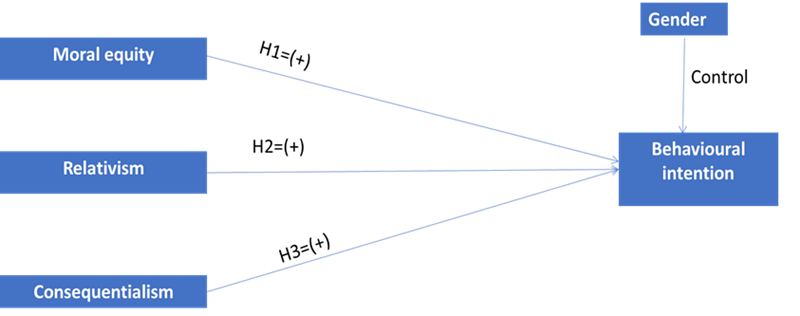
Figure 1
Theoretical Framework of our Study
Materials and Methods
Population and Sampling
The target population consisted of Spanish amateur long-distance road runners and triathletes. A minimum sample size of 239 observations was established, which, according to G*Power 3.10 (Faul et al., 2009), provides a power of 80% for testing the significance of a regression model with four input variables at a 5% significance level and allowing a small Cohen's effect size (0.05).
The sample was stratified as follows to ensure representativeness:
-
A quota of at least 10% women was established. Although there may be a significantly greater number of male participants than female participants, this ratio aligns with the gender distribution in long-distance road races in Spain (Andrés-Sánchez & de Torres-Burgos, 2021) and in trail running events (Madruga-Vicente et al., 2021), which are rarely above 15%.
-
A quota of 30% was established for athletes who practice combined sports that include running, such as triathlon, as their perception of the need for uniformity in equipment may differ from that of strictly long-distance runners (Andrés-Sánchez & de Torres-Burgos, 2021).
-
A quota of 30% was set for athletes holding athletics and/or triathlon federation licences, as licenced athletes are likely to have greater competitive motivation.
Data Collection
The survey used in this study included 252 amateur athletes and triathletes from Spain; thus, the minimum sample size required was achieved. It was fully completed in March 2021 through digital means. The survey was self-administered and accessible via a Google Forms link that allowed only one response per IP address and was redacted in Spanish and Catalan.
The questionnaire was distributed among various athletics and triathlon clubs in Spain, as well as through social media platforms such as Facebook and WhatsApp groups composed of practitioners of these sports. In the case of clubs, the hyperlink was sent to a club representative, who then shared it with the members, allowing them to respond if they wished to do so.
Sample Profile
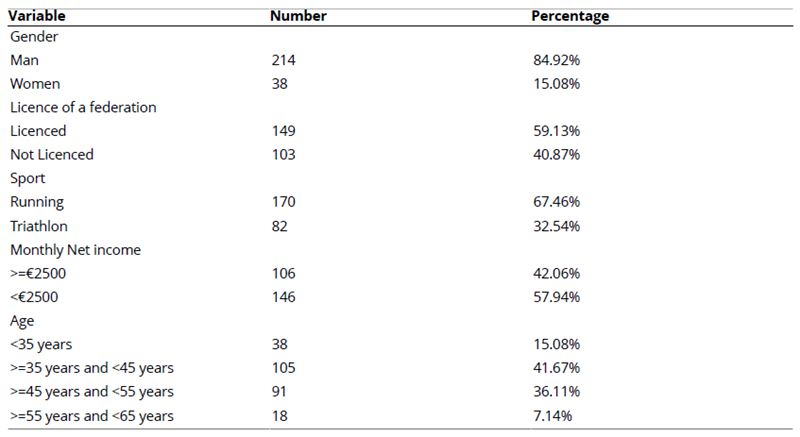
Table 2 presents the demographic profile of the individuals surveyed. The average age of the respondents was 44 years, with a standard deviation of 8.79 years. The gender distribution was 85% male and 15% female. Moreover, 67.46% of the responses were from runners, while the remainder were from triathletes. Fifty-nine percent of the athletes were affiliated with a sports federation, whereas 41% did not possess a licence. Thus, the established quotas regarding gender, sport practices, and possession of a federation licence were met. Finally, 42% of the athletes reported a monthly income exceeding €2500.
Profile of the Sample
Questionnaire and Measurement Model
The questionnaire started with the following introductory text: “The Breaking2.0 and Ineos1.59 events by Nike showcased their carbon fibre plate shoes in the athletic world. Since then, various brands have marketed different models with the same technology. With that technology, Eliud Kipchoge was able to break the two-hour barrier in the marathon and has enabled breaking world records in various road running distances. In fact, many athletes who have used them report experiencing improvements in their performance. On the other hand, in various athletic forums, many people have expressed both support and opposition to the use of these shoes in competitions.
In this regard, as a member of the athletic community, if you have an opinion on these shoes, we would appreciate if you could answer the following questions regarding their use in competitions.
The items used to measure the variables in Figure 1 are listed in Table 3. Thus, the scale utilized for the dependent variable, behavioral intention to use CFPSs, was adapted from Venkatesh and Davis (2000) and has been employed in studies of technological acceptance from an MES perspective, such as those conducted by Pelegrín-Borondo et al. (2020), Olarte-Pascual et al. (2021), and Andrés-Sánchez et al. (2021). The scales concerning ethical dimensions (moral equity, relativism, and consequentialism) are adaptations of the MES by Shawver and Sennetti (2009). Notably, consequentialism has been constructed by merging the corresponding dimensions of egoism and utilitarianism. Gender was established as a dichotomous variable taking a value of 1 if the response came from a male.
Except for gender, all the questions were answered on an 11-point Likert scale ranging from 0 ('absolutely bad evaluation') to 10 ('absolutely good evaluation'), with a neutral position corresponding to a score of 5. Various authors recommend this scale, which is more extensive than the commonly used 4-, 5-, or 7-point scales, for several reasons. First, it allows individuals to capture more nuances than the limitations of 4-, 5-, or 6-point scales do. Second, the 11-point Likert scale offers greater sensitivity and approaches an interval level of scaling and normality. Moreover, the range from 0-10 is easily understood by most individuals (Leung, 2011).
The questionnaire was initially distributed to 16 athletes and 2 trainers to gather feedback on its readability and ease of response. The insights obtained from the pilot test allowed for improvements in the readability of the questionnaire but did not fundamentally alter it. Concurrently, with this small subsample, we were able to conduct an initial assessment of the consistency and discriminant validity of the scales.
Descriptive Statistics and Scale Reliability Measures
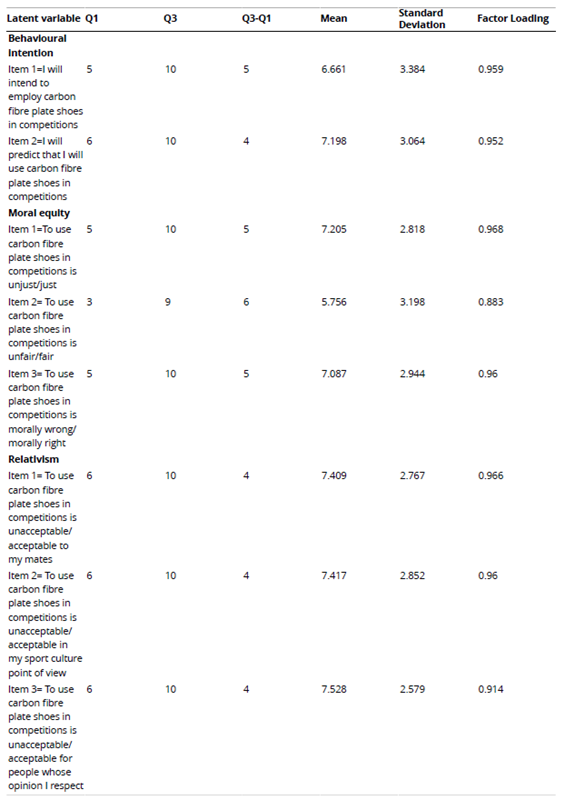
Descriptive Statistics and Scale Reliability Measures
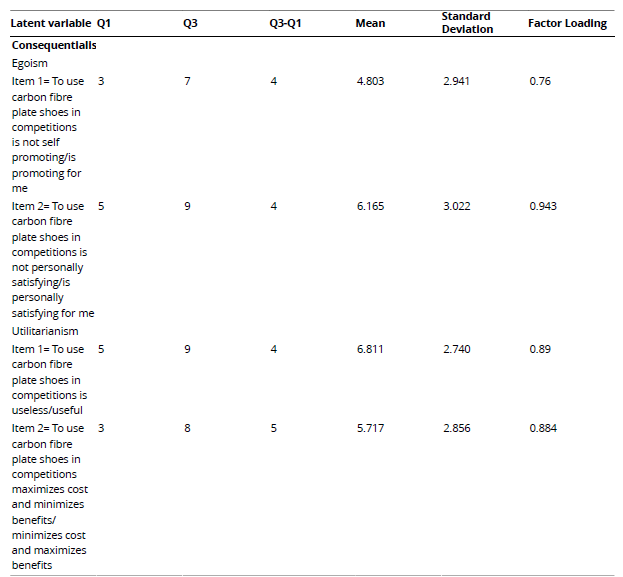
Note. (a) Q1 stands for the first quartile, and Q3 for the third quartile.
Data Analysis
The quantitative methods utilized to evaluate the explanatory and predictive capacity of the presented model, as well as the identification of necessary conditions, follow a sequential application involving partial least squares (PLS-SEM) and necessary condition analysis (NCA). This methodology provides a complementary perspective that yields more insightful results than does the mere use of conventional structural equation modelling (Richter et al., 2020). PLS-SEM allows us to analyse the likelihood that the proposed explanatory variables can be understood as sufficient conditions. In other words, PLS-SEM enables us to establish statements such as "a positive perception of moral equity has a positive effect on CFPSs acceptance". This fulfils RO1 and evaluates the hypotheses presented in Section 2.2. However, PLS-SEM does not allow us to determine whether a given construct can be considered a necessary condition for producing acceptance; for example, "a minimum moral equity perception is necessary to produce behavioralintention toward the use of CFPSs" (Dul, 2016). Therefore, for RO2, which aims to investigate the presence of necessary constructs to generate the intention to wear CFPSs, NCA is employed (Dul, 2016; Dul et al., 2020).
Both PLS-SEM and NCA were conducted using SmartPLS 4.0 software. The analysis procedure for both techniques, complementing their results, followed the protocol outlined in Richter et al. (2020). Therefore, we initially implemented PLS-SEM with the following steps:
-
Scale reliability was assessed by evaluating internal consistency and discriminant capacity using measures such as Cronbach's alpha (CA), convergent reliability (CR), average variance extracted (AVE), and factor loadings. It is expected that CA and CR>0.7, AVE>0.5 and a factor loading >0.702 (Hair et al., 2019). Additionally, we implemented confirmatory factor analysis (CFA) of the measurement model implicit in Figure 1. In this analysis, we assess the normed fit index (NFI), comparative fit index (CFI) and Tucker‒Lewis’s index (TLI), which are expected to be > 0.85, and the standardized root mean squared residual (SRMSR), which is expected to be < 0.1.
-
Discriminant validity was evaluated using both the Fornell–Larcker criterion and heterotrait–monotrait (HTMT) ratios (Hair et al., 2019).
-
The model displayed in Figure 1 was fitted by running consistent partial least squares percentile bootstrapping with 5,000 subsamples. In this step, we tested the reliability of the hypotheses formulated in Section 2.2.
-
We evaluated the predictive capability of the model via Stone and Greisser's Q2 measure.
NCA wassubsequently performed by implementing the next steps:
-
We measure the constructs as the latent variable scores used in the regression performed via PLS-SEM.
-
We analyse the scatter plots of bivariate representations of the explained variable (behavioural intention to use CFPSs, Y axis) with respect to the explanatory factors (X axis) to remove the outliers. We defined an outlier as one for which the difference between behavioral intention and the explanatory factor was 3 times the standard deviation of that difference in the sample.
-
The scatter plots after removing the outliers allow us to visualize the so-called ceiling envelopment-free disposal hull (CE-FDH) and ceiling regression-free disposal hull (CR-FDH), which are obtained by smoothing the CE-FDH.
-
We subsequently stated the size of the necessity effect (d). The effects can be classified as small (0 <d< 0.1), medium (0.1 ≤ d< 0.3), large (0.3 ≤ d< 0.5), or very large (≥ 0.5). We also state their statistical significance. According to Dul (2016), values of d>0.1 with p< .05 are considered relevant for practical purposes. We have two estimates of d: that from CE-FDH, whose value can be considered optimistic, and that obtained from CR-FDH.
-
We present the bottleneck tables to enable bottleneck analysis. This assessment involves an analysis of necessity in terms of degree: "A level of moral equity A is necessary for level B of intention to use CFPSs" (Dul, 2016).
Results
Descriptive Statistics and Results of PLS-SEM Analysis
The average scores and standard deviations of the items included in the study are provided in Table 3. Notably, all the items were answered on an 11-point Likert scale ranging from 0 to 10; thus, the neutral or indifferent evaluation score was 5. The mainstream behavioural intention toward the use of CFPSs is favourable toward the use of the CFPSs since the mean of its two items was approximately seven. The evaluation of moral equity is also favourable, as the first and third items are approximately seven, and in any case, the average for the "unfair/fair" item is practically 6. In the relativism dimension, all the items are above seven, so we can infer that, in general, the use of the CFPSs is acceptable in the analysed sample. Regarding consequentialism, for three items, the average number of evaluations clearly exceeded five. The exception is "not self-promoting/promoting," for which the average score is slightly less than five.
The analysis of the first quartile (Q1) and third quartile (Q3) and their differences in items in Table 3 allowed us to refine the analysis of the mean values. On the one hand, we observe a high interquartile variation, with jumps between 4 and 6 points. Thus, while the overall evaluation of ethical items is generally favourable—given that the first quartile is practically 5 for all items—there is a significant gap between neutral and enthusiastic perceptions. It is noteworthy that in one item concerning moral equity (related to fairness) and another related to consequentialism (pertaining to “self-promotion for me”), the first quartile clearly indicates an unfavourable perception of the CFPS (its value is three). Therefore, we can argue that within the evaluated sample, opinions regarding the CFPSs are quite heterogeneous.
The results in Table 4 indicate that all the scales are internally consistent, as Cronbach's alpha and CR > 0.7 and AVE > 0.5. Similarly, Table 3 shows that factor loadings > 0.702 for all the items. Similarly, the results of the CFA suggest that the measurement model was adequate since NFI=0.913, CFI=0.924 and TLI=0.901. Similarly, the SRMSR=0.038, which is clearly less than 0.1. Therefore, the integration of egoism and utilitarianism into consequentialism is not only reasonable from a theoretical point of view but also analytically reasonable.
Table 5 shows that the scales also present discriminant capability since the squared AVEs of the latent variables are always above their Pearson's correlation. The HTMT ratio between pairs of latent variables is usually < 0.85. The exception is the pair of moral equity with relativism, for which HTMT is 0.925, which, although not optimal, does not constitute a serious violation since HTMT is still < 1, and the Fornell–Larker criterion was met.
Figure 2 shows that, regarding the overall quality of the fit of the model, R² was close to 50% (48.8%), so it could be characterized as medium (Hair et al., 2019). Figure 2 also shows that the model has predictive ability since Q2=45.7%,which is greater than 0.
Table 6 shows the values of the path coefficients (β) and their significance measured with the p value. We observed that the influence of relativism (β = 0.354, p< .001) and consequentialism (β=0.281, p<.001) on acceptance was significant and consistent with the hypothesis developed in the second section. Moreover, the impact of moral equity on acceptance has the sign that we assume, but it is not significant (β=0.105, p=.299). However, this does not necessarily imply that moral equity is not relevant for explaining acceptance since without NCA analysis, we cannot establish if it is a necessary condition. Finally, gender was not statistically significant (β=0.075, p=.648).
Measures of Internal Consistency of Scales

Discriminant Validity Matrix
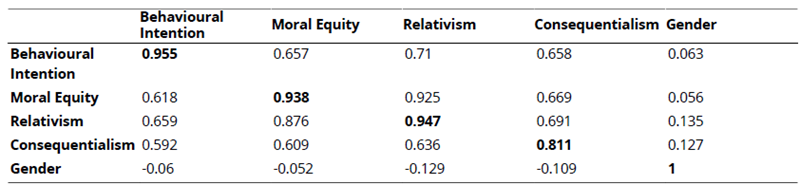
Note. The square root of the average variance extracted appears on the principal diagonal. Below the main diagonal, Pearson's correlations are found, and above the principal diagonal are the HTMT ratios.
Path Coefficients for the Inner Model
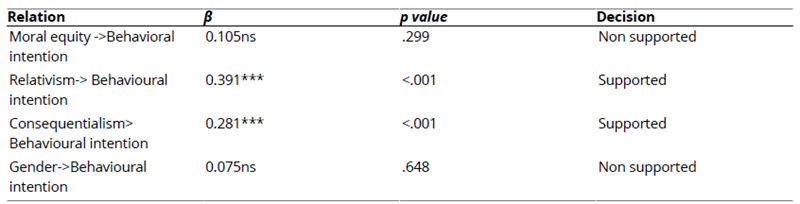
Note. “ns” and “***” denote no significance and significance at the 0.01% level, respectively
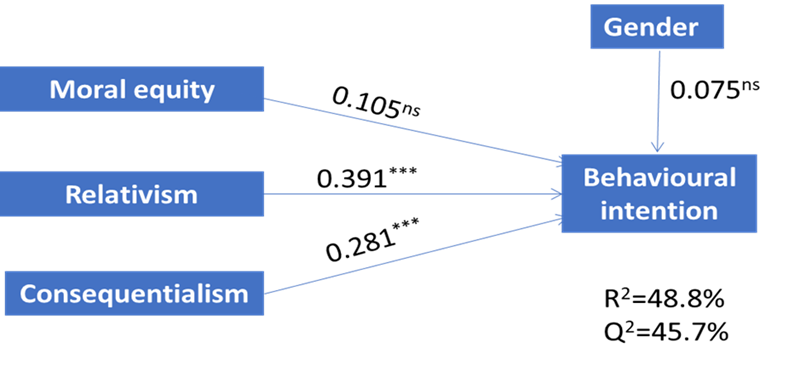
Figure 2
Results of Model Fitting in Figure 1
Note.“ns” and “***” denote no significance and significance at the 0.01% level, respectively.
Results of Necessary Condition Analysis
First, we quantified the values of the constructs analysed via their factor extractions (Richter et al., 2020). We subsequently removed the outliers and identified three outliers in moral equity; therefore, we developed the NCA for this factor using 249 observations. In the case of relativism and consequentialism, we found only one outlier, and so the NCA was developed using 251 observations. The scatter plots after removing the outliers are displayed in Figure 3.
The necessity size effects are shown in Table 7, both if we take the CE-FDH focus as a reference and if we consider the CR-FDH. With the CE-FDH analysis, we observe that size effects in the case of all variables, except for gender, are medium. However, in the case of moral equity and consequentialism, the coefficient is not much greater than 0.1. Thus, for moral equity, d=0.111 (p<0.001); for consequentialism, d=0.131 (p<.001); and for relativism, d=0.264 (p<.001). In contrast, with the CR-FHD measure, which is more conservative, while the effects of moral equity and consequentialism become <0.1 (0.085 for moral equity and 0.091 for consequentialism), the effects of relativism remain of medium size and significant (d=0.233, p<.001).
Table 8 shows the bottleneck tables associated with both CE-FDH and CR-FDH, allowing us to evaluate the minimum value that the explanatory variables must take for a certain level of acceptance of CFPSs to occur. According to the bottleneck table constructed for the CE-FDH, to be within 50% of the behavioral intention to use CFPSs, relativism must be above 2.39%. The other variables are not bottlenecks for this level of behavioral intention. To achieve higher levels of behavioral intention (90% or higher), individuals must exhibit more than 23% relativism, 12% moral equity, and 6.38% consequentialism.
Size Effects of Explanatory Constructs

Bottlenecks for CE-FDH and CR-FDH
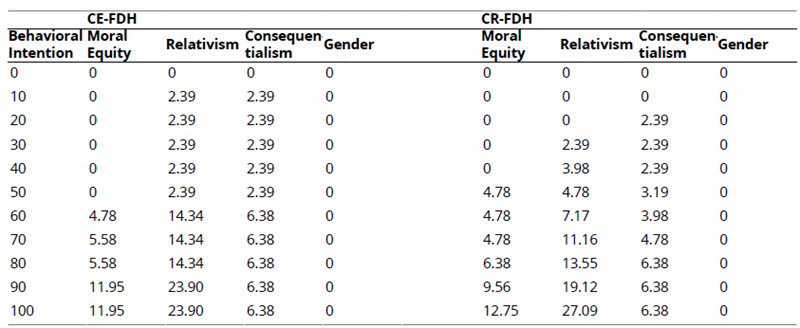
Note. Quantities are presented as percentages
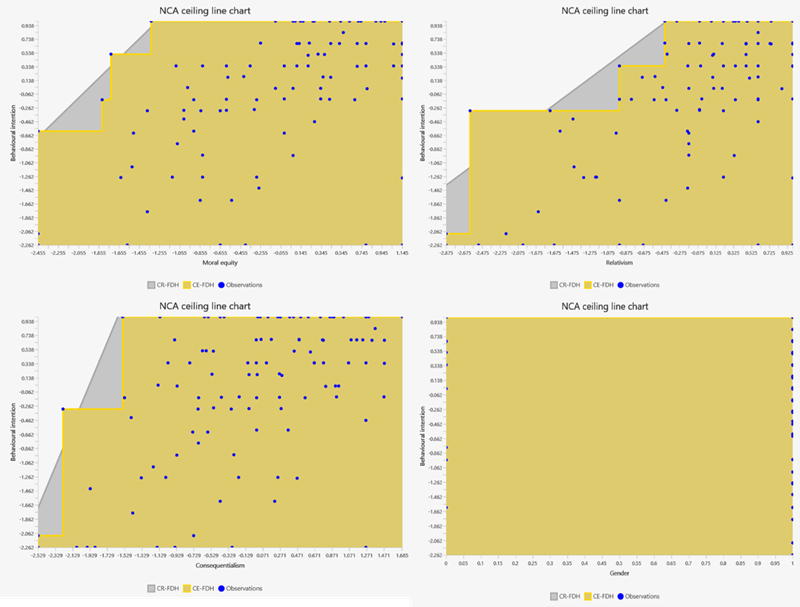
Figure 3
Scatter Plots of the Relationships Between Behavioural Intention to Use Carbon Fibre Plate Shoes and Moral Equity, Relativism, Consequentialism and Gender
Note. From top to bottom and left to right, we display the scatterplots of behavioural intention to use carbon fibre plate shoes with moral equity, relativism, consequentialism and gender.
Discussion
General Considerations
This study encompasses two research objectives (ROs). The first objective (RO1) explores the feasibility of extending the multiple ethical scale (MES) proposed by Reidenbach and Robin (1990) to elucidate the intention to use innovative sports technology, specifically carbon fibre plate shoes (CFPSs). The second research objective (RO2) examines whether attaining evaluated ethical constructs to a certain degree is a necessary condition for the existence of behavioral intention toward using CFPSs in competitions.
In the assessment of RO1, we checked that MES had capability to explain and predicting behavioral intention to use CFPSs. Thus, the results obtained align with the reviewed literature in Table 1 concerning the explanatory ability of the MES in decision making on issues with moral implications.
It has been checked that moral equity was not statistically significant in explaining the acceptance of CFPSs. Nevertheless, this does not imply that moral equity is irrelevant for the intention to use CFPSs. The fact that it has some impact as a necessary condition in acceptance reveals that the potential use of CFPSs requires perceiving a certain threshold of fairness in its use. Thus, strict adherence to Loland's thin theory (2009) would lead to rejection of the use of CFPSs for not reaching a minimum threshold in moral equity perception. Conversely, adherence to relativism or thick position would lead to, once the fairness perception threshold is reached, the athlete evaluating other parameters, such as aspects related to the opinion that the athletic environment has of the use of CFPSs (relativism) or the consequences of using this type of running shoes (consequentialism).
Our study was conducted when CFPSs had emerged from the regulatory grey area they were previously in, and it was confirmed that those with a maximum sole thickness of 40 mm could be used, which enhanced the perception that their use was fair, as wearing them was explicitly permitted in official competitions. Therefore, it is likely that, in the perception of most athletes, the minimum threshold of acceptability regarding moral equity has probably been surpassed; thus, it is no longer relevant.
We observed that the ethical construct with the greatest impact was relativism. This finding confirms the relevance that opinions and advice from peers, social networks, and coaches have for endurance sports practitioners (McCormick et al., 2020). It also aligns with the findings in the acceptance of sports wearables (Aksoy et al.,2020; Kim & Chiu, 2019) and sports apps (Ferreira-Barbosa et al., 2022).
The relevance of both egoism and utilitarianism, which have been consolidated within consequentialism, has proven significant. Notably, these ethical factors have been shown to be important for the intention to use wearables (Olarte-Pascual et al., 2021) and insertable (Pelegrín-Borondo et al., 2020; Andrés-Sánchez et al., 2021). This finding is in accordance with reports in the field of sport wearables (Aksoy et al., 2020; Kim & Chiu, 2019), as well as in sports apps (Ferreira-Barbosa et al., 2022), where it has been shown that motivations to adopt new sports technology are highly influenced by consequentialist reasons such as usefulness, usability, price value, or hedonic motivations.
Theoretical and Practical Implications
Over the past few years, various technological advancements have emerged, often posing a moral challenge in the world of sports (Pérez-Triviño, 2014; Dyer, 2015). The analytical results provided by the MES in the case of these technologies offer insights that can be leveraged by companies manufacturing and marketing equipment. An organization that aims to compete successfully in sports equipment by introducing new technologies must formulate an ethical strategy grounded in the moral assessments of its users. Furthermore, it is crucial for organizations to understand how enhancing the behavioral intention to use a given sport technology can be achieved by addressing the facets of moral judgment.
Moral equity was not statistically significant in explaining the acceptance of CFPSs. Nonetheless, this does not imply that it is an irrelevant dimension in sports. This ethical dimension explains the need for homogeneity among all competitors in terms of access to sports equipment (Dyer, 2020). The relevance of ethical variables in a particular activity depends on the ethical issue that arises within it. For example, in an academic context, Leonard et al. (2017) reported that while utilitarianism is the main ethical dimension of individual activities, relativism becomes more relevant in group-based activities. Thus, the results seem to suggest that although there may be certain equality barriers to using CFPSs because their price is slightly higher than that of traditional competition shoes, this higher price is not perceived as a significant barrier to access.
The lack of significance of moral equity also suggests that although the use of these shoes may, to some extent, be considered a form of technological doping (Muñiz-Pardos et al., 2021), it is not perceived negatively as chemical or pharmaceutical doping. A possible reason for this is that the use of performance-enhancing technologies in equipment has no impact on athlete health, unlike doping practices that involve the use of chemical substances.
Likewise, we must also remark that there is a threshold of moral equity necessary for the intention to use CFPSs to exist. The introduction of an innovative model of running shoes must therefore consider that there is a threshold in the user's perception regarding the "fairness" or "equality" of its use that must be reached. However, beyond this threshold, the positive impact of moral equity on the intention to use is not relevant.
Relativism appears to explain a significant portion of the behavioral intention toward wearing CFPSs. Consequently, the favourable opinion of the athletic community is the variable with the greatest impact and the greatest degree of necessity in generating behavioral intention. In this context, events such as Breaking2 and Ineos 1.59 have heightened interest and excitement in long-distance road running (O’Grady &Gracey, 2020), suggesting that organizing such events is an effective strategy for enhancing perceptions within the athletic community. In fact, the prohibition of carbon fibre plate shoes and the nullification of world records achieved with these shoes would have been controversial and unpopular decisions (O’Grady & Gracey, 2020). Therefore, we understand that the strategy pursued with these events has engendered positive perceptions of technology within the runner and triathlete communities. Thus, it seems advisable to organize events similar to Breaking2, where spectacle and sport are combined to foster a positive perception of new competition-focused sports technologies before their widespread commercialization.
In endurance sports, the subjective norm is often induced by club coaches (McCormick et al., 2020), who tend to focus their advice on improving sports performance and reducing injuries. Thus, a potentially relevant factor in shaping a favourable attitude toward a new development in sports equipment is that it is perceived as truly effective and unlikely to cause injuries. On the other hand, relationships between endurance sports practitioners should also be considered relevant for stimulating subjective norm (McCormick et al., 2020). These interactions are sometimes face-to-face (e.g., in training groups) but also in virtual communities. Thus, both WoM and eWoM can be factors that encourage or discourage the intention to use innovative sports equipment.
Consequentialism has also been revealed as a relevant variable in the acceptance of new technologies in running shoes. Thus, a clearer perception of the positive consequences of a particular innovation in running shoes encourages the acceptance of CFPSs. We remark once again that events such as Ineos1.59 allow potential users to experience various positive consequences, which can include both egoist motivations (for instance, improving athletic performance) and utilitarianism (for example, the achievement of new milestones in road running sports, such as completing a marathon in under two hours by a human being).
Finally, the lack of significance of gender in explaining the acceptance of CFPSs does not imply that the highlighted aspects of its influence are not real but rather that they may neutralize each other. Thus, while females may be more influenced by social norms (Hazari, 2018), males tend to be more competitive (Lores & Murcia, 2008), and both factors may enable the use of CFPSs.
We have shown that the combined application of partial least squares structural equation modelling (PLS-SEM) and necessary comparative analysis (NCA) enables a more profound explanation of new sport technology acceptance. We confirmed that, for a certain level of acceptance to manifest, there must be a corresponding attainment of moral equity, acceptance among peers, and practical utility. Consequently, an assertion such as "a more intense perception that CFPSs enhance athletic performance produces greater acceptance" holds true only when certain thresholds in moral equity and relativism are met.
Conclusions
This study investigated the perceptions of a sample of amateur athletes regarding the adoption of carbon fibre plate shoes for road running. Widespread acceptance of their use was observed. The use of PLS-SEM revealed that the use of MES latent variables as antecedents to behavioral intention toward the use of CFPSs in competitions in this paper is reliable. The most impactful philosophical construct is relativism, which also is the variable with the greatest effect size. Notably, consequentialism is also a significant and necessary condition. Moreover, although moral equity does not significantly explain the intention to use, it also has a significant necessity effect size.
This study has several limitations that may encourage the development of future research. The male/female ratio, 85/15, is close to the proportions typically recorded in road running and triathlon events in Spain (Andrés-Sánchez & de Torres-Burgos, 2021; Madruga-Vicente et al., 2021). However, perhaps a more balanced sex ratio would have been preferable.
This study was conducted after World Athletics had already regulated road running shoes. In a context that may not necessarily be athletic, it would be interesting to conduct a similar study of a technology that could improve athletic performance before it is regulated and then compare the results with those obtained after it has already been subjected to regulations.
Additionally, the results were obtained in a specific country, Spain; therefore, the results may be very similar if the study had been conducted in a country with a similar culture, such as Portugal or Italy. However, these findings should be considered with caution if they are intended to be extrapolated to countries with very different cultures, such as Japan.
Ethics Committee Statement
(1) All participants received detailed written information about the study and the procedure; (2) No data directly or indirectly related to the participants’ health were collected; therefore, the Declaration of Helsinki was not mentioned when informing the participants; (3) The anonymity of the collected data was guaranteed at all times; (4) Approval from an ethics board or committee was not obtained because, given the nature of the data, anonymous opinions of a non-sensitive nature, it was not considered necessary; (5) Voluntary completion of the questionnaire was taken as consent for the use of the data in the research.
Conflict of Interest Statement
The author declares no conflict of interest.
Funding
The authors did not receive any additional funding beyond the resources provided by their institution.
Authors' Contribution
The sole author was responsible for all aspects of the manuscript.
Data Availability Statement
The data are available from the author upon request by email.
References
Ahadzadeh, A. S., Ong, F. S., Deng, R., & Ali, R. S. (2023). Unravelling the Relationship between Competitiveness Trait and Intention to Use Memory Implants: The moderating roles of moral equity, egoism, and utilitarianism. International Journal of Human–Computer Interaction, 40(24), 1-15. https://doi.org/10.1080/10447318.2023.2291621
Ajzen, I. (2002). Perceived behavioral control, self-efficacy, locus of control, and the theory of planned behavior. Journal of Applied Social Psychology, 32(4), 665–683. https://doi.org/10.1111/j.1559-1816.2002.tb00236.x
Aksoy, N. C., Alan, A. K., Kabadayi, E. T., & Aksoy, A. (2020). Individuals' intention to use sports wearables: The moderating role of technophobia. International Journal of Sports Marketing and Sponsorship, 21(2), 225-245. https://doi.org/10.1108/IJSMS-08-2019-0083
Andrés-Sánchez, J., & de Torres-Burgos, F. (2021). Evaluación ética de atletas y triatletas españoles sobre uso de la tecnología Vaporfly. Revista Iberoamericana de Ciencias de la Actividad Física y el Deporte, 10(3), 139-159. https://doi.org/10.24310/riccafd.2021.v10i3.12840
Andrés-Sánchez, J., Arias-Oliva, M., & Pelegrín-Borondo, J. (2021). The influence of ethical judgements on acceptance and non-acceptance of wearables and insideables: Fuzzy set qualitative comparative analysis. Technology in Society, 67, 101689. https://doi.org/10.1016/j.techsoc.2021.101689
Andrés-Sánchez, J., de Torres-Burgos, F., & Arias-Oliva, M. (2023). Why disruptive sport competition technologies are used by amateur athletes? An analysis of Nike Vaporfly shoeswith an UTAUT model. Journal of Sport and Health Research, 15(1). https://doi.org/10.58727/jshr.89629
Arias-Oliva, M., Pelegrín-Borondo, J., Almahameed, A. A., & Andrés-Sánchez, J. D. (2021). Ethical attitudes toward COVID-19 passports: Evidences from Spain. International Journal of Environmental Research and Public Health, 18(24), 13098. https://doi.org/10.3390/ijerph182413098
Arias-Oliva, M., Pelegrín-Borondo, J., Lara-Palma, A. M., & Juaneda-Ayensa, E. (2020). Emerging cyborg products: An ethical market approach for market segmentation. Journal of Retailing and Consumer Services, 55, 102140. https://doi.org/10.1016/j.jretconser.2020.102140
Barnes, K. R., & Kilding, A. E. (2019). A randomized crossover study investigating the running economy of highly-trained male and female distance runners in marathon racing shoes versus track spikes. Sports Medicine, 49(2), 331-342. https://doi.org/10.1007/s40279-018-1012-3
Bermon, S., Garrandes, F., Szabo, A., Berkovics, I., & Adami, P. E. (2021). Effect of advanced shoe technology on the evolution of road race times in male and female elite runners. Frontiers in Sports and Active Living, 3, 653173. https://doi.org/10.3389/fspor.2021.653173
Burns, G. T., & Tam, N. (2020). Is it the shoes? A simple proposal for regulating footwear in road running. British Journal of Sports Medicine, 54(8), 1-2. http://dx.doi.org/10.1136/bjsports-2018-100480
Cruz, C. A., Shafer, W. E., & Strawser, J. R. (2000). A multidimensional analysis of tax practitioners' ethical judgments. Journal of Business Ethics, 24(3), 223-244. https://doi.org/10.1023/A:1006140809998
de Torres Burgos, F., & de Andrés-Sánchez, J. (2021). Tecnología Vaporfly en zapatillas de fondo en ruta: Algunas consideraciones éticas sobre uso y regulación. FairPlay, Revista de Filosofia, Ética y Derecho del Deporte, 20, 68-89. https://raco.cat/index.php/FairPlay/article/view/393497
Deigh, J. (2010). An Introduction to Ethics. Cambridge Introductions to Philosophy. Cambridge University Press. https://doi.org/10.1017/CBO9780511750519
Dul, J. (2016). Necessary condition analysis (NCA):Logic and methodology of “necessary but not sufficient” causality. Organizational Research Methods, 19(1), 10-52. https://doi.org/10.1177/109442811558400
Dul, J., Van der Laan, E., & Kuik, R. (2020). A statistical significance test for necessary condition analysis. Organizational Research Methods, 23(2), 385-395. https://doi.org/10.1177/1094428118795272
Dyer, B. (2015). The controversy of sports technology: A systematic review. SpringerPlus, 4(524), 1-12. https://doi.org/10.1186/s40064-015-1331-x
Dyer, B. (2020). A pragmatic approach to resolving technological unfairness: The case of Nike’s Vaporfly and Alphafly running footwear. Sports Medicine-Open, 6(21), 1-10. https://doi.org/10.1186/s40798-020-00250-1
Faul, F., Erdfelder, E., Buchner, A., & Lang, A.-G. (2009). Statistical power analyses using G*Power 3.1: Tests for correlation and regression analyses. Behavior Research Methods, 41, 1149-1160. https://doi.org/10.3758/BRM.41.4.1149
Ferreira-Barbosa, H. F., García-Fernández, J., Pedragosa, V., & Cepeda-Carrion, G. (2022). The use of fitness centre apps and its relation to customer satisfaction: A UTAUT2 perspective. International Journal of Sports Marketing and Sponsorship, 23(5), 966-985. https://doi.org/10.1108/IJSMS-01-2021-0010
Ford, R. C., & Richardson, W. D. (1994). Ethical decision making: A review of the empirical literature. Journal of Business Ethics, 13, 205-221. https://link.springer.com/article/10.1007/BF02074820
Guinness, J., Bhattacharya, D., Chen, J., Chen, M., & Loh, A. (2020). An observational study of the effect of nike Vapor fly shoes on marathon performance. ArXiv. https://doi.org/10.48550/arXiv.2002.06105
Hair, J. F., Risher, J. J., Sarstedt, M., & Ringle, C. M. (2019). When to use and how to report the results of PLS-SEM. European Business Review, 31(1), 2-24. https://doi.org/10.1108/EBR-11-2018-0203
Hazari, S. (2018). Investigating social media consumption, sports enthusiasm, and gender on sponsorship outcomes in the context of Rio Olympics, International Journal of Sports Marketing and Sponsorship, 19 (4), 396-414. https://doi.org/10.1108/IJSMS-01-2017-0007
Hébert-Losier, K., Finlayson, S. J., Driller, M. W., Dubois, B., Esculier, J. F., & Beaven, C. M. (2022). Metabolic and performance responses of male runners wearing 3 types of footwear: Nike Vaporfly 4%, Saucony Endorphin racing flats, and their own shoes. Journal of Sport and Health Science, 11(3), 275-284. https://doi.org/10.1016/j.jshs.2020.11.012
Hogenová, A. (2002). Legality and legitimacy in sport. European Journal of Sport Science, 2(1), 1-8. https://doi.org/10.1080/17461390200072104
Hoogkamer, W., Kipp, S., & Kram, R. (2019). The biomechanics of competitive male runners in three marathon racing shoes: A randomized crossover study. Sports Medicine, 49(1), 133-143. https://doi.org/10.1007/s40279-018-1024-z
Hoogkamer, W., Kipp, S., Frank, J. H., Farina, E. M., Luo, G., & Kram, R. (2018). A comparison of the energetic cost of running in marathon racing shoes. Sports Medicine, 48(4), 1009-1019. https://doi.org/10.1007/s40279-017-0811-2
Hunter, I., McLeod, A., Valentine, D., Low, T., Ward, J., & Hager, R. (2019). Running economy, mechanics, and marathon racing shoes. Journal of Sports Sciences, 37(20), 2367-2373. https://doi.org/10.1080/02640414.2019.1633837
Jones, K., & Leonard, L. N. (2016). Applying the multidimensional ethics scale in c2c e-commerce. Issues in Information Systems, 17(1), 26-36. https://doi.org/10.48009/1_iis_2016_26-36
Jung, I. (2009). Ethical judgments and behaviors: Applying a multidimensional ethics scale to measuring ICT ethics of college students. Computers & Education, 53(3), 940-949. https://doi.org/10.1016/j.compedu.2009.05.011
Kiesewetter, P., Bräuer, S., Haase, R., Nitzsche, N., Mitschke, C., & Milani, T. L. (2022). Do carbon-plated running shoes with different characteristics influence physiological and biomechanical variables during a 10 km treadmill run? Applied Sciences, 12(15), 7949. https://doi.org/10.3390/app12157949
Killen, M. (2018). The origins of morality: Social equality, fairness, and justice. Philosophical Psychology, 31(5), 767-803. https://doi.org/10.1080/09515089.2018.1486612
Kim, T., & Chiu, W. (2019). Consumer acceptance of sports wearable technology: The role of technology readiness. International Journal of Sports Marketing and Sponsorship, 20(1), 109-126. https://doi.org/10.1108/IJSMS-06-2017-0050
Kujala, J. (2001). A multidimensional approach to Finnish managers' moral decision-making. Journal of Business Ethics, 34(3), 231-254. https://doi.org/10.1023/A:1012583424721
Leonard, L. N., & Jones, K. (2017). Ethical awareness of seller’s behavior in consumer-to-consumer electronic commerce: Applying the multidimensional ethics scale. Journal of Internet Commerce, 16(2), 202-218. https://doi.org/10.1080/15332861.2017.1305813
Leonard, L.N., Riemenschneider, C.K. & Manly, T.S. (2017). Ethical behavioural intention in an academic setting: Models and predictors. Journal of Academic Ethics, 15, 141–166. https://doi.org/10.1007/s10805-017-9273-2
Leung, S.O. (2011). A comparison of psychometric properties and normality in 4-, 5-, 6-, and 11-point Likert scales. Journal of Social Service Research, 37(4), 412–421. https://doi.org/10.1080/01488376.2011.580697
Littlejohns, R., Gouthro, M. B., & Dickinson, J. (2019). Runners’ engagement and social support practices: Exploring the uses and role of online activities. Sport in Society, 22(12), 2243-2260. https://doi.org/10.1080/17430437.2019.1571486
Loland, S. (2009). The ethics of performance-enhancing technology in sport. Journal of the Philosophy of Sport, 36(2), 152-161. https://doi.org/10.1080/00948705.2009.9714754
Loland, S. (2018). Performance-enhancing drugs, sport, and the ideal of natural athletic performance. The American Journal of Bioethics, 18(6), 8-15. https://doi.org/10.1080/15265161.2018.1459934
Llopis, D., & Llopis, R. (2006). Razones para participar en carreras de resistencia. Un estudio con corredores aficionados. Cultura, Ciencia y Deporte, 2(4), 33-40. https://doi.org/10.12800/ccd.v2i4.168
Lores, A. P., & Murcia, J. A. M. (2008). Actitud de los universitarios ante la práctica físico-deportiva: Diferencias por géneros. Revista de Psicología del Deporte, 17(1), 7-23. https://www.redalyc.org/pdf/2351/235119246001.pdf
Mahan III, J. E., Seo, W. J., Jordan, J. S., & Funk, D. (2015). Exploring the impact of social networking sites on running involvement, running behavior, and social life satisfaction. Sport Management Review, 18(2), 182-192. https://doi.org/10.1016/j.smr.2014.02.006
Madruga-Vicente, M., Cerro-Herrero, D., Angosto-Sánchez, S., & Prieto-Prieto, J. (2021). Calidad percibida e intenciones futuras en eventos deportivos: Segmentación de participantes de carreras por montaña. Cultura, Ciencia y Deporte, 16(50), 605-615. https://doi.org/10.12800/ccd.v16i50.1584
Matties, J. R., & Rowley, K. M. (2023). A pilot study: Effects of an 8-week training intervention in carbon-plated running shoes. Footwear Science, 15(sup1), S182-S183. https://doi.org/10.1080/19424280.2023.2202943
McCormick, A., Anstiss, P. A., & Lavallee, D. (2020). Endurance athletes’ current and preferred ways of getting psychological guidance. International Journal of Sport and Exercise Psychology, 18(2), 187-200. https://doi.org/10.1080/1612197X.2018.1486874
Morales, A. T., Tamayo Fajardo, J. A., & González-García, H. (2019). High-speed swimsuits and their historical development in competitive swimming. Frontiers in Psychology, 10, 2639. https://doi.org/10.3389/fpsyg.2019.02639
Muñiz-Pardos, B., Sutehall, S., Angeloudis, K., Guppy, F. M., Bosch, A., & Pitsiladis, Y. (2021). Recent improvements in marathon run times are likely technological, not physiological. Sports Medicine, 51, 371–378. https://doi.org/10.1007/s40279-020-01420-7
Murata, K., Arias-Oliva, M., & Pelegrín-Borondo, J. (2019). Cross-cultural study about cyborg market acceptance: Japan versus Spain. European Research on Management and Business Economics, 25(3), 129–137. https://doi.org/10.1016/j.iedeen.2019.07.003
Nguyen, N. T., Basuray, M. T., Smith, W. P., Kopka, D., & McCulloh, D. (2008). Moral issues and gender differences in ethical judgment using Reidenbach and Robin’s (1990) multidimensional ethics scale: Implications in teaching of business ethics. Journal of Business Ethics, 77, 417-430. https://doi.org/10.1007/s10551-007-9357-9
Nielsen, A., Franch, J., Heyde, C., de Zee, M., Kersting, U., & Larsen, R. G. (2022). Carbon plate shoes improve metabolic power and performance in recreational runners. International Journal of Sports Medicine, 43(09), 804-810. https://doi.org/10.1055/a-1776-7986
O'Grady, T. J., & Gracey, D. (2020). An evaluation of the decision by world athletics on whether or not to ban the nike vapor fly racing shoe in 2020. Entertainment and Sports Law Journal, 18(1), 3. https://doi.org/10.16997/eslj.257
Olarte-Pascual, C.,Pelegrín-Borondo, J., Reinares-Lara, E., Arias-Oliva, M. (2021). From wearable to insideable: Is ethical judgment key to the acceptance of human capacity-enhancing intelligent technologies? Computers in Human Behavior, 114, 106559. https://doi.org/10.1016/j.chb.2020.106559
Pelegrín-Borondo, J., Arias-Oliva, M., Murata, K., & Souto-Romero, M. (2020). Does ethical judgment determine the decision to become a cyborg? Journal of Business Ethics, 161(1), 5-17. https://doi.org/10.1007/s10551-018-3970-7
Pérez-Triviño, J. L. (2013). La filosofía del deporte: Un panorama general. FairPlay, Revista de Filosofía, Ética y Derecho del Deporte, 1(1), 3-26. https://raco.cat/index.php/FairPlay/article/view/264079/351598
Pérez-Triviño, J. L. (2014). Sport enhancement: From natural doping to brain stimulation. International Journal of Technoethics, 5(2), 82-93. https://doi.org/10.4018/ijt.2014070106
Rae, S. (2018). Moral choices: An introduction to ethics. Zondervan Academic.
Reidenbach, R. E., & Robin, D. P. (1990). Toward the development of a multidimensional scale for improving evaluations of business ethics. Journal of Business Ethics, 9(8), 639–653. https://doi.org/10.1007/BF00383391
Reinares-Lara, E., Olarte-Pascual, C., & Pelegrín-Borondo, J. (2018). Do you want to be a cyborg? The moderating effect of ethics on neural implant acceptance. Computers in Human Behavior, 85, 43-53. https://doi.org/10.1016/j.chb.2018.03.032
Richter, N. F., Schubring, S., Hauff, S., Ringle, C. M., & Sarstedt, M. (2020). When predictors of outcomes are necessary: Guidelines for the combined use of PLS-SEM and NCA. Industrial Management & Data Systems, XI(12), 2243-2267. https://doi.org/10.1108/IMDS-11-2019-0638
Rodrigo-Carranza, V., González-Mohíno, F., Santos del Cerro, J., Santos-Concejero, J., & González-Ravé, J. M. (2021). Influence of advanced shoe technology on the top 100 annual performances in men’s marathon from 2015 to 2019. Scientific Reports, 11(1), 22458. https://doi.org/10.1038/s41598-021-01807-0
Ross, T. (2020). Running shoe tech: The Emperor’s clothes, and the issues for the integrity of running. The Science of Sport.
Sailors, P. R. (2009). More than a pair of shoes: Running and technology. Journal of the Philosophy of Sport, 36(2), 207-216. https://doi.org/10.1080/00948705.2009.9714757
Shawver, T. J., & Sennetti, J. T. (2009). Measuring ethical sensitivity and evaluation. Journal of Business Ethics, 88(4), 663–678. https://doi.org/10.1007/s10551-008-9973-z
Sinnot-Armstrong, W. (2023). Consequentialism. In E. N. Zalta Stanford (Ed.), Encyclopaedia of philosophy. https://plato.stanford.edu/entries/consequentialism/
Venkatesh, V., & Davis, F. D. (2000). A theoretical extension of the Technology Acceptance Model: Four longitudinal field studies. Management Science, 46, 186–204. https://plato.stanford.edu/archives/win2023/entries/consequentialism/
Vermeulen, E., Grobbelaar, S. S., & Botha, A. (2021). Conceptualising a systems thinking perspective in sport studies. Theoretical Issues in Ergonomics Science, 22(2), 161-177. https://doi.org/10.1080/1463922X.2020.1788662
Yang, S. C. (2012). Ethical academic judgments and behaviors: Applying a multidimensional ethics scale to measure the ethical academic behavior of graduate students. Ethics & Behavior, 22(4), 281-296. https://doi.org/10.1080/10508422.2012.672907
Author notes
a Correspondence: Jorge de Andrés-Sánchez, jorge.deandres@urv.cat
Additional information
Short title: Ethical Perceptions and New Sport Tech Acceptance
How to cite this article: De Andrés-Sánchez, J. (2026). The role of ethical perceptions in the acceptance of innovative sport technologies for competition: analysis of carbon plate running shoes. Cultura, Ciencia y Deporte, 21(67), 2193. https://doi.org/10.12800/ccd.v21i67.2193


