
CONTINUING EDUCATION: NEEDS OF PHYSICAL EDUCATION TEACHERS IN COMPULSORY SECONDARY SCHOOL/BACCALAUREATE/VOCATIONAL TRAINING IN ANDALUSIA
FORMACIÓN PERMANENTE: NECESIDADES DEL PROFESORADO DE EDUCACIÓN FÍSICA DE EDUCACIÓN SECUNDARIA OBLIGATORIA/BACHILLERATO/FORMACIÓN PROFESIONAL EN ANDALUCÍA


Mauricio Serrano-Brazo, Augusto Rembrandt Rodríguez-Sánchez, Gonzalo Ramírez-Macías
CONTINUING EDUCATION: NEEDS OF PHYSICAL EDUCATION TEACHERS IN COMPULSORY SECONDARY SCHOOL/BACCALAUREATE/VOCATIONAL TRAINING IN ANDALUSIA
Cultura, Ciencia y Deporte, vol. 21, no. 67, 2026, 10.12800/ccd.v21i67.2143
Universidad Católica San Antonio de Murcia
Mauricio Serrano-Brazo a
Universidad de Sevilla, España
Augusto Rembrandt Rodríguez-Sánchez
Universidad de Sevilla, España
Gonzalo Ramírez-Macías
Universidad de Sevilla, España
Received: 29 November 2023
Accepted: 09 July 2025
Abstract: In-service teacher training is linked to the professional development of teachers and the continuous social transformation of all agents of the educational community. The purpose of this research is to identify the training needs expressed by Physical Education teachers at the Compulsory Secondary School / Baccalaureate / Vocational Training level in Andalusia. The present research has adopted the embedded single-case study design, using a semi-structured interview to collect data from the sample (n = 20), to which the technique of content analysis technique has been applied using Atlas.ti software, v. 8.4. The analysis of the results obtained through the application of coding cycles revealed eight themes. Initial and in-service teacher training and the characteristics of teachers in the subject stand out. The in-service training offered by the Teacher Training Centres (PTCs) is identified as decontextualised, lacking in specificity and with a high theoretical component, although a high student-teacher ratio and excessive bureaucracy are the aspects of greatest concern in the profession. In conclusion, there is a need to promote change policies in which teachers are given more recognition for proposing training actions and for participating as assistants in these actions. Furthermore, teachers suggest that their training needs should be central to the provision of contextualised lifelong learning.
Keywords: Continuing education, need for training, physical education, secondary school, teacher training.
Resumen: La formación permanente del profesorado está asociada al desarrollo profesional docente y a la continua transformación social de todos los agentes de la comunidad educativa. El objetivo de esta investigación es averiguar las necesidades en relación con la formación permanente que manifiestan los docentes de Educación Física en la etapa de Educación Secundaria Obligatoria/Bachillerato/FP en Andalucía. La presente investigación ha empleado el diseño de estudio de caso único embebido, utilizando la entrevista semiestructurada para la recogida de datos de la muestra (n = 20), a los que se aplicó la técnica de análisis de contenido por medio del software Atlas.ti, v. 8.4. El análisis de los resultados obtenidos mediante la aplicación de los ciclos de codificación evidencia ocho temas. Destaca la formación inicial y continua del profesorado, así como las características propias de los docentes de la especialidad. La formación permanente ofrecida desde los Centros del Profesorado (CEP) se identifica como descontextualizada, falta de especificidad y con un alto componente teórico; aunque una ratio elevada y la excesiva burocratización son los aspectos que más preocupan en la profesión. En conclusión, se precisa impulsar acciones de cambio donde el profesorado obtenga un mayor reconocimiento al proponer acciones formativas, así como por participar en calidad de asistente de las mismas. Además, el profesorado propone que sus necesidades formativas funcionen como eje central para ofrecer una formación permanente contextualizada.
Palabras clave: Educación física, enseñanza secundaria, formación continua, formación de profesores, necesidad de formación.
Introduction
Continuing teacher training is a reflective learning process that improves teaching practice and knowledge (Levin et al., 2013) and changes teaching practices (Lund, 2020). Teachers themselves consider continuing education to be a factor in social transformation and progress in the educational environment (Pascual-Arias et al., 2022).
However, according to Apple (2006), changes in a constantly changing society do not guarantee progress or modernisation in education. This is because they can perpetuate social inequalities when associated with conservative policies. In countries where these policies are implemented, progress is being made toward the corporatisation and privatisation of continuing teacher training (Ward, 2016). This encourages teachers to question the value of a system that does not serve the interests of students or the teaching profession.
To understand the current situation regarding the training needs of Physical Education teachers, various databases and bibliographic portals were reviewed: Dialnet, Dimensions IA, Google Scholar, Scopus and Web of Science. Continuing education in this specialism has been found to be disconnected from teaching realities on the international stage (Schleicher, 2018; Ward & Kim, 2024). In Spain, López-Rupérez et al. (2021) demonstrate that training proposals are homogeneous despite competences belonging to different autonomous communities. However, this issue does not affect the ability to respond to the needs of teachers in this field (Kern & Patton, 2024). Therefore, it is necessary to consider whether the training offered by educational authorities aligns with the demands of the teachers. In light of this, it is important to consider what the PTCs offers the teaching community and the level of teacher involvement.
To encourage effective change, Organic Law 3/2020 in Spain states that continuing education programmes “must take into account the adaptation of knowledge and methods to scientific and teaching method developments” (2020, p. 122869). However, each Spanish autonomous community develops its own specific continuing education regulations. In Andalusia, continuing education is regulated as a right and obligation of teachers through Decree 93/2013, which establishes Teacher Training Centres (PTCs) as the bodies responsible for proposing training activities. Similarly, all state-employed teachers must complete 60 hours of training activities to obtain six-year period recognition.
Gutiérrez-García & Martínez-Álvarez (2019) explain that participation in the PTC 's continuing education does not require subject-specific training, and individuals can undertake generic training activities to obtain the six-year period certification. However, the European Commission's (2022) recommendation for successful education is that continuing education centres should offer greater specialisation. Tannehill et al. (2021) argue that this new approach should emphasise the importance of the subject. Therefore, it will be necessary to identify the specific needs of Physical Education teachers (Ensign et al., 2018).
For this reason, and to achieve a holistic approach to continuing education, Escalié et al. (2017) recommend that the group work together to identify their needs. Despite the lack of consensus on what continuing education for the group should entail, this aspect should be promoted (Borges & Fraga, 2023). To this end, Physical Education teachers should not be considered passive participants in continuing education (Saleem & Zamir, 2016). Therefore, it is essential that teachers act as evaluators of the system in which they participate (Zhang-Zhi & Zhang-Nam, 2011).
In this regard, Anacleto et al. (2017) highlight that the offer sometimes does not correspond to the specific needs of Physical Education. Furthermore, continuing education is often decontextualised (Ferreira et al., 2015) and perceived as distant from the practical challenges encountered by teachers (McPhail & Lawson, 2020). For this reason, Iredale (2018) advocates a continuing education system based on proposals drawn from teachers' own experiences.
Therefore, it is crucial to understand the arguments put forward by teachers, as these form the basis for identifying their specific motivations and demands related to continuing education. In light of this inherent reality of the teaching profession, the main objective of this study is to determine the continuing professional development needs of secondary school Physical Education teachers in Andalusia.
Method
This research is framed within the constructivist paradigm, which is based on generating knowledge through an understanding of constructs related to reality (Lincoln & Guba, 2013).
The research design used was an embedded single-case study (Yin, 2018) with multiple units of analysis, given its suitability for an in-depth study of a phenomenon. The analysis of the units in this case study was informed by teaching experiences (Patton, 2015), which were collected through interviews. The study is guided by the authenticity rigour criteria of justice, ontology, education, catalysis, and tactics (Lincoln et al., 2024), aiming to provide descriptive validity (Maxwell, 2017) and offer an accurate reflection of the research context.
Participants
This study uses a nonprobabilistic, intentional sampling technique, employing the snowball method to recruit participants (Gierczyk et al., 2023; Patton, 2015; Seidman, 2006) and reach the target population (Robson & McCartan, 2016).
The inclusion criteria for informants restrict the sample to active Physical Education teachers in compulsory secondary education, baccalaureate, and vocational training in Andalusia. Participation is restricted to public servant teachers who gained entry to the profession by participating in a public selection process. Unlike teachers in private and private subsidised schools, this group is the only one required to undergo training through the PTCs to be eligible for salary increases (Order 28/2005). In addition, participants were required to have more than seven years of teaching the subject. This criterion was included because, at this stage of professional development, continuing education is considered to have a limited capacity to transform teachers' ideas about teaching and learning (Bacaicoa & Marín, 2001).
The number of interviews (n = 20) was determined by data saturation (Mason, 2010), in which the conduct of new interviews depended on the transcription and analysis of previous interviews. The interview analysis process ended when no new data or categories emerged (Rubin & Rubin, 2012).
Based on the above, the sample consisted of 20 Physical Education teachers (10 women and 10 men), with an average age of 44.5 years (σ = 6.4 / R = 35-37). The transcriptions were made from an audio sample comprising 718 minutes of interviews with an average duration of 35.9 minutes (σ = 11.1).
The form used in this research revealed that, collectively, the interviewees had experience with 96.8% of the 32 existing PTCs in Andalusia. All provinces were represented among the interviewees, who had an average of 18.5 years of experience in the teaching profession (σ = 6.6 / R = 6-30).
Instruments
The semistructured interview technique was used for data collection, as it allows professionals to provide individual descriptions of their learning experiences, as highlighted by Kvale & Brinkmann (2009). Understanding the experiences of those who comprise educational organisations is essential to understanding how they function (Seidman, 2006). Table 1 shows the application of the stages proposed by Guba & Lincoln (1982) to the interview in order to analyse the training needs of Physical Education teachers.
Stages for Identifying Needs
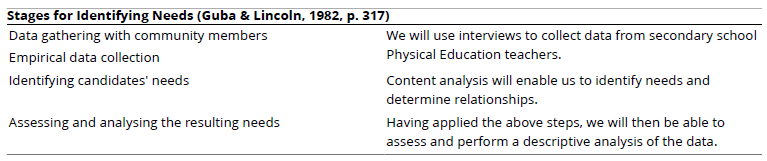
Note.Adapted from The Place of Values in Needs Assessment, by Guba y Lincoln (1982, pp. 311-320). Educational Evaluation and Policy Analysis.
A review of the literature allowed the interview guide to be configured around four dimensions: 1) proposals for improvement in continuing education, 2) continuing education, 3) training activities, and 4) the identified needs in Physical Education.
The interview was composed based on Galletta's (2013) proposal for semistructured interviews, which establishes the design and order of the questions that make up the script. This script is divided into three segments: initial (opening), middle (specificity) and final (review). These questions are accompanied by further probing questions, as defined by Qu & Dumay (2011), which allow for a more extensive narrative on a particular topic.
Once the instrument had been created, the proposal was submitted for review by experts with recognised track records and experience in the field (Escobar-Pérez & Cuervo-Martínez, 2008). They reviewed the proposed interview and suggested modifications which were accepted. The ethical conduct of this research, including the interviews, adhered to the principles of the Declaration of Helsinki as outlined by the World Medical Association. Additionally, the necessary permissions were obtained through the Andalusian Biomedical Research Ethics Portal (PEIBA) under project code 2673-N-20. The ethics committee reviewed documentation that included the instrument with the interview guide, the questions that would be part of the sociodemographic questionnaire, the project development protocol, and an informed consent form.
Procedure
Before conducting the interview, potential interviewees were contacted by telephone. Those who agreed to participate received an email containing a form (https://ec.europa.eu/eusurvey/runner/5a00f2de-6a8c-5021-bdaf-616ae37b268f) containing sociodemographic and identification questions. This tool was created using the EUSurvey platform. According to current regulations (Organic Law 3/2018 of 5 December on the Protection of Personal Data and Guarantee of Digital Rights), and to safeguard the privacy of participants, the form also requested informed consent to participate in this research. Due to the COVID-19 pandemic, interviews were conducted remotely through video calls using the open-source software Jitsi (https://meet.jit.si/).
To systematise the content analysis process, the interviews were recorded using Open Broadcaster Software (https://obsproject.com/) so they could be transcribed and converted into text later.
Data Analysis
The coding techniques and cycles suggested by Saldaña (2015) were used to code the information extracted from the interviews. Content analysis was employed for data processing (Krippendorf, 1990) as it facilitates the conceptualisation of reality.
The first coding cycle began with determining the units of analysis that consisted of each interview conducted. During the sampling phase, structural coding was the first technique applied, as it allows the data to be related to the specific interview questions. Attribute coding was then used to establish codes that referred to descriptive data. However, during the recording phase, simultaneous coding was used to encode the same unit of information with different codes. This was accompanied by the use of provisional coding, which enables the creation of codes prior to analysing the different data units from the interviews.
In the second coding cycle, the data was reorganised and the codes and subcodes became categories and themes, respectively. This recoding of the extracted information was carried out using pattern coding. Finally, to obtain categories that clearly represented the data collected in the interviews, focused coding was used to create and modify the codes collected in the first coding cycle (Saldaña, 2015).
Babbie (2014) highlights the importance of using qualitative analysis software for text processing and analysis. After applying the coding cycles and establishing the codes, Atlas.ti tool (version 8.4) was used to process the extracted data corpus.
Results
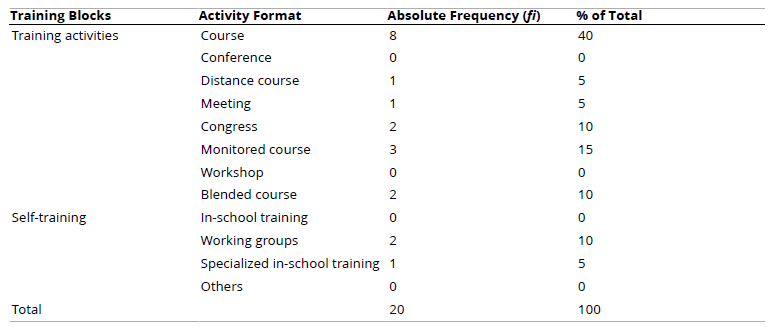
The results obtained from the preliminary questionnaire and the coding of the interview data reveal the continuing education needs expressed by the Physical Education teachers in Andalusia. Table 2 shows the training activities proposed by the PTCs, in addition to the format or type of training considered most suitable by the Physical Education teachers.
Preference in the Typology of Continuing Education Activities Offered by the PTCs
Note. Adapted from Ministry of Education and Sport, Regional Government of Andalusia, 2022 (https://www.juntadeandalucia.es/educacion/portals/web/ced/actividades-formativas).
Forty percent of the participants stated that courses were their preferred form of continuing education and this is also the most common type of training offered by PTC for Physical Education. 60% of those interviewed had participated in some form of continuing education activity with Andalusia PTC in the last six months. Regarding attendance, 80% expressed a preference for face-to-face activities, 15% preferred a blended approach, and 5% opted for online/distance learning.
Content Analysis Results
After applying the focused coding technique to the data derived from the content analysis, the predominance of some of the categories in their respective themes is evident. Table 3 shows the eight themes inferred from the second coding cycle. Each theme encompasses different categories and is characterised by the repetition of its concept, as represented by the text fragments found in the sample.
Frequencies of Themes Found After the Application of Coding Cycles
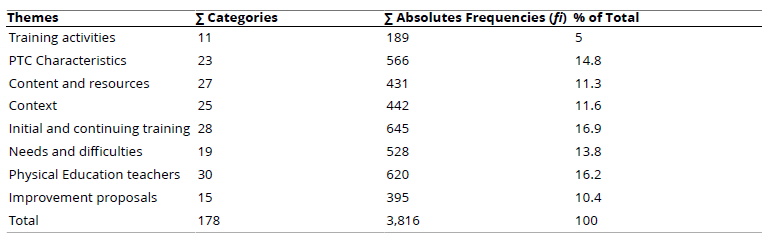
Table 4 presents the eight themes extracted from the interview analysis. The four most frequent categories for each theme are included in the table, indicating their frequency. The total number of categories presented constitutes 43.5% of the total coding of the interviews. The results also include categories that significantly influence the development of continuing education but that appear less frequently in the text corpus. These are included with their absolute frequency (fi) indicated.
Frequencies and Categories of Highest Representation
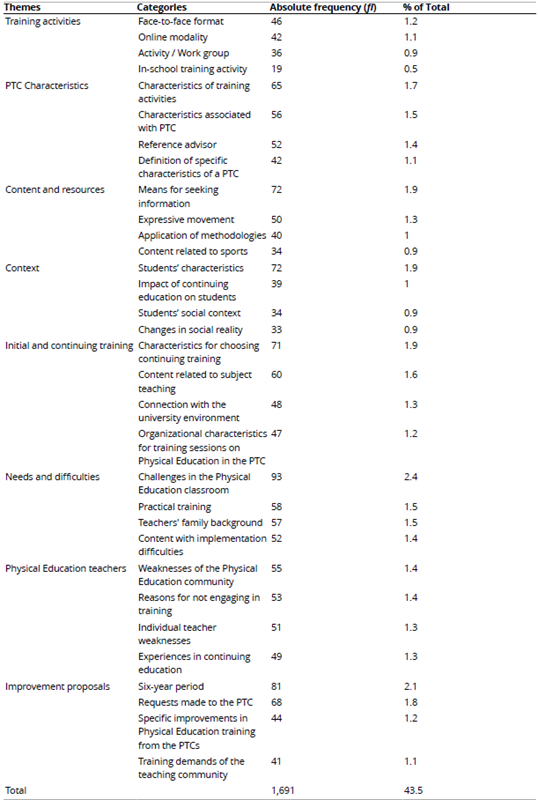
Training activities include categories related to the type of training proposals offered by PTC and the type of attendance. In terms of type, the category is the one most frequently mentioned by teachers, although it is not considered the most appropriate. The questionnaire completed by the interviewees states that only 10% of the teachers prefer this option. One motivation for working groups is that they are carried out “with people from your own subject, with the same interest”, while at the same time “recognising its high practical relevance”. Regarding the type of attendance, “face-to-face training” is considered the most important category by the interviewees, who regard it as a fundamental element, in line with the results from the previous form.
In terms of the “characteristics of training activities”, there is an overemphasis on theory in the implementation of subject content in continuing education at PTCs. The particularities attributed to PTC are revealed among the “characteristics associated with PTCs”. Teachers reported “that PTCs lack solid or well-defined training.
Regarding the continuing education on offer, there is a demand for more places, particularly in relation to the location of the workplace. This is the determining factor in choosing a specific PTC, as teachers recognise that “there is a difference between the offerings of some PTC and others”. Similarly, there is some concern about the “reference advisor” when this responsibility is not held by a Physical Education specialist, and at the same time there is a certain distance in their relationship with teachers.
With regard to “content and resources”, expressive movement has become the most representative specific content block in Physical Education, followed by “natural environment” (fi = 33) at a lower frequency. Furthermore, the interviewees argue that developing expressive movement content is difficult. They cited a lack of initial and ongoing training, as well as obstacles posed by the students themselves, some of whom think that “it is not part of Physical Education”. For content related to the natural environment, guidance is the most widely used resource. “Considerable organisational difficulties” are encountered when developing more complex proposals for activities related to the natural environment that can be adapted to safe practice. The most popular means to keep up to date with developments on the subject are “social media” (fi = 22) and “the internet” (fi = 15).
Regarding the “context” surrounding the profession, the “location of the centre” (fi = 18) and the “characteristics of the students” are described as factors influencing the continuing education. It is stated that “I have noticed a difference because, as I have said, it depends on the place rather than the years”. Similarly, the category “educational policies” (fi = 27) is seen as an unfavourable attribute in continuous transformation, and the interviewees share a view against regulatory changes.
The categories included in “initial and continuing training” are the most representative, accounting for 16.9% of the total sample. The category with the highest frequency is “characteristics for choosing continuing training”, where interest in participating in Physical Education activities, the impact of participation on students, and professional responsibility prevail. Additionally, this category includes a second, less influential reason why the group decides to undergo training. This is to obtain accreditation for a six-year period (which is achieved by completing 60 hours of training at a PTC and six years of normal public teaching activity).
In terms of the design of “organizational characteristics for training sessions on Physical Education in the PTCs”, it is suggested that face-to-face training activities be adapted to real classroom conditions, with greater specificity to the subject. In this regard, the “request made to the PTCs” reinforce the need to create Physical Education training courses that are not general in nature, as well as increasing the specialised offering for the subject. They consider the courses to be “very ambiguous... very general”, and call for training activities to be “in line with the title” offered.
In line with the claim regarding the applicability of the training activities proposed by the PTCs, the interviewed teachers pointed out the need to design “practical courses where we can clearly apply our content to the playground or our own space”, in the “needs and difficulties” theme. However, the predominant category is that dedicated to the “challenges in the Physical Education classroom”, where there has been an exponential increase in bureaucracy, as well as a very high student-teacher ratio. This ratio is considered “the greatest need in education today”, making individualised education impossible. According to one of the interviewees, improving “it would allow us to get things out of them that I never imagined”.
The topic of Physical Education teachers highlights some of the weaknesses of the Physical Education community, calling for greater unity and commitment to support teachers specialising in this area. In this regard, a category has been created that highlights the “reasons for not engaging in training”, which include offers that are disconnected from teachers´ needs, and the feeling that training “is being slowed down” for transfer competitions. This reason is linked to the demand for speakers with “experiences in continuing education” who specialise in this field. Having this knowledge "gives you a better idea of what can happen to you, what can happen... You have that knowledge and you see it; it is much easier for you to put it into practice". Furthermore, they emphasise the limited time available for further training, with time spent with “family” (fi = 57), being the main factor.
In relation to improvement proposals, the predominant category is “six-year period”, as suggested by teachers on what should be considered when granting it. This defines that “if you don”t work that number of hours, you are not entitled to a pay rise, which is really what it boils down to; it is a mistake”. Regarding specific improvements in Physical Education training from the PTCs, the importance of face-to-face teaching is emphasised, and “specific, innovative content for Physical Education” is requested. In this regard, content related to “introduction to climbing” or “how to work on orientation with new technologies” is proposed, with a focus on practical applications.
Discussion
The findings show that teachers are interested in activities related to the subject as a way of connecting with professionals in the field. For this reason, Attard (2016) emphasises the importance of based continuing education on teacher participation and providing ongoing professional advice. Consequently, educational structures providing teacher training are proposed to lay the foundations for realising all the informal learning that takes place within the group.
To achieve this, it is necessary to understand not only the needs expressed by teachers, but also the evolution of their interests and professional trends. Barriopedro et al. (2016) state that the most experienced teachers are best at designing and planning their classes. However, this group is also the most likely to stop participating in continuing education (Luis-Pascual & Gómez-Ruano, 2011). This is a key issue which opens up the space to explore why they stop taking an active part in their training, and to understand how teachers” needs evolve.
For this reason, it has been identified as a necessary element for suitability that the speakers are teachers of the subject. At the same time, it is requested that these speakers have experience at the same educational level as the training activity. Through this proposal, the interviewees aim to avoid three factors that can undermine continuing education: activities that bring together teachers from different stages; training in Physical Education that is not subject-specific; and, as Ward (2011) highlights, excessive theorisation.
Similarly, the needs identified through the analysis of continuous experience, which arise from daily teaching practice, are, as indicated by Pascual-Arias & López-Pastor (2024) and the interviewees themselves, a fundamental aspect of understanding teaching realities. This understanding is reflected in the interviews through the importance given to the category referring to the characteristics of the students social context. This category highlights its importance for professional practice and, consequently, its importance for continuing education.
This scenario challenges the traditional understanding of the profession, as accepting the influence of context raises questions about the significance of daily classroom activities for students´ development. However, teachers´ influence in planning and teaching in challenging contexts is enhanced when educators engage in dialogue (Collie et al., 2017). This raises the question of whether the work carried out by the PTCs and teachers is appropriate for the students´ environment.
At the same time, this objective is undermined by an offer that is deemed insufficient and inconsistent. For this reason, the interviewees recommend that the reference advisors be Physical Education experts. However, according to Manzanares and Galván-Bovaira (2012), this would imply the professionalisation of the role. This approach does not seem to satisfy advisers, who argue that it distances them from their perception of the profession.
However, it is recognised that the current system of six-year accreditation periods does not prevent teachers from achieving it. However, it is considered inefficient, since participating in training activities, regardless of their type or characteristics, does not automatically lead to improvement. Olssen (2006) emphasises that the democratic structure of continuing education is failing to provide a convincing response to teachers´ needs. Consequently, he proposes that continuing teacher training should not be based on the neoliberal rationale of acquiring new skills that may be irrelevant to the profession. Pedrero-Guzmán (2005) highlights this feature as an element that undermines the objective of the PTCs, trivialising their function and the value of their work. Furthermore, it links the completion of a certain number of training hours with remuneration, which, according to those interviewed, equates to the commodification of continuing education.
The content analysis revealed that expressive movement presents the greatest difficulty to the teaching community. This may be due to students rejecting the content, as well as possible deficiencies in training and a lack of previous experience on the part of teachers (Archilla, 2013). Similarly, the importance of “experience” is clear, both in the design of continuing education (Calderón & Martínez de Ojeda, 2014) and for professional advancement (Asma et al., 2022; Hadar & Brody, 2010).
Thus, in line with Escudero (2017), while continuing education remains an important element of professional development in teaching, it has not been identified as the most pressing issue to be addressed in pursuit of professional improvement. Interviewees highlight that the elements causing the most difficulty in the profession are the increased technical and bureaucratic responsibilities of teaching staff (Slingerland et al., 2017), and especially the student-teacher ratio. This coincides with Imbernón (2020) contribution, in which he attributes this issue to the implementation of conservative public policies that burden the education system structurally.
To improve the structure of continuing education, teachers must create spaces in which teachers can truly drive the process. This is because the education system and its continuing education do not need to be completely controlled by the state (Avis et al., 2018), as excessive control can distort educational practice. In order to move away from this approach and generate relevant activities, the contributions of teachers to continuing education in Physical Education must be recognised more widely. Real incentives must be promoted for their participation as organisers to impact recognition of their continuing education and improve their professional development, stimulating the active commitment of the group (Evans et al., 2023). To increase this participation, PTCs must adopt a role that forcefully advocates for teachers´ needs and rejects proposals that do not originate from teachers.
One limitation of this research is that the interviews were conducted online due to the COVID-19 pandemic, a factor that could have potentially influenced the data gathered (Brinkmann, 2018). Participants´ extensive professional experience may provide an inaccurate representation of continuing education, as teachers with more years of experience tend to be less concerned about participating in training activities (Luis-Pascual & Gómez-Ruano, 2011). This study assumes that the snowball technique may result in some members of the target population being excluded from the sample. However, the difficulty of reaching participants, coupled with the established use of this technique in qualitative research (Gierczyk et al., 2023), has led to its suitability being confirmed.
Conclusions
Based on a study of Physical Education teachers in the needs of compulsory secondary education in Andalusia, it is possible to identify which elements of change could be applied to continuing professional development.
Although the analysis of the PTC´s offerings presents a heterogeneous picture, common elements in the group´s needs are revealed. On the one hand, teachers propose that continuing education should focus on face-to-face training activities in the form of courses. This training should be practical, allowing initiatives to be implemented in the Physical Education classroom. Furthermore, it is suggested that these training activities should be organised by Physical Education teachers working at the same educational level to which the proposal relates. This issue is described as essential because it connects to the educational reality and its context. Another element highlighted is the need to promote change in the current situation, where there is a general lack of knowledge about how to coordinate and propose activities within PTCs.
Consequently, the characteristics that define continuing education require a reconsideration of the roles of teachers and PTC students in the organisation of training activities. A lack of recognition for participation was identified as a primary reason for not taking part; therefore, this recognition must be increased. Recognising teacher participation will lead to increased interaction with PTCs. It will also enable the expansion of the existing Physical Education offer, which is currently deemed insufficient and decontextualised. Therefore, some teachers argue that their training through the PTC is conditional on completing the six-year period.
The continuing professional development needs of Physical Education teachers focus on content related to expressive movement and the natural environment. Therefore, it is essential to establish a two-way relationship that encourages feedback between universities and continuing education centres. Strengthening this relationship through various public institutions is crucial to advance knowledge of continuing education in Physical Education and to respond to the expressed needs of the group.
The diagnosis of the difficulties faced by Andalusian Physical Education teachers reveals that improving communication between PTCs and teachers is crucial, since the training activities and content proposed by continuing education do not align with the needs of the teaching community. Therefore, the design of training activities proposed by PTCs should be based on more active teacher integration, strengthening their role as trainers and institutionalising processes for the continuous identification and addressing of their training needs.
Ethics Committee Statement
The study was conducted in accordance with the Declaration of Helsinki and was approved by the Research Ethics Committee of Andalucía (PEIBA), with the project code 2673-N-20.
Conflict of Interest Statement
The authors declare that there are no conflicts of interest for the publication of this manuscript.
Funding
Not applicable.
Authors' Contribution
Conceptualization M.S-B., A.R.R-S & G.R-M.; Methodology M.S-B., A.R.R-S & G.R-M; Software M.S-B., A.R.R-S & G.R-M.; Validation M.S-B., A.R.R-S & G.R-M.; Formal Analysis M.S-B.; Investigation M.S-B.; Resources M.S-B.; Data Curation M.S-B., A.R.R-S & G.R-M.; Writing – Original Draft M.S-B.; Writing – Review & Editing M.S-B.; Visualization M.S-B., A.R.R-S & G.R-M.; Supervision A.R.R-S & G.R-M. All authors have read and agreed to the published version of the manuscript.
Data Availability Statement
Data are available from the corresponding author upon reasonable request (mauserbra@alum.us.es)
References
Anacleto, F. N. D. A., Ferreira, J. D. S., Januário, C. A. S. D. S., & Santos, J. H. D. (2017). Continuing education of physical education teachers and self-assessment of the teaching domain. Motriz: Revista de Educação Física, 23. https://doi.org/10.1590/S1980-6574201700030028
Andalusian Regional Government (2005). Order of March 28, 2005, regulating the salary promotion of teaching civil servants at all educational levels, except university, and determining the requirements and evaluation criteria for their activities. Official Gazette of the Regional Government of Andalusia, 77, 10-16. https://www.juntadeandalucia.es/boja/2005/77/2
Andalusian Regional Government (2013). Decree 93/2013, of 27, 2013, regulating the initial and continuing education of teachers in the Autonomous Community of Andalusia, as well as the Andalusian System of Continuing Teacher Education. Official Gazette of the Regional Government of Andalusia, 170, 6-50. https://www.juntadeandalucia.es/boja/2013/170/1
Apple, M. (2006). Educating the Right Way: Markets, Standards, God, and Inequality. Routledge & CRC Press.
Archilla, M. T. (2013). Dificultades del profesorado de Educación Física con los contenidos de Expresión Corporal en Secundaria [Tesis doctoral, Universidad de Valladolid, Facultad de Educación de Segovia]. Repositorio documental de la Universidad de Valladolid. https://doi.org/10.35376/10324/4082
Asma, M., Kaya Saylam, D., Senavci, D., Çamliyer, H., & Çamliyer, H. (2022). Examination of In-Service Trainings in Terms of Functionality and Meeting the Needs and Expectations of Physical Education Teachers. Journal of Educational Issues, 8(1), 693-724. https://doi.org/10.5296/jei.v8i1.19771
Attard, K. (2016). Personally driven professional development: reflective self-study as a way for teachers to take control of their own professional development. Teacher Development, 21(1), 40–56. https://doi.org/10.1080/13664530.2016.1218363
Avis, J., Fisher, R., & Thompson, R. (2018). Teaching in Lifelong Learning. A guide to theory and practice. McGraw-Hill Education.
Babbie, E. (2014). The Practice of Social Research. Wadsworth Cengage.
Bacaicoa, F., & Marín, M. (2001). La formación permanente del profesorado: ¿para qué sirven los cursos de actualización? Fuentes: Revista de la Facultad de Ciencias de la Educación, 3, 46-60. https://revistascientificas.us.es/index.php/fuentes/article/view/2731
Barriopedro, M. I., Ruiz-Pérez, L. M., Gómez-Ruano, M. A., & Rico, I. (2016). Las preferencias participativas del profesorado de educación física en su actividad profesional. Anales de Psicología, 32(2), 332-340. https://doi.org/10.6018/analesps.32.2.212401
Borges, R. M., & Fraga, A. B. (2023). Long-term continuing education: An analysis of factors that potentialize the change of physical education teacher´s conception. Pro-Posições, 34, 1-23. https://doi.org/10.1590/1980-6248-2021-0068EN
Brinkmann, S. (2018). The interview. En N. K. Denzin & Y. S. Lincoln (Eds.). The Sage Handbook of Qualitative Research (5th ed., pp. 576-599). SAGE.
Calderón, A., & Martínez de Ojeda, D. (2014). La formación permanente del profesorado de educación física. Propuesta de enseñanza del modelo de Educación. Revista de Educación, 363, 128-153. https://doi.org/10.4438/1988-592X-RE-2012-363-173
Collie, R. J., Perry, N. E., & Martin, A. J. (2017). School Context and Educational System Factors Impacting Educator Stress. In T. M. McIntyre, S. E. McIntyre, & D. J. Francis (Eds.), Educator Stress: An Occupational Health Perspective (pp. 3-22). Springer International Publishing. https://doi.org/10.1007/978-3-319-53053-6_1
Ensign, J., Mays, A., & Hodges, P. (2018). Entering the Field of Physical Education: The Journey of Fifteen First-Year Teachers. Research Quarterly for Exercise and Sport, 89(1), 66-79. https://doi.org/10.1080/02701367.2017.1408951
Escalié, G., Recoules, N., Chaliès, S., & Legrain, P. (2017). Helping students build competences in physical education: Theoretical proposals and illustrations. Sport, Education and Society, 24(4), 390-403. https://doi.org/10.1080/13573322.2017.1397507
Escobar-Pérez, J., & Cuervo-Martínez, Á. (2008). Validez de contenido y juicio de expertos: una aproximación a su utilización. Avances en medición, 6(1), 27-36. https://www.humanas.unal.edu.co/lab_psicometria/download_file/view/171/250
Escudero, J. M. (2017). La formación continua del profesorado de la Educación Obligatoria en el contexto español. Profesorado, Revista de Currículum y Formación del Profesorado, 21(3), 1-20. https://recyt.fecyt.es/index.php/profesorado/article/view/59785
European Commission (2022). Pathways to school success. European Education Area. https://data.europa.eu/doi/10.2766/874295
Evans, K., Lee, W. O., Markowitsch, J., & Zukas, M. (2023). Third international handbook of lifelong learning. Springer.
Ferreira, J.D.S., Santos, J.H.D., & Costa, B.D.O. (2015). Perfil de formação continuada de professores de educação física: Modelos, modalidades e contributos para a prática pedagógica. Revista Brasileira de Ciências do Esporte, 37(3), 289-298. https://doi.org/10.1016/j.rbce.2014.01.002
Galletta, A. (2013). Mastering the Semi-Structured Interview and Beyond: From Research Design to Analysis and Publication. New York University Press.
Gierczyk, M. K., Gromkowska-Melosik, A., Scott, S., & Parker, C. (2023). The Snowball Sampling Strategy in the Field of Social Sciences. Contexts and Considerations. Przegląd Badań Edukacyjnych, 43. https://doi.org/10.12775/PBE.2023.029
Guba, E., & Lincoln, Y. (1982). Competing paradigms in qualitative research. Educational Evaluation and Policy Analysis, 4(3), 311-320. https://doi.org/10.2307/1164061
Gutiérrez-García, C., & Martínez-Álvarez, L. (2019). Spain. Physical Education Teacher Education in Spain. In A. MacPhail, D. Tannehill & Z. Avsar (Eds.), European Physical Education Teacher Education Practices (pp. 360-379). Meyer & Meyer Sport.
Hadar, L., & Brody, D. (2010). From isolation to symphonic harmony: Building a professional development community among teacher educators. Teaching and Teacher Education, 26(8), 1641-1651. https://doi.org/10.1016/j.tate.2010.06.015
Imbernón, F. (2020). Desarrollo personal, profesional e institucional y formación del profesorado. Algunas tendencias para el siglo XXI. Qurriculum. Revista de Teoría, Investigación y Práctica educativa, 33, 49-67. https://doi.org/10.25145/j.qurricul.2020.33.04
Iredale, A. (2018). Teacher Education in Lifelong Learning. Springer International Publishing. https://doi.org/10.1007/978-3-319-65819-3
Kern, B. D., & Patton, K. (2024). Continuing Professional Development in Physical Education: Future Directions and Lessons Learned. Kinesiology Review, 13(2), 186-196. https://doi.org/10.1123/kr.2024-0006
Krippendorff, K. (1990). Metodología de análisis de contenido. Teoría y práctica. Paidós.
Kvale, S., & Brinkmann, S. (2009). Interviews: Learning the Craft of Qualitative Research Interviewing. SAGE.
Levin, B. B., He, Y., & Allen, M. H. (2013). Teacher Beliefs in Action: A Cross-Sectional, Longitudinal Follow-Up Study of Teachers´ Personal Practical Theories. The Teacher Educator, 48(3), 201-217. https://doi.org/10.1080/08878730.2013.796029
Lincoln, Y.S., & Guba, E.G. (2013). The constructivist credo. Left Coast Press.
Lincoln, Y.S., Lynham, S., & Guba, E. G. (2024). Paradigmatic controversies, contradictions, and emerging confluences, revisited. En N. K. Denzin, Y. S. Lincoln, M. D. Giardina & G.S. Cannella (Eds.). The SAGE Handbook of Qualitative Research (6.ª ed., pp. 75-112). SAGE.
López Rupérez, F., García García, I., & Expósito-Casas, E. (2021). Formación inicial y formación permanente del profesorado de educación secundaria en España. Bordón. Revista De Pedagogía, 73(4), 65–84. https://doi.org/10.13042/Bordon.2021.91081
Luis-Pascual, J. C., & Gómez-Ruano, M. A. (2011). La percepción profesional docente de la formación continua: Un estudio con grupos de discusión de educación física. Revista Española de Educación Física y Deportes: REEFD, 394, 99-120. https://doi.org/10.55166/reefd.v0i394.224
Lund, L. (2020). When school-based, in-service teacher training sharpens pedagogical awareness. Improving Schools, 23(1), 5–20. https://doi.org/10.1177/1365480218772638
Manzanares, A., & Galván-Bovaira, M. J. (2012). La Formación Permanente del Profesorado de Educación Infantil y Primaria a través de los Centros de Profesores. Un modelo de evaluación. Revista de Educación, 359, 431-455. https://doi.org/10.4438/1988-592X-RE-2011-359-101
Mason, M. (2010). Sample Size and Saturation in PhD Studies Using Qualitative Interviews. Forum: Qualitative Social Research, 11(3), 1-19. https://doi.org/10.17169/fqs-11.3.1428
Maxwell, J. A. (2017). The validity and reliability of research: A realist perspective. En D. Wyse, N. Selwyn, E. Smith & L. E. Suter (Eds.). The SAGE handbook of educational research (vol. 1, pp. 116-140). SAGE.
Mcphail, A., & Lawson, H. (2020). School Physical Education and Teacher Education: Collaborative Redesign for the 21st Century. Routledge. https://doi.org/10.4324/9780429330186
Olssen, M. (2006). Understanding the Mechanisms of Neoliberal Control: Lifelong Learning, Flexibility and Knowledge Capitalism. International Journal of Lifelong Education, 25, 213-230. https://doi.org/10.1080/02601370600697045
Pascual-Arias, C., López-Pastor, V. M., Fuentes, T., & Hortigüela-Alcalá, D. (2022). La formación permanente del Profesorado como elemento influyente para implicar al alumnado en su evaluación: un estudio de caso. Revista Iberoamericana de Evaluación Educativa, 15(1), 81-99. https://doi.org/10.15366/riee2022.15.1.005
Pascual-Arias, C., & López-Pastor, V. M. (2024). Competencia investigadora, investigación-acción y formación permanente del profesorado. Alteridad, 19(2). https://doi.org/10.17163/alt.v19n2.2024.02
Patton, M. Q. (2015). Qualitative research & evaluation methods: Integrating theory and practice. SAGE.
Pedrero-Guzmán, M. C. (2005). Análisis de la Educación Física en la Región de Murcia desde la perspectiva psicosocial del alumno. [Tesis doctoral, Universidad de Murcia]. Repositorio institucional de la Universidad de Murcia.
Qu, S., & Dumay, J. (2011). The qualitative research interview. Qualitative Research in Accounting & Management, 8(3), 238-264. https://doi.org/10.1108/11766091111162070
Robson, C., & McCartan, K. (2016). Real World Research. Wiley.
Rubin, H. J., & Rubin, I. S. (2012). Qualitative interviewing: The art of hearing data. SAGE.
Saldaña, J. (2015). The coding manual for qualitative researchers. SAGE.
Saleem, Z., & Zamir, S. (2016). Role of In-Service Teacher Training in the Professional Development of Prospective Teachers. Information and Knowledge Management, 6(8), 53-60. https://core.ac.uk/reader/234672360
Schleicher, A. (2018). Primera Clase: Cómo construir una escuela de calidad para el siglo XXI. OECD Publishing.
Seidman, I. (2006). Interviewing As Qualitative Research: A Guide for Researchers in Education and the Social Sciences. Teachers College Press, Columbia University.
Slingerland, M., Borghouts, L., Jans, L., Weeldenburg, G., van Dokkum, G., Vos, S., & Haerens, L. (2017). Development and optimisation of an in-service teacher training programme on motivational assessment in physical education. European Physical Education Review, 23(1), 91–109. https://doi.org/10.1177/1356336X16639212
Spanish Government (2018). Organic Law 3/2018, of December 5, on the Protection of Personal Data and Guarantee of Digital Rights. Official State Gazette, 294, 122868-122953. https://www.boe.es/eli/es/lo/2001/12/21/6/con
Spanish Government (2020). Organic Law 3/2020, of December 29, amending Organic Law 2/2006, of May 3, on Education. Official State Gazette, 340, 122868-122953. https://www.boe.es/eli/es/lo/2001/12/21/6/con
Tannehill, D., Demirhan, G., Čaplová, P., & Avsar, Z. (2021). Continuing professional development for physical education teachers in Europe. European Physical Education Review, 27(1), 150-167. https://doi.org/10.1177/1356336X20931531
Ward, P. (2011). The future Direction of Physical Education Teacher Education: It´s All in the Details. Japanese Journal of Sport Education Studies, 30(2), 63-72. https://doi.org/10.7219/jjses.30.2_63
Ward, P. (2016). Policies, Agendas, and Practices Influencing Doctoral Education in Physical Education Teacher Education. Quest, 68(4), 420-438. https://doi.org/10.1080/00336297.2016.1234964
Ward, P., & Kim, I. (2024). Unpacking Pedagogical Content Knowledge in Physical Education: What We Know and Do Not Know. Kinesiology Review, 13(2), 176-185. https://doi.org/10.1123/kr.2023-0076
Yin, R. K. (2018). Case study research and applications: Design and methods. SAGE.
Zhang-Zhi & Zhang-Nan (2011). Research on the system construction of the continuing education for the physical education teacher. 2011 IEEE International Symposium on IT in Medicine and Education, 124-128. https://doi.org/10.1109/ITiME.2011.6130799
Author notes
Correspondence: Mauricio Serrano Brazo, mauserbra@alum.us.es
Additional information
Short title: Continuing Education in PE in Andalusia
How to cite this article: Serrano-Brazo, M., Rodríguez-Sánchez, A.R., & Ramírez-Macías, C. (2025). Cotinuing Education: Needs of physical education teachers in compulsory secondary school/baccalaureate/vocational training in Andalusia. Cultura, Ciencia y Deporte, 21(67), 2143. https://doi.org/10.12800/ccd.v21i67.2143


