
SCORING SYSTEM CHANGING IN YOUTH BASKETBALL: RUNNING SCORE VS. SET SCORE
CAMBIO EN EL SISTEMA DE TANTEO EN BALONCESTO DE FORMACIÓN: MARCADOR CORRIDO FRENTE A MARCADOR POR SET


Jesús Salado, Ricardo André Birrento, Enrique Ortega
SCORING SYSTEM CHANGING IN YOUTH BASKETBALL: RUNNING SCORE VS. SET SCORE
Cultura, Ciencia y Deporte, vol. 20, no. 66, 2025, 10.12800/ccd.v20i66.2206
Universidad Católica San Antonio de Murcia
Jesús Salado
Fernando III University, España
Universidad de Murcia, España
Universidad de Murcia, España
Ricardo André Birrento a
Universidad de Murcia, España
Universidad de Murcia, España
Universidad de Murcia, España
Enrique Ortega
Universidad de Murcia, España
Universidad de Murcia, España
Universidad de Murcia, España
Received: 27 April 2024
Accepted: 24 february 2025
Abstract: The aims of this study are as follows: a) to analyze the technical-tactical actions in a competition with the Spanish Basketball Federation (FEB) rules (running score) and in a modified competition (SET score); b) to analyze the parents’ opinions on their preference for the two competition models. The sample consisted of 10 U-10 basketball players. A tournament was held in which two teams participated. A game was played according to the official basketball rules of the Spanish Basketball Federation, and a week later, the same game was played with the same players, with FEB regulations,but with the type of scoring modified so that in this modified tournament, the winner of the game was the team that won more SETs of play, starting each SET of play with 0-0. Using observational methodology, the following variables were analyzed for each game: (a) number of 1 vs.1, B) successful shots, c) ball acquisition, and d) number of passes. Interviews were conducted with 17 parents to determine their opinions on both competitions. The results obtained highlight the parents' preference for SET score, which improves the number of shots and 1 vs. 1 shot taken by the players with respect to the FEB rules score game.
Keywords: Opinion, rules modifying, technical-tactical, under-10, variability.
Resumen: Los objetivos del presente trabajo son: a) analizar las acciones técnico-tácticas en una competición con el reglamento de la Federación Española de Baloncesto (FEB) (tanteo arrastrado) y en una competición modificada (tanteo por set); b) analizar la opinión de madres/padres sobre su preferencia sobre los dos modelos de competición. La muestra estuvo formada por 10 jugadores de baloncesto sub-10. Se llevó a cabo un partido en el que participaron dos equipos. Se disputó un partido con la reglamentación oficial de baloncesto de la Federación Española de Baloncesto, y una semana después se disputó el mismo partido con los mismos jugadores, con la reglamentación de la FEB, pero modificando el tipo de tanteo, de manera que en el partido modificado el ganador del partido era el equipo que ganaba más periodos de juego, empezando cada periodo de juego con 0-0. Mediante metodología observacional, se analizaron de cada partido las siguientes variables: a) número de 1 vs.1, B) lanzamientos acertados, c) obtención del balón y d) número de pases. Se realizaron entrevistas a 17 madres y padres para conocer su opinión sobre ambas competiciones. Los resultados obtenidos destacan la preferencia por parte de los padres/madres del tanteo por set, que aporta mejoras en la cantidad de tiros y de 1 vs.1 que realizan los jugadores con respecto al partido de tanteo de reglamento FEB.
Palabras clave: Benjamín, modificación de reglas, opinión, técnico-táctico, variabilidad.
Introduction
The teaching of sports in general, and of basketball in particular, has undergone significant evolution in recent years. In this regard, several instructional models for sports have been developed, among which the following stand out: the Traditional Model, the Structural Model, Cognitive Styles, the Teaching Games for Understanding (TGfU) Model, and the Integrated Model (Alarcón et al., 2010). More recently, new methodological approaches have emerged, such as non-linear pedagogical models and differentiated learning frameworks, which emphasize the athlete’s ability to adapt to various contexts and to apply diverse technical-tactical actions (Buszard et al., 2016; Button et al., 2020; Gorman et al., 2021).
These modified learning situations should not be limited exclusively to training sessions. It is essential that competition—an integral component of the teaching-learning process—also incorporates adaptations in which the styles of play, game duration, playing areas, rules, scorekeeping systems, and other elements are adjusted according to the participants’ stage of development. Such adaptations enhance competition as a formative and educational tool (Bazaco et al., 2011).
In this context, sports rules have become a topic of analysis and reflection among sports federations, coaches, and researchers. The rule modifications implemented in recent years within team sports aim to make sports practice as equitable and engaging as possible (Birrento Aguiar et al., 2023). However, most of the changes introduced by international federations are designed for high-performance contexts. These same rules are frequently adopted by national and regional federations in youth sports without prior validation or adaptation to the psycho-evolutionary characteristics of young athletes (García-Angulo et al., 2020; Birrento Aguiar et al., 2023). Consequently, the distinction between school-age participants and professional athletes is often disregarded (García-Angulo et al., 2020; Giménez-Egido et al., 2020; Ortega-Toro et al., 2020).
Regarding rules modifications reported in the literature, studies have been conducted across a range of sports. For instance, in field hockey, Timmerman et al. (2019) altered game duration, number of players, and field dimensions, observing that these changes influenced participants’ performance actions. In soccer, García-Angulo et al. (2020) reduced the number of players, goal size, and pitch dimensions, concluding that these adjustments increased both the quantity and variability of technical-tactical actions and enhanced teamwork, among other outcomes. Similarly, in tennis, Giménez-Egido et al. (2020) modified net height and court dimensions, finding that the modified competition produced greater technical-tactical variability.
In basketball, research has explored changes to basket height, ball size, and court markings (Arias et al., 2012; Ortega-Toro et al., 2020, 2021), as well as to the number of players. These studies reported increases in players’ self-efficacy, as well as improvements in technical-tactical and physical performance among developing athletes (Conte et al., 2016; Ortega-Toro et al., 2021). In line with these findings, recent studies demonstrate that manipulating basket distance and height affects the technical execution of the shooting motion (Andrés et al., 2023); that the number of technical-tactical actions increases during both fast-break and positional offensive phases (Ortega et al., 2009); and that significant differences are observed in the kinematic performance of players in the under-13 category according to their maturational development (Birrento Aguiar et al., 2023).
Nevertheless, there remains a scarcity of research analyzing modifications to the scoring system and their pedagogical implications within the teaching-learning process of young players, particularly studies that integrate the perspectives of all stakeholders involved in player development. It is therefore essential to consider the opinions of players, coaches, club administrators, and parents when designing such modifications (Ortega-Toro et al., 2012).
Accordingly, the objectives of the present study are as follows: a) To analyze technical-tactical actions in competitions conducted under the rules of the Spanish Basketball Federation (FEB) (cumulative scoring) and in a modified competition (set-based scoring); andb) To examine parents’ opinions regarding their preference between the two competitive models.
Materials and Methods
Sample
The sample consisted of 20 under-10 basketball players and 17 parents. The players participated in two games, and the parents were interviewed at the conclusion of the second game. Written informed consent was obtained from all participants and their parents prior to participation in the study. The research was approved by the Institutional Research Ethics Committee of the University of Murcia (Ref. 2828/2020).
Procedure
The players participated in two games with the following characteristics: the first game was played according to the Spanish Basketball Federation (FEB) minibasketrules, using a cumulative scoring system; the second game was held one week later under a modified rule system employing set-based scoring. In the set-based format, the outcome of each quarter (set) was considered independently, with one point awarded for each quarter won and the score reset to zero at the beginning of every quarter.
A 1 vs. 1 situation was defined as any instance in which an offensive player in possession of the ball, during a positional attack, successfully surpassed their direct defender (shoulder-to-shoulder line) or created sufficient space to attempt a shot. A 1 vs. 1 was also recorded when the player executed a feint to generate a shooting opportunity or performed a step back move that concluded with a shot attempt.
Regarding the parents’ opinions, a qualitative design was employed, and semi-structured interviews were conducted to gather their perceptions and preferences.
Instruments
For the analysis of technical-tactical actions, an observational methodology was employed (Anguera & Hernández, 2014). Based on the instrument designed and validated by Ortega et al. (2009), the following technical-tactical variables were recorded: a) ball acquisition (number of times the player obtained the ball control possession time ; b) ball possession time; c) number of 1vs.1 situations; d) number of passes; e) basic technical-tactical actions; f) offensive rebounds; g) defensive rebounds; h) successful shots; i) missed shots; and j) total shots attempted.
To ensure data quality control, the observer training procedure proposed by Losada and Manolov (2015) was followed. Two observers underwent a structured training process. After the training period, both inter- and intra-observer reliability were calculated. For intra-observer reliability, an additional expert researcher served as the reference point. Reliability was assessed both before and after the observation process using Cohen’s Kappa coefficient for categorical variables and the Intraclass Correlation Coefficient (ICC) for temporal variables. The lowest inter-observer reliability value obtained was 0.90, and the lowest intra-observer reliability value was 0.92.
For the analysis of the interviews, the phases proposed by Elo and Kyngäs (2008) were followed. These included: a preparation phase, an organization phase—during which data were coded, and a category system was developed—and finally, a reporting phase, where the analytical process was completed. In accordance with the literature, this process was carried out by multiple coders (Guest & MacQueen, 2008; Schreier, 2012). The coding team in this study consisted of three professionals with experience in content analysis. Coder training was structured as follows:1. Description and familiarization with the coding system; 2. Co-coding practice; and 3. Content analysis practice.
Two interviews were coded independently, and the inter-coder agreement exceeded 92% (Saldaña, 2015).
Statistical Analysis
For the statistical analysis, both descriptive and inferential analyses were performed to identify differences between the two games. The Wilcoxon test was used to examine potential differences in technical-tactical variables between the two types of competition, and the effect size was calculated using the rank biserial correlation (RBC). The statistical analyses were conducted using the JAMOVI software (version 2.4.8), with a significance level set at p< .05. For the analysis of parents’ opinions, the MAXQDA software was used.
Results
Table 1 presents the mean values, standard deviations, and inferential statistics for the technical-tactical variables analyzed in the two games.
Technical-Tactical Variables Results
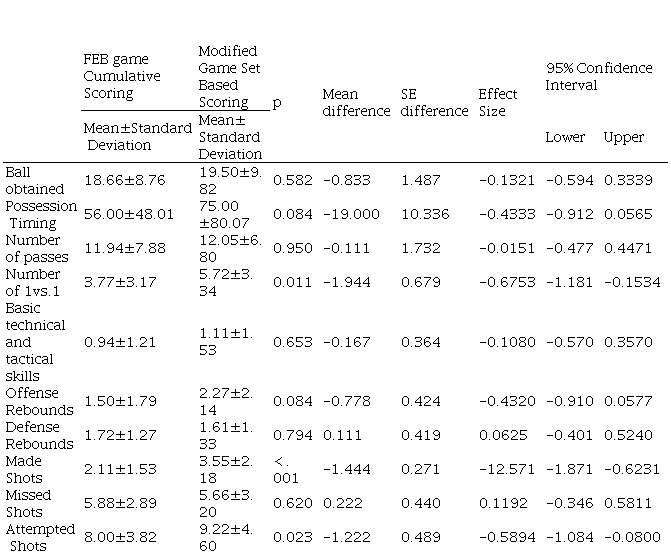
The data presented in Table 1 show statistically significant differences in the number of 1 vs. 1 situations (p = 0.01; RBC = -0.675), successful shots (p< 0.01; RBC = -12.571), and total shots attempted (p = 0.02; RBC = -0.589), with higher values observed in the set-based scoring game compared to the cumulative scoring game. Trends toward statistical significance were also noted for ball possession time and offensive rebounds. In all cases, values in the set-based scoring game were higher than those in the cumulative scoring game, except for missed shots and defensive rebounds.
Regarding parents’ opinions, Table 2 presents the frequencies of comments corresponding to the analyzed codes.
Codes Frequency
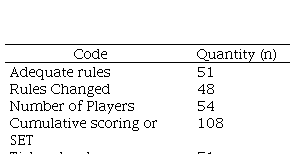
Regarding parents’ opinions on whether the rules for this age category are appropriate, most respondents (58.8%) indicated that they consider the current rules adequate, as exemplified by Interviewee 7: “I think so. It seems to help them be disciplined.” Conversely, 41.2% of respondents considered the rules inadequate or in need of improvement. In this regard, Interviewee 10 stated, “Some rules are very strict.”
With respect to potential changes in the rules, parents’ suggestions mainly focused on the number of players and the type of scoring system, although they also highlighted the importance of general flexibility in applying the rules. Regarding the number of players, parents expressed a preference for reducing the number on the court: “I like 4x4” (Interviewee 3). Concerning flexibility in rule enforcement, Interviewee 16 commented, “Perhaps allowing a bit more mobility and some minor infractions, although they already do this.”
Finally, regarding set-based versus cumulative scoring, 58.8% of parents of the players preferred the set-based system, 35.3% preferred cumulative scoring, and 5.9% were undecided. In this context, Interviewee 1 noted, “I think set-based scoring is better. It helps prevent demotivation after a bad streak because you can recover in the next set.” Similarly, Interviewee 5 stated, “It’s perfect because when the children were losing by a lot, they lost motivation.”
Discussion
The aims of the present study were to analyze technical-tactical actions in a competition conducted under a cumulative scoring system and in a modified competition (set-based scoring), and, secondly, to examine parents’ opinions regarding their preference between the two competitive models.
In a study on rules modifications in basketball, Birrento Aguiar et al. (2021) analyzed the different youth basketball rules established by regional federations, concluding that there is a wide variety of modifications, particularly in the early developmental categories (under-8, under-10, and under-12). However, these changes have generally not been based on scientific evidence, but rather on the specific proposals of federation officials. While these proposals may be highly valuable, it would be of great interest to analyze them from a scientific perspective to support more evidence-based decision-making.
In the pursuit of such scientific evidence, several studies have introduced rule modifications (Cañadas Alonso & Ortega Toro, 2017; Martínez-Fernández et al., 2015; Ortega Toro et al., 2012; Piñar López, 2005; Piñar et al., 2009; Thomas et al., 2023), which have led to increases in the degree, type, and rate of player involvement with the ball during play (Piñar López, 2005; Conte et al., 2016; Ortega-Toro et al., 2021). The modifications applied in these studies and their effects were as follows:
-
Reducing basket height (Ortega-Toro et al., 2021; Thomas et al., 2023). Ortega-Toro et al. (2021) reported that lowering the basket height to 2.80 meters improved players’ perceived self-efficacy and enjoyment.
-
Reducing the number of players (Martínez-Fernández et al., 2015; Piñar et al., 2009), which led to an increase in the number of possessions and one- on-one situations, enhancing attacking effectiveness and overallparticipation.
-
Altering players’ participation time (Cañadas Alonso & Ortega Toro, 2017), where a reduction in the number of players per period resulted in greater participation and a higher frequency of technical-tactical actions with the ball.
-
Adjusting ball size and weight (Arias et al., 2012), which demonstrated that tailoring the ball to players aged 9–11 increased the number of shots attempted, improved shooting accuracy, and enhanced levels of satisfaction.
In line with these findings, Thomas et al. (2023), in their study examining shooting from various positions with different ball sizes and basket heights, concluded that shorter shooting distances and lower basket heights (2.60–2.85 m) were beneficial for children’s learning. The results obtained in the present study are consistent with the evidence cited above. Significant differences were observed in the number of one-on-one situations, shots attempted, and successful shots. Additionally, variables such as ball possession time (p = 0.08) and the number of offensive rebounds (p = 0.08) yielded values close to statistical significance.
These results agree with those found in previous research, indicating that the modification introduced—in this case, the change in the scoring system—resulted in improvements in one-on-one situations, shots attempted, and successful shots. This improvement may be attributed to the fact that isolating the outcome of each quarter allows players to compensate for a poor result in the previous period, thereby reducing the potential demotivation caused by large score differentials. This aspect was also highlighted by some of the interviewees in this study.
Regarding the appropriateness of the rules for this age category, more than half of the participants considered the current rules to be adequate. This contrasts with the findings of Cañadas and Ortega (2017), where parents and coaches indicated that it was necessary to adapt the rules to the characteristics of young players—particularly with respect to the number of players, playing time, and ball size. However, when focusing specifically on the rules related to scoring, and after experiencing both competition formats (continuous scoring versus set-based scoring), more than half of the respondents expressed a preference for the set-based model. This type of response is quite common, as initial resistance to change is often observed; however, once participants experience and reflect upon the new format, it is typical for opinions to shift—both among parents and among players, coaches, and administrators.
The implementation of a set-based competition model and the reduction of the number of players on the court during the early stages of sports initiation may promote greater player participation, minimize large score differentials, and enhance competitiveness by providing each set as a new opportunity for success.
Conclusions
In conclusion, the change in the scoring system appears to have a positive impact on various aspects of the game, such as the number of one-on-one situations, the number of shots attempted, and the number of successful shots. However, further research in this area is required to consolidate the evidence supporting its effectiveness in enhancing player development.
Ethics Committee Statement
The study was conducted in accordance with the Declaration of Helsinki and was approved by the International Research Ethics Committee of the University of Murcia (No. 28/28/2020).
Conflict of Interest Statement
The funding organizations or institutions had no influence on the study design, data analysis, or interpretation of the results.
Funding
This research was funded by BASKET 2.0 (No. 21076/PDC/19), Fundación Séneca – Science and Technology Agency of the Region of Murcia.
Authors' Contribution
Conceptualization: J.S. & E.O.; Methodology: J.S.; Software: E.O.; Validation: J.S., Y.Y. & E.O.; Formal Analysis: E.O.; Investigation: J.S. & R.B.; Resources: E.O.; Data Curation: E.O.; Writing – Original Draft: J.S.; Writing – Review & Editing: R.B.; Visualization: J.S.; Supervision: E.O.; Project Administration: E.O.; Funding Acquisition: E.O. All authors have read and approved the published version of the manuscript".
Data Availability Statement
Data availability is not applicable to this article.
Acknowledgements
Federación de Baloncesto de la Región de Murcia.
References
Alarcón López, F., Cárdenas Vélez, D., Miranda León, M. T., Ureña Ortín, N., & Piñar López, M. I. (2010). La metodología de enseñanza en los deportes de equipo. Revista de Investigación en Educación, 7, 91-103. https://revistas.uvigo.es/index.php/reined/article/view/1854/1765
Andrés, J. M. P., López, M. I. P., & Toro, E. O. (2023). Relación entre la ejecución del lanzamiento a canasta desde diferentes distancias y distintas pruebas de lanzamiento en jugadores masculinos de baloncesto sub-12. Revista Observatorio del Deporte, 9(3), 1-15. https://doi.org/10.58210/odep306
Anguera, M. T., & Hernández-Mendo, A. (2014). Metodología observacional y psicología del deporte: Estado de la cuestión. Revista de Psicología del Deporte, 23(1), 103-109. https://www.redalyc.org/pdf/2351/235129571018.pdf
Arias, J. L., Argudo, F. M., & Alonso, J. I. (2012). Effect of basketball mass on shot performance among 9–11 year-old male players. International Journal of Sports Science & Coaching, 7(1), 69-79. https://doi.org/10.1260/1747-9541.7.1.69
Bazaco Belmonte, M. J., Hernández, E., Sainz de Baranda, M. del P., & Ortega Toro, E. (2011). Elementos que influyen para lograr un adecuado uso pedagógico de la competición: Reglas y la propia competición. Trances: Transmisión del Conocimiento Educativo y de la Salud, 3(2), 241-254. https://fb39c223-56a9-4ed3-91f4-073579bde094.filesusr.com/ugd/fa6be1_d00ea3cfa1ea45a18c1fef5e288ab693.pdf
Birrento Aguiar, R. A., Giménez Egido, J. M., Palao Andrés, J. M., & Ortega-Toro, E. (2023). Influence of rule manipulation on technical–tactical actions in young basketball players: A scoping review. Children, 10(2), 323. https://doi.org/10.3390/children10020323
Birrento Aguiar, R. A., Vizcaíno Domínguez, C., Sáenz-López Buñuel, P., & Ortega Toro, E. (2021). Revisión de los reglamentos deportivos en baloncesto en etapas de formación (u10, u12, u13 y u14). E-Balonmano.com: Revista de Ciencias del Deporte, 17(3), 181-194. https://doi.org/10.17398/1885-7019.17.181
Buszard, T., Reid, M., Masters, R., & Farrow, D. (2016). Scaling the equipment and play area in children’s sport to improve motor skill acquisition: A systematic review. Sports Medicine, 46(6), 829-843. https://doi.org/10.1007/s40279-015-0452-2
Button, C., Seifert, L., Chow, J. Y., Davids, K., & Araujo, D. (2020). Dynamics of skill acquisition: An ecological dynamics approach. Human Kinetics Publishers. https://books.google.cl/books?hl=es&lr=&id=2TPODwAAQBAJ&oi=fnd&pg=PP2&dq=Dynamics+of+Skill+Acquisition:+A+Ecological+Dynamics+Approach%3B&ots=XaJ-ohRrj2&sig=4P9KgGqJpzVFbcqh39Wa_js-6ys
Cañadas Alonso, M., & Ortega Toro, E. (2017). Modificación de reglas y competición en baloncesto: Opinión de padres y entrenadores. Revista de Psicologíadel Deporte, 26(1), 23-26. http://www.observatoriobizkaiabasket.com/Web/Archivos/GD/256/modreglas.pdf
Conte, D., Favero, T. G., Niederhausen, M., Capranica, L., & Tessitore, A. (2016). Effect of different number of players and training regimes on physiological and technical demands of ball-drills in basketball. Journal of Sports Sciences, 34(8), 780-786. https://doi.org/10.1080/02640414.2015.1069384
Elo, S. & Kyngäs, H. (2008). The qualitative content analysis process. Journal of Advanced Nursing, 62(1), 107-115. https://doi.org/10.1111/j.1365-2648.2007.04569.x
García-Angulo, A., Palao, J. M., Giménez-Egido, J. M., García-Angulo, F. J., & Ortega-Toro, E. (2020). Effect of the modification of the number of players, the size of the goal, and the size of the field in competition on the play actions in U-12 male football. International Journal of Environmental Research and Public Health, 17(2), 518. https://doi.org/10.3390/ijerph17020518
Gimenez-Egido, J. M., Ortega-Toro, E., Palao, J. M., Verdú-Conesa, I., & Torres-Luque, G. (2020). Effect of modification rules in competition on technical–tactical action in young tennis players (under-10). Frontiers in Psychology, 10, 2789. https://doi.org/10.3389/fpsyg.2019.02789
Gorman, A., Headrick, J., Renshaw, I., McCormack, C., & Topp, K. (2021). A principled approach to equipment scaling for children’s sport: A case study in basketball. International Journal of Sports Science & Coaching, 16(1), 158-165. https://doi.org/10.1177/1747954120954569
Guest, G., & MacQueen, K. M. (2008). Handbook for Team-based Qualitative Research. Rowman Altamira.
Losada, J. L., & Manolov, R. (2015). The process of basic training, applied training, maintaining the performance of an observer. Quality & Quantity: International Journal of Methodology, 49(1), 339-347. https://psycnet.apa.org/doi/10.1007/s11135-014-9989-7
Martínez-Fernández, S., García Rubio, J., & Ibáñez Godoy, S. J. (2015). Incidence of type of game mode in player participation in minibasket. Revista de Psicología del Deporte, 24(3), 65-68. https://ddd.uab.cat/pub/revpsidep/revpsidep_a2015v24n3/revpsidep_a2015v24n3p65.pdf
Ortega, E., Palao, J. M., de Baranda, P. S., & García, L. M. (2009). Preferencias y nivel de satisfacción en acciones técnico-tácticas, y en tipo de ataque y defensa utilizado en la competición en jóvenes jugadores de baloncesto. Cuadernos de Psicología del deporte, 9, 65. https://revistas.um.es/cpd/article/view/85791/82611
Ortega Toro, E., Alarcón López, F., & Piñar López, M. I. (2012). Modificaciones reglamentarias en baloncesto de formación: Un nuevo equipamiento, una nueva perspectiva. In A. Antúnez Medina & S. J. Ibáñez Godoy (Eds.), El camino hacia la excelencia en baloncesto (pp. 135-159). Wanceulen Editorial.
Ortega-Toro, E., García-Angulo, F. J., Giménez-Egido, J. M., & Palao, J. M. (2021). Effect of scaling basket height for young basketball players during the competition: Seeking out positive sport experiences. Journal of Sports Sciences, 39(24), 2763-2771. https://doi.org/10.1080/02640414.2021.1957584
Ortega-Toro, E., Gimenez-Egido, J. M., Verdu-Conesa, I., & Palao, J. M. (2020). Effect of basket height adaptation on technical–tactical skills, self-efficacy, cooperation, and students’ perception in a basketball unit. Sustainability, 12(23), 10180. https://doi.org/10.3390/su122310180
Piñar López, M. I. (2005). Incidencia del cambio de un conjunto de reglas de juego sobre algunas de las variables que determinan el proceso de formación de los jugadores de minibasket (9-11 años). [Tesis Doctoral, Universidad de Granada]. Universidad de Granada. http://hdl.handle.net/10481/544
Piñar, M. I., Cárdenas, D., Alarcón, F., Escobar, R., & Torre, E. (2009). Participation of mini-basketball players during small-sided competitions. Revista de Psicología del Deporte, 18(3), 445-449. http://hdl.handle.net/10481/33133
Saldaña, J. (2015). The coding manual for qualitative researchers. Sage.
Schreier, M. (2012). Qualitative content analysis in practice. Sage publications.
Thomas, C., Nolte, K., Schmidt, M., &Jaitner, T. (2023). Lower baskets and smaller balls influence mini-basketball players’ throwing motions. Biomechanics, 3(1), 71-78. https://doi.org/10.3390/biomechanics3010007
Timmerman, E. A., Savelsbergh, G. J., & Farrow, D. (2019). Creating appropriate training environments to improve technical, decision-making, and physical skills in field hockey. Research Quarterly for Exercise and Sport, 90(2), 180-189. https://doi.org/10.1080/02701367.2019.1571678
Author notes
aAutor para la correspondencia: Ricardo André Birrento Aguiar, ra.birrentoaguiar@um.es
Additional information
Título Abreviado: Scoring System Changing in Youth Basketball
How to cite this article: Salado, J., Birrento, R. A., & Ortega, E. (2024). Scoring system changing in youth basketball: running score vs SET score. Cultura, Ciencia y Deporte, 20(66), 2206. https://doi.org/10.12800/ccd.v20i66.2206


