
TELL ME HOW MUCH YOU RUN AND I´LL TELL YOU WHAT GRADE YOU DESERVE. ASSESSMENT IN CHILEAN PHYSICAL EDUCATION
DIME CUÁNTO CORRES Y TE DIRÉ QUÉ NOTA MERECES. EVALUACIÓN EN LA EDUCACIÓN FÍSICA CHILENA


Fernando Muñoz-Sepúlveda, Alexandra Valencia-Peris, Daniel Martos-García, Alberto Moreno Doña
TELL ME HOW MUCH YOU RUN AND I´LL TELL YOU WHAT GRADE YOU DESERVE. ASSESSMENT IN CHILEAN PHYSICAL EDUCATION
Cultura, Ciencia y Deporte, vol. 20, no. 66, 2025, 10.12800/ccd.v20i66.2171
Universidad Católica San Antonio de Murcia
Fernando Muñoz-Sepúlveda
Universidad Autónoma de Chile, Chile
Alexandra Valencia-Peris a
Universidad de Valencia, España
Daniel Martos-García
Universidad de Valencia, España
Alberto Moreno Doña
Universidad de Valparaíso, Chile
Received: 02 february 2024
Accepted: 27 march 2025
Abstract: The importance of assessment as a defining element in every educational process requires an exploration of the experiences of Chile’s future teachers during their school training. This study identifies the meanings, feelings and consequences associated with physical fitness tests in Physical Education. An inductive categorical analysis was generated from a study of 60 narrative accounts of students of different teaching specialities. The results indicated the wide prevalence of physical fitness tests to assess and grade the subject, leading to stress and feelings of anxiety. Students with a low level of physical fitness expressed their frustration, discouragement and insecurity, while some even dropped out of the class under various pretexts. Conversely, the physically fit students who satisfied the required standards found the tests to be both motivating and satisfying. The results indicated that the emotional impact of physical fitness tests for grading Physical Education affects all students, particularly those with low fitness levels, who suffered feelings of frustration and discomfort as a result of their negative experiences in the subject.
Keywords: Assessment, frustration, narratives, social justice.
Resumen: La importancia de la evaluación como elemento definitorio de todo proceso educativo genera la necesidad de indagar sobre experiencias del futuro profesorado chileno en su etapa de formación escolar, identificando significados, sentimientos y consecuencias que generaron los test de condición física usados en la asignatura de Educación Física. A partir del estudio de 60 relatos narrativos de estudiantes de diferentes especialidades de Pedagogía, se generó un análisis categorial inductivo. Los resultados manifiestan alta prevalencia de los test de condición física para evaluar y calificar la asignatura, provocando estrés y sensación de ansiedad. El estudiantado con bajos niveles de condición física manifestaba sentimientos de frustración, desmotivación e inseguridad, hasta el extremo de desertar de la clase mediante justificantes o excusas diversas. Por otro lado, quienes declaran buenos niveles de condición física y cuyas aptitudes encajaban con los estándares exigidos, los test generaban motivación y satisfacción. Como conclusión, los test de condición física utilizados en Educación Física para calificar conllevan una gran carga emocional para todo el estudiantado, especialmente para quienes no presentan altos niveles de condición física. En estos casos prevalecen sentimientos de frustración y malestar hacia la asignatura por las experiencias negativas que esta genera en el alumnado.
Palabras clave: Evaluación, frustración, justicia social, relatos.
Introduction
Assessment has emerged as a defining element in every educational process (Santos Guerra, 1995) to such an extent that its orientation and deployment significantly determine its formative nature (López-Pastor, 2006; Prieto, 2015). However, despite the wide consensus on its relevance, it should be remembered that the concept of assessment is polysemic. This means that from a technocratic perspective, assessment is linked to control and measurement, judging the validity of the objective and accountability, to mention but a few of its purposes (Calatayud, 2021; Mora, 2004; Hortigüela-Alcalá et al., 2021). From this perspective, the main purpose of assessment is to grade students (López-Pastor et al., 2006) to the point that both the terms assessment and grading seem synonymous (Hortigüela-Alcalá et al., 2021). In Physical Education (PE), this approach focused on measuring and grading leads to the use of tests and physical examinations to verify students' physical condition (Atienza et al., 2018; Sánchez-Hernández et al., 2022).
This conception of assessment is contrasted with an alternative form of assessment associated with the practical and critical paradigms, which brings together innovative forms of assessment that leave aside the reductionism of the technical model and lead the way to socializing and enriching the educational process (Añazco-Martinez et al., 2024; Atienza et al., 2018; McArthur, 2019). This open conception of assessment allows for multiple proposals such as formative, participatory, authentic or emancipatory assessment and thus moves away from the objectives of classification and measurement and has more to do with promoting learning (Calatayud, 2021; Talanquer, 2015). This learning-centered approach to assessment is characterized by being part of the teaching and learning process itself, having a formative purpose and involving students (Herrero-González et al., 2023; Hortigüela-Alcalá et al., 2019).
As various studies have shown (Hamodi & López, 2012; Gallardo-Fuentes et al., 2017; Hortigüela-Alcalá et al., 2019; 2021; Pérez-Pueyo et al., 2020) this possibility also exists in PE itself.
However, like many other aspects of education, implementing assessment in classrooms depends on the teachers involved and are mostly aligned with the traditional technical concept (Atienza et al., 2021; Barrientos et al., 2023; Calatayud, 2021; López-Pastor et al., 2006). This aspect is influenced by the training given to the teachers about assessment. Although PE teacher training has recently considered alternative forms of assessment (Herrero-González et al., 2023; Hortigüela-Alcalá et al., 2021), these concepts are not normally transferred to primary and secondary school classrooms, due to lack of time and a work overload, among other reasons (Barrientos et al., 2023).
Assessment by the Technical Paradigm: Physical Fitness Tests
The dominant technical PE paradigm is directed towards physical and athletic rather than formative or learning-oriented results (Oliver-Álvarez & Martos-García, 2023; Tinning, 2017), so that understanding and applying assessment by this model considers the students’ measurement, comparison and control functions. As mentioned above, for this the technical paradigm uses supposedly objective tests, such as quizzes, to evaluate and grade students on their physical or athletic performance (Calatayud, 2021; Sánchez-Hernández et al., 2022). However, despite the supposed benefits of using physical tests in PE, the literature on the subject has confirmed a long list of contraindications and harmful effects on students (López-Pastor & Pérez Pueyo et al., 2024). The evidence thus warns of the contraindications involved in them in future adherence to physical activity (Camacho-Miñano & Prat, 2018; Danthony et al., 2020).
This is a key factor because, given the reductionism of the technical paradigm, which does not take into account any other than observable variables (Véliz et al., 2020), while an interpretive and more constructivist vision of education must take the processes and emotions that occur in learning processes into account. In this regard, some studies that have revealed how the use of tests in PE can cause devastating experiences for inactive students (Beltrán-Carrillo & Devís, 2019; Oliver-Álvarez & Martos-García, 2023; Tinning, 2017) and/or for students with reduced motor skills (Danthony et al., 2020; Garrett & Wrench, 2008). PE assessment, deployed from a technical perspective can provoke fear and anxiety to students (Huhtiniemi et al., 2021; Monforte & Pérez-Samaniego, 2017), ranking them on their performance (Atienza et al., 2018) and can even make some students hate towards the subject (Oliver et al., 2021), despite which traditional models are still being used. In the Spanish context, for example, 90% of teachers have declared that they continue to use this method to assess the subject (López-Pastor et al., 2012).
PE Assessments in the Chilean Context
Something similar has occurred in Chile, as can be seen by the Education Quality Measurement System (SIMCE), which has been implemented from a technical and reductionist perspective and also in the subject of Physical Education and Health (PEH). Since its introduction more than a decade ago it has focused on an assessing physical fitness, measuring students' anthropometric aspects, muscular performance, flexibility and cardiorespiratory stamina (Ministry of Education, 2010). This type of standardized testing lays down an evaluative logic that is barely formative and can even lead to the devaluating teachers professionally (Moreno Doña et al., 2014).
Apart from this aspect, paying attention to assessment would allow compliance with the set of learning outcomes proposed by the Ministry of Education (2015) that are clearly related to acquiring healthy lifestyle habits in the school population. According to Moreno-Doña et al. (2014), assessment plays a fundamental role in promoting the transcendence of human motor skills in the active life of schoolchildren, which is one of the purposes of the Curricular Bases for PEH proposed by the Ministry of Education (2015). The assessment of PEH is governed by Decree Nº 67 (Ministry of Education, 2018), which regulates promotion in the school context, proposes a grading system in all subjects to verify learning at all levels and favor progression to a higher level. This decree gives schools the option of proposing their own evaluation systems, in line with the general recommendations provided by the current legislation, so that there may be wide differences in the evaluation processes used in different schools.
According to the decree, students’ progress is closely related to summative assessment but does not address formative assessment, which is considered to have greater educational value (López-Pastor et al., 2006; López-Pastor, 2009). Considering assessment as a form of dialogue, mutual understanding and improvement (Santos Guerra, 1995) beyond advancement (Collier, 2011), it is important to consider it from the global perspective (Moreno Doña & Poblete Gálvez, 2015), involving the main stakeholders in the process and especially those students who have always taken part in the subject.
As happens in other countries, the evidence points to the wide use of physical fitness tests to assess the subject of PEH in secondary education (approximately 13 to 17 years old) in the Chilean context (Portes-Júnior et al., 2022). The curricular bases of PEH in Chile explicitly state that physical fitness tests should not be used to award a grade (Ministry of Education, 2016). This raises the first question: what does their use imply for students in deciding on a grade? According to Corbin (2010), the results of administering these tests to students can generate both positive and negative feelings, so that the consequences remain uncertain. In light of this question, the aim of this study is to identify the feelings and consequences experienced by Chilean students regarding the use of physical fitness tests as grading criteria, based on their assessment experiences in the PEH.
Material and Methods
Narrative Study
This qualitative study uses biographical narratives in the framework of a narrative inquiry (Bolívar, 2002) to capture students' experiences related to assessments in the subject of PEH. The methodology is based on hermeneutics and phenomenology, allowing for the interpretation of the participants’ experiences and feelings (León, 2015).
Narrative inquiry, which has gained popularity in the field of PE (Devís-Devís, 2017; Dowling et al., 2013; Groves & Laws, 2003) can be adapted to the research context and collect stories openly and reflectively (Kincheloe, 2001; Pérez-Samaniego et al., 2011). In this study, biographical accounts helped us to understand how students interpret their experiences in assessment and provided a suitable framework for narrative analysis.
Participants
Sixty student teachers from the Faculty of Education of a university in the Maule region of Chile participated in this study. These were enrolled in six different programs: 10 from Spanish Language and Communications, 10 from the English Department (ED), 10 from Physical Education (PE), 10 from Early Childhood Education (ECE), 10 from Elementary Education (EE) and 10 from the History and Geography Department (HG). On the question of gender, the students were given the options of female, male, and non-binary, resulting in the distribution given in Table 1.
Distribution of Participants by Gender
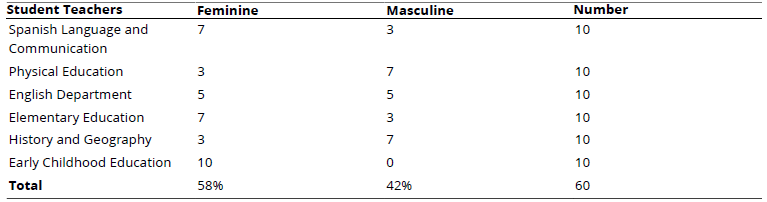
Based on their teacher training experience, in 2022 the level 5 students of each grade were invited to take part. This corresponded to the first semester of the third year of their university course, during which they all should have training in the subject of didactics and assessment. The participants were aged between 20 and 30, with an average of 22.41 and a standard deviation of 3.15.
The inclusion criteria considered eligible any students who had regular PEH classes subject during their school years, i.e. without having been exempt from it for a period longer than one year.
Procedure
The invitation to participate was extended to each of the undergraduate levels to explain the study’s context and objective. Agreement to participate was by signing an informed consent form approved by the university's ethics committee (Record No. CEC 38-21). The group then met in a dedicated classroom, where they were given a virtual form to answer brief questions related to a general description and, finally, to the heading of the narrative requested. All accessed the narrative simultaneously, which was read aloud by the principal researcher.
The heading used was as follows:
“In this stage, it's important for you to go back to your school years, recalling experiences from first to fourth year of high school regarding ASSESSMENT in the subject of Physical Education or Physical Education and Health. The idea is for you to tell us about the assessment processes you went through in the subject. The style of your narrative depends on your comfort level; you can write a general account or describe specific moments that will help us construct the reality you experienced. It's also very important to describe your perceptions of the assessments in the subject, and what you felt after these experiences as regards the assessor, the instrument, the atmosphere and the meaning, etc.”
The heading used in this study gave the participants the freedom to describe their experiences and connect emotionally with them according to the points they considered relevant.
Various strategies were used for the ethical and credibility criteria, as follows: a) the heading and the entire procedure were designed jointly by the principal researcher and an international team with extensive experience in qualitative research, thus avoiding a proposal limited to the perspective of a single researcher; b) student participation was entirely voluntary and anonymous; c) the instrument was administered by a researcher who was not a teacher of any of the student participants (Cornejo and Salas (2011); d) two subsequent meetings were held with the participants in which the interpretations and main results were presented and endorsed by the participants themselves (del Villar Álvarez, 1994).
Data Analysis
Although there are different strategies for generating a narrative analysis that provides an understanding of what the participants' wish to express, we chose to use inductive categorical analysis (Hodge and Sharp, 2016; Pérez-Samaniego et al., 2011). This strategy allowed the data obtained to speak for itself, as the subjects wrote freely about their experiences. The analysis began by identifying explicit units of meaning and assigning a code to each one. The long list of codes that emerged from the first analysis was organized and categorized following Trainor and Bundon (2021), a process that significantly reduced the number of categories. The category matrix that emerged after the inductive analysis can be seen in Table 2; the numbers corresponding to the number of times the code appeared are shown in brackets.
Category Matrix of Narratives
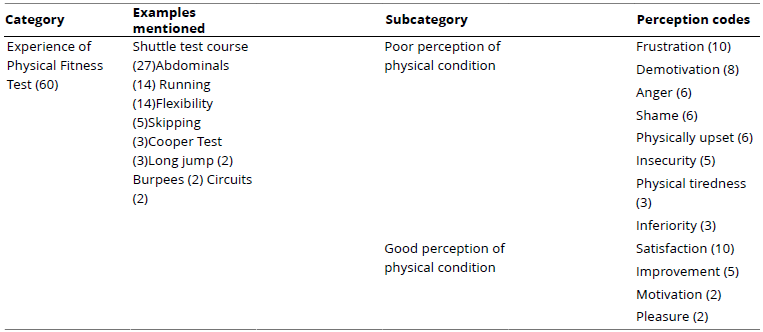
Due to the wide range of content possibilities in the narratives, a conceptual map was designed to transfer the data from the inductive to the general in order to organize the emerging themes (Nowell et al., 2017).
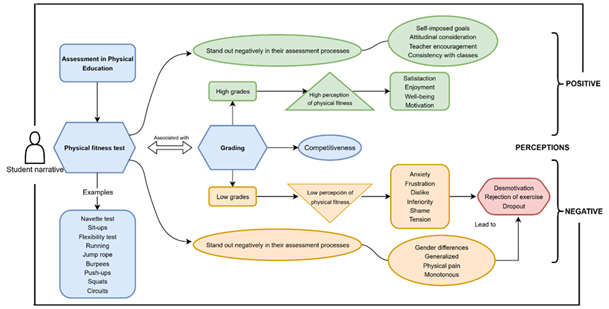
Figure 1
Conceptual map of Physical Assessment Test Experiences
As an alternative to the traditional academic format, literary techniques were then used to introduce student quotations using an identification number, then the grade initials and the last letter referring to gender (e.g., 2 ED F, i.e. the second female student teacher of English Department). Quotations also help present interpretations and support results (Smith et al., 2015).
Results
The students generally described assessments in their narratives associated with grading, which is why they are mentioned in the results as similes and reflect the traditional approach to complying with grading regulations in each context. Experiences in the subject were also expressed that were more closely related to traditional and reproductive teaching styles, sometimes similar to military instruction. This style contained different nuances in the methodologies used in sports or folk dance. The narratives were then analyzed based on the use of fitness tests in assessment situations linked to grading.
Tell me how Fast you run and I'll tell you What Grade you Deserve
Although running is the main metaphor used to explain the dominant evaluation system, it was not the only physical activity that seemed to count toward a grade in PEH. The distance jumped, number of squats or sit-ups performed in a given time could also be used:
-
“Every physical education assessment I've ever taken has been about physical stamina” (4 HG F).
-
“The teacher assessed us on push-ups, sit-ups, and jumping a certain distance. These three scores were averaged and then we were given a single grade according to how well we did” (9 ECE F).
-
“The assessments were geared toward the ideal student. I remember the teacher having a chart that showed how high each student should jump, how long they should last on the Test Course, or how many sit-ups/push-ups they should do per minute. When I saw that, I felt I was far from that ideal” (8 SLC M).
All 60 students reported having experienced physical fitness tests during their school years associated with a grade. Some of those most frequently mentioned were the Shuttle Course, sit-ups, flexibility tests, running a certain distance in a specific time, skipping, burpees, push-ups, squats and circuits, so that the grade was generated solely according to one’s performance. When performance was lower than expected, the grade was lowered according to the tables that the teachers did not always provide:
-
“In the first unit assessment tools the students were guided only by the established standards, according to the marks based on each student's gender and age” (4 PE F).
-
“Another way the teacher assessed us was by walking around an entire block outside the school. Each time we completed a lap, the teacher made a mark on our hands and the grade was given by the number of lines on our hands” (7 SLC F).
-
“In primary school, we took the famous Shuttle course test. After completing a certain number of minutes, we received a score of 7.0, the maximum. I always got a 7.0, but I had to give it my all or I would get a poor grade. In this regard, I felt a lot of pressure, since not performing well physically could hurt my overall grade point average” (3 SLC F).
The competitiveness and anxiety associated with these tests were common factors among students. The sole purpose was to grade and classify each student's individual performance, so that even when the subject was well regarded, the assessment generated feelings of nervousness:
-
“There was an evaluation at the end of each period and generally these were of a practical nature, where one had to run, jump, stretch, jog, do a test course, etc. Generally, this made me somewhat anxious because it generated an atmosphere of competition between classmates” (4HG M).
-
“In middle school I started to like physical activity more, but when it came time to evaluate, I got nervous because I wanted to reach the goal and get the highest grade” (9 ECE F).
High Performance, High Grades, High Motivation
An analysis of the narratives reveals that only a minority of students were able to meet the test expectations, either because they were in good physical condition or because they liked the military method:
-
“Since I was considered a good athlete, the tests were not difficult, as I could do them without any problem” (10 EE F).
-
“Another test the teacher gave us was sit-ups. I really liked being able to reach the goal and accomplish what the teacher required of us” (4 EE F).
-
“They were very intense, similar to military indoctrination, but it wasn't a problem for me since I liked it when they pushed me and I pushed myself even harder” (5 HG M).
The feelings of satisfaction, enjoyment and well-being associated with the fitness tests are related to meeting the expectations placed on each student, always in cases of optimal performance and so generating top grades. In these cases, the high motivation for the subject and the assessment system is evident:
-
“In elementary school, I loved the Test Course assessment, as I always did very well and performed well. I loved Thursday and having to run and do different activities” (4 EE F).
Less positive feedback on fitness tests was generated when teachers considered the attitudinal dimension in their assessment or when there was consistency between the classes and their assessment methods:
-
“They only assessed our physical performance, although I must emphasize that they involved assessment indicators for attitudinal dimensions, which is certainly characteristic of Physical Education” (9 PE M).
Thus, for example, the simple act of encouraging students during their effort was a change worth remembering:
-
“He made us take a test that involved running 16 laps in 12 minutes. When I was on the tenth lap I couldn't take any more; my tongue was almost hanging out. He looked at me and every time I passed him he encouraged me. Not just me but everyone else taking the test. He was someone who could change your life” (6 PE M).
Poor Performance, low Grades, low Motivation
Quantitatively speaking, more than half the narratives analyzed reflected feelings of anxiety, frustration, hatred, shame and inferiority when faced with this type of assessment scenario. These negative feelings were generated by not meeting the physical demands of the various tests due to low fitness levels:
-
“My experience wasn't very pleasant because the instructor demanded a high physical performance from me, and I didn't have much stamina, so I was frustrated that I couldn't reach the goal and got angry” (10 EE F).
-
“It was always a huge struggle to do all the PE activities correctly, because I was always the youngest and everyone was required to perform the same. It was always frustrating because grades were important for me and I never met the standards required” (7 PE F).
This lack of motivation and rejection of the subject was exacerbated by the physical discomfort and suffering caused by the effort to achieve not just a top grade but even the minimum required. In these cases, hateful memories of this type of test are most prevalent in the subjects:
-
“He evaluated us on a Shuttle course. I remember that it was one of the worst experiences I have ever had because I was very tired and I was short of breath and I felt my heart beating very fast. I felt dizzy and I wanted to vomit. Apart from that it depended on the amount of time you were evaluated. I also remember that I had classmates who were overweight and they couldn't do much and got a bad grade because of it” (7 SLC F).
-
“I remember how much I suffered with the hateful test course. I was also a little afraid of the teacher. I would run until I couldn't breathe. I felt so weak and I even suffered headaches trying to get a better grade. The worst part was that I wasn't doing that badly compared to my classmates” (3 ECE F).
Giving up
The low grades obtained directly resulted in feelings of frustration, which in several cases led to dropping out of the course. People invented excuses to try to avoid repeating the assessment tests:
-
“I saw how my classmates became discouraged by not meeting the teacher’s and classmates’ expectations, so they would start crying or simply not take the test and hide behind any excuse” (3HG M).
-
“But anyway, after learning about this test, the famous story of me being on my period began, every time we had to take the test course I tried to avoid it since I didn't want to experience that kind of embarrassment again” (8 EE F).
This absenteeism in the subject led to a feeling of relief at not having to go through the assessments as they caused great discomfort and psychological pressure, diminished self-esteem and a clear desire to permanently abandon PEH classes:
-
“In high school, I chose not to do anything… I avoided feeling sweaty or clumsy at all costs” (4 SLC F).
-
“With this in mind, I decided to wear a skirt to school to avoid PE. Due to the type of the school, PE was only offered in 1st and 2nd grade. In 3rd grade I felt relieved that I would no longer be required to do 50 squats in two minutes or that I would only be assessed on my stamina”(4 HG F).
Discussion
This study addresses the consequences and interpretations for students of using fitness tests in PE classes during their school years, recalling their experiences from a pedagogical perspective, based on their training as future teachers.
Even though the Chilean PE curriculum includes an assessment indicator that suggests a physical fitness test, the same program advises against grading the tests by performance and instead suggests using them solely for educational purposes (Ministry of Education, 2016). However, the fact is that these physical fitness tests are perpetuated for purposes of grading and used to assess motor skills and procedural aspects, giving rise to discrimination in the classroom (Moreno-Doña et al., 2016; Portes-Júnior et al., 2022; Rodríguez-Rodríguez et al., 2017). In fact, these types of standardized tests lay down an evaluative logic that is barely formative and can even lead to devaluing teachers professionally (Moreno Doña et al., 2014; Oliver-Álvarez & Martos-García, 2023).
The purpose of assessment in general and fitness tests in particular should be to improve teaching and learning processes, emphasizing formative aspects throughout the educational process, as indicated in Decree Nº 67 (Ministry of Education, 2018). In addition to controlling grading and promotion, this decree establishes general guidelines on the recommended formative focus, although it also allows individual schools to propose their own assessment regulations. With all the above curricular and legislative guidelines that give teachers a certain freedom to propose different methods of assessment, measuring students’ performance still has an important place in its aims, in agreement with Zubillaga and Cañadas (2021).
It is worth mentioning that the accounts of the students’ experiences of fitness tests when they were at school, the future PE teachers positively highlighted the importance of attitudinal elements among the assessment criteria, reflecting their personal experience of the discipline (Rodríguez et al., 2018; Silva et al., 2024). It is essential to promote this practice, not only in the assessment itself but also in the class methodologies and in the curriculum (Mujica Johnson, 2019).
It should be noted that narratives expressing positive experiences with fitness tests in PE were noticeably less frequent. The feelings of satisfaction in meeting expectations reported by physically fit students can be explained by the pleasure of obtaining good grades or by the motivation generated by receiving positive reinforcement and recognition (Álvarez-Rivera et al., 2015; Nabaskues et al., 2019). In some of these narratives, while recounting their positive experiences with fitness tests, they recalled the uncomfortable position of their overweight classmates, who found it more difficult to meet the goals set by the teachers. This example of empathy has also been found in previous studies (Bores-García et al., 2021; Mújica-Johnson et al., 2017; Oliver et al., 2021).
Due to the narrative nature of this research, it should be noted that the interpretations of Chilean students of their experiences in PEH assessments are in agreement with the findings of other studies (Danthony et al., 2020; Nabaskues et al., 2019; Phillips et al., 2017). For example, they highlight the pressure and feelings of anxiety that arise in specific grading situations regarding physical performance (Calatayud, 2021; Sánchez-Hernández et al., 2022). This can be explained by the importance of weighting grades that grant access to higher education since the grade point average (including PEH) can influence the choice of the degree one wishes to study or the benefits that can be obtained, including the free nature of these studies (Ministry of Education, 2023). Previous studies have confirmed the influence of grades on the way students experience their educational process (Martos-Garcia and García-Puchades, 2023).
Given the importance of grades in the school system, there is bound to be a feeling of competitiveness. While some regarded this as a motivation and generated a desire to excel, for others it put them under pressure within the course. The literature confirms what the students said, indicating that perceived competence can be either negatively related to anxiety in the case of individuals not in the best of physical fitness (Baghurst & Mwavita, 2014; Danthony et al., 2020; Garrett & Wrench, 2008) or positively related to commitment to learning (Coterón et al., 2013). The literature also links a negative self-perception with feelings of physical and social anxiety (Camacho-Miñano et al., 2006; Escalante-Izeta et al., 2016).
Feelings of frustration, anger and shame emanate from the reported situations in grading by fitness tests when the outcomes depend entirely on the teachers. The interpretations depend on the personal characteristics of those who go through this experience and negative emotions can be aroused among physically inactive individuals (Beltrán-Carrillo & Devís, 2019). When the class methodologies and pedagogical models highlight attitudinal aspects, positive emotions are attributed (Bores-García et al., 2021; Mújica-Johnson et al., 2017) but when they are related to the summative evaluation process through physical fitness tests, added to a low perception of one's own physical condition, the emotions become negative not only for the students but can also be a strain on the teachers (Sonlleva et al., 2018; Véliz et al., 2020).
When memories of physical pain and discomfort associated with physical fitness assessments are evoked, they are mainly related to the Shuttle course, which is used to determine an individual's maximum oxygen consumption by means of equations according to age or gender, among other variables. It is mainly used because of its low implementation cost and high correlation, compared to a direct method (López-Gil et al., 2020). Since it requires the maximum effort and considering the small number of classes (generally once a week) or the lifestyle of Chilean schoolchildren, it could be considered a risky activity without proper supervision (Curilem et al., 2012). On the other hand, fatigue and muscle pain are also associated with negative emotions (Danthony et al., 2020; Duque et al., 2021).
The desire to drop out of class or seeking excuses to avoid assessments is similar to wanting to drop out of sports when negative experiences and lack of motivation foster the desire to escape from suffering (Gil et al., 2012). The narratives literally stated that their worst school experiences were in PE assessments Oliver et al. (2021). This dropping out and the subsequent rejection of intense physical activity have unfortunate consequences for the Chilean reality in relation to physical fitness and health (Aguilar-Farias et al., 2016).
Finally, the recommendations provided by the study subjects in their accounts emphasize not associating these abnormal practices with a grade and with no formative value, as has been maintained in the literature for decades (Mora, 2004). Traditional evaluation models with a technical focus are being replaced by proposals such as authentic assessment (Ahumada, 2005) or formative and shared assessment (López-Pastor & Sicilia-Camacho, 2017), in which the experiences and results indicate that students perceive a better overall climate in class sessions, as they significantly contributes to their learning in the subject and their academic performance (López-Pastor et al., 2012; Silva et al., 2024). These interpretations should be addressed with greater emphasis in initial teacher training to prepare future PE teachers (Asenjo-Paredes et al., 2024; Hortigüela-Alcalá et al., 2015).
Conclusions
Physical fitness tests continue to be an important feature of PEH in the Chilean context and can arouse a strong aversion to PE classes in some students.
Associating these tests with a grade based on physical performance generates feelings of anxiety and competitiveness. When students are in good physical condition, their interpretation of the fitness tests generates feelings of satisfaction, well-being and motivation to achieve the required standards, although these may empathize with their peers who suffer in these assessment scenarios.
When students have low levels of physical fitness, falling far short of the teachers' expectations, the feelings that emerge are frustration, anxiety, hatred, insecurity, shame and discomfort, which can lead to rejection and a desire to drop the subject, or even invent excuses to skip class. They also evoke memories of discomfort and boredom, generating feelings of resentment towards physical exercise.
All of the above situations highlight the need to promote a healthy lifestyle associated with physical activity and health care, one of the objectives of the subject’s national curriculum.
Finally, we recommend applying the subject's curricular guidelines; fitness tests should not be used to grade students on their performance or physical condition, but only for educational purposes.
This study’s main limitation lies in the wide variety of topics covered by the narratives, since allowing students to openly express their experiences generated a huge amount of information associated with the methodologies, the PE teachers’ characteristics and recommendations based on their own training as future teachers.
To complement this research, it would be interesting to understand the opinions of schoolteachers who continue to use fitness tests to generate grades and to delve deeper into their reasons and the ways in which the traditional assessment models are used.
Giving students a voice to avoid replicating these practices would provide an epistemological foundation that could be used in initial PE teacher training.
Ethics Committee Statement
The study was conducted in accordance with the Declaration of Helsinki and was approved by the Ethics Committee of the Universidad Autónoma de Chile (registration code CEC 38-21, November 24, 2021).
Conflict of Interest Statement
There are no conflicts of interest.
Funding
This research did not receive any funding.
Authors' Contribution
Conceptualization: F.M.S., A.V.P., D.M.G. and A.M.D.; Methodology: F.M.S., A.V.P., D.M.G. and A.M.D.; Validation: F.M.S., A.V.P., D.M.G. and A.M.D.; Formal Analysis: F.M.S., A.V.P. and D.M.G.; Investigation: F.M.S., A.V.P., D.M.G. and A.M.D.; Data Analysis: F.M.S., A.V.P. and D.M.G.; Writing – Original Draft: F.M.S., A.V.P., D.M.G. and A.M.D.; Writing – Review & Editing: F.M.S., A.V.P., D.M.G. and A.M.D.; Supervision: A.V.P. All authors have read and agreed to the published version of the manuscript.
Data Availability Statement
Data are available upon request from the corresponding author at alexandra.valencia@uv.es.
Referencias
Aguilar-Farias, N., Cortinez-O’Ryan, A., Sadarangani, K. P., Oetinger, A. Von, Leppe, J., Valladares, M., Balboa-Castillo, T., Cobos, C., Lemus, N., Walbaum, M., & Cristi-Montero, C. (2016). Results from Chile’s 2016 Report Card on physical activity for children and youth. Journal of Physical Activity and Health, 13(s2), S117–S123. https://doi.org/10.1123/JPAH.2016-0314
Añazco-Martínez, L. A., Gallardo-Fuentes, F. J., & Carter-Thuillier, B. I. (2024). Evaluación formativa y compartida en educación física escolar: “una revisión sistemática de las experiencias/publicaciones/estudios recientes en América Latina.” Revista Internacional de Investigación en Ciencias Sociales, 20(1), 51-72. https://doi.org/10.18004/riics.2024.junio.51
Ahumada, P. A. (2005). La evaluación auténtica: Un sistema para la obtención de evidencias y vivencias de los aprendizajes. Perspectiva Educacional, Formación de Profesores, (45), 11–24. https://www.redalyc.org/articulo.oa?id=333329100002
Álvarez, L., Cuevas, R., Lara, A., & González, J. (2015). Diferencias del autoconcepto físico en practicantes y no practicantes de actividad física en estudiantes universitarios. Cuadernos de Psicología Del Deporte, 15(2), 27–34. https://doi.org/10.4321/s1578-84232015000200004
Asenjo-Paredes, C., Gallardo-Fuentes, F., Carter-Thuillier, B., & Peña-Troncoso, S. (2024). Concepciones y prácticas evaluativas en la formación inicial del profesorado en Educación Física. Revista Ciencias de la Actividad Física UCM, 25(1), 1-17. https://doi.org/10.29035/rcaf.25.1.9
Atienza, R., Valencia, A., Devís, J. (2018). Experiencias de evaluación en educación física. Una Aproximación desde la formación inicial del profesorado. Estudios Pedagógicos (Valdivia), 44(2), 127–147. https://doi.org/10.4067/S0718-07052018000200127
Atienza, R., Valencia-Peris, A., & López-Pastor, V. M. (2021). Students’ experiences during their early schooling – when and who should assess schoolchildren’s physical education. Journal of Physical Education and Sport, 21(3), 1479–1490. https://doi.org/10.7752/jpes.2021.03188
Baghurst, T., & Mwavita, M. (2014). Evaluation, rationale, and perceptions regarding fitness testing in physical education teacher education programs. The Global Journal of Health and Physical Education Pedagogy, 3(4), 349-365. https://www.researchgate.net/profile/Dane-Coetzee/publication/282755953_Kinderkinetics_Best_Practice_in_South_Africa/links/561b7dcb08ae044edbb317bb/Kinderkinetics-Best-Practice-in-South-Africa.pdf#page=75
Barrientos, E. J., López-Pastor, V. M., Lorente-Catalán, E., & Kirk, D. (2023). Challenges with using formative and authentic assessment in physical education teaching from experienced teachers’ perspectives. Curriculum Studies in Health and Physical Education, 14(2), 109-126. https://doi.org/10.1080/25742981.2022.2060118
Beltrán-Carrillo, V. J., Devís-Devís, J., & Brown, D. H. K. (2012). When physical activity participation promotes inactivity: Negative experiences of Spanish adolescents in physical education and sport. Youth & Society, 44(1), 3–23. https://doi.org/10.1177/0044118X10388262
Bolívar Botía, A. (2002). ¿De nobis ipsis silemus?: Epistemología de la investigación biográfico-narrativa en educación. REDIE: Revista Electrónica de Investigación Educativa, 4(1), 1–26. https://www.scielo.org.mx/pdf/redie/v4n1/v4n1a3.pdf
Bores-García, D., Hortigüela-Alcalá, D., Hernando-Garijo, A., & González-Calvo, G. (2021). Análisis de la motivación del alumnado hacia la expresión corporal a través del uso de la evaluación formativa y compartida. Retos. Nuevas Tendencias en Educación Física, Deporte y Recreación, 40, 198–208. https://doi.org/10.47197/retos.v1i40.83025
Camacho-Miñano, M. J., Fernández-García, E., & Rodriguez-Galiano, M. I. (2006). Imagen corporal y práctica de actividad física en las chicas adolescentes: Incidencia de la modalidad deportiva. RICYDE. Revista Internacional de Ciencias Del Deporte, 2(3), 1–19. https://doi.org/10.5232/ricyde2006.00301
Camacho-Miñano, M. J., & Prat Grau, M. (2018). Violencia simbólica en la educación física escolar: un análisis crítico de las experiencias negativas de futuros maestros de primaria. Movimento, 24(3), 815–826. https://doi.org/10.22456/1982-8918.79171
Calatayud Salom, M. (2021). Metáforas evaluativas del alumnado universitario de Educación Física. Necesidad de un cambio radical. Retos, 41, 854-865. https://doi.org/10.47197/retos.v41i0.82706
Collier, D. (2011). Increasing the value of physical education. Journal of Physical Education, Recreation & Dance, 82(7), 38–41. https://doi.org/10.1080/07303084.2011.10598656
Coterón López, J., Franco Álvarez Álvarez, E., Pérez Tejero, J., & Sampedro, J. (2013). Clima motivacional, competencia percibida, compromiso y ansiedad en Educación Física. Diferencias en función de la obligatoriedad de la enseñanza. Revista de Psicología del Deporte, 22(1), 151-157. http://hdl.handle.net/11531/21761
Corbin, C. B. (2010). Texas youth fitness study: A commentary. Research Quarterly for Exercise and Sport, 81(S3), S75–S78. https://doi.org/10.1080/02701367.2010.10599696
Cornejo, M., & Salas, N. (2011). Methodological rigor and quality: A challenge to qualitative social research. Psicoperspectivas, 10(2), 12–34. https://doi.org/10.5027/PSICOPERSPECTIVAS-VOL10-ISSUE2-FULLTEXT-144
Curilem, C., Atilo, A., & Tuillang, Y. (2012). Aplicación del test course navette en escolares. Revista Motricidad Humana, 16(2), 95-99. https://revistamotricidad.com/?rmh_articulos=course-navette-test-aplicaction-in-school
Danthony, S., Mascret, N., & Cury, F. (2020). Test anxiety in physical education: The predictive role of gender, age, and implicit theories of athletic ability. European Physical Education Review, 26(1), 128-143. https://doi.org/10.1177/1356336X19839408
del Villar Álvarez, F. (1994). La credibilidad de la investigación cualitativa en la enseñanza de la educación física. Apunts. Educación Física y Deportes, 3(37), 26–33.
Devís-Devís, J. (2017). La investigación narrativa en la educación física y el deporte. Movimento, 23(1), 13-24. https://doi.org/10.22456/1982-8918.71277
Dowling, F., Garrett, R., & Wrench, A. (2013). Narrative inquiry in physical education research: The story so far and its future promise. Sport, Education and Society, 20(7), 924-940. https://doi.org/10.1080/13573322.2013.857301
Duque, V. H., Reina, M., Mancha, D., Ibáñez, S. J., & Saenz, P. (2021). Relación de la carga de entrenamiento con las emociones y el rendimiento en baloncesto formativo. Retos, 40, 164-173. https://doi.org/10.47197/retos.v1i40.82441
Escalante-Izeta, E. I., Haua-Navarro, K., Moreno-Landa, L. I., & Bertha Pérez-Lizaur, A. (2016). Variables nutricias asociadas con la ansiedad y la autopercepción corporal en niñas y niños mexicanos de acuerdo con la presencia de sobrepeso/obesidad. Salud Mental, 39(3), 157–163. https://doi.org/10.17711/SM.0185-3325.2016.014
Gallardo-Fuentes, F. J., López-Pastor, V. M., & Carter Thuillier, B. (2017). ¿Hay evaluación formativa y compartida en la formación inicial del profesorado en Chile? Percepción de alumnado, profesorado y egresados de una Universidad. Psychology, Society & Education, 9(2), 227–238. https://ojs.ual.es/ojs/index.php/psye/article/view/699/769
Garrett, R., & Wrench, A. (2008). Connections, pedagogy and alternative possibilities in primary physical education. Sport, Education and Society, 13(1), 39–60. https://doi.org/10.1080/13573320701780514
Gil, P., Cuevas, R., & Contreras, O. R. (2012). Educación Física y hábitos de vida activa: Percepciones de los adolescentes y relación con el abandono deportivo. Aula Abierta, 40(3), 115–124.
Gobierno de Chile. (2023). Resolución 2106: Procedimientos e instrumentos del sistema de acceso a las instituciones de educación superior, 1. https://bcn.cl/39trq
Groves, S., & Laws, C. (2003). The use of narrative in accessing children’s experiences of physical education. European Journal of Physical Education, 8(2), 160–174. https://doi.org/10.1080/1740898030080205
Hamodi, C., & López, A. T. (2012). La evaluación formativa y compartida en la Formación Inicial del Profesorado desde la perspectiva del alumnado y de los egresados. Psychology, Society, & Education, 4(1), 103-116. https://doi.org/10.25115/psye.v4i1.484
Herrero-González, D., López-Pastor, V. M., Manrique-Arribas, J. C., & Moura, A. (2023). Formative and shared assessment: Literature review on the main contributions in physical education and physical education teacher education. European Physical Education Review, 0(0). https://doi.org/10.1177/1356336X231220995
Hodge, K., & Sharp, L.-A. (2016). Case studies. In B. Smith & A. C. Sparkes (Eds.), Routledge handbook of qualitative research in sport and exercise (pp. 62–74). Routledge. https://doi.org/10.4324/9781315762012
Hortigüela-Alcalá, D., González-Víllora, S., & Hernando-Garijo, A. (2021). Do we really assess learning in physical education? Teachers’ perceptions at different educational stages. Retos. Nuevas Tendencias en Educación Física, Deporte y Recreación, 42, 643–654. https://doi.org/10.47197/retos.v42i0.88686
Hortigüela Alcalá, D., Pérez Pueyo, Á., & González Calvo, G. (2019). Pero… ¿A qué nos referimos realmente con la evaluación formativa y compartida?: Confusiones habituales y reflexiones prácticas. Revista Iberoamericana de Evaluación Educativa, 12(1), 13–27. https://doi.org/10.15366/riee2019.12.1.001
Hortigüela-Alcalá, D., Pérez-Pueyo, A., & Salicetti, A. (2015). ¿Cómo percibe el alumnado universitario de educación física la evaluación recibida? Contraste de dos metodologías diferentes. Retos. Nuevas Tendencias en Educación Física, Deporte y Recreación, 28, 66-70. https://doi.org/10.47197/retos.v0i28.34845
Huhtiniemi, M., Salin, K., Lahti, J., Sääkslahti, A., Tolvanen, A., Watt, A., & Jaakkola, T. (2020). Finnish students’ enjoyment and anxiety levels during fitness testing classes. Physical Education and Sport Pedagogy, 26(1), 1–15. https://doi.org/10.1080/17408989.2020.1793926
Portes-Júnior, M., Novoa-Ramírez, C. A., Pérez-Gutiérrez, P. A., Roco-Espinoza, G. A., & Valdés-Retamal, S. E. (2022). Contenidos curriculares, aprendizajes esperados e instrumentos de evaluación utilizados por los docentes de Educación Física en enseñanza media de la comuna de Talca: Un estudio piloto. Journal of Movement & Health, 19(2), 1-9. https://doi.org/10.5027/jmh-Vol19-Issue2(2022)art150
Kincheloe, J. L. (2001). Describing the bricolage: Conceptualizing a new rigor in qualitative research. Qualitative Inquiry, 7(6), 679–692. https://doi.org/10.1177/107780040100700601
León, G. L. (2015). La narrativa, como recurso en la investigación educativa. Praxis Investigativa ReDIE: Revista Electrónica de la Red Durango de Investigadores Educativos, 7(13), 85-92. https://praxisinvestigativa.mx/assets/13_7_narrativas.pdf
López-Gil, J. F., Camargo, E., & Lucas, J. L. Y. (2020). Capacidad aeróbica en escolares de Educación Primaria determinada mediante el test Course Navette: Una revisión sistemática. Revista Electrónica Interuniversitaria de Formación Del Profesorado, 23(3), 217–232. https://doi.org/10.6018/REIFOP.402151
López-Pastor, V. M. (2009). Evaluación formativa y compartida en educación superior: Propuestas, técnicas, instrumentos y experiencias. Narcea.
López-Pastor, V. M., Kirk, D., Lorente-Catalán, E., MacPhail, A., & Macdonald, D. (2012). Alternative assessment in physical education: A review of international literature. Sport, Education and Society, 18(1), 57–76. https://doi.org/10.1080/13573322.2012.713860
López Pastor, V. M., Monjas Aguado, R., Gómez García, J., López Pastor, E., Martín Pinela, J., González Badiola, J., Barba Martín, J. J., Aguilar Baeza, R., González Pascual, M., Heras Bernardino, C., Martín, M. I., Manrique Arribas, J. C., & Marugán García, L. (2006). La evaluación en educación física. Revisión de los modelos tradicionales y planteamiento de una alternativa: La evaluación formativa y compartida. Retos. Nuevas Tendencias en Educación Física, Deporte y Recreción, 10, 31–40. https://doi.org/10.47197/retos.v0i10.35061
López-Pastor, V. M., & Pérez-Pueyo, Á. (2024). Evaluación de la condición física: Razones para superar el modelo tradicional y revisión de alternativas educativas. In Á. Pérez-Pueyo, D. Hortigüela Alcalá, C. Gutiérrez García, & R. A. Barba Martín (Coords.), Evaluación formativa y Compartida En Educación Física: Fundamentos y Experiencias Prácticas en Todas las Etapas Educativas (pp. 97–124). Universidad de León, Servicio de Publicaciones. https://hdl.handle.net/10612/22962
López-Pastor, V., & Sicilia-Camacho, A. (2017). Formative and shared assessment in higher education. Lessons learned and challenges for the future. Assessment & Evaluation in Higher Education, 42(1), 77-97. https://doi.org/10.1080/02602938.2015.1083535
Martos García, D., & García Puchades, W. (2023). La evaluación participativa y la negociación con el alumnado: una propuesta basada en la Pedagogía de la Ignorancia. REDU. Revista de Docencia Universitaria, 21(1), 129-146. https://doi.org/10.4995/redu.2023.17372
McArthur, J. (2015). Assessment for social justice: The role of assessment in achieving social justice. Assessment & Evaluation in Higher Education, 41(7), 967–981. https://doi.org/10.1080/02602938.2015.1053429
Ministry of Education. (2010). Informe de resultados Educación Física SIMCE 8° básico 2010. https://www.mineduc.cl
Ministry of Education. (2016). Educación Física y Salud-Programa de estudio Séptimo Básico. https://www.curriculumnacional.cl/614/articles-20744_programa.pdf
Ministry of Education. (2015). Bases curriculares de Séptimo a Segundo Medio. https://www.curriculumnacional.cl/614/articles-37136_bases.pdf
Ministry of Education. (2018). Decreto 67. 2018, 1–9. Recuperado de https://www.bcn.cl/leychile/navegar?idNorma=1127255
Ministry of Education. (2023). Resolución exenta N° 2106: Procedimientos e instrumentos del sistema de acceso a las instituciones de educación superior. Biblioteca del Congreso Nacional de Chile. https://bcn.cl/39trq
Monforte, J., & Pérez-Samaniego, V. (2017). El miedo en Educación Física: una historia reconocible. Movimiento, 85-100. https://doi.org/10.22456/1982-8918.71272
Mora, A. I. (2004). La evaluación educativa: Concepto, períodos y modelos. Revista Actualidades Investigativas en Educación, 4(2), 1-28. https://doi.org/10.15517/aie.v4i2.9084
Moreno Doña, A., Rivera García, E., & Trigueros Cervantes, C. (2014). Sistema de medición de la calidad de la Educación Física Chilena: Un análisis crítico. Movimento, 20(1), 145-167. https://doi.org/10.22456/1982-8918.41485
Moreno Doña, A., & Poblete Gálvez, C. (2015). La educación física chilena y su profesorado: Proponiendo algunos retos para la investigación en el área. Retos. Nuevas Tendencias en Educación Física, Deporte y Recreación, 28, 291–296. https://doi.org/10.47197/retos.v0i28.35651
Moreno-Doña, A.., Valencia-Peris, A., & Rivera-García, E. (2016). La educación física escolar en tres centros educativos de chile: Una caracterización de sus prácticas docentes. Qualitative Research in Education, 5(3), 255–275. https://doi.org/10.17583/qre.2016.2105
Mujica Johnson, F. N. (2019). Análisis crítico de la formación actitudinal en la asignatura de Educación Física y Salud en Chile. Revista de Estudios y Experiencias en Educación, 18(38), 151-166. https://www.scielo.cl/pdf/rexe/v18n38/0718-5162-rexe-18-38-151.pdf
Mújica-Johnson, F.-N., Orellana-Arduiz, N. del C., & Concha-López, R.-F. (2017). Emociones en la clase de Educación Física: Revisión narrativa (2010-2016). Ágora para la Educación Física y el Deporte, 19(1), 119. https://doi.org/10.24197/aefd.1.2017.119-134
Nabaskués, I., Usabiaga, O., Martos-García, D. & Standal, O. F. (2019). Comprensión de la habilidad desde la perspectiva del futuro profesorado de Educación Física. Retos. Nuevas Tendencias en Educación Física, Deporte y Recreación, 36, 121-128. https://doi.org/10.47197/retos.v36i36.67598
Nowell, L. S., Norris, J. M., White, D. E., & Moules, N. J. (2017). Thematic analysis: Striving to meet the trustworthiness criteria. International Journal of Qualitative Methods, 16(1), 1–13. https://doi.org/10.1177/1609406917733847
Oliver, M., Pérez-Samaniego, V. y Monforte, J. (2021). Humillación, educación física y educación superior en actividad física y ciencias del deporte: una autoetnografía moderada. Movimento, 27, e27036. https://doi.org/10.22456/1982-8918.111554
Oliver-Álvarez, M., & Martos-García, D. (2023). La evaluación tradicional y sus consecuencias. Un caso en la Educación Física hegemónica. Cultura, Ciencia y Deporte, 18(58), 27-49. https://doi.org/10.12800/ccd.v18i58.1976
Pérez-Pueyo, Á., Hortigüela-Alcalá, D., & Fernandez-Río, J. (2020). Evaluación formativa y modelos pedagógicos: Estilo actitudinal, aprendizaje cooperativo, modelo comprensivo y educación deportiva. Revista española de Educación Física y Deportes, (428), 47-66. https://doi.org/10.55166/reefd.vi428.881
Pérez-Samaniego, V., Fuentes Miguel, J., & Devís Devís, J. (2011). El análisis narrativo en la educación física y el deporte. Movimento,17(4), 11–42. https://doi.org/10.22456/1982-8918.24402
Phillips, S. R., Marttinen, R., & Mercier, K. (2017). Fitness assessment: Recommendations for an enjoyable student experience. Strategies, 30(5), 19-24. https://doi.org/10.1080/08924562.2017.1344168
Prieto, A. (2015). Los paradigmas de evaluación en educación física MULTIárea. Revista de didáctica. (7), 110–130. https://doi.org/10.18239/mard.v0i7.665
Rodríguez, I., del Valle, S., & De la Vega, R. (2018). Revisión nacional e internacional de las competencias profesionales de los docentes de Educación Física. Retos. Nuevas Tendencias en Educación Física, Deporte y Recreación, 34, 383-388. https://doi.org/10.47197/retos.v0i34.58609
Rodríguez-Rodríguez, F. J., Gatica, C. C., Bernal, J. L., & Almagià, A. A. F. (2017). Evaluación de la educación física escolar en Enseñanza Secundaria. Retos. Nuevas Tendencias en Educación Física, Deporte y Recreación, 31, 76-81. https://doi.org/10.47197/retos.v0i31.49097
Sánchez-Hernández, N., Soler-Prat, S. y Martos-García, D. (2022). La Educación Física desde dentro. El discurso del rendimiento, el currículum oculto y las discriminaciones de género. Ágora para la Educación Física y el Deporte, (24), 46-71 https://doi.org/10.24197/aefd.24.2022.46-71
Santos Guerra, M. A. (1995). La evaluación: Un proceso de diálogo, comprensión y mejora. En La evaluación: Un proceso de diálogo, comprensión y mejora (pp. 26–33). Aljibe.
Silva, R. J. R., Cunha, F. M. P., Da Silva, A. M. C., & Batista, P. M. F. (2024). Empowering students in physical fitness through assessment for learning in physical education. Journal of Physical Education and Sport, 24(5), 1174-1182. https://doi.org/10.7752/jpes.2024.05135
Smith, B., McGannon, K. R., & Williams, T. L. (2015). Ethnographic creative nonfiction: Exploring the whats, whys and hows. In G. Molnar & L. Purdy (Eds.), Ethnographies in Sport and Exercise Research (pp. 59–73). Routledge. https://durham-repository.worktribe.com/output/1631084
Sonlleva, M., Martínez, S., & Monjas, R. (2018). Los procesos de evaluación y sus consecuencias. Análisis de la experiencia del profesorado de educación física. Estudios Pedagógicos, 44(2), 329–351. https://doi.org/10.4067/S0718-07052018000200329
Talanquer, V. (2015). La importancia de la evaluación formativa. Educacion Quimica, 26(3), 177–179. https://doi.org/10.1016/j.eq.2015.05.001
Tinning, R. (2017). Physical education, curriculum and pedagogy. Routledge.
Trainor, L. R., & Bundon, A. (2021). Developing the craft: Reflexive accounts of doing reflexive thematic analysis. Qualitative Research in Sport, Exercise and Health, 13(5), 705-726. https://doi.org/10.1080/2159676X.2020.1840423
Véliz, B., Ketterer, B., & Thuillier, C. (2020). Racionalidad técnica-instrumental en educación física. Un estudio cualitativo en contexto chileno. Revista Espacios, 41(4), 19. https://www.revistaespacios.com/a20v41n04/a20v41n04p19.pdf
Zubillaga, M., & Cañadas, L. (2021). Finalidades de los procesos de evaluación y calificación en Educación Física. Espiral. Cuadernos del profesorado, 14(29), 124-135. https://doi.org/10.25115/ECP.V14I29.4398
Author notes
Autor para la correspondencia: Alexandra Valencia-Peris, alexandra.valencia@uv.es
Additional information
How to cite this article: Muñoz-Sepúlveda, F., Valencia-Peris, A., Martos-García, D., & Moreno Doña, A.C. (2025). Tell me how much you run, and I’ll tell you what grade you deserve: Assessment in Chilean Physical Education. Cultura, Ciencia y Deporte, 20(66), 2171. https://doi.org/10.12800/ccd.v20i66.2171
Título Abreviado: Assessment in Chilean Physical Education


