
BOOST YOUR SUCCESS: EXPLORING THE LINK BETWEEN GAMIFICATION AND MOTIVATION
IMPULSA TU ÉXITO: EXPLORANDO LA CONEXIÓN ENTRE GAMIFICACIÓN Y MOTIVACIÓN


Víctor Javier Sotos-Martínez, Juan Alejandro Pinol-Vázquez, Alberto Ferriz-Valero
BOOST YOUR SUCCESS: EXPLORING THE LINK BETWEEN GAMIFICATION AND MOTIVATION
Cultura, Ciencia y Deporte, vol. 20, no. 65, 2025, 10.12800/ccd.v20i65.2508
Universidad Católica San Antonio de Murcia
Víctor Javier Sotos-Martínez a
International University of Valencia, España
Juan Alejandro Pinol-Vázquez
University of Alicante, España
Alberto Ferriz-Valero
University of Alicante, España
Received: 13 may 2025
Accepted: 24 july 2025
Abstract: In response to the current need to promote more active participation in Physical Education, educators have advocated for the use of innovative strategies such as gamification. However, there is a notable lack of comprehensive research examining the impact of gamification on behavioral regulation and Basic Psychological Needs (BPNs). Therefore, the aim of this study was to investigate the influence of gamification on the motivation of secondary school students in Physical Education. A total of 105 fourth-year secondary education students participated in the study. Participants were assigned to either an experimental group (n = 59) or a control group (n = 46), based on the pre-existing class groupings established at the beginning of the academic year. During the study, participants completed two questionnaires (BPN-PE and SMS-II-PE), administered both before and after the intervention. The results revealed increases in autonomy, competence, relatedness, and intrinsic motivation among students in the experimental group, along with a decrease in amotivation. No significant changes were observed in the control group. In conclusion, a gamified approach appears to enhance self-determined motivation and support all three BPNs.
Keywords: Motivational, engagement, active methodologies, basic psychological needs, secondary education.
Resumen: Ante la actual necesidad de motivar una participación más activa en Educación Física, los educadores han propuesto el uso de técnicas innovadoras como la gamificación. No obstante, escasos son los estudios que observan el impacto de la gamificación sobre regulaciones del comportamiento y Necesidades Psicológicas Básicas. Por ello, el objetivo de este estudio fue investigar la influencia de la gamificación en la motivación de los estudiantes de secundaria de Educación Física. Durante esta investigación, participaron a un total de 105 alumnos de cuarto año de la educación secundaria. Estos estudiantes fueron asignados al grupo experimental (n = 59) o al grupo control (n = 46), conforme a las agrupaciones iniciales del curso. A lo largo del estudio, los participantes completaron dos cuestionarios (BPN-PE y SMS-II-PE), administrados antes y después de la intervención. Los hallazgos del estudio revelaron un aumento de autonomía, competencia, relación y motivación intrínseca entre el grupo experimental, mientras que, el sentimiento de amotivación mostró una reducción. No se observaron cambios en el grupo control. En resumen, se puede deducir que un enfoque gamificado produce mejoras en la motivación autodeterminada y todas las Necesidades Psicológicas Básicas.
Palabras clave: Motivación, compromiso, metodologías activas, necesidades psicológicas básicas, enseñanza secundaria.
Introduction
At the moment, there is currently a clear lack of motivation among students during the teaching–learning process (Soledispa et al., 2020). Motivation plays a crucial role in education, it enhances students’ attention and effort (Buckley & Doyle, 2016; Kurniawan et al., 2022). Consequently, in an effort to enhance motivation, educators often turn to the Self-Determination Theory (SDT) (Deci & Ryan, 1985). This macro-theory comprises six sub-theories that collectively offer a comprehensive understanding of motivational contexts and cognitive well-being (Ryan & Deci, 2017).
In the pursuit of high-quality teaching, educators and researchers have explored innovative pedagogical approaches that position the student at the center of the learning process (Peralta & Guamán, 2020), with gamification standing out as a particularly promising methodology (Mendez-Coca, 2015). Gamification involves the application of game elements to non-game contexts in order to influence student behavior (Khaldi et al., 2023; Werbach & Hunter, 2012). Although gamification has been widely implemented across various sectors beyond education (Dichev & Dicheva, 2017), its adoption within educational settings remains underdeveloped. Nevertheless, the use of gamification in education is attracting increasing attention as a means to enhance student engagement, academic performance, and active lifestyles (Carrasco-Ramírez et al., 2019; Erdvik et al., 2014).
Gamification shows significant potential, particularly in reducing dropout rates, enhancing motivation, and promoting competency-based learning (Prieto-Andreu, 2020). Furthermore, it helps prevent monotony and boredom, serving as an effective tool to deliver knowledge and skills while maintaining student engagement (Arufe-Giráldez, 2019; Sotos-Martínez et al., 2024). Therefore, the integration of gamification into education can foster positive learning outcomes through the use of game elements in formal teaching processes. Specifically, in the subject of Physical Education, gamification is an especially suitable active methodology due to the playful nature of its activities and games (Ferriz-Valero et al., 2023). Gamification has demonstrated improvements in motivation and Basic Psychological Needs (BPNs) in primary education (Quintas et al., 2020; Sotos-Martínez et al., 2023a), secondary education (Fernandez-Rio et al., 2020; Soriano-Pascual et al., 2022; Sotos-Martínez et al., 2024), and higher education (Ferriz-Valero et al., 2019, 2020).
Despite the growing practical interest in gamification within educational contexts, little research has delved into its effects on different motivational regulations and BPNs of students enrolled in Physical Education across various secondary school levels, highlighting a gap in the current scientific literature. Therefore, the objective of this study was to examine the effects of a gamified intervention in Physical Education classes, at the final level of secondary education, on psychological variables such as motivational regulation and BPNs.
Hypotheses
H1. The gamified intervention will increase the three BPNs (autonomy, competence, and relatedness) compared to the group not exposed to gamification.
H2. The gamified intervention will increase intrinsic motivation compared to the group not exposed to gamification.
H3. The gamified intervention will decrease amotivation compared to the group not exposed to gamification.
Materials and Methods
Participants
The initial sample consisted of 111 fourth-year secondary school students during the 2022–2023 academic year. Six students were excluded for not properly completing the questionnaires, resulting in a final sample of 105 participants, of whom 59 were male (56.2%) and 46 were female (43.8%). Participants were selected from two secondary schools in Spain, which were chosen for inclusion in the study. The average age of participants was 15.21 years (SD = 1.39).
All participants and their legal guardians were informed about the potential benefits and limitations of the study. In accordance with the principles of the Declaration of Helsinki (1975), legal guardians provided informed consent by signing the required authorization form. They also granted permission for the data to be used anonymously. This study was approved by the Ethics Committee of the University of Alicante (Approval ID: UA-2022-05-24).
Procedure
Participants were divided into two distinct groups: an experimental group (EG, n = 59) and a control group (CG, n = 46), using a non-probabilistic cluster sampling approach while maintaining the natural classroom distribution for both groups. These groups participated in an educational unit focused on volleyball (Table 1) over a period of four weeks (eight sessions), in accordance with the predetermined instructional plan.
Overview of the Research Design
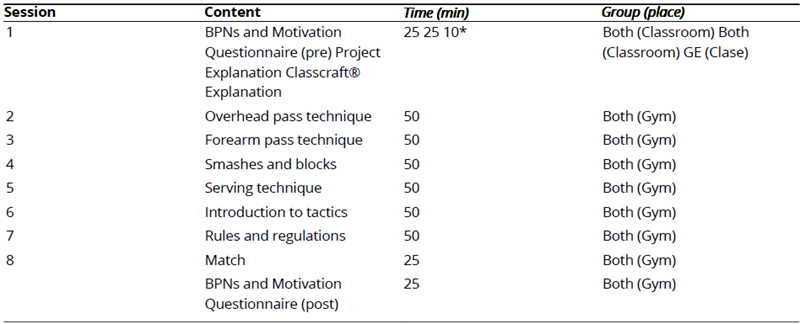
Note. BPNs= Basic Psychological Needs; EG = Experimental Group; * = After the session
In the experimental group (EG), all instructional activities were conducted using the gamified digital tool known as ClassCraft®. The control group (CG) received the same educational content and performed the same tasks as the EG, with the sole difference being the absence of the gamified tool. In the EG, ClassCraft® was used to structure task explanation, practice, and feedback. Meanwhile, in the CG, the time allocated to game dynamics in the EG was instead used to provide more detailed explanations of the tasks. After the first session, the EG received a short 15-minute training session on the basic functionality of ClassCraft®. This familiarization occurred outside of school hours to avoid interfering with instructional time, thereby ensuring that both groups received the same amount of instructional time and content, differing only in the methodology applied.
The gamified group used the ClassCraft® platform in Spanish. This tool supported a gamified and collaborative learning approach aligned with the characteristics of gamification-oriented websites. It also allowed for the creation of individual student codes and class codes.
In the context of gamification, different models can be implemented, such as the PBL model (Points, Badges, and Leaderboards), which involves rewards based on these elements (Chou, 2016; Ferriz-Valero et al., 2023), and the MDA framework (Mechanics, Dynamics, and Aesthetics) (Landers et al., 2018). Through ClassCraft®, it was possible to regulate the occurrence of student behaviors and actions by aligning them with teacher objectives, using both the PBL and MDA models. To achieve this, connections were established between behaviors and points, encompassing both positive outcomes (rewards) and negative consequences (penalties when reaching zero Life Points, or LP).
Specifically, a PBL model was employed by awarding points, badges, and leaderboard rankings for various behaviors, primarily technical-tactical in nature (e.g., body position oriented toward the target when passing, triangle formation with index fingers and thumbs, palm strike when spiking, clear communication with teammates, emotional support for peers, or fair play). These points were categorized into five types: Experience Points (XP), Health Points (HP), Action Points (AP), Life Points (LP), and Gold Pieces (GP). These metrics enabled the teacher to guide behavior toward desired outcomes by adjusting reinforcement or penalties accordingly (Reeve, 2012).
In summary, GP allowed for character customization and were earned by leveling up through XP. XP were obtained via positive reinforcement following appropriate behaviors and were used to progress through levels. LP represented health and were crucial to staying in the game; they decreased as a result of negative behaviors. Characters reaching zero LP faced a "battle" and corresponding consequences. AP referred to points that enabled the use of acquired powers. HP represented power points, with one HP gained upon leveling up and used to unlock abilities. Additionally, students' point progress was displayed on a leaderboard within the ClassCraft® platform, allowing performance to be monitored during sessions.
Additionally, an MDA (Mechanics, Dynamics, and Aesthetics) model was implemented by incorporating: engaging themes and meaningful purposes through a gamified narrative designed to evoke emotions in participants; challenges and missions that reflect progression within the storyline; and immersion into the theme using elements of mystery, rule-setting, and developmental possibilities (Pérez-López & Navarro-Mateos, 2023).
Each participant had a personal account, allowing them to create their own customized avatars. Upon selecting their avatars, students could choose from three distinct character roles: Mage, Warrior, or Healer. Each character possessed unique powers designed to support their team or clan. Teams were formed by the students themselves, under the condition that they be mixed-gender and composed of a maximum of six members, with all roles represented within each team. All participants were required to accept the "Hero Pact," a commitment to adhere to the rules and decisions established by the Grand Master (the teacher), as a prerequisite for participating in the study.
Each character had its own strengths, weaknesses, and powers. For example, the Healer was suitable for students inclined to help others, capable of restoring both their own health points and those of other team members. The Warrior adopted a more offensive role, making them more susceptible to health point reductions and damage from others. Lastly, the Mage supported teammates by granting Action Points (AP), enabling strategic use of team powers.
Instruments
Basic Psychological Needs (BPNs)
The Spanish version of the Basic Psychological Needs in Physical Education Scale (BPN-PE) was used (Menéndez-Santurio & Fernández-Río, 2018). This questionnaire includes 12 items grouped into three factors (four items per factor) that assess: autonomy (e.g., “I feel as if the activities we do were chosen by me”), competence (e.g., “I succeed even in classes that most of my classmates consider difficult”), and relatedness (e.g., “I feel that I belong to a great group of good friends”). Items were rated on a 5-point Likert scale ranging from 1 (strongly disagree) to 5 (strongly agree). The scale was developed based on a sample of 624 Spanish secondary school students from eight schools, aged between 12 and 19 years. Confirmatory factor analysis (CFA) indicated an acceptable model fit: χ² = 155.39; p< .05; χ²/df = 3.04; RMSEA = .05; 90% CI [.04, .06]; GFI = .95; CFI = .97; TLI = .97; IFI = .97; NFI = .96; SRMR = .03. Cronbach’s alpha values were .84 for autonomy, .85 for competence, and .87 for relatedness.
Motivational Regulations
The Spanish version of the Sport Motivation Scale II adapted for Physical Education (SMS-II-PE) was used (Pelletier et al., 1995), as translated, adapted, and validated by Granero-Gallegos et al. (2018) for Spanish secondary school students. The questionnaire consists of 18 items grouped into six factors (three items per factor) that assess: intrinsic motivation (e.g., “For the pleasure I feel while doing physical and sport activities”), integrated regulation (e.g., “Because engaging in physical-sport activities is a fundamental part of my life”), identified regulation (e.g., “Because physical-sport activities are a way to develop myself”), introjected regulation (e.g., “Because I would feel bad if I didn’t participate and try in class”), external regulation (e.g., “Because I receive rewards from people around me when I do it”), and amotivation (e.g., “I used to participate and put effort into classes, but now I wonder if I should continue doing so”). Items were rated on a 5-point Likert scale ranging from 1 (strongly disagree) to 5 (strongly agree). The scale was developed based on a sample of 1,055 Spanish secondary school students from eight schools, aged between 12 and 17 years. CFA results indicated an adequate model fit: χ² = 481.57; p< .001; χ²/df = 4.01; RMSEA = .054; 90% CI [.49, .59]; CFI = .94; TLI = .95; SRMR = .047. Cronbach’s alpha values were .68 for intrinsic motivation, .70 for integrated regulation, .73 for identified regulation, .76 for introjected regulation, .72 for external regulation, and .65 for amotivation.
Data Analysis
All analyses were conducted using SPSS Statistics version 25.0. Descriptive statistics, including means and standard deviations, were calculated for each factor. Normality tests using the Kolmogorov–Smirnov test revealed non-normal distributions in all cases (p< .05). To assess initial differences between the experimental group (EG) and the control group (CG), a Mann–Whitney U test was performed. Finally, the Wilcoxon signed-rank test was used to evaluate the within-group (pre–post) effects of the intervention.
Results
Between-Group Differences
When comparing baseline data between both groups, no significant differences were observed in any of the variables (p> .05).
Within-Group Differences (Pre vs. Post)
The experimental group (EG) showed significant improvements in autonomy (p< .01), competence (p = .043), relatedness (p< .01), intrinsic motivation (p< .01), and amotivation (p< .01) (Figure 1). In the observed changes for the EG, most post-test scores increased compared to pre-test values, except for amotivation, which showed a significant decrease (Table 2). In contrast, the control group (CG) did not exhibit significant differences in any of the variables (Figure 2).
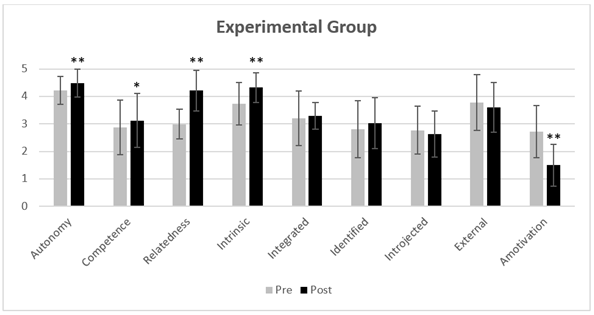
Figure 1
Graph of BPNs and Motivational Regulation for the EG
Note. **: p< 0.01; *: p< 0.05.
Within-Group Differences (pre vs. Post) in BPNs and Motivation Variables for the EG Using the Wilcoxon Test (Mean ± Standard Deviation)
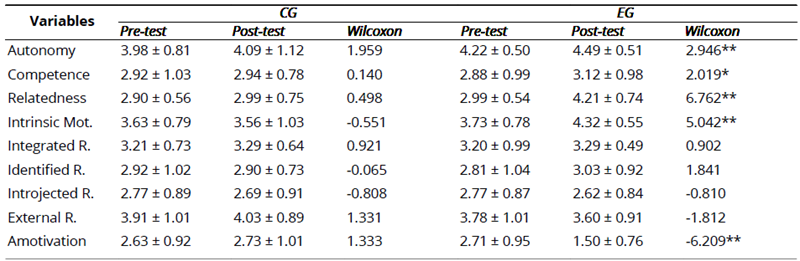
*p< .05
** p < .01
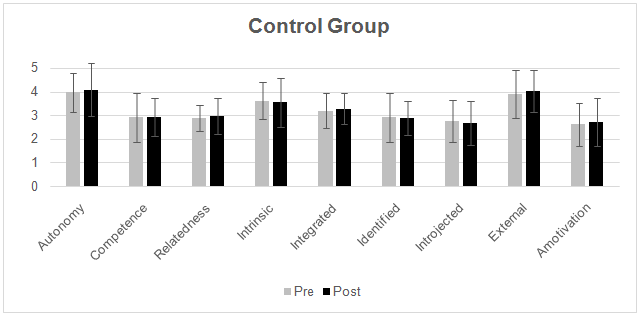
Figure 2
Graph of BPNs and Motivational Regulation for the CG
Discussion
The aim of this study was to examine the impact of a gamified instructional approach on students' motivational aspects and BPNs in the fourth year of secondary education.
The results revealed a significant increase in intrinsic motivation in the experimental group (EG), with no changes observed in the control group (CG), aligning with previous studies (Fernandez-Rio et al., 2020, 2022; Sotos-Martínez et al., 2023a; Sotos-Martínez et al., 2024). This increase in intrinsic motivation is consistent with the existing literature, which highlights the effectiveness of gamified methodologies in fostering more self-determined forms of motivation.
In higher education students, some authors have reported that gamification may lead to increases in less self-determined forms of motivation (Castañeda-Vázquez et al., 2019; Ferriz-Valero et al., 2020), and in some cases, even result in a decline in intrinsic aspects (Hanus & Fox, 2015). These findings contrast with the results of the present study, which observed improvements in intrinsic motivation and no significant changes in extrinsic motivational variables. The adverse results reported in previous research could be attributed to several limitations, such as the absence of a control group, non-probabilistic sampling, or the implementation of external rewards beyond those inherent to the gamified environment, potentially promoting a reward-based motivational model that undermines intrinsic motivation.
Conversely, at the same educational level, the use of gamification supported by information and communication technologies has been shown to enhance more intrinsic motivational characteristics (Ferriz-Valero et al., 2019, 2023). In primary education, most studies report improvements in motivation and BPNs following the implementation of gamified approaches (Andrade et al., 2019; Dolera-Montoya et al., 2021; Sotos-Martínez et al., 2023a; Sotos-Martínez et al., 2024). In line with this, Fernandez-Rio et al. (2020) observed increases in intrinsic motivation using a gamified methodology (MarvPE) among primary and secondary Physical Education students. In another study, Fernandez-Rio et al. (2022) reported improvements in BPNs and intrinsic motivation following the implementation of a gamification program based on Dragon Ball in secondary education. Similarly, Sotos-Martínez et al. (2022) found increases in intrinsic motivation in secondary students using a technology-based gamified tool. Therefore, the present findings align with the notion that the use of a gamified methodology promotes more self-determined forms of student motivation.
Given the increase in motivation, it is logical to expect a corresponding decrease in amotivation, although this was only observed in the EG. The results revealed a significant reduction in amotivation in the EG, consistent with other studies in Physical Education where gamified interventions led to decreases in amotivation (Dolera-Montoya et al., 2021; Sotos-Martínez et al., 2024). However, there are also studies that did not observe reductions in amotivation among secondary school students following gamified programs (Real-Pérez et al., 2021). In that study, amotivation levels remained stable, in contrast with the control group, which exhibited increases. Consequently, an increase in intrinsic motivation, such as that observed in the present study, may indeed contribute to a decrease in amotivation, in line with the principles outlined by Ryan and Deci (2000).
The results also demonstrate a significant increase in all BPNs in the EG, with no changes observed in the CG. These results follow the same trend as previous studies (Fernandez-Rio et al., 2022; Quintas et al., 2020; Sotos-Martínez et al., 2024), where greater improvements in BPNs were achieved in the gamified group compared to the control group. It is logical to assume that a gamified intervention can impact BPNs, according to the perspective presented by SDT, through various game dynamics that are implemented (leaderboards, narratives, badges, challenges, feedback, etc.) (Muangsrinoon & Boonbrahm, 2019). Furthermore, the implementation of a digital tool such as ClassCraft® allows for higher levels of perceived competence and autonomy among students (Jeno et al., 2019). As for the improvement in the relatedness variable, this can be attributed to the implementation of group work facilitated by gamification through ClassCraft® (Van Ryzin & Roseth, 2019).
Limitations and Future Lines of Research
The duration of the intervention—four weeks—could be considered a potential limitation, as it may affect the emergence of motivational changes and the impact that a longer gamification process could have on motivational regulation. An important limitation of this study is the use of a non-probabilistic sample, as participants were selected from specific educational centers and pre-established classes were maintained from the beginning of the school year. This type of sampling can introduce bias and limits the representativeness of the sample, making it difficult to generalize the results to other populations or different educational contexts.
Based on these limitations, several lines of future research are proposed. It would be relevant to explore the impact of this type of gamified intervention in the long term, as well as in other educational levels or different sociocultural contexts, to verify the consistency of the results. In addition, future research could adopt more robust experimental designs, include random samples, and combine quantitative methods with qualitative approaches such as interviews or focus groups. This would allow for a deeper understanding of the motivational processes involved and of how students experience this type of active methodology.
Practical Implications of the Study
The use of gamification in the area of Physical Education, more precisely during secondary education, offers an effective strategy to promote more self-determined motivation. By improving intrinsic motivation and satisfying BPNs, this method favors greater engagement in physical activity, which can translate into greater adherence to healthy habits in the long term. Moreover, the reduction of amotivation contributes to decreasing apathy or disinterest, facilitating a more dynamic and participatory educational environment. It is recommended that teachers incorporate playful and collaborative dynamics using reward systems, roles, or missions, adapted to curricular content, through the use of digital gamified tools, in order to foster active participation and student engagement.
Conclusion
The implementation of a gamified approach appears to achieve improvements in more self-determined motivational characteristics. In this study, a gamified approach in fourth-year secondary school Physical Education classes resulted in improvements in intrinsic motivation, BPNs, and a decrease in amotivation. Therefore, the findings of the present study support the use of gamification in Physical Education classes for secondary school students as a means to enhance motivation.
Ethics Committee Statement
The study was conducted in accordance with the Declaration of Helsinki and was approved by the Ethics Committee of the University of Alicante (Approval ID: UA-2022-05-24).
Conflict of Interest
The funding entities or institutions had no influence on the study design, data analysis, or interpretation of the results. The authors of this study declare no conflict of interest with respect to the research, authorship, and/or publication of this article.
Funding
This research did not receive any funding due to the lack of necessity.
Author Contributions
Conceptualization: Sotos-Martinez V. J. &Ferriz-Valero A.; Methodology: Sotos-Martinez V. J.; Software: Sotos-Martinez V. J.; Validation: Sotos-Martinez V. J. &Ferriz-Valero A.; Formal Analysis: Sotos-Martinez V. J.; Investigation: Sotos-Martinez V. J.; Resources: Sotos-Martinez V. J.; Data Curation: Sotos-Martinez V. J. &Ferriz-Valero A.; Writing – Original Draft: Sotos-Martinez V. J.; Writing – Review & Editing: Sotos-Martinez V. J. & Pinol-Vázquez J. A.; Visualization: Pinol-Vázquez J. A.; Supervision: Ferriz-Valero A.; Project Administration: Ferriz-Valero A. All authors have read and agreed to the published version of the manuscript.
Data Availability Statement
The data supporting the findings of this study are not publicly available due to their confidential nature. The dissemination of the collected information is restricted as it could compromise the privacy and identity of the participants. Any reasonable request for additional information will be considered by the authors in accordance with applicable ethical and legal constraints.
Acknowledgements
The authors would like to express their sincere gratitude to the educational institutions that collaborated in the development of this research, providing access and the necessary conditions for its implementation. We also deeply appreciate the voluntary participation and commitment of all individuals involved—without their collaboration, this study would not have been possible. Furthermore, this work was made possible thanks to the dedication of Víctor J. Sotos-Martínez in the context of his doctoral thesis.
References
Andrade, A., Correia, C. K., Cruz, W. M. D., & Bevilacqua, G. G. (2019). Acute Effect of Exergames on Children’s Mood States During Physical Education Classes. Games for Health Journal, 8(3), 250-256. https://doi.org/10.1089/g4h.2018.0083
Arufe-Giráldez, V. (2019). Fortnite EF, un nuevo juego deportivo para el aula de Educación Física. Propuesta de innovación y gamificación basada en el videojuego Fortnite. Sportis. Scientific Technical Journal of School Sport, Physical Education and Psychomotricity, 5(2), 323-350. https://doi.org/10.17979/sportis.2019.5.2.5257
Buckley, P., & Doyle, E. (2016). Gamification and student motivation. Interactive Learning Environments, 24(6), 1162-1175. https://doi.org/10.1080/10494820.2014.964263
Carrasco-Ramírez, V. J., Matamoros-Rodríguez, A., & Flores-Aguilar, G. (2019). Analysis and comparison of the results obtained after the application of a gamified methodology and a traditional one in physical education in “bachillerato” (Spanish education for 16 to 18 years old students). Education, Sport, Health and Physical Activity (ESHPA), 3(1), 29-45. http://hdl.handle.net/10481/53213
Castañeda-Vázquez, C., Espejo-Garcés, T., Zurita-Ortega, F., & Fernández-Revelles, A. B. (2019). Physical education´s teacher training program through gaming, ict and continuous assessment. Revista Euroamericana de Ciencias del Deporte, 8(2), 55-64. https://doi.org/10.6018/sportk.391751
Chou, Y. (2016). Actionable gamification: Beyond points, badges, and leaderboards. Octalysis Media.
Deci, E. L., & Ryan, R. M. (1985). The general causality orientations scale: Self-determination in personality. Journal of Research in Personality, 19(2), 109-134. https://doi.org/10.1016/0092-6566(85)90023-6
Dichev, C., & Dicheva, D. (2017). Gamifying education: What is known, what is believed and what remains uncertain: A critical review. International Journal of Educational Technology in Higher Education, 14. https://doi.org/10.1186/s41239-017-0042-5
Dolera-Montoya, S., Valero-Valenzuela, A., Jimenez-Parra, J. F., & Manzano-Sanchez, D. (2021). Improvement of the classroom climate through a plan of gamified coexistence with physical activity: Study of its effectiveness in primary education. Multidisciplinary Journal of Education, 14(28), 65-77. https://doi.org/10.25115/ecp.v14i28.4420
Erdvik, I. B., Øverby, N. C., & Haugen, T. (2014). Students’ self-determined motivation in physical education and intention to be physically active after graduation: The role of perceived competence and identity. Journal of Physical Education and Sport, 14(2), 232-241. https://doi.org/10.7752/jpes.2014.02035
Fernández-Rio, J., de las Heras, E., González, T., Trillo, V., & Palomares, J. (2020). Gamification and physical education. Viability and preliminary views from students and teachers. Physical Education and Sport Pedagogy, 25(5), 509-524. https://doi.org/10.1080/17408989.2020.1743253
Fernandez-Rio, J., Zumajo-Flores, M., & Flores-Aguilar, G. (2022). Motivation, basic psychological needs and intention to be physically active after a gamified intervention programme. European Physical Education Review, 28(2), 432-445. https://doi.org/10.1177/1356336X211052883
Ferriz-Valero, A., Agulló-Pomares, G., & Tortosa-Martínez, J. (2023). Benefits of Gamified Learning in Physical Education Students: A Systematic Review. Apunts Educación Física y Deportes, 153, 39-51. https://doi.org/10.5672/apunts.2014-0983.es.(2023/3).153.04
Ferriz-Valero, A., García-Martínez, S., García-Jaen, M., Østerlie, O., & Sellés, S. (2019). Gamificación: Metodologías activas en Educación Física en docencia universitaria. In Investigación e innovación en la Enseñanza Superior. Nuevos contextos, nuevas ideas (pp. 1116-1126). Editorial Octaedro.
Ferriz-Valero, A., Østerlie, O., García-Martínez, S., & García-Jaén, M. (2020). Gamification in physical education: Evaluation of impact on motivation and academic performance within higher education. International Journal of Environmental Research and Public Health, 17, 1-16. https://doi.org/10.3390/ijerph17124465
Hanus, M. D., & Fox, J. (2015). Assessing the effects of gamification in the classroom: A longitudinal study on intrinsic motivation, social comparison, satisfaction, effort, and academic performance. Computers and Education, 80, 152-161. https://doi.org/10.1016/j.compedu.2014.08.019
Jeno, L. M., Adachi, P. J. C., Grytnes, J. A., Vandvik, V., & Deci, E. L. (2019). The effects of m-learning on motivation, achievement and well-being: A Self-Determination Theory approach. British Journal of Educational Technology, 50(2), 669-683. https://doi.org/10.1111/bjet.12657
Khaldi, A., Bouzidi, R., & Nader, F. (2023). Gamification of e-learning in higher education: A systematic literature review. Smart Learning Environments, 10(1). https://doi.org/10.1186/s40561-023-00227-z
Kurniawan, R., Heynoek, F. P., Bakti, F. R. F. K., & Sigit, C. N. (2022). Motivation in physical education for junior high school students: A gender perspective. Journal of Physical Education and Sport, 22(12), 3072-3079. https://doi.org/10.7752/jpes.2022.12389
Landers, R. N., Auer, E. M., Collmus, A. B., & Armstrong, M. B. (2018). Gamification Science, Its History and Future: Definitions and a Research Agenda. Simulation and Gaming, 49(3), 315-337. https://doi.org/10.1177/1046878118774385
Mendez-Coca, D. (2015). Study of the Motivations of Secondary Students of Physics and Chemistry and the Influence of the Methodologies of Education in Their Interest. Educacion XXI, 18(2), 215-235.
Menéndez-Santurio, J. I., & Fernández-Río, J. (2018). Spanish Version Of The Basic Psychological Needs In Physical Education Scale. Revista Internacional de Medicina y Ciencias de la Actividad Física y del Deporte, 69(2018).
Muangsrinoon, S., & Boonbrahm, P. (2019). Game Elements from Literature Review of Gamificaction in Healthcare Context. Journal of Technology and Science Education, 9(1), 20-31. https://doi.org/10.3926/jotse.556
Peralta, D. C., & Guamán, V. J. (2020). Metodologías activas para la enseñanza y aprendizaje de los estudios sociales. Sociedad & Tecnología, 3(2), 2-10. https://doi.org/10.51247/st.v3i2.62
Pérez-López, I. J., & Navarro-Mateos, C. (2023). Guía para gamificar: Construye tu propia aventura. Copideporte.
Prieto-Andreu, J. M. (2020). A systematic review about gamification, motivation and learning in high school. Teoria de la Educacion, 32(1), 73-99. https://doi.org/10.14201/teri.20625
Quintas, A., Bustamante, J. C., Pradas, F., & Castellar, C. (2020). Psychological effects of gamified didactics with exergames in Physical Education at primary schools: Results from a natural experiment. Computers and Education, 152(6), 103874. https://doi.org/10.1016/j.compedu.2020.103874
Real-Pérez, M., SánchezOliva, D., & Padilla-Moledo, C. (2021). Africa Project «La Leyenda de Faro»: Effects of a methodology based on gamification on situational motivation about the content of Corporal Expression in Secondary Education. Retos, 42, 567-574. https://doi.org/10.47197/retos.v42i0.86124
Ryan, R. M., & Deci, E. L. (2000). Self-Determination Theory and the Facilitation of Intrinsic Motivation, Social Development, and Well-Being. American Psychologist, 55(1), 68-78.
Ryan, R. M., & Deci, E. L. (2017). Self-Determination Theory: Basic Psychological Needs in Motivation, Development, and Wellness. Guilford Press.
Soledispa, A. M., San Andrés, E. J., & Soledispa, R. A. (2020). Motivación y su influencia en el desempeño académico de los estudiantes de educación básica superior: Motivación de los estudiantes. Revista Científica Sinapsis, 3(18). https://doi.org/10.37117/s.v3i18.431
Soriano-Pascual, M., Ferriz-Valero, A., García-Martínez, S., & Baena-Morales, S. (2022). Gamification as a Pedagogical Model to Increase Motivation and Decrease Disruptive Behaviour in Physical Education. Children, 9(12), 1931. https://doi.org/10.3390/children9121931
Sotos-Martínez, V. J., Baena-Morales, S., & Ferriz-Valero, A. (2024). Gamificación y el poder de la novedad: Revolucionando el aprendizaje de la educación física a través de estrategias lúdicas. Magister, 36, 25-31. https://doi.org/10.17811/msg.36.1.2024.25-31
Sotos-Martínez, V. J., Ferriz-Valero, A., García-Martínez, S., & Tortosa-Martínez, J. (2022). The effects of gamification on the motivation and basic psychological needs of secondary school physical education students. Physical Education and Sport Pedagogy, 29(2), 160-176. https://doi.org/10.1080/17408989.2022.2039611
Sotos-Martínez, V. J., Tortosa-Martínez, J., Baena-Morales, S., & Ferriz-Valero, A. (2023a). Boosting Student’s Motivation through Gamification in Physical Education. Behavioral Sciences, 13(2), 165. https://doi.org/10.3390/bs13020165
Sotos-Martínez, V. J., Tortosa-Martínez, J., Baena-Morales, S., & Ferriz-Valero, A. (2023b). It’s game time: Improving basic psychological needs and promoting positive behaviours through gamification in physical education. European Physical Education Review, 30(3), 1-23. https://doi.org/10.1177/1356336X231217404
Van Ryzin, M. J., & Roseth, C. J. (2019). Effects of cooperative learning on peer relations, empathy, and bullying in middle school. Aggressive Behavior, 45(6), 643-651. https://doi.org/10.1002/ab.21858
Werbach, K., & Hunter, D. (2012). For the win: How game thinking can revolutionize your business. Wharton School Press.
Author notes
aAutor para la correspondencia: Victor Javier Sotos-Martinez, victorj.sotos@professor.universidadviu.com
Additional information
Título Abreviado: Exploring the Link Between Gamification and Motivation
How to cite this article: Sotos-Martinez, V. J., Pinol-Vázquez, J. A., & Ferriz-Valero, A. (2025). Boost your success: exploring the link between gamification and motivation. Cultura, Ciencia y Deporte, 20(65), 2508. https://doi.org/10.12800/ccd.v20i65.2508


