
STRANGE DANCER THINGS. APPLICATION OF GAMIFICATION IN DANCE
STRANGE DANCER THINGS. APLICACIÓN DE LA GAMIFICACIÓN EN LA DANZA


Mario Amatria Jiménez, Martín Iglesias, Fernando González Alonso, Rubén Arroyo del Bosque
STRANGE DANCER THINGS. APPLICATION OF GAMIFICATION IN DANCE
Cultura, Ciencia y Deporte, vol. 20, no. 65, 2025, 0.12800/ccd.v20i65.2496
Universidad Católica San Antonio de Murcia
Mario Amatria Jiménez a
Pontifical University of Salamanca, España
Martín Iglesias
Pontifical University of Salamanca, España
Fernando González Alonso
Pontifical University of Salamanca, España
Rubén Arroyo del Bosque
University of Burgos, España
Received: 29 April 2025
Accepted: 10 september 2025
Abstract: This study analyses the impact of gamification in urban dance teaching, assessing its influence on learning, choreographic memory and student engagement. A quasi-experimental study was designed with 26 students aged 12-13 years, divided into an experimental group (EG) and a control group (CG). While the CG followed a traditional methodology based on the systematic repetition of movements, the EG used a gamified approach inspired by role-playing games, incorporating progressive challenges, collaborative dynamics and a reward system. Over seven sessions, four key dimensions were analysed: theoretical knowledge, body expression, technical skills and choreographic execution. The results showed a significant improvement in the GE, which obtained higher scores (9.55 and 9.2) than the CG (6.4). In addition, the GE showed higher attendance, less need for review and more autonomous and effective learning. These findings suggest that gamification not only optimises the acquisition of knowledge and skills in dance, but also enhances motivation, teamwork and choreographic retention. It is concluded that this methodology represents an effective pedagogical strategy for the technical-artistic and socio-emotional development of students.
Keywords: Gamification, urban dance, active learning, choreographic memory, student motivation.
Resumen: Este estudio analiza el impacto de la gamificación en la enseñanza de la danza urbana, evaluando su influencia en el aprendizaje, la memoria coreográfica y el compromiso del alumnado. Se diseñó un estudio cuasi-experimental con 26 estudiantes de entre 12 y 13 años, divididos en un grupo experimental (GE) y un grupo control (GC). Mientras que el GC siguió una metodología tradicional basada en la repetición sistemática de movimientos, el GE utilizó un enfoque gamificado inspirado en juegos de rol, incorporando desafíos progresivos, dinámicas colaborativas y un sistema de recompensas. A lo largo de siete sesiones, se analizaron cuatro dimensiones clave: conocimientos teóricos, expresión corporal, habilidades técnicas y ejecución coreográfica. Los resultados evidenciaron una mejora significativa en el GE, que obtuvo calificaciones superiores (9.55 y 9.2) respecto al GC (6.4). Además, el GE mostró mayor asistencia, menor necesidad de repasos y un aprendizaje más autónomo y efectivo. Estos hallazgos sugieren que la gamificación no solo optimiza la adquisición de conocimientos y habilidades en danza, sino que también potencia la motivación, el trabajo en equipo y la retención coreográfica. Se concluye que esta metodología representa una estrategia pedagógica eficaz para el desarrollo técnico-artístico y socioemocional del alumnado.
Palabras clave: Gamificación, danza urbana, aprendizaje activo, memoria coreográfica, motivación estudiantil.
Introduction
Urban dance, as an artistic and cultural expression, has emerged as a comprehensive educational tool that transcends its aesthetic dimension. Several studies have demonstrated that its integration into educational contexts fosters the development of motor skills, creativity, critical thinking, and socio-emotional competencies (Alemán & Serrano, 2001; Ordóñez, 2022). Moreover, dance functions as a dynamic symbolic laboratory, integrating multiple disciplines and promoting relational identities (Ordóñez, 2022). Its instruction contributes to the physical, intellectual, and emotional development of adolescents, generating benefits at both motor and socio-affective levels (Alemán & Serrano, 2001). Recent research also highlights that incorporating dance-based strategies into physical education classes enhances students’ physical and mental health (Gutiérrez-Cantos & Enríquez-Caro, 2023). In this regard, dance in school environments not only strengthens aesthetic awareness and self-awareness of one’s limitations and competencies but also promotes progressive and enriching relationships with this art form (de Figueiredo, 2016).
The evolution of teaching methodologies has encouraged the adoption of participatory models that place the learner at the center of the educational process. Within this framework, active methodologies have gained prominence due to their capacity to stimulate critical thinking, creativity, and autonomy. These approaches foster more dynamic and interactive learning experiences, strengthening effective communication and problem-solving in real-world scenarios (Delgado et al., 2024). They also nurture curiosity, collaboration, and the development of metacognitive strategies, thereby facilitating competency-based learning that equips students for future academic and professional challenges (Lira, 2011; Luelmo del Castillo, 2018). The implementation of active methodologies has thus become a cornerstone for ensuring educational quality, particularly in formative and professional contexts (Delgado et al., 2024).
Among these methodologies, gamification has positioned itself as an innovative strategy that applies game-related elements and dynamics in non-playful contexts (López-Marí et al., 2022; Villamar & Sánchez, 2024). Its purpose is to increase motivation and engagement by introducing clear objectives, continuous feedback, and reward systems, thereby transforming the learning process into a more interactive and participatory experience (Cobos, 2022). In educational settings, gamification not only sparks students’ interest but also facilitates the acquisition of key competencies through challenge-solving and collaborative work (Kapp, 2012). It further promotes teamwork, cooperation, goal achievement, and the stimulation of effort and ingenuity (Alonso, 2019).
One of the most noteworthy applications of gamification in education is the use of role-playing games, which combine immersive narratives, cooperation, and problem-solving (Ortiz-de-Urbina et al., 2010). These dynamics allow participants to assume fictional roles and explore complex situations from an experiential perspective, promoting the development of social skills, empathy, and creativity. The integration of role-playing into classroom practices reinforces participatory and meaningful learning, aligning with the principles of gamification. In this sense, the Adventure School methodology has been recognized for its capacity to enrich educational experiences through these approaches (Morales-Carbajal & Vila-Angulo, 2019; Zurita et al., 2024).
Within the field of urban dance, gamification presents particularly promising potential. The intrinsic structure of this discipline—grounded in choreography memorization, movement exploration, and collective creation—naturally aligns with gamification principles (Fica et al., 2022). Elements such as difficulty levels, achievement-based rewards, and immediate feedback can be integrated into dance instruction to optimize learning, enhance technical performance, and strengthen teamwork.
In light of the foregoing, the present study aims to evaluate the impact of a gamified model in the teaching of urban dance, analyzing its effectiveness in knowledge acquisition, technical-artistic performance, choreographic memory, and student engagement.
Materials and Methods
Participants
The study was conducted using a convenience sampling strategy (Otzen & Manterola, 2017), comprising 26 female students between 12 and 13 years of age, enrolled in a dance academy located in Carbajosa de la Sagrada, Castile and León (Spain). Participants were divided into two groups: the control group, Urban Dance I Tuesday, consisting of 12 members, and the experimental group, Urban Dance I Thursday, consisting of 14 students. Both groups had been attending the same institution for the past five years, characterized by consistent attendance and a balanced level of skills and knowledge in urban dance.
Instruction for the students followed a weekly 90-minute session structure, which included warm-up, technical component, choreographic component, freestyle, and cool-down.
Parental or legal guardian authorization was obtained prior to the intervention. An informative session was held to explain the purpose of the evaluation and the procedures to be followed, during which questions from students and parents/legal guardians were addressed.
This study was approved by the Ethics Committee of the Pontifical University of Salamanca (record dated April 11, 2025) and adhered to the ethical principles outlined in the Declaration of Helsinki (1964) and its subsequent revisions. Additionally, it complied with the American Psychological Association (APA, 2019) guidelines for conducting research with minors.
Design
The study employed a quasi-experimental design with post-test measurement, which allowed the assessment of intervention effects without random participant allocation. The experimental group (EG) worked with a gamified approach based on the implementation of a role-playing game, whereas the control group (CG) followed a traditional methodology centered on observation and repetition of movements.
The intervention lasted seven sessions, each with a defined structure that included warm-up—featuring a single demonstration of a choreographic segment from the final routine—main activity development, and closing. In the experimental group, gamification was introduced through progressive challenges, symbolic rewards, and collaborative dynamics, fostering students’ autonomy and engagement. In contrast, the control group focused on direct instruction, relying on systematic exercise repetition and technical correction by the instructor.
Procedure
The intervention was based on a role-playing game inspired by Dungeons & Dragons (D&D) and set in the Stranger Things universe, integrating gamification as a strategy for both theoretical and practical learning. Participants were organized into two teams of seven members and selected an avatar from three available roles: Wizard, Warrior, or Healer. Each role entailed specific abilities that influenced both individual performance and group dynamics within the game.
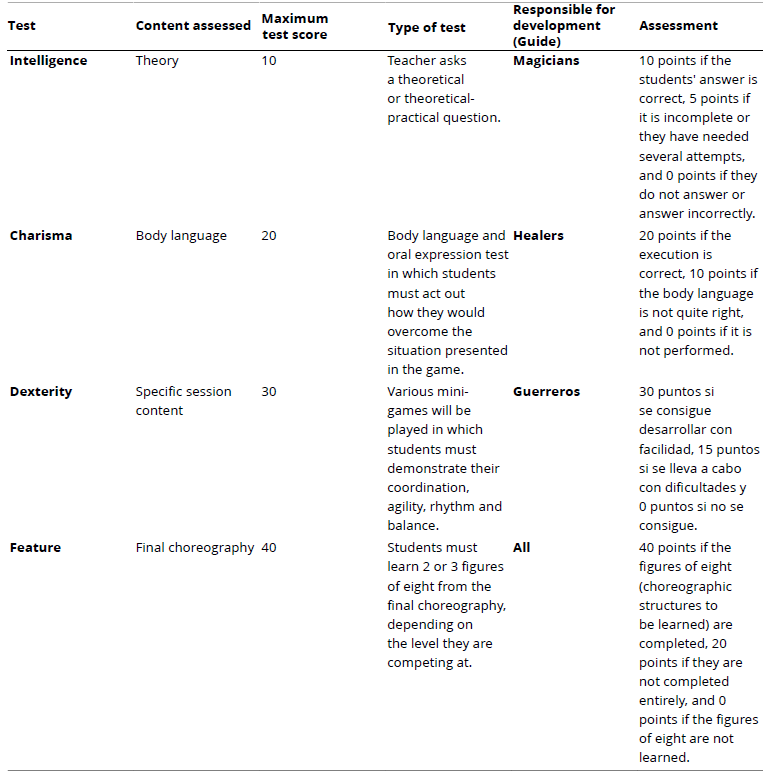
To progress through the experience, students were required to overcome a series of challenges designed to assess different dimensions of learning, including theoretical knowledge, technical skills, expressive capacity, and choreographic execution. These challenges were divided into four categories: theory, charisma, dexterity, and characteristic. Each carried a maximum score depending on the evaluation criterion: theory (up to 10 points), charisma (up to 20 points), dexterity (up to 30 points), and characteristic, which assessed accuracy in executing choreographic movements (up to 40 points) (see Table 1).
Relationship Between the Type of Test, the Content Assessed, its Maximum Value, the Person Responsible for Leading the Group's Response, and the Evaluation of the Responses
Challenge difficulty increased progressively through the introduction of “monster levels,” which modified both the complexity of the tasks and the number of choreographic movements to be performed. Students could only face a monster if their total score was equal to or greater than that of the corresponding adversary (see Table 2).
Monster Levels and Encounter Points

Summary of “The Story”
King Tristan entrusts the characters with a dangerous mission: to eliminate the Thessalhydra, a monstrous creature that has been terrorizing his kingdom. The last sighting of the beast placed it within the caverns inhabited by a tribe of troglodytes.
To accomplish their mission, the adventurers must confront and defeat the tribe, then follow the trail of the Thessalhydra into a cursed labyrinth. Within this labyrinth, they encounter the Lost Knight, a mysterious warrior trapped inside, who offers his assistance in finding the way out.
To escape, the characters must locate a hidden portal that transports them to a parallel dimension known as the Upside Down. There, they meet the enigmatic Proud Princess, who reveals both the path back to their own world and the route leading to the Thessalhydra’s lair.
Facing the creature constitutes the ultimate trial. Only if the adventurers succeed in defeating it and present proof of their victory to King Tristan will they be able to claim their reward and secure peace in the kingdom.
Objectives of the Didactic Proposal
The objectives to be achieved by the students are as follows:
-
Develop fundamental technical skills in urban dance.
-
Acquire both theoretical and practical knowledge of basic physical capacities.
-
Understand the theoretical principles of dance.
-
Learn to properly perform warm-up, static and dynamic stretching, and cool-down.
-
Develop interpretative capacity and emotional expression through movement.
-
Explore and experiment with different musical rhythms through freestyle.
-
Foster teamwork and collaboration.
-
Recognize and execute basic Hip Hop movements.
-
Improve listening skills to follow rhythm and musical structure.
-
Learn and develop choreographic sequences.
-
Enhance improvisation in music, rhythm, and movement.
Table 3 and Figure 1 present the development of the sessions carried out within the didactic proposal.
Development of the Sessions
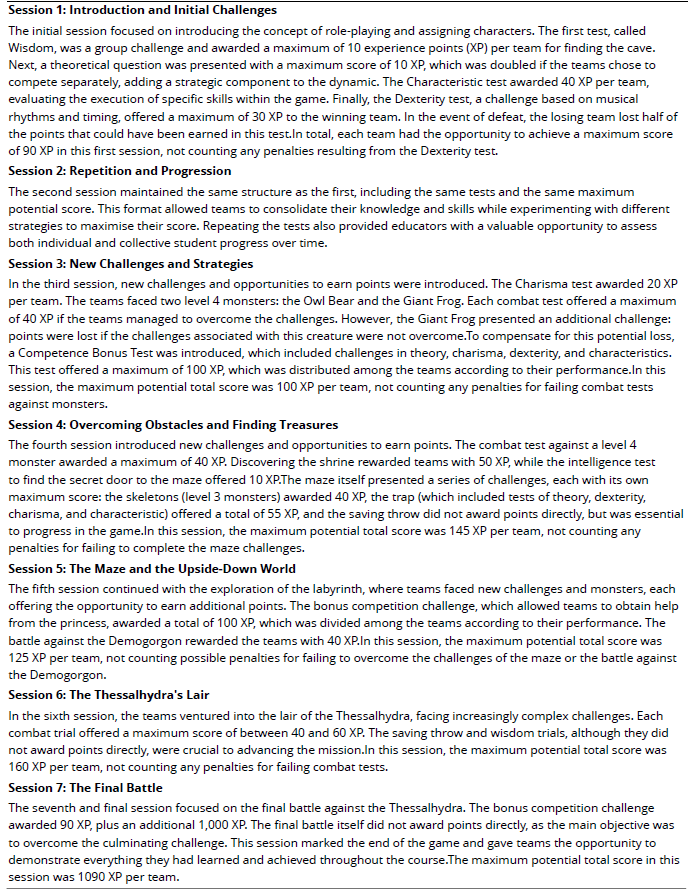
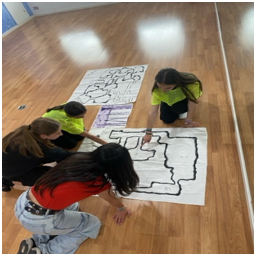
Figure 1
Development of a Gamified Session – Session 5-
In the context of combat dynamics against different monsters, the successful completion of each confrontation was intrinsically linked to the accurate execution of a predetermined number of “eights,” the quantity of which varied according to the opponent’s difficulty level. This progression system, grounded in the technical and choreographic execution of eights, required participants to consolidate their mastery as they advanced toward increasingly complex challenges. Consequently, the final battle against the most formidable adversary represented the culminating trial, where participants were required to demonstrate full mastery of the complete choreography (42 eights), without the possibility of review or external assistance. This ultimate test assessed both individual aptitude and team cohesion and coordination.
Evaluation and Instruments Used
Evaluation Criteria
The evaluation will focus on four fundamental dimensions, each carrying a specific weight in the final grade. First, theoretical aspects will be assessed, accounting for 10% of the total, measuring the knowledge acquired regarding basic physical capacities and dance through knowledge tests and related activities.
Second, body expression will also account for 10%, emphasizing the ability to improvise, interpret, and convey emotions through movement, as well as the exploration and experimentation with different musical rhythms (freestyle).
The third dimension is dexterity, weighted at 20%, which will evaluate the development of basic technical skills in urban dance, the acquisition of fundamental hip-hop movements, teamwork and collaboration skills, and knowledge of warm-up, stretching, and cool-down techniques. Finally, choreography will represent 60% of the total, assessing the learning and development of choreographic sequences, including the final game choreography.
Evaluation Instruments
The following instruments were employed for assessment:
-
Direct observation: Continuous monitoring of each student’s performance during class sessions, recording participation, progress, and difficulties.
-
Knowledge tests: Specific tests designed to assess theoretical and practical understanding of basic physical capacities and dance.
-
Charisma tests: Evaluation of improvisation, interpretation, and emotional expression through movement.
-
Dexterity tests: Measurement of technical skills in urban dance, as well as knowledge of warm-up, stretching, and cool-down techniques.
-
Characteristic tests: Assessment of learning and execution of choreographic sequences, including the final game choreography.
-
Teamwork evaluation: Observation and assessment of students’ ability to collaborate, cooperate with peers, and solve problems both individually and collectively.
Grading System
The final grade was obtained by summing the points earned in each evaluation criterion, weighted according to its percentage value. A numerical scale was used to express the level of achievement attained by each student.
Data Analysis
A descriptive analysis of the results was conducted as the first essential stage of data interpretation, providing a clear and concise summary of the information. Descriptive statistics were employed as the methodological tool.
Percentages were first calculated to determine the proportion of students within different performance categories, offering an overview of group outcomes. Measures of central tendency, such as the arithmetic mean (average), were then computed to identify the typical performance of students. The mean served as a key indicator for understanding the overall level of acquired knowledge.
It is important to note that the descriptive analysis was univariate, as each variable (score or percentage) was analyzed independently.
Subsequently, an independent-samples Student’s .-test was applied to evaluate differences in means between the two groups (Field, 2024). It is worth highlighting, as noted by Cohen et al. (2013), that the use of this parametric inferential test is particularly suitable for small samples (n < 30). The results obtained provide a robust foundation for understanding students’ performance in the assessments, while also identifying areas with potential for improvement.
Results
The results of the evaluation are presented below, structured into four sections with differentiated weightings: Intelligence (10%), charisma (10%), dexterity (20%), and characteristic tests (60%).
In the Experimental Group (EG), the evaluation was conducted collectively, with participants divided into two subgroups (Group 1 and Group 2). All members of each subgroup received the same score in each assessment category. Group 1 achieved a final score of 9.55, while Group 2 reached a final score of 9.2 (see Figure 2).
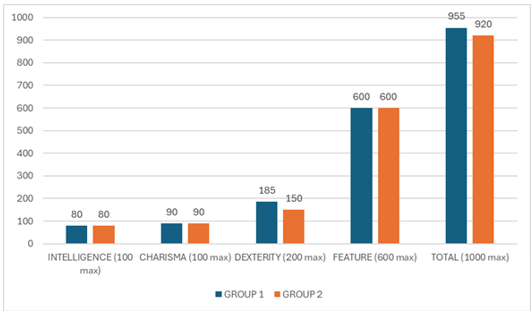
Figure 2
List of Scores Achieved by Groups 1 and 2 of the GE
In the CG (Control Group), each student was assessed individually in all sections. Subsequently, the arithmetic mean of the marks obtained in each section was calculated for the group as a whole. The results were as follows: 63/100 in intelligence, 62.5/100 in charisma, 142.5/200 in skills, and 372.5/600 in characteristic tests. The total average score for the control group was 6.4 (Figure 3).
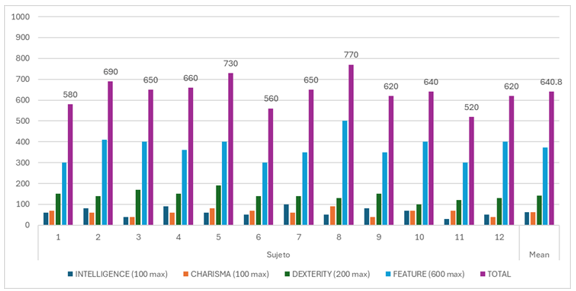
Figure 3
List of Scores Achieved by GC Participants
Figure 4 shows a comparison of the means obtained in each of the sections evaluated for the groups studied (CG and EG). As can be seen, the results obtained in all the elements evaluated show a notable difference between the two groups.
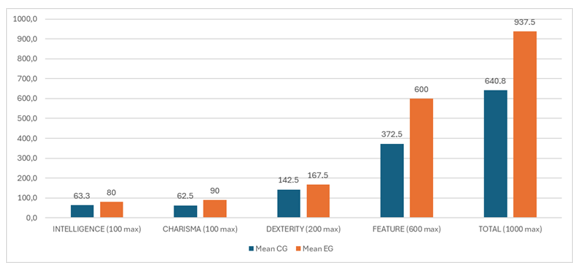
Figure 4
Comparison of Means of the Results Obtained Between the CG (Control Group) and the EG (Experimental Group)
To examine whether there were significant differences in the dependent variable between the experimental group and the control group, a Student's t-test for independent samples was performed.
First, the assumption of equal variances was evaluated using Levene's test. The results indicated that there was no significant difference in variances between the groups (F = 1.26) = 1.026, p = .331). Therefore, equal variances were assumed for the t-test.
The analyses revealed a significant difference in means between the experimental group (M = 937.50, SD = 24.75) and the control group (M = 640.83, SD = 69.60). The Student's t-test indicated that this difference was statistically significant (t(12) = 5.795, p < .001), with the experimental group showing a considerably higher mean than the control group. The difference in means was 296.67 (95% CI: 185.13−408.20).
The descriptive statistics and t-test results are summarised in Tables 4 and 5.
Descriptive Statistics Between the Experimental Group and the Control Group

Results of Student's t-Test for the Difference in Means Between the Experimental Group and the Control Group

As can be observed, the results obtained in all evaluated elements were higher in the Experimental Group (EG) compared to the Control Group (CG). Likewise, the following additional observations should be highlighted.
Qualitative observations made during the study revealed notable differences in performance and group dynamics. On the one hand, the EG was characterized by perfect class attendance (no absences were recorded), demonstrating a high level of commitment to the learning process. Participants did not require weekly review sessions, which suggests adequate individual preparation prior to classes and an effective capacity to assimilate the presented content. This group successfully completed the program and achieved the learning objectives within the established timeframe of seven sessions.
On the other hand, the Control Group averaged three absences per student, evidencing lower consistency in participation. Members of this group required a greater number of repetitions and weekly reviews to comprehend the content, which could indicate a lower level of individual preparation or greater difficulty in assimilating the information. In this group, nine sessions were required to address the program content, without achieving 100% of the learning objectives.
Discussion
The aim of this research was to evaluate the impact of a gamified model in urban dance classes, analyzing its effectiveness in learning, technical-artistic performance, choreographic memory, and student engagement.
The results of this study revealed a highly significant difference between the means of the Experimental Group and the Control Group. Specifically, the Experimental Group, which experienced an active teaching methodology based on gamification, obtained significantly higher academic performance than the Control Group, which followed a traditional teaching approach. The EG not only outperformed the CG in all evaluated aspects, but also demonstrated greater commitment, participation, and efficiency in the learning process.
These findings align with growing evidence supporting the effectiveness of active methodologies, particularly gamification, in optimizing learning. Several studies have shown that gamification can increase motivation, interest, collaboration, and knowledge assimilation among students at different educational levels (Domínguez et al., 2013; Sailer et al., 2017; Velasco, 2022).
By integrating playful elements such as points, levels, challenges, and rewards, gamification can transform learning into a more engaging and interactive experience (Deterding et al., 2011). This characteristic may explain the greater attendance, reduced need for reviews, and achievement of learning objectives in fewer sessions observed in the EG.
Additionally, the teamwork promoted through gamification can foster student interaction, the exchange of ideas, and collaborative learning (Kapp, 2012). These aspects may have contributed to a deeper understanding of the content and better academic performance in the EG.
Conclusions
This study focused on the implementation of gamification in dance education, addressing the following key aspects:
-
Design and implementation of a gamified approach: A gamified approach integrating both theoretical and practical elements into dance classes was designed and implemented. Its successful application enriched the educational process, demonstrating the feasibility and benefits of gamification in dance teaching.
-
Evaluation of learning effectiveness: Gamification proved to be an effective tool for the acquisition of knowledge and skills, fostering dynamic and interactive learning that encouraged active student participation.
-
Analysis of influence on development and performance: The inclusion of playful elements not only improved students’ academic performance but also supported their personal and artistic development, enhancing creativity, confidence, and teamwork.
-
Investigation of the impact on choreographic memory: A significant improvement was observed in students’ ability to recall and perform choreographic sequences. This suggests that gamification is an effective strategy for strengthening choreographic memory, a key aspect of dance education.
-
Assessment of increased engagement: The EG demonstrated a remarkable increase in engagement levels, reflected in regular class attendance and active participation during sessions.
The results of this study support gamification as a viable and effective strategy in dance teaching. It not only improves the teaching–learning process but also fosters the integral development of students. These findings endorse the incorporation of gamification as an active and transformative methodology in dance education.
Implications for Teaching Practice
The results of this study have significant implications for teaching practice. Gamification, as an active methodology, has proven to be an effective tool to motivate students, foster active participation, and improve academic performance. Teachers may consider incorporating gamified elements in their classes, such as points, badges, leaderboards, and challenges, in order to make learning more engaging, dynamic, and interactive. By integrating these elements, educators can create a learning environment that not only captures students’ interest but also promotes greater collaboration, creativity, and perseverance in their educational process.
Limitations and Future Research Directions
It is important to note that this study presents certain limitations. First, the sample size was relatively small, and the study was conducted in a specific context, which limits the generalizability of the findings to other settings or populations.
Despite these restrictions, the findings suggest that gamification can be an effective tool to enhance learning. Future research with larger samples and more robust experimental designs is recommended, as this would allow for the confirmation of these results and provide deeper insights into the mechanisms through which gamification impacts the learning process.
This study also opens several avenues for future research. It would be of interest to explore the impact of gamification in other educational contexts, with different student profiles and across various disciplines. Additionally, further investigation into the specific mechanisms explaining how gamification influences learning, as well as the factors that may moderate its effectiveness, would be valuable.
Ethics Committee Statement
The study was conducted in accordance with the Declaration of Helsinki and was approved by the Ethics Committee of the Pontifical University of Salamanca (minutes dated 11 April 2025).
Conflict of Interest Statement
The funding entities or institutions had no influence on the study design, data analysis or interpretation of results.
Funding
This research did not receive funding from any institution or entity to carry out the research conducted.
Authors' Contribution
Conceptualization M.A., L.M., F.G. & R.A.; Methodology M.A., L.M., F.G. & R.A.; Software M.A., L.M., F.G. & R.A.; Validation M.A., L.M., F.G. & R.A.; Formal Analysis M.A., L.M., F.G. & R.A.; Investigation M.A., L.M., F.G. & R.A.; Resources M.A., L.M., F.G. & R.A.; Data Curation M.A., L.M., F.G. & R.A.; Writing – Original Draft M.A., L.M., F.G. & R.A.; Writing – Review & Editing M.A., L.M., F.G. & R.A.; Visualization M.A., L.M., F.G. & R.A.; Supervision M.A., L.M., F.G. & R.A.; Project Administration M.A. All authors have read and agreed to the published version of the manuscript.
Data Availability Statement
Data available upon request from the corresponding author at mamatriaji@upsa.es.
References
Alemán, C., & Serrano, C.G. (2001). La danza como elemento educativo en el adolescente. Apunts: Educación Física y Deportes, 31-37. https://raco.cat/index.php/ApuntsEFD/article/view/301902
Alonso, F. G. (2019). Interculturality and gamification in teacher training. Revista de Ciências Humanas, 20(02), 38-62. https://doi.org/10.31512/19819250.2019.20.02.38-62
Cobos, J. C. (2022). El uso de la gamificación para aumentar la participación y el compromiso estudiantil. Nexus Research Journal, 1(1), 34–42. https://doi.org/10.62943/nrj.v1n1.2022.5
Cohen, J., Cohen, P., West, S. G., & Aiken, L. S. (2013). Applied multiple regression/correlation analysis for the behavioral sciences. Routledge. https://doi.org/10.4324/9780203774441
De Figueiredo, S. P. (2016). A dança e a expressão corporal: prática educativa, cultural e social. ERAS| European Review of Artistic Studies, 7(1), 67-75. https://doi.org/10.37334/eras.v7i1.83
Delgado Aza, T. S., Rosero Bustos, A. M., Rocha Tayupanta, G. E., Suasnavas Reina, S. A., Maldonado Cruz, M. de J., & Santillán Vaca, H. S. (2024). Implementación de Metodologías Activas en el Proceso de Enseñanza-Aprendizaje en el Aula: Implementation of Active Methodologies in the Teaching-Learning Process in the Classroom. Revista Científica Multidisciplinar G-Nerando, 5(1), 1027–1046. https://doi.org/10.60100/rcmg.v5i1.238
Deterding, S., Dixon, D., Khaled, R., & Nacke, L. (2011). From game design elements to gamefulness: defining" gamification". In Proceedings of the 15th international academic MindTrek conference: Envisioning future media environments (pp. 9-15). https://doi.org/10.1145/2181037.2181040
Domínguez, A., Saenz-de-Navarrete, J., De-Marcos, L., Fernández-Sanz, L., Pagés, C., & Martínez-Herráiz, J. J. (2013). Gamifying learning experiences: Practical implications and outcomes. Computers & education, 63, 380-392. https://doi.org/10.1016/j.compedu.2012.12.020
Field, A. (2024). Discovering statistics using IBM SPSS statistics. Sage.
Fica, A., Burgess Jaramillo, V., González Salgado, T., & Rojas Pino, M. (2022). Gamificación en Medicina de Urgencia. Revista Española de Educación Médica, 3(3). https://doi.org/10.6018/edumed.531501
Gutiérrez-Cantos, P. J., & Enriquez-Caro, L. (2023). Caracterización de la danza como estrategia para fortalecer en el desarrollo físico- integral de los estudiantes. MQRInvestigar, 7(4), 1271–1283. https://doi.org/10.56048/MQR20225.7.4.2023.1271-1283
Kapp, K. M. (2012). The gamification of learning and instruction: Game-based methods and strategies for training and education. Pfeiffer.
Lira, R. I. (2010). Las metodologías activas y el foro presencial: su contribución al desarrollo del pensamiento crítico / Active learning methodologies and syncronous forum: its contribution to the development of critical thinking. Actualidades Investigativas En Educación, 10(1). https://doi.org/10.15517/aie.v10i1.10093
López-Mari, M., Martín-Alonso, Á. S., & Peirats-Chacón, J. (2022). De los videojuegos a la gamificación como estrategia metodológica inclusiva. Revista Colombiana de Educación, (84). https://doi.org/10.17227/rce.84-12518
Luelmo del Castillo, M. J. (2018). Origen y desarrollo de las metodologías activas dentro del sistema educativo español. Encuentro Journal, 27, 4–21. https://doi.org/10.37536/ej.2018.27.1890
Morales-Carbajal, R., & Villa Angulo, C. (2019). Juegos de rol para la enseñanza de las matemáticas. Education in the Knowledge Society (EKS), 20, 13. https://doi.org/10.14201/eks2019_20_a7
Ordóñez Matute, A. R. (2022). Dispositivo didáctico relacional. Reivindicación del valor del aprendizaje de la danza para una educación integral. Revista Panamericana De Pedagogía, (35), 251–274. https://doi.org/10.21555/rpp.vi35.2734
Ortiz-de-Urbina Criado, M., Medina Salgado, S., & De La Calle Durán, C. (2010). Herramientas para el aprendizaje colaborativo: una aplicación práctica del juego de rol. Education in the Knowledge Society (EKS), 11(3), 277–300. https://doi.org/10.14201/eks.7463
Otzen T, & Manterola C. (2017). Técnicas de Muestreo sobre una Población a Estudio. International Journal of Morphology, 35(1), 227-32.
Sailer, M., Hense, J. U., Mayr, S. K., & Mandl, H. (2017). How gamification motivates: An experimental study of the effects of specific game design elements on psychological need satisfaction. Computers in human behavior, 69, 371-380. https://doi.org/10.1016/j.chb.2016.12.033
Villamar, A. M., & Sánchez, R. (2024). Explorando las bases pedagógicas de la gamificación como enfoque metodológico en la enseñanza superior. Educación, 33(65), 166-188. http://dx.doi.org/10.18800/educacion.202402.e001
World Medical Association (WMA). (2021). Declaración de Helsinki de la AMM – Principios éticos para las investigaciones médicas en seres humanos. Disponible en: https://www.wma.net/es/policies-post/declaracion-de-helsinki-de-la-amm-principios-eticos-para-las-investigaciones-medicas-en-seres-humanos/
Zurita, P. L. S., Morales, R. V. P., Montalvo, H. P. B., & Román, S. C. G. (2024). Gamificación en la Educación: Mas allá de la diversión, estrategias efectivas para el aprendizaje significativo. Polo del Conocimiento, 9(3), 3908-3931. https://doi.org/10.23857/pc.v9i3.6886
Author notes
Autor para la correspondencia: Mario Amatria Jiménez, mamatriaji@iupsa.es
Additional information
Título Abreviado: Strange Dancer Things
How to cite this article: Amatria, M., Iglesias, M., González, F. & Arroyo, R. (2025). Strange dancer things. Application of gamification in dance. Cultura, Ciencia y Deporte, 20(65), 2496. https://doi.org/10.12800/ccd.v20i65.2496


