
EFFECT OF THE GAMIFICATION "THE ANDALUZO’S ADVENTURE" ON SCHOOLCHILDREN’S MOTIVATION, INTENTION TO BE PHYSICALLY ACTIVE, AND WEEKLY PHYSICAL ACTIVITY
EFECTO DE LA GAMIFICACIÓN "LA AVENTURA DE ANDALUZO" SOBRE LA MOTIVACIÓN, INTENCIÓN DE SER FÍSICAMENTE ACTIVO Y ACTIVIDAD FÍSICA SEMANAL DE ESCOLARES


Juan Antonio Berdones-Sola, Daniel Mayorga-Vega, Jesús Viciana, Santiago Guijarro-Romero
EFFECT OF THE GAMICATION "THE ANDALUZO’S ADVENTURE" ON SCHOOLCHILDREN’S MOTIVATION, INTENTION TO BE PHYSICALLY ACTIVE, AND WEEKLY PHYSICAL ACTIVITY
Cultura, Ciencia y Deporte, vol. 20, no. 65, 2025, 10.12800/ccd.v20i65.2418
Universidad Católica San Antonio de Murcia
Juan Antonio Berdones-Sola
University of Granada, España
Daniel Mayorga-Vega a
Universidad de Málaga, España
Jesús Viciana
University of Granada, España
Santiago Guijarro-Romero
Autonomous University of Madrid, España
Received: 28 january 2025
Accepted: 22 may 2025
Abstract: The objective was to examine the effects of a gamified intermittent programming unit (PU) based on behavior modification strategies on Primary Education students’ motivation towards Physical Education, intention to be physically active, and weekly physical activity (PA) levels. Twelve classes, comprising a total of 203 students from 4th to 6th grade in Primary Education (40.9% female; 9–12 years old), were randomly assigned to the gamified group (n = 121) and the control group (n = 82). The gamified group completed a five-week gamified intermittent PU (three sessions/week) during the first 15 minutes of each session. Behavior modification strategies were also applied, including PA wristbands, PA reminders, diaries, educational counseling, and goal setting. Before and after the intervention, dependent variables were assessed using validated questionnaires. The results showed that students in the gamified group significantly improved their identified and autonomous motivation towards Physical Education and PA during recess (p < .05, r = 0.15–0.18). A gamified intermittent PU based on behavior modification strategies appears to be effective in enhancing autonomous and identified motivation as well as PA during recess.
Keywords: Primary Education, innovative intervention, motivation, Physical Education, intention.
Resumen: El objetivo fue examinar los efectos de una unidad de programación (UP) intermitente gamificada basada en estrategias de modificación del comportamiento en escolares de Educación Primaria sobre la motivación hacia la Educación Física, intención de ser físicamente activo y niveles de actividad física (AF) semanal. Doce clases con un total de 203 escolares de 4-6º curso de Educación Primaria (40.9% mujeres; 9-12 años) se asignaron aleatoriamente al grupo gamificado (n = 121) y control (n = 82). El grupo gamificado realizó una UP intermitente gamificada de cinco semanas (tres sesiones/semana) durante los primeros 15 minutos de cada sesión. Se aplicaron también estrategias de modificación del comportamiento como pulseras de AF, recordatorios de AF, diarios, asesoramiento educativo y establecimiento de objetivos. Antes y después de la intervención las variables dependientes se evaluaron mediante cuestionarios validados. Los resultados mostraron que los escolares del grupo gamificado mejoraron de manera estadísticamente significativa la motivación identificada y autónoma hacia la Educación Física y la AF durante el recreo (p < .05, r = 0.15-0.18). Una UP intermitente gamificada basada en el uso de estrategias de modificación del comportamiento parece ser efectiva para mejorar la motivación autónoma e identificada, así como la AF durante el recreo.
Palabras clave: Educación Primaria, intervención innovadora, motivación, Educación Física, intención.
Introduction
The regular practice of physical activity (PA) is recognized as one of the most important elements in improving children's physical, mental, and social health, as well as their wellbeing (Organization for Economic Cooperation and Development, OECD/World Health Organization, WHO, 2023). WHO recommends that children engage in 60 minutes daily of moderate to vigorous intensity of PA throughout the week (WHO, 2020). However, globally, eight out of every 10 schoolchildren are physically inactive (Guthold et al., 2020). Moreover, data from longitudinal studies indicate that there is a decline in moderate to vigorous intensity of PA from six years of age in girls and nine years in boys (Farooq et al., 2020). Therefore, interventions to promote healthy levels of moderate to vigorous intensity of PA before adolescence through different contexts such as education are considered essential (OECD/WHO, 2023).
Physical Education (PE) is an ideal context for promoting a healthy level of PA (Association for Physical Education, 2020). One of the PE curriculum competencies in most educational systems worldwide is the promotion of healthy PA habits (Association for Physical Education, 2020; SHAPE America, 2024). However, problems have been detected that directly affect the planning of the subject, such as the reduced time available to address the high number of objectives and competencies to be developed (Casado-Robles et al., 2019). A possible solution could be the promotion of regular PA through the intermittent programming units proposed by Viciana and Mayorga-Vega (2016). The structure of this innovative programming unit model consists of dividing the PA session into two (or more) parts, working specific curricular objectives during time slots of each session (e.g., the first 15 minutes), for several sessions. Thus, the second part of the session could be dedicated to work on a different objective (Viciana & Mayorga-Vega, 2016). Considering that producing health-related behavioral changes in schoolchildren (e.g., generating healthy PA habits) is a time-consuming process (Neil-Sztramko et al., 2021), the application of an intermittent programming unit provides a more efficient management of learning time compared to allocating the entire session during an intensive period. In this sense, promoting this behavior change progressively outside the FE setting and over an extended period could be more effective than concentrating all the allocated time on achieving this goal in just a few weeks. For example, in an intermittent programming unit, one objective could be worked during the first 15 minutes of the session, then, another programming unit with a different objective could be addressed in the rest of the PE session. These intermittent programming units have demonstrated their effectiveness in developing different curricular objectives such as, for example, improving cardiorespiratory capacity (Guijarro-Romero et al., 2020a) or postural education (Sainz de Baranda et al., 2010).
To understand the effectiveness of these interventions in the context of PE, Self-Determination Theory can serve as a framework for understanding student behavior (Ryan & Deci, 2020). Self-Determination Theory classifies the different types of regulations that lead to a given behavior on a continuum that encompasses three categories organized from the lowest to the highest level of self-determination: autonomous motivation, controlled motivation, and demotivation (Ryan & Deci, 2020). On one hand, autonomous motivation encompasses integrated regulation, where actions are consistent with a sense of self, identified regulation, which involves acting in coherence with personal values, and intrinsic motivation, where actions are performed for the pleasure they bring. On the other hand, controlled motivation includes external regulation, where actions are performed to obtain rewards or avoid punishment, and introjected regulation, where actions are performed to feel good and avoid negative emotions such as guilt. Finally, demotivation represents a lack of interest and motivation. In their systematic review and meta-analysis, Kelso et al. (2020) pointed out that PE seems to be an ideal context for achieving positive motivational outcomes, such as improvements of schoolchildren’s intrinsic motivation.
Together with motivation, intention is one of the main mediators of active behavior (Viciana et al., 2019). According to the Theory of Planned Behavior, intention is considered as the closest antecedent to trigger a behavior (Ajzen, 2011; McEachan et al., 2011). Previous studies have shown that self-determined levels of motivation in EF are related to the intention to be physically active (Fernández-Espínola et al., 2021; Fierro-Suero et al., 2023; Viciana et al., 2019). Moreover, in particular intrinsic motivation, which is centered on the achievement of goals and challenges in PA and on the experience of pleasant and stimulating sensations related to the activity itself, is identified as the factor that most influences the intention to remain physically active (Hein et al., 2004). In accordance with the aforementioned, new pedagogical approaches have emerged with the aim of improving schoolchildren’s motivation and keeping them more active in and out of school hours (Arufe-Giráldez et al., 2022; Mazeas et al., 2022). Currently, gamification is a methodology that is causing higher levels of motivation and learning in the educational environment (Fernandez-Rio et al., 2020; Quintas et al., 2020). Gamification is defined as the use of game elements in non-game contexts (Deterding et al., 2011). The elements of gamification are divided into three categories (Werbach & Hunter, 2015): (a) dynamics, considered as the set of general aspects on which gamification is sustained, such as narrative, emotion and relationships, progression, constraints and autonomy; (b) mechanics, considered as the processes that help gamification progress, such as competition, cooperation, feedback, achievements and rewards; and (c) components, considered as the specific aspects specific to dynamics and mechanics, such as avatars, challenges, customization, achievements, unlocking content, gifts, leaderboards, levels, and points.
In addition to the use of gamification, the use of behavior modification strategies such as self-monitoring through PA wristbands, goal setting, or educational counseling have been shown to be effective in promoting regular PA practice among schoolchildren (Casado-Robles et al., 2022). Similarly, the inclusion of a greater number of behavior modification strategies such as diaries and reminders seems to increase the effect of the intervention on PA among schoolchildren (Casado-Robles et al., 2022). In this sense, the combined use of the aforementioned behavior modification strategies and gamification as part of PA promotion programs could promote motivation towards PE, intention to be physically active, and PA practice if employed together (Arufe-Giráldez et al., 2022; Casado-Robles et al., 2022; Mazeas et al., 2022).
Despite that the study of the effects of gamified interventions in PE is receiving a great deal of attention (Camacho-Sánchez et al., 2023), research in primary school students is still scarce. The systematic review by Arufe-Giráldez et al. (2022) shows how the use of gamification as a methodological strategy in PE interventions seems to improve the schoolchildren’s intrinsic motivation. Regarding the intention to be physically active, no previous studies have been found that analyze the effect of gamified interventions on this variable in the context of primary schoolchildren. However, in the Compulsory Secondary Education stage, Fernandez-Rio et al. (2022) observed that after a gamified intervention inspired by the manga series Dragon Ball Z for nine weeks (nine sessions in total) aimed at working on physical fitness and coordination, students improved their intention to be physically active. Regarding PA, in the systematic review and meta-analysis conducted by Mazeas et al. (2022) gamification has been shown to be an effective methodology to promote the practice of PA by schoolchildren in the context of PE. However, of the 16 studies included in the review, only three of them were conducted with primary education schoolchildren (Garde et al., 2015, 2016, 2018), so previous evidence in this population group is still reduced. Moreover, none of them applied all the previously mentioned behavior modification strategies nor analyzed the effect of the intervention on motivation or the intention to be physically active of schoolchildren. Therefore, considering the gaps in scientific knowledge previously highlighted, it seems necessary to conduct further research on this novel methodology to better understand how it works in the context of PE with primary schoolchildren. Unfortunately, to our knowledge, no previous study has been found in the context of PE that analyzes the effect of a gamified intermittent programming unit using multiple behavior modification strategies (including PA wristbands, educational counseling, diaries, PA reminders, and goal setting) on motivation toward PE, intention to be physically active, and weekly PA levels in primary schoolchildren.
Consequently, the main objective of the present study was to examine the effects of a gamified intermittent programming unit (based on behavior modification strategies in primary education) on motivation towards PE, intention to be physically active and weekly PA levels. The main hypothesis was that schoolchildren who performed the gamified intermittent programming unit based on behavior modification strategies would show higher motivation towards PE, higher intention to be physically active and higher levels of weekly PA.
Material and Methods
Study Design
The present study was performed according to CONSORT guidelines for cluster randomized controlled studies (Campbell et al., 2012). The protocol followed respects the standards of the Declaration of Helsinki (64th WMA, Brazil, October 2013) and was approved by the Ethics Committee of the University of Granada. Recruitment of participants was performed in June 2022 and the intervention was conducted from October to December 2022. For practical reasons and due to the nature of the study (i.e., natural clusters in the educational setting), a cluster-randomized controlled trial design was applied (Guijarro-Romero et al., 2023). This study was not blinded (treatments were not hidden from schoolchildren or teachers) and parallel groups were used (study with two different treatments), with two evaluation phases.
Participants
First, two public schools in the province of Granada (Granada, Spain) were chosen for convenience. Principals and PE teachers were contacted and informed about the study and their permission to conduct it was requested. After obtaining approval, the 273 schoolchildren (39.9% female) in the fourth to sixth grades of primary education (i.e., aged 9 to 12 years) were invited to participate. The schoolchildren and their legal guardians were fully informed about the characteristics of the study. In addition, before the start of the study, verbal assent was obtained from the schoolchildren and signed written informed consent was obtained from their legal guardians. According to the reports from the educational center, all the families of the schoolchildren had a medium socioeconomic level.
The inclusion criteria were: a) being enrolled in the fourth to sixth year of primary education in the selected schools (classes in which permission was obtained from the schools); b) participating in the PE classes normally; c) being free of any health problem that hindered participation in PA normally; d) presenting the corresponding informed consent signed by their legal guardians; and e) presenting their own verbal assent. The exclusion criteria were: a) not having correctly performed the assessment of the dependent variables in the pre-intervention and/or post-intervention measures according to the administration standards (being excluded only in those incomplete variables and not from the study as a whole); and b) not having an attendance percentage equal to or higher than 85% in the PE sessions during the intervention period.
Sample Size
The sample size calculation was estimated considering both normal and non-normal distribution of the data. Assuming normal distribution, the parameters were set as follows: significance level α = 0.05; number of participants per group n = 15; effect size δ = 0.50; intraclass correlation coefficient ρ = .01 and statistical power (1 - β) = .80 (natural cluster randomized trials with person-level outcomes, analyzed with Optimal Design Plus Empirical Evidence version 3.01 software for Windows). A final minimum sample size of 180 participants (12 groups) was estimated. Assuming a non-normal distribution, parameters were set as follows: effect size d = 0.50; significance level α = .05 and statistical power (1 - β) = .80 (Wilcoxon-Mann-Whitney t-tests -two groups- function of G*Power Version 3.1.9.4 software for Windows). A final minimum sample size of 134 participants was estimated.
Randomization
Randomization was performed at the school level to avoid treatment contamination, using a computerized random number generator. This was done before the pre-intervention assessment was administered by an independent investigator blinded to the study objective and following a 1:1 ratio in the gamified group (GG) or control group (CG). In addition, in accordance with educational legislation, prior to the start of the school year, the schoolchildren had been randomly assigned by the educational center following the criterion that the classes should have the same proportion of boys and girls.
Measurements
The assessment was conducted during PE classes at the beginning and at the end of the intervention program (pre-intervention and post-intervention, respectively). Each assessment was conducted during two PE classes by the same evaluators, instruments, and conditions. Likewise, before the start of the study, sociodemographic data (age, gender and grade) were collected from the school reports and anthropometric measurements of the schoolchildren. In addition, we recorded whether the schoolchildren had had previous experience with PA wristbands (yes/no) and whether they were currently using them (yes/no). The schoolchildren completed the questionnaires in an ordinary classroom under silent conditions. The researcher provided a full explanation on how to correctly fill out the questionnaire at the beginning of the evaluation sessions. The schoolchildren were asked to be as honest as possible and the confidentiality of the data obtained was guaranteed. Although instructions on how to properly answer the questionnaires were printed at the top, the researcher was present during all the evaluation sessions in order to clarify any doubts that might arise. The measurement procedure followed for each variable is detailed below.
Anthropometry
Body mass (kg) and height (cm) of the schoolchildren were measured following the International Standards for Anthropometric Assessment (Stewart et al., 2011). Next, body mass index was calculated as body mass divided by body height squared (kg/m²). Finally, the body weight status of the schoolchildren was classified according to gender- and age-adjusted body mass index thresholds as overweight/obese or not overweight/obese (Cole et al., 2000). Body mass index and body weight status scores have shown high validity among schoolchildren (Cole et al., 2000).
Motivation Toward Physical Education
The motivation of schoolchildren towards PE was assessed using the Motivation Questionnaire in PE in Primary Education (CMEF-EP; Leo et al., 2016). This questionnaire is composed of a total of 20 items that appear preceded by the sentence “I participate in PE classes...” analyzing five factors of motivation with four items each: intrinsic motivation (e.g., “because PE is fun”); identified regulation (e.g., “because this subject provides me with knowledge and skills that I consider important”); introjected regulation (e.g., “because I see it as necessary to feel good about myself”); external regulation (e.g., “to show the teacher and classmates my interest in the subject”); and demotivation (e.g., “but I really feel that I am wasting my time with this subject”). In accordance with previous studies (Guijarro-Romero et al., 2023), a 10-point Likert scale, from 1 (“Totally disagree”) to 10 (“Totally agree”), was used to adapt the scale of the questionnaire to the Spanish schoolchildren’s grades. Subsequently, autonomous (i.e., averaging intrinsic motivation and identified regulation) and controlled motivation (i.e., averaging introjected and external regulation) were also calculated (Chemolli & Gagné, 2014). The Spanish version of the CMEF-EP has been shown to have adequate psychometric properties in Primary Education schoolchildren (CFI = .92; TLI = .91; GFI = .93; SRMR = .05; RMSEA = .04; Cronbach's alpha = .64-.78) (Leo et al., 2016).
Intention to be Physically Active
Schoolchildren's intention to be physically active was assessed using the adapted and validated version of the Measure of Intentionality to be Physically Active questionnaire (MIFA; Arias-Estero et al., 2013). This questionnaire is composed of a five-item dimension (e.g., “In addition to PE classes, I like to practice sports”). A Likert-type scale ranging from 1 (“Totally disagree”) to 10 (“Totally agree”) was used. The Spanish version of the MIFA has demonstrated adequate psychometric properties in Primary School students (CFI = .93; GFI = .91; RMSEA = .06; Cronbach's alpha = .80) (Arias-Estero et al., 2013).
Weekly Physical Activity
Weekly PA was self-reported by schoolchildren using the Children's PA Pictorial PA Questionnaire (C-PAFI; Morera-Castro et al., 2018). This questionnaire has a version for boys and another for girls. It is composed of seven closed questions and a pictorial scale of responses. The first five questions reflect the level of PA that the child has performed during the last seven days: during the week (Monday to Friday), weekends, breaks at school, when not at school, and during PE classes. Each question has four possible answers related to the level of PA: sedentary (1), not very active (2), active (3) or very active (4) (these PA levels are represented in a drawing without facial gestures as a scale in each question). For example, “During the last weekend (Saturday and Sunday) I went...”. In addition, it has a question (the sixth), which assesses whether or not the child belongs to a sports team or dance group (organized extracurricular PA), as well as the frequency of such activity per week and the duration per session; and the seventh question identifies the means of transportation to school (active: walking, cycling, or other; and non-active: car, bus, or other). The Spanish version of the C-PAFI has shown a statistically significant correlation with PA assessed by the PA questionnaire for children (PAQ-C) in Primary Education schoolchildren (r = .59, p < .001) (Morera-Castro et al., 2018).
Intervention
Both groups performed a programming unit for five weeks (a total of 15 sessions, three sessions per week of 50 minutes duration). Specifically, the GG performed a gamified intermittent programming unit (Viciana & Mayorga-Vega, 2016; Blázquez & Flores, 2024) using only the first 15 minutes of the session. The rest of the time of the sessions was dedicated to basketball and soccer learning. The gamification was called “Andaluzo's adventure”, where the narrative was based on a character in the shape of the Autonomous Community of Andalusia called “Andaluzo”. During the first week, the adventure and the challenges to be overcome in each level were presented. The students created their avatars in teams. Afterwards, they learned how the PA wristbands worked and were given the “Andaluzo passport”, where they were stamped as they completed the challenges of individual steps on a weekly basis. From the second to the fifth week of the program, the students had to travel through the eight provinces of Andalusia overcoming eight levels (two per week), for which four challenges of progressive steps were established both individually and in teams: level one, from Granada (starting point) to Jaén passing through Almería (9,000 steps); level two, from Jaén to Córdoba passing through Seville (10,000 steps); level three, from Córdoba to Cádiz passing through Huelva (11,000 steps); and level four, from Huelva to Granada passing through Málaga (arrival) (12,000 steps). Therefore, they had to achieve a minimum number of daily steps per week at the individual and team levels. At the team level, the steps were obtained by calculating the averages of each of the team members. The group advanced two provinces if they met the step challenge and one if they did not. For example, if they met the challenge of 9,000 steps, they advanced to Jaén, and if not, only to Almería. In addition, if schoolchildren met the challenges, stories and games about the province they had reached were unlocked, which they practiced during the remaining time of one of the EF sessions, thus working on Andalusian culture. Fulfillment of the step challenges was monitored through the Garmin Vivofit JR wristbands that the schoolchildren wore all day during the entire period of the intervention. During the first 15 minutes of the sessions, the information recorded by the wristbands was analyzed to provide feedback to the students.
Moreover, from week two to week five, educational counseling was provided, including information on different topics such as PA recommendations, the benefits of regular PA practice, and the different types of activity according to their intensity to comply with WHO guidelines (PA pyramid). Likewise, proposals were offered to overcome barriers to PA practice, healthy practice options for recreation and free time, videos and news items to raise awareness of the importance of regular PA practice, and a guide document called “the 10 commandments of health” aimed at promoting an active lifestyle.
The CG conducted a traditional soccer and basketball programming unit. However, this group did not receive any behavior modification strategies developed in the GG.
Statistical Analysis
Descriptive statistics were calculated for the general characteristics of the participants (mean and standard deviation or percentage) and the dependent variables (median and interquartile range or percentage). First, statistical test assumptions (e.g., histograms and Q-Q plots of normality) were checked. Then, as exploratory analyses, one-factor analysis of variance (ANOVA) for continuous variables and the chi-square test for categorical variables were performed to examine possible differences in general characteristics between the two groups. The internal consistency of the dependent variables measured in the present study was evaluated with Cronbach's alpha. Subsequently, given that the data of the dependent variables did not follow a normal distribution, the effect of the gamified intermittent programming unit on the scores on the dependent variables (post-intervention - pre-intervention change) of the schoolchildren was examined using the Mann-Whitney U test. Finally, McNemar's exact test was used to examine the effect of the program on the proportion of schoolchildren actively commuting to school. Effect sizes were estimated using Rosenthal's r for continuous variables and Cramer's V for dichotomous variables. All statistical analyses were performed using SPSS version 25.0 for Windows (IBM® SPSS® Statistics). The level of statistical signification was p < .05.
Results
Final Simple and General Characteristics
A total of 203 schoolchildren (40.9% female) agreed to participate and met the inclusion criteria from among the 273 schoolchildren who were invited to participate in the present study. However, only 182 schoolchildren (39.0% female) successfully met the exclusion criteria. A total of 76-78 CG participants and 101 GG participants submitted complete data for the dependent variables (Figure 1).
![Flow Chart of the Participants Included in the Present Study. All Numbers Correspond to Schools [Students].](6602825011_gf2.png)
Figure 1
Flow Chart of the Participants Included in the Present Study. All Numbers Correspond to Schools [Students].
Table 1 shows the general characteristics of the included participants. The results of the one-factor ANOVA and the chi-square test showed no statistically significant differences in terms of general characteristics between the two groups (p > .05), except for course and gender (p < .05). Regarding attendance percentage, the included GG participants obtained an average of 96.1% (14.4 sessions). In the sample of the present study, the internal consistency of all dependent variables was equal to or higher than .70 (from .70 to .79), except for intrinsic motivation (.65) and introjected motivation toward PE (.53).
General Characteristics of Participants
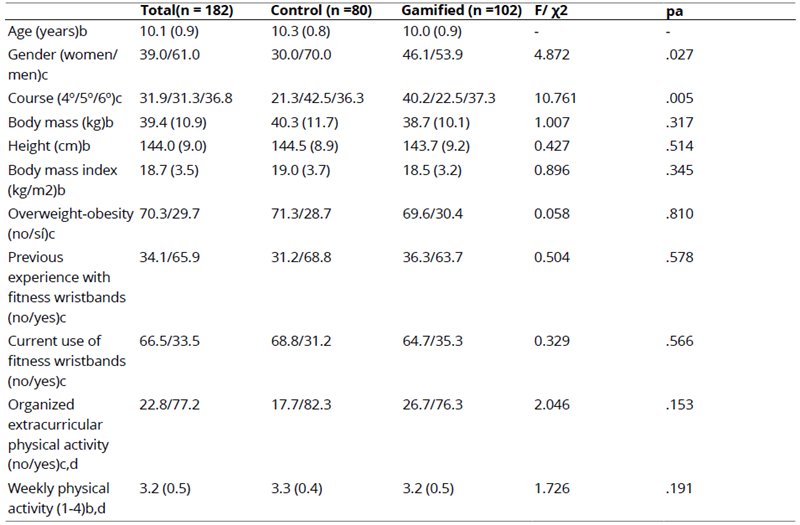
Note. a Significance level of the one-factor analysis of variance for continuous variables and the chi-square test for categorical variables; Data are presented as mean (standard deviation) for continuous variablesb and as percentage for categorical variablesc; dBegining scores (pre-intervention).
Effect of the Gamified Intermittent Programming Unit
The results of the Mann-Whitney U test showed that GG schoolchildren statistically significantly improved their scores on identified and autonomous motivation toward EF and PA during school recess compared to CG schoolchildren (p < .05, r = 0.15-0.18). In addition, the results showed that CG schoolchildren statistically significantly reduced their weekly PA scores compared to GG schoolchildren (p < .05,r = 0.15). For the rest of the dependent variables examined, no statistically significant differences were found (p > .05) (Table 2). In addition, the results of McNemar's exact test showed that there were no statistically significant differences in the proportion of schoolchildren actively commuting to school before and after the intervention, both for the CG (from 71.6% to 66.2%, p = .125, Cramer's V = .881) and the GG (from 42.1% to 49.5%, p = .092, Cramer's V = .734).
Effect of Intermittent Programming Unit on Dependent Variables Punctuation
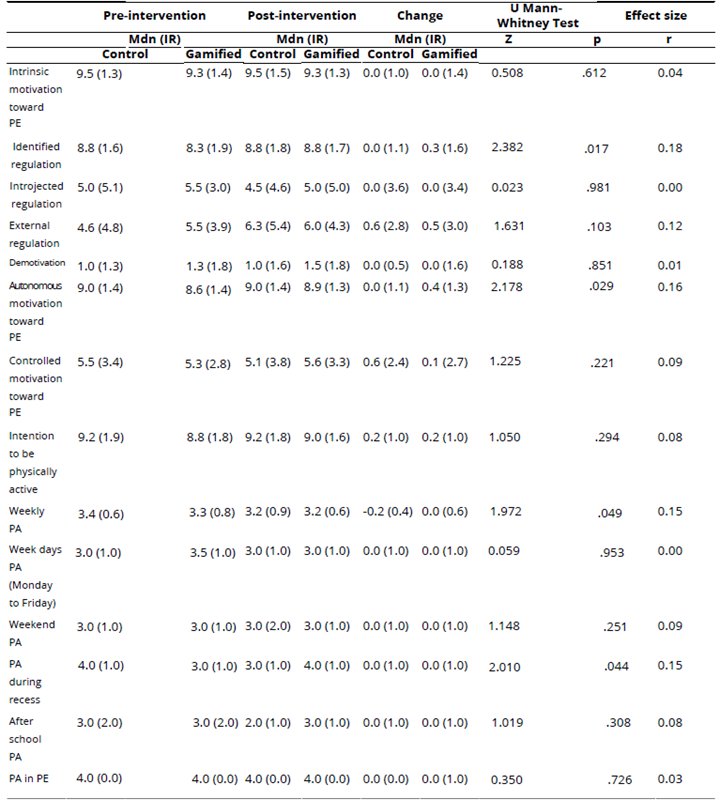
Note. Mdn = median; IR = interquartile range; PE = Physical Education; PA = physical activity. Control: n = 78 for the variables intrinsic motivation toward PE, identified, introjected and external regulations, demotivation, autonomous and controlled motivation toward PE; n = 77 for the variables intention to be physically active, weekly physical activity, physical activity on weekdays (Monday to Friday), physical activity on weekend days, physical activity during recess and physical activity in PE; n = 76 for the variable physical activity after school. Gamified, n = 101.
Discussion
The aim of the study was to examine the effects of a gamified intermittent programming unit based on behavior modification strategies in primary school children on motivation towards PE, intention to be physically active, and weekly PA levels. The results of the study showed that there was an improvement in identified and autonomous motivation and PA during recess in GG schoolchildren. In addition, the CG schoolchildren reduced their weekly PA after the intervention compared to those in the GG, showing a positive effect on this variable.
Regarding motivation, the use of gamification in PE seems to increase motivation towards the contents of the subject (Arufe-Giráldez et al., 2022), and in our case the gamified intervention could have caused schoolchildren to find PE classes more attractive and consequently more motivating. This could be explained because autonomous motivation, as a form of behavioral regulation, is related to an internal locus of causality and, therefore, to the performance of activities simply for the satisfaction of the activity itself (Vansteenkiste et al., 2010). Similarly, educational counseling provided to schoolchildren during classes, as concluded in the systematic review and meta-analysis by Casado-Robles et al. (2022), could have been effective in making them understand the practical value of PA, allowing them to see this unit of programming as not only relevant in the school context, but also in their future life outside school. In addition, the allocation of rewards presented in a non-controlling way (without league tables that excessively compare schoolchildren) as shown by Arufe-Giráldez et al. (2022), could have reinforced the autonomous motivation of schoolchildren by rewarding their effort without generating external pressure. Unfortunately, to our knowledge, no previous study in the context of PE has analyzed the effect of a gamified intermittent programming unit using multiple behavior modification strategies on the motivation towards PE of schoolchildren. Studies with traditional programming units that have analyzed the effect of gamified interventions in the context of PE on the motivation of primary school students are scarce, specifically three (Fernandez-Rio et al., 2020; Quintas et al., 2020; Sotos-Martínez et al., 2023).
The findings of the present study coincide with those of Sotos-Martínez et al. (2023), who observed an increase in intrinsic motivation towards PE after a gamified proposal based on the use of the technological application “ClassDojo” during the development of the sessions, centered on the personalization of avatars and a system of positive and negative points that modified the appearance of the avatars. A key aspect on the similarity of results that could explain the increase in autonomous motivation in the present study is the positive and immediate feedback based on information about the competition (Badami et al., 2011; Woolley & Fishbach, 2018), and to the motivation identified the use of avatars in the narrative (Birk et al., 2016). Fernandez-Rio et al. (2020) also obtained an improvement in intrinsic motivation through gamification based on the “Marvel” universe. However, despite the fact that their intervention was mainly based on knowledge such as group cohesion, healthy habits, body image, physical fitness, and motor skills, the achievement of incremental learning objectives and the development of tasks adjusted to the level of the schoolchildren could have contributed to the perception of competence, a key factor in the Self-Determination Theory (Ryan & Deci, 2020). In our case, this was done with advancement in progressive step challenges across the provinces of Andalusia.
In contrast, in the study by Quintas et al. (2020), in which they used exergames such as “Just Dance Now”, based on game elements such as points, rankings and levels, but without a structured narrative to contextualize the intervention, no statistically significant differences were found in intrinsic motivation towards PE in schoolchildren. This could be due to the fact that the feedback was limited to momentary performance, without a narrative framework that promoted a deeper connection with the intervention, as well as the use of visible boards where the outcome of the dances was compared individually among the schoolchildren.
Regarding the intention to be physically active, no statistically significant differences between groups were found in the present study. These results are opposite to previous studies conducted in the context of PE that have applied gamified interventions and found increases in intention to be physically active (Fernandez-Rio et al., 2022). For example, in the study by Fernandez-Rio et al. (2022) conducted with secondary students, improvements in the intention to be physically active were observed after a gamified intervention based on the Dragon Ball Z series, suggesting that age could be a determining factor. Furthermore, together with the age difference, in the study by Fernandez-Rio et al. (2022) the initial values of the experimental group on the intention to be physically active were considerably lower compared to the CG, which could have influenced this group to more easily achieve an increase in their values (Guijarro-Romero et al., 2020b). In contrast, in the present study, both the GG and the GC started with very high values (8.8 and 9.2 out of 10, respectively). This suggests that the schoolchildren in our study already intended to practice PA from the beginning, which might have reduced the chances for generating further significant increases (Owen et al., 2014). In this sense, it is important to highlight that the maintenance of a high basal intention to be physically active is an important achievement of the present study.
Regarding weekly PA, no differences were found in this variable after the intervention. Despite having employed strategies such as gamification (Mazeas et al., 2022), goal setting, PA wristbands, and educational counseling (Casado-Robles et al., 2022) that have been shown to be effective in improving the PA of schoolchildren in PA promotion programs, they did not have an effect in the present study. A possible explanation could be related to weather conditions, since the pre-intervention measurement was performed in October, at the beginning of autumn, and the post-intervention in December, mid-winter. In other words, these are periods of the year in which certain climatic factors such as rain or low temperatures could have affected the PA practice of the schoolchildren, especially after the intervention. In this regard, the systematic review and meta-analysis by Zheng et al. (2021) concluded that weather factors, such as rain and cold temperatures or season, as well as short day length, have a significant impact on schoolchildren's PA levels. This fact is supported by the observed decrease in weekly PA levels of the CG after the intervention while the GG maintained them showing a positive effect of the intervention and thus avoiding the usual decrease in PA levels as a consequence of low temperatures or rain (Zheng et al., 2021). Previous studies that have applied gamified interventions to improve schoolchildren's PA have found opposite results to the present study. For example, Garde et al. (2015, 2016) found an average increase of 1991 and 2934 daily steps, respectively, after the implementation of an intervention based on the active video game “MobileKids Monster Mannor”. For their part, Garde et al. (2018) examined the effect of a two-week gamified program based on the use of an active video game on the PA levels of schoolchildren. These authors also observed a significant increase of 1758 steps in the first week of the intervention. In contrast, after the second week and follow-up, they found no difference in PA levels. This failed maintenance was attributed to the disappearance of gamified elements (i.e., new levels to reach), as well as the disappearance of the novelty effect, since once participants unlocked all the active video game levels and rewards in the first week, there were no new goals or incentives to continue practicing PA. Therefore, it seems that the short duration of the interventions in previous studies (Garde et al., 2015, 2016, 2018) together with the novelty effect (González-Cutre et al., 2021) could have been the main causes of the observed differences in PA levels.
Regarding PA by specific contexts, a significant improvement was obtained in PA during recess. It should be taken into account that the program followed suggested challenges and games to be carried out at recess, and that this time period occurred during the school day, when the students had just received these indications. Therefore, the temporal proximity and the suggestions of structured activities in this period could explain this positive effect on recess PA (Casado-Robles et al., 2020). The systematic review and meta-analysis by Parrish et al. (2020) confirmed that interventions with specific proposals during recess have an effect on increasing PA. For example, Coolkens et al. (2018) used parkour activities, previously practiced in PE classes, in a structured way during breaks obtaining increases in the PA levels of moderate-vigorous intensity of schoolchildren.
As for the lack of change in PA variables in the out-of-school context, this could be attributed to the dependence of schoolchildren on the decisions of family members to participate in PA outside school hours, added to the negative effect of the adverse weather conditions mentioned previously (Zheng et al., 2021). This reason of family dependence is highlighted as one of the main barriers to doing PA outside school hours according to the responses to the interviews with primary schoolchildren analyzed in the qualitative study conducted by López-Fernández et al. (2024) in a study with wristbands to increase PA.
The present study presents the following strengths. First, to our knowledge, this is the first to analyze the effect of a gamified intermittent programming unit based on behavior modification strategies in primary school children on motivation toward PE, intention to be physically active, and weekly PA levels. Furthermore, due to the nature of the present study (i.e., educational center) and in order to maintain ecological validity, the use of a randomized controlled design was more appropriate for the purpose of the study (Campbell et al., 2012). Finally, the comparison with a CG that did not receive any behavior modification strategy allows us to verify that the effects obtained are due to the intervention carried out. However, the present study also has limitations that should be highlighted. First, the use of a non-probabilistic and relatively small sample offers a lower power of generalization. This limits the generalizability of the results obtained to the particular population and context studied. Second, the lack of a follow-up evaluation precludes examining the long-term effects of the intervention. However, due to time, material, and human resource constraints, it was not possible to examine a larger probability sample, as well as to conduct a follow-up measure. Finally, regarding the collaboration of the families, although their authorization was requested at the beginning of the study, they were not integrated as part of the intervention program, which could have affected PA outcomes outside the school context. Future studies should include a probabilistic and larger sample, which would provide greater generalization of the results obtained. In addition, it would be interesting to explore the effect of similar studies by applying an intervention that includes families in the process (for example, through talks on the benefits of the proposal, PA suggestions on active travel, family activities in the evenings and weekends, or strategies to encourage their children to be physically active). Likewise, it would be convenient to analyze the effect of a similar intervention carried out with schoolchildren with low levels of intention to be physically active to see if such a program has a positive effect.
Conclusions
A gamified intermittent programming unit based on behavior modification strategies appears to be effective in improving autonomous and identified motivation toward EF as well as PA during recess. Moreover, it had a positive effect on the maintenance of weekly PA. Therefore, PE teachers should take into account these characteristics to design health-oriented PE programming units that promote motivation and PA practice, especially in settings where schoolchildren have greater control over their participation in PA such as recess.
Ethics Committee Statement
The study was conducted in accordance with the Declaration of Helsinki and was approved by the Ethics Committee: University of Granada (code number: 169/CEIH/2016, June 6th, 2016).
Conflict of Interest Statement
The authors declare no conflict of interest.
Funding
This publication is part of the School-Fit project (Reference number: A-SEJ-448-UGR20), funded by the FEDER/Junta de Andalucía-Consejería de Transformación Económica, Industria, Conocimiento y Universidades [FEDER/ Regional Government of Andalusia-Ministry of Economic Transformation, Industry, Knowledge and Universities].
Authors' Contribution
Individual contributions to the present study were: Juan Antonio Berdonces-Sola: Conceptualization, investigation, methodology, project administration, resources, roles/writing – original draft, writing – review & editing. Daniel Mayorga-Vega: Conceptualization, methodology, supervision, data curation, formal analysis, visualization, writing – review & editing. Jesús Viciana: Conceptualization, methodology, funding acquisition, visualization, roles/writing – original draft, writing – review & editing. Santiago Guijarro-Romero: Conceptualization, investigation, methodology, supervision, visualization, roles/writing – original draft, writing – review & editing. All authors have read and agreed to the published version of the manuscript.
Data Availability Statement
The data that support the findings of this study are available on request from the corresponding author [dmayorgavega@uma.es].
Acknowledgements
Authors gratefully acknowledge all the participating children. Additionally, the authors acknowledge all the members of the schools for their enthusiasm and collaboration, especially the schools’ principals and the PE teachers. We also thank Aliisa Hatten for the English revision of the manuscript.
References
Ajzen, I. (2011). The theory of planned behaviour: Reactions and reflections. Psychology & Health, 26(9), 1113–1127. https://doi.org/10.1080/08870446.2011.613995
Association for Physical Education. (2020). Health position paper. Association for Physical Education.
Arias-Estero, J. L., Castejón, F. J., & Yuste, J. L. (2013). Propiedades psicométricas de la escala de intencionalidad de ser físicamente activo en Educación Primaria. Revista de Educación, (362), 485–505. https://doi.org/10.4438/1988-592X-RE-2013-362-239
Arufe-Giráldez, V., Sanmiguel-Rodríguez, A., Ramos-Álvarez, O., & Navarro-Patón, R. (2022). Gamification in physical education: A systematic review. Education Sciences, 12(8), 540. https://doi.org/10.3390/educsci12080540
Badami, R., Vaezmousavi, M., Wulf, G., & Namazizadeh, M. (2011). Feedback after good versus poor trials affects intrinsic motivation. Research Quarterly for Exercise and Sport, 82(2), 360–364. https://doi.org/10.1080/02701367.2011.10599765
Birk, M., Atkins, C., Bowey, J., & Mandryk, R. (2016). Fostering intrinsic motivation through avatar identification in digital games. In J. Kaye, A. Druin, C. Lampe, D. Morris, & J. P. Hourcade (Eds.), Proceedings of the 2016 CHI Conference on Human Factors in Computing Systems (pp. 2982-2995). ACM Press. https://doi.org/10.1145/2858036.2858062
Blázquez, D., & Flores, G. (2024). Gamificación Educativa. In D. Blázquez (Ed.), Métodos de enseñanza en educación física. Enfoques innovadores para la enseñanza de competencias (5a. Ed., pp. 361–390). INDE.
Camacho-Sánchez, R., Manzano-León, A., Rodríguez-Ferrer, J. M., Serna, J., & Lavega-Burgués, P. (2023). Game-based learning and gamification in physical education: A systematic review. Education Sciences, 13(2), 183. https://doi.org/10.3390/educsci13020183
Campbell, M. K., Piaggio, G., Elbourne, D. R., & Altman, D. G. (2012). CONSORT 2010 statement: Extension to cluster randomised trials. BMJ, (345), e5661. https://doi.org/10.1136/bmj.e5661
Casado-Robles, C., Guijarro-Romero, S., & Mayorga-Vega, D. (2019). Planificación en Educación Física mediante unidades didácticas innovadoras para incrementar los niveles de actividad física habitual de los escolares. En S. Alonso García, J. M. Romero Rodríguez, C. Rodríguez-Jiménez, & J. M. Sola Reche (Eds.), Investigación, Innovación Docente y TIC. Nuevos Horizontes Educativos (pp. 283–296). Dykinson S.L.
Casado-Robles, C., Mayorga-Vega, D., Guijarro-Romero, S., & Viciana, J. (2020). Sport education-based irregular teaching unit and students’ physical activity during school recess. The Journal of Educational Research, 113(4), 262–274. https://doi.org/10.1080/00220671.2020.1806014
Casado-Robles, C., Viciana, J., Guijarro-Romero, S., & Mayorga-Vega, D. (2022). Effects of consumer-wearable activity tracker-based programs on objectively measured daily physical activity and sedentary behavior among school-aged children: A systematic review and meta-analysis. Sports Medicine - Open, 8(1), 18. https://doi.org/10.1186/s40798-021-00407-6
Chemolli, E., & Gagné, M. (2014). Evidence against the continuum structure underlying motivation measures derived from self-determination theory. Psychological Assessment, 26(2), 575–585. https://doi.org/10.1037/a0036212
Cole, T. J., Bellizzi, M. C., Flegal, K. M., & Dietz, W. H. (2000). Establishing a standard definition for child overweight and obesity worldwide: International survey. BMJ, 320(7244), 1240–1243. https://doi.org/10.1136/bmj.320.7244.1240
Coolkens, R., Ward, P., Seghers, J., & Iserbyt, P. (2018). Effects of generalization of engagement in parkour from physical education to recess on physical activity. Research Quarterly for Exercise and Sport, 89(4), 429-439. https://doi.org/10.1080/02701367.2018.1521912
Deterding, S., Dixon, D., Khaled, R., & Nacke, L. (2011). From game design elements to game fulness: Defining “gamification”. In A. Lugmayr, H. Franssila, C. Safran, & I. Hammouda (Eds.), Proceedings of the 15th International academic MindTrek conference: Envisioning future media environments (pp. 9–15). Association for Computing Machinery. https://doi.org/10.1145/2181037.2181040
Farooq, A., Martin, A., Janssen, X., Wilson, M. G., Gibson, A. M., Hughes, A., & Reilly, J. J. (2020). Longitudinal changes in moderate-to-vigorous-intensity physical activity in children and adolescents: A systematic review and meta-analysis. Obesity Reviews, 21(1), e12953. https://doi.org/10.1111/obr.12953
Fernández-Espínola, C., Jorquera-Jordán, J., Paramio-Pérez, G., & Almagro, B. J. (2021). Necesidades psicológicas, motivación e intención de ser físicamente activo del alumnado de Educación Física. Journal of Sport and Health Research, 13(3), 467-480. https://recyt.fecyt.es/index.php/JSHR/article/view/91224
Fernandez-Rio, J., Heras, E. D. L., González, T., Trillo, V., & Palomares, J. (2020). Gamification and physical education: Viability and preliminary views from students and teachers. Physical Education and Sport Pedagogy, 25(5), 509–524. https://doi.org/10.1080/17408989.2020.1743253
Fernandez-Rio, J., Zumajo-Flores, M., & Flores-Aguilar, G. (2022). Motivation, basic psychological needs and intention to be physically active after a gamified intervention programme. European Physical Education Review, 28(2), 432–445. https://doi.org/10.1177/1356336X211052883
Fierro-Suero, S., Castillo, I., Almagro, B. J., & Saénz-López, P. (2023). The role of motivation and emotions in physical education: understanding academic achievement and the intention to be physically active. Frontiers in Psychology, 14, 1253043. https://doi.org/10.3389/fpsyg.2023.1253043
Garde, A., Chowdhury, M., Rollinson, A. U., Johnson, M., Prescod, P., Chanoine, J. P., Ansermino, J. M., & Dumont, G. A. (2018). A multi-week assessment of a mobile exergame intervention in an elementary school. Games for Health Journal, 7(1), 43–50. https://doi.org/10.1089/g4h.2017.0023
Garde, A., Umedaly, A., Abulnaga, S. M., Junker, A., Chanoine, J. P., Johnson, M., Ansermino, J. M., & Dumont, G. A. (2016). Evaluation of a novel mobile exergame in a school-based environment. Cyberpsychology, Behavior, and Social Networking, 19(3), 186–192. https://doi.org/10.1089/cyber.2015.0281
Garde, A., Umedaly, A., Abulnaga, S. M., Robertson, L., Junker, A., Chanoine, J.P., Ansermino, J. M., & Dumont, G. A. (2015). Assessment of a mobile game (“MobileKids Monster Manor”) to promote physical activity among children. Games for Health Journal, 4(2), 149–158. https://doi.org/10.1089/g4h.2014.0095
González-Cutre, D., Jiménez-Loaisa, A., Abós, Á., & Ferriz, R. (2021). Estrategias motivacionales para incluir novedad y variedad en Educación Física. In L. García-González (Ed.), Cómo motivar en Educación Física. Aplicaciones prácticas para el profesorado desde la evidencia científica (pp. 99–116). Servicio de Publicaciones Universidad de Zaragoza.
Guijarro-Romero, S., Mayorga-Vega, D., Casado-Robles, C., & Viciana, J. (2023). Effect of an activity wristband-based intermittent teaching unit in Physical Education on studentsʼ physical activity and its psychological mediators: A cluster-randomized controlled trial. School-fit study. Frontiers in Psychology, 14, 1228925. https://doi.org/10.3389/fpsyg.2023.1228925
Guijarro-Romero, S., Mayorga-Vega, D., Casado-Robles, C., & Viciana, J. (2020a). Effect of a physical education-based fitness intermittent teaching unit on high school students’ cardiorespiratory fitness: A cluster-randomized con-trolled trial. Journal of Sports Medicine and Physical Fitness, 60(5), 700–708. https://doi.org/10.23736/S0022-4707.20.10328-1
Guijarro-Romero, S., Mayorga-Vega, D., Casado-Robles, C., & Viciana, J. (2020b). Una unidad didáctica intermitente de acondicionamiento físico solo mejora los niveles de capacidad cardiorrespiratoria de los estudiantes con un perfil no saludable de condición física. Retos. Nuevas Tendencias en Educación Física, Deportes y Recreción, 38, 8-15. https://doi.org/10.47197/retos.v38i38.73605
Guthold, R., Stevens, G. A., Riley, L. M., & Bull, F. C. (2020). Global trends in insufficient physical activity among adolescents: A pooled analysis of 298 population-based surveys with 1·6 million participants. The Lancet. Child & Adolescent Health, 4(1), 23–35. https://doi.org/10.1016/S2352-4642(19)30323-2
Hein, V., Müür, M., & Koka, A. (2004). Intention to be physically active after school graduation and its relationship to three types of intrinsic motivation. European Physical Education Review, 10(1), 5–19. https://doi.org/10.1177/1356336X04040618
Kelso, A., Linder, S., Reimers, A. K., Klug, S. J., Alesi, M., Scifo, L., Borrego, C. C., Monteiro, D., & Demetriou, Y. (2020). Effects of school-based interventions on motivation towards physical activity in children and adolescents: A systematic review and meta-analysis. Psychology of Sport and Exercise, 51, 101770. https://doi.org/10.1016/j.psychsport.2020.101770
Leo, F. M., García-Fernández, J. M., Sánchez-Oliva, D., Pulido, J. J., & García-Calvo, T. (2016). Validación del cuestionario de motivación en Educación Física en Educación Primaria (CMEF-EP). Universitas Psychologica, 15(1), 315-326. http://dx.doi.org/10.11144/Javeriana.upsy15-1.vmpe
López-Fernández, I., Mayorga-Vega, D., Guijarro-Romero, S., & Viciana, J. (2024). Opiniones de los participantes en una intervención para el fomento de la actividad física en el contexto escolar: Estudio Fit-Person. Retos. Nuevas Tendencias en Educación Física, Deportes y Recreación, 55, 1053-1062. https://doi.org/10.47197/retos.v55.106263
Mazeas, A., Duclos,M., Pereira, B., & Chalabaev, A. (2022). Evaluating the effectiveness of gamification on physical activity: Systematic review and meta-analysis of randomized controlled trials. Journal of Medical Internet Research, 24(1), e26779. https://doi.org/10.2196/26779
McEachan, R. R. C., Conner, M., Taylor, N. J., & Lawton, R. J. (2011). Prospective prediction of health-related behaviours with the theory of planned behaviour: A meta-analysis. Health Psychology Review, 5(2), 97–144. https://doi.org/10.1080/17437199.2010.521684
Morera-Castro, M., Jiménez-Díaz, J., Araya-Vargas, G., & Herrera-González, E. (2018). Cuestionario pictórico de la actividad física infantil: Diseño y validación. Actualidades Investigativas en Educación, 18(2), 55–83. https://doi.org/10.15517/aie.v18i2.33127
Neil-Sztramko, S. E., Caldwell, H., & Dobbins, M. (2021). School-based physical activity programs for promoting physical activity and fitness in children and adolescents aged 6 to 18. The Cochrane Database of Systematic Reviews, 9(9), CD007651. https://doi.org/10.1002/14651858.CD007651.pub3
OECD/OMS. (2023). Step up! Tackling the burden of insufficient physical activity in Europe. OECD Publishing. https://www.oecd.org/en/publications/step-up-tackling-the-burden-of-insufficient-physical-activity-in-europe_500a9601-en.html
Organización Mundial de la Salud. (2020). WHO guidelines on physical activity and sedentary behaviour. Organización Mundial de la Salud. https://www.who.int/publications/i/item/9789240015128
Owen, K., Smith, J., Lubans, D., Ng, J., & Lonsdale, C. (2014). Self-determined motivation and physical activity in children and adolescents: A systematic review and meta-analysis. Preventive Medicine, 67, 270–279. https://doi.org/10.1016/j.ypmed.2014.07.033
Parrish, A. M., Chong, K. H., Moriarty, A. L., Batterham, M., & Ridgers, N. D. (2020). Interventions to change school recess activity levels in children and adolescents: A systematic review and meta-analysis. Sports Medicine, 50(9), 2145–2173. https://doi.org/10.1007/s40279-020-01347-z
Quintas, A., Bustamante, J. C., Pradas, F., & Castellar, C. (2020). Psychological effects of gamified didactics with exergames in Physical Education at primary schools: Results from a natural experiment. Computers & Education, 152, 103874. https://doi.org/10.1016/j.compedu.2020.103874
Ryan, R. M., & Deci, E. L. (2020). Intrinsic and extrinsic motivation from a self-determination theory perspective: Definitions, theory, practices, and future directions. Contemporary Educational Psychology, 61, 101860. https://doi.org/10.1016/j.cedpsych.2020.101860
Sainz de Baranda, M. del P., Rodríguez García, P. L., & Santonja Medina, F. (2010). Efectos sobre la disposición sagital del raquis de un programa de educación postural en educación física de primaria. Apunts: Educación Física y Deportes, 4(102), 16–21. https://revista-apunts.com/wp-content/uploads/2020/11/016-021-2.pdf
SHAPE America - Society of Health and Physical Educators. (2024). National Physical Education Standards (4th Edition). Human Kinetics.
Sotos-Martínez, V. J., Tortosa-Martínez, J., Baena-Morales, S., & Ferriz-Valero, A. (2023). Boosting student’s motivation through gamification in physical education. Behavioral Sciences, 13(2), 165. https://doi.org/10.3390/bs13020165
Stewart, A., Marfell-Jones, M., Olds, T., & De Ridder, J. (2011). International standards for anthropometric assessment. International Society for the Advancement of Kinanthropometry
Vansteenkiste, M., Niemiec, C. P., & Soenens, B. (2010). The development of the five mini theories of self-determination theory: An historical overview, emerging trends, and future directions. In T. C. Urdan & S. A. Karabenick (Eds.), The decade ahead: Theoretical perspectives on motivation and achievement. Advances in Motivation and Achievement (pp. 105–165). Emerald Group Publishing Limited.
Viciana, J., & Mayorga-Vega, D. (2016). Innovative teaching units applied to physical education: Changing the curriculum management for authentic outcomes. Kinesiology, 48(1), 142–152. https://doi.org/10.26582/k.48.1.1
Viciana, J., Mayorga-Vega, D., Martínez-Baena, A., Hagger, M. S., Liukkonen, J., & Yli-Piipari, S. (2019). Effect of self-determined motivation in physical education on objectively measured habitual physical activity: A trans-contextual model. Kinesiology, 51(1), 141–149. https://doi.org/10.26582/k.51.1.15
Werbach, K., & Hunter, D. (2015). The gamification toolkit: Dynamics, mechanics, and components for the win. University of Pennsylvania Press.
Woolley, K., & Fishbach, A. (2018). It’s about time: Earlier rewards increase intrinsic motivation. Journal of Personality and Social Psychology, 114(6), 877–890. https://doi.org/10.1037/pspa0000116
Zheng, C., Feng, J., Huang, W., & Wong, S. H. S. (2021). Associations between weather conditions and physical activity and sedentary time in children and adolescents: A systematic review and meta-analysis. Health & Place, 69, 102546. https://doi.org/10.1016/j.healthplace.2021.102546
Author notes
Autor para la correspondencia: Daniel Mayorga-Vega, dmayorgavega@uma.es
Additional information
Título Abreviado: “The Andaluzo’s Adventure” and Schoolchildren’s Psychological Mediators
How to cite this article: Berdones-Sola, J. A., Mayorga-Vega, D., Viciana, J. & Guijarro-Romero, S. (2025). Effect of the gamification “The andaluzo’s adventure” on schoolchildren’s motivation, intention to be physically active, and weekly physical activity. Cultura, Ciencia y Deporte, 20(65), 2418. https://doi.org/10.12800/ccd.v20i65.2418


