
EFFECTS OF HEART RATE VARIABILITY-BASED TRAINING ON FUNCTIONAL CAPACITY AND QUALITY OF LIFE IN CARDIAC PATIENTS
EFECTOS DEL ENTRENAMIENTO BASADO EN VARIABILIDAD DE LA FRECUENCIA CARDÍACA SOBRE LA CAPACIDAD FUNCIONAL Y LA CALIDAD DE VIDA EN PACIENTES CARDÍACOS


Rut López-Osca, Ignacio Martínez González-Moro, Antonio Granero-Gallegos, María Carrasco-Poyatos
EFFECTS OF HEART RATE VARIABILITY-BASED TRAINING ON FUNCTIONAL CAPACITY AND QUALITY OF LIFE IN CARDIAC PATIENTS
Cultura, Ciencia y Deporte, vol. 20, no. 64, 2025, 10.12800/ccd.v20i64.2312
Universidad Católica San Antonio de Murcia
Rut López-Osca
University of Almeria, España
Ignacio Martínez González-Moro
University of Murcia, España
Antonio Granero-Gallegos
University of Almeria, España
María Carrasco-Poyatos a
University of Almeria, España
Received: 02 september 2024
Accepted: 18 february 2025
Abstract: In cardiac rehabilitation, high-intensity interval training (HIIT) is safe and effective, but it is not adapted to individual needs. Therefore, HRV-based training is a novel approach. The aim was to analyse the effect of HRV-based training on functional capacity and quality of life in cardiac patients. It was an 8-week randomised controlled trial with an experimental group that trained based on HRV (HRV_G) and a control group that followed HIIT training (HIIT_G). Functional capacity was assessed through three specific tests from the Senior Fitness Test; quality of life using the MacNew QLMI Questionnaire; body composition variables and minutes of work at high and low intensity. Jamovi 2.3 software was used. There were significant differences between groups in hip circumference (p = .010), as well as in minutes of work at high (p = .012) and low intensity (p = .026). However, both groups improved functional capacity but only HRV_G increased self-perceived quality of life (p = .037). HRV-based training achieves the same benefits as HIIT with respect to functionality and quality of life with less work volume at high intensity, thus optimising the exercise dose. However, the duration of cardiac rehabilitation programmes would need to be extended.
Keywords: Heart rate variability, cardiac rehabilitation, functional capacity, quality of life, HIIT.
Resumen: En rehabilitación cardiaca, el entrenamiento basado en alta intensidad (HIIT) es seguro y eficaz, sin embargo no se adapta a las necesidades individuales. Por ello, el entrenamiento basado en HRV es una apuesta novedosa. El objetivo fue analizar el efecto del entrenamiento basado en HRV sobre la capacidad funcional y calidad de vida en pacientes cardíacos. Fue un ensayo controlado aleatorizado de 8 semanas con un grupo experimental que entrenó basándose en el HRV (HRV_G) y un grupo de control que siguió un entrenamiento de HIIT (HIIT_G). Se valoró la capacidad funcional mediante 3 pruebas del Senior Fitness Test; calidad de vida mediante el Cuestionario MacNew QLMI; variables de composición corporal y minutos de trabajo a alta y baja intensidad. Se utilizó el software Jamovi 2.3. Hubo diferencias significativas entre grupos, en el perímetro de cadera (p = .010), así como en los minutos de trabajo a alta (p = .012) y baja intensidad (p = .026). Sin embargo, ambos grupos mejoraron la capacidad funcional pero solo en HRV_G aumentó la autopercepción de calidad de vida (p = .037). El entrenamiento basado en HRV consigue los mismos beneficios que el HIIT con respecto a la funcionalidad y la calidad de vida con menos volumen de trabajo a alta intensidad, optimizando así la dosis de ejercicio. Sin embargo, sería necesario prolongar la duración de los programas de rehabilitación cardiaca.
Palabras clave: Variabilidad de la frecuencia cardíaca, rehabilitación cardíaca, capacidad funcional, calidad de vida, HIIT.
Introduction
Cardiovascular diseases kill 17.9 million people every year (WHO, 2023). There are many risk factors that can increase the likelihood of suffering cardiovascular disease that are fundamentally related to lifestyle (Mozaffarian et al., 2008), such as eating habits, physical inactivity and smoking. These can cause other risk factors to appear like excess adipose tissue and endothelial and metabolic dysfunction, which in turn favor the appearance of subclinical diseases such as dyslipidemia, hypertension, diabetes, inflammatory processes, thrombosis or arrhythmias, ultimately resulting in clinical cardiovascular pathologies. Age also plays an important role in cardiovascular diseases, with elderly people being the main victims of most cardiopathies (Fundación Española del Corazón, 2024). This is due to progressive deterioration in functional capacity, which is associated with a higher number of cardiovascular events and all-cause mortality (De Oliveira-Brito et al., 2014).
At the same time, having suffered a cardiovascular disease and having been treated does not ensure that these risk factors stop having an effect. These patients can experience diverse physical and emotional symptoms such as fatigue, edema, difficulty sleeping and limitations in daily physical and social activities (Konstam et al., 1996), all of which translate into a poor quality of life and a higher rate of hospitalization and mortality (Zambroski et al., 2005). Consequently, the needs and circumstances of patients with cardiovascular diseases require an individualized approach different from the current way the medical system functions (Schwartz et al., 2019). Controlling the cardiovascular disease solely through pharmacological treatment does not seem enough to ensure a good recovery and to enjoy a good quality of life (Goyal et al., 2019). For this reason, physical exercise has become part of the cardiac rehabilitation process over the last few years (Mehra et al., 2020). There are diverse studies demonstrating that physical exercise and activity are safe and beneficial tools for improving functional capacity and all the clinical variables of patients with cardiovascular diseases (Beckers et al., 2008; O'Connor et al., 2009; Bozkurt et al., 2021).
Among the different types of physical exercise that can be carried out, aerobic exercise is the cornerstone of cardiac rehabilitation, providing multiple benefits (Haykowsky et al., 2007). Continuous moderate-intensity aerobic training is the most studied and most used modality, since it is effective, safe and well-tolerated by patients (O'Connor et al., 2009). However, more recent studies have proposed high-intensity interval training (HIIT) as a more effective alternative for cardiac rehabilitation (Ballesta-García et al., 2019). HIIT has proven to be just as safe as continuous moderate-intensity training and to offer greater benefits in terms of cardiorespiratory capacity and improved VO2max, in addition to improving the physiological state, quality of life, and functional capacity of patients with cardiovascular diseases (Bozkurt et al., 2021; Wisløff et al., 2007).
However, using a standardized exercise program for the same group can lead to a wide range of reactions in terms of performance and physiological adaptations (Hautala et al., 2006). Exercise recommendations should be individually tailored to each person's capabilities, precautions, and goals (Galloza et al., 2017). This has led to a recent and novel line of research based on training control using heart rate variability (HRV). HRV is the result of the interaction between the Autonomic Nervous System (ANS) and the Cardiovascular System. It is defined as “the oscillation in the interval between consecutive heart beats as well as the oscillations between consecutive instantaneous heart rates” (Task Force, 1996). A low HRV value is related to worse adaptability, cardiovascular disease, aging and stress (Rodas et al., 2008). Therefore, there is a clear relationship between HRV and cardiovascular pathology, and it is considered a powerful predictor of mortality following acute myocardial infarction (Hadaya and Ardell, 2020).
HRV-based training is a non-invasive, reliable and efficient option for programming daily training loads in patients with cardiac pathologies, promoting the principle of training individualization even when working in a group (Carrasco-Poyatos et al., 2022). It has been shown that taking HRV into account is a suitable way to distinguish between varying physiological demands during endurance exercise and is useful for monitoring responses to different exercise intensities and durations (Gronwald and Hoos, 2020). In fact, in the recent study by McGregor et al. (2023) recommended shorter HIIT interval training in patients with cardiac pathologies due to the difficult adaptability to high intensity training that they have demonstrated and its possible relationship with adverse events. This methodology has been used in cardiac rehabilitation programs (Carrasco-Poyatos et al., 2024; Manresa-Rocamora et al., 2022) resulting in a more beneficial outcome in terms of cardiorespiratory capacity than the standardized HIIT-type programs. It has also been used with professional cyclists and runners (Carrasco-Poyatos et al., 2022; Javaloyes et al., 2019). Nonetheless, its effect on functional capacity and the quality of life of people with cardiac pathologies remains unclear.
In summary, and with the intention of highlighting the objectives of the present project, although HIIT has been shown to be a reliable training in cardiac rehabilitation, there are gaps about how to effectively individualize training in vulnerable patients, so HRV-based training is a novel aspect to test and consider in cardiac rehabilitation and future research. For all the above reasons, the objectives set out in the present study were as follows: (i) to analyze the effect of HRV-based training on functional capacity, quality of life and parameters related to body composition in patients who have suffered ischemic cardiopathy, comparing the results with a standardized HIIT-based training program; (ii) to determine the high and low-intensity training volume of both groups; and (iii) to analyze the relationships between the study variables.
Materials and Methods
A randomized controlled trial by groups (clusters) was designed lasting 8 weeks. Patients were placed in the cardiac rehabilitation groups by professional health workers, randomly assigning them the treatment of said groups. In total, four groups were considered, two of them comprising the experimental group (HRV_G) and the other two comprising the control group (HIIT_G). The trial protocol was approved by the University and Hospital Bioethics Committees and registered on an official website. The research was conducted in accordance with the World Medical Association's Declaration of Helsinki and the Consolidated Standards of Reporting Trials (CONSORT) for studies controlled and randomized by cluster (Campbell et al., 2012).
Participants
The sample consisted of hospital patients affected by ischemic cardiomyopathy. The following participants were recruited: patients who obtained the approval of the cardiology specialists and who fulfilled the following inclusion and exclusion criteria proposed in the protocol by Carrasco-Poyatos et al. (2022). The inclusion criteria were: (i) people with cardiovascular pathologies classified by the cardiology specialist as having a low or moderate risk of acute myocardial infarction or ischemic cardiopathy, (ii) that said patients would require cardiac rehabilitation, and (iii) that they were adults. Conversely, the exclusion criteria were: (i) having a left ejection fraction of less than 30%, (ii) the presence of contraindications, absolute or relative to the performance of the stress test indicated by the Spanish Society of Cardiology (Arós et al., 2000), including but not limited to: a recent heart attack (less than 3 days), unstable angina, uncontrolled arrhythmia, non-stabilized heart failure, severe arterial hypertension (SBP > 200 and/or DBP > 110 mmhg); (iii) taking medication for other pathologies that prevent them carrying out the exercise program (e.g., fibromyalgia, depression, etc.); (iv) absence of medication to control the cardiac pathology or modification thereof during the intervention, (v) people who are participating or have participated in other similar exercise programs in the previous three months, (vi) attending less than 90% of the exercise sessions, and (vii) failure to sign the informed consent. Subsequently, an informative meeting was held between the physical-health professionals and the participants at which the intervention was explained and the informed consent signed.
Intervention
The 8-week protocol was divided into 2 weeks of familiarization followed by 6 weeks of intervention. The two-week familiarization consisted of continuous work at a moderate intensity of between 65 and 75% maximum heart rate (HRmax); this was the same for both groups. In the following 6 weeks of intervention, the HIIT_G group followed a standardized interval HIIT protocol with an intensity range of 85% to 100% HRmax. In total, 8 intervals were performed at a density of 0.5. In contrast, the HRV_G group followed a training regimen based on the daily baseline value of their pre-training HRV. The training load was determined following the scheme designed by Kiviniemi et al. (2007). According to this author, when the pre-training measurement value was within or above the individual normal ranges, the patient performed high-intensity interval training, following the same program as the HIIT_G group. However, if the HRV value was below normal, the patient performed continuous low-intensity training at 50-60% HRmax. Figure 1 shows an example of the training record. Both groups trained three days a week, with sessions lasting one hour. The session was divided into a 10–15-minute warm-up, focused on the preparation and mobility of large muscle groups and lower body work. The main part of the session corresponded to the interventions of each group, and this was followed by a cool-down recovery period. The warm-up and cool-down were the same for both groups. The entire intervention was based on the protocol proposed by Carrasco- Poyatos et al. (2022).
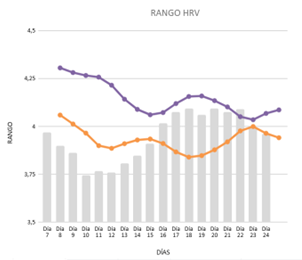
Figure 1
Example of Daily HRV Values for a Patient in the HRV_G Group
Note. The columns refer to each of the daily HRV measurements; the orange line corresponds to the lower limit and the purple line to the upper limit of their normal range.
Variables
The primary outcome measure was functional capacity, while the secondary outcomes were (i) quality of life, (ii) body composition, and (iii) training volume. The variables were assessed during the first and last intervention sessions, except for the minutes of high and low-intensity work, which were measured daily.
To assess functional capacity, three tests were used from the Senior Fitness Test proposed by Rikli and Jones (2013). To measure cardiorespiratory fitness, the 6-Minute-Walk Test (6MWT) was employed, which consisted of walking the maximum possible distance for 6 minutes at a speed that could be maintained continuously. Agility and dynamic balance were assessed using the Timed-Up and Go (TUG) test, which measures the time it takes the participant to get up from a chair, walk 3 meters, go around a cone, and sit back down as quickly as possible, both on the right and left side. To assess walking speed, the time it took to walk 30 meters at the maximum possible speed was recorded.
Quality of life was measured using the MacNew QLMI (Valenti et al., 1996) self-perception quality-of-life questionnaire, translated into Spanish by Brotons-Cuixart et al. (2000). The questionnaire was designed to measure the physical and emotional consequences of a myocardial infarction. It consists of 27 items grouped into three levels: emotional, physical, and social. The overall score of the questionnaire is calculated by the linear average of all the items. For the body composition variables, the following were recorded: the weight and height of each participant, using a Seca 756 weighing scale with a height meter. Subsequently, the BMI was calculated using the formula BMI = kg/m2. The waist and hip circumferences were measured with a tape measure to obtain the WHR (WHR = the Waist-to-Hip Ratio). The relative fat mass (RFM) was obtained using the formula proposed by Woolcott and Bergman (2018) (64 - (20 x (height / waist circumference))).
Sample Size and Power
To calculate the sample size and statistical power, the TUG was taken as the reference variable, being the most used functional capacity variable found in the literature. To determine a valid sample size, the formula n = CI2·d2/SD2 was used, where CI is the confidence interval, d is the estimated error, and SD is the standard deviation of the reference studies. The SD from the article by Kamalakannan et al. (2024) was used as the reference, namely 1.5 s. According to this calculation, the valid sample size for an estimated error (d) of 0.61 was 23 subjects. This sample size (n = 23) yielded a statistical power of 91% considering a variance of 1. These calculations were performed using RStudio 3.15.0 software. The significance level was set at p ≤ .05.
Randomization and Blinding
The participants were assigned to the cardiac rehabilitation program according to the cardiologist's diagnosis, becoming part of a group. Hence, these could not be randomized to the treatment. It was therefore decided to randomize the treatment to the groups using the cluster model. Regardless of this, the participants were blinded to treatment since everyone’s HRV was measured prior to training. Data treatment and the group randomization process was carried out by the data analysis team. Informed consent was obtained individually prior to randomization.
Statistical Analysis
Statistical analysis was performed using Jamovi Version 2.3 software. Prior to data analysis, the distribution (normality) of the variables was determined using the Kolmogorov-Smirnov test. From the results, parametric tests were applied for variables with a normal distribution and non-parametric tests for variables with a non-normal distribution. First, a descriptive analysis of the sample variables was performed, and presented as the mean, standard deviation (SD), and range. Since this was a randomized controlled trial, the intention-to-treat technique was used to eliminate experimental death bias. Initially, they found statistically significant differences between the two study groups in the age and quality-of-life variables, so these were used as co-variables in the inter-group post-test analysis using one-way ANCOVA. Intra-group changes were determined with Student’s t test or the Mann-Whitney U test. In all cases, the 95% confidence interval and the standardized mean difference (Cohen's d) were included to determine the effect magnitude (Hopkins et al., 2009), considering 0.20 to 0.49 a small effect, 0.50 to 0.79 a moderate effect, and 0.80 to 1 a large effect. Pearson's bivariate correlation (r) test was used to assess the relationships between variables. The correlation thresholds were as follows: 0.1, small; 0.3, moderate; 0.5, large; 0.7, very large; and 0.9, almost perfect (Hopkins et al., 2009). The significance level was set at p ≤ 0.05 and all the p values were 2-tailed.
Results
In total, 85 patients were considered and examined, resulting in 46 participants being randomly divided into the HRV_G (n = 23) and HIIT_G (n = 23) groups. After the intervention, and taking into account the inclusion and exclusion criteria, 21 participants remained in HRV_G and 16 participants in HIIT_G. The reasons for the follow-up loss and this process are presented in Figure 2.
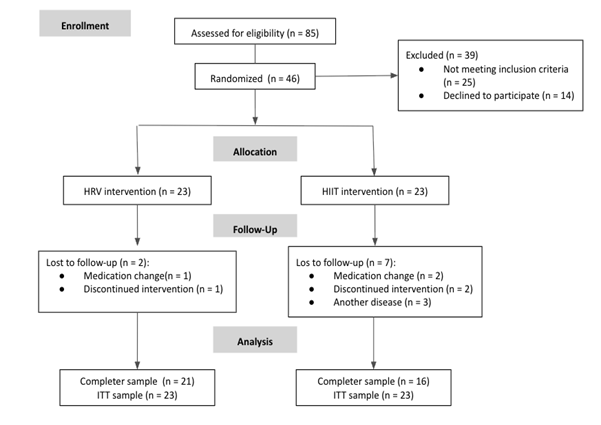
Figure 2
Flowchart
Table 1 and 2 describes the initial values for each variable and group. It also indicates the significant differences between groups found pre-intervention in the MacNew questionnaire for quality of life (p = .012) and age (p = .011). Specifically, the HIIT_G group was younger and presented better quality-of-life scores that the HRV_G group. Hence, and as indicated in the methodology, both variables were used as covariates in the subsequent analysis.
Descriptive Statistics of the Variables and the pre-intervention Differences Between the Groups
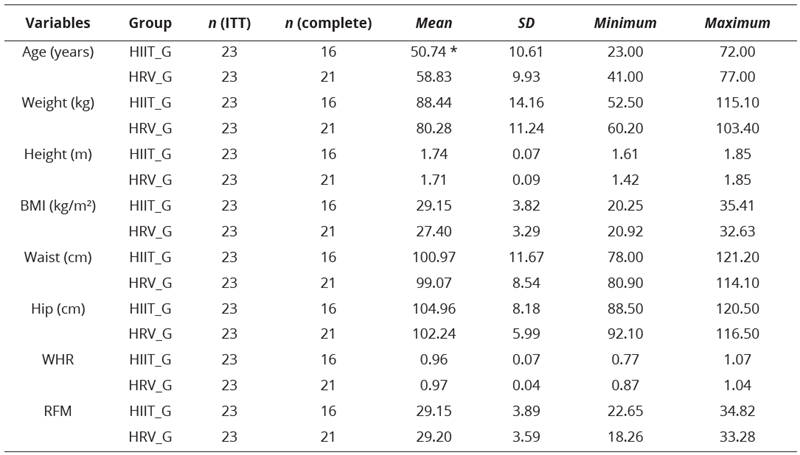
Note. BMI = body mass index; RFM = relative fat mass; WHR = waist-hip ratio. *= there are statistically significant differences (p ≤ .05) between the groups.
In the post-test, significant differences were found between groups in the variables weight (p = .031), hip circumference (p = .010), minutes of work at high intensity (p = .012) and minutes of work at low intensity (p = .026). If we consider the effects between groups adjusted for the variables age and MacNew, there were significant differences in the variables BMI (Xdif = 1.85±.65; p = .040; d = .096), hip circumference (Xdif = 13.47 ± 21.22; p = .008; d = .156), and minutes of work at high intensity (Xdif= 26.6 ± 17.1; p = .047; d = .091). Table 3 shows the differences between groups, both adjusted and unadjusted for covariates.
Post- intervention Differences Between the Groups
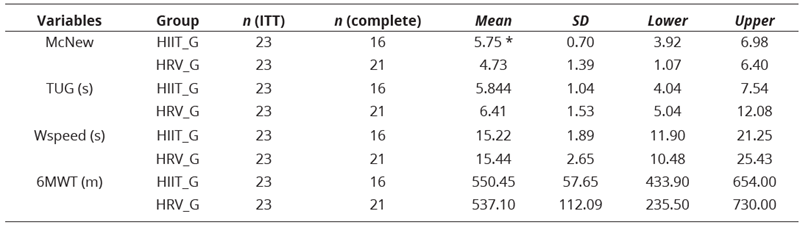
Note. McNew = quality of life questionnaire; TUG = Timed Up and Go; Wspeed = walking speed; 6MWT= 6 Minutes Walk Test. * = there are statistically significant differences (p ≤ .05) between the groups.
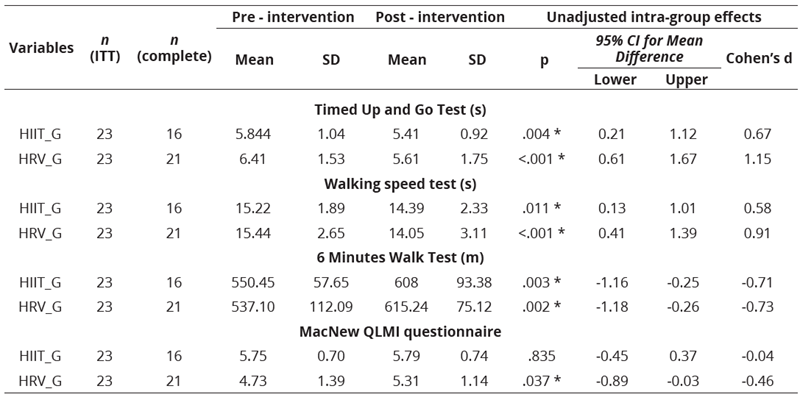
Regarding the intra-group differences, both groups (HIIT_G and HRV_G) significantly improved the waist circumference (HIIT_G, Δ = 0.95 ± 0.82 cm, p = .012; HRV_G, Δ = 1.14 ± 0.71 cm, p = .028), the WHR (HIIT_G, Δ = 0.01 ± 0.0 cm, p = .031; HRV_G, Δ = 0.01 ± 0.0 cm, p = .043), the RFM (HIIT_G, Δ = 0.28 ± 0.17 %, p = .018; HRV_G, Δ = 0.45 ± 0.19 %, p = .016) and the three Senior Fitness Test elements: TUG (HIIT_G, Δ = 0.43 ± 0.12 s, p = .004; HRV_G, Δ = 0.8 ± 0.22 s, p <.001), Vmar (HIIT_G, Δ = 0.83 ± 0.44 s, p = .011; HRV_G, Δ = 1.39 ± 0.46 s, p = <.001) and 6MWT (HIIT_G, Δ = -58 ± 35.73 m, p = .003; HRV_G, Δ = -78.14 ± 36.97 m, p = .002). However, only the HRV_G group had an increased (improved) score in the McNew quality-of-life questionnaire (Δ = -0.58 ± 0.25 points, p = .037). This can be seen in tables 3 and 4.
Regarding the relationships between variables in the sample as a whole, a significant and direct correlation was found between the Timed Up and Go test and the minutes of high intensity work (p = .007, r = 0.391, r² = 0.153).
Intra-group Differences (I)
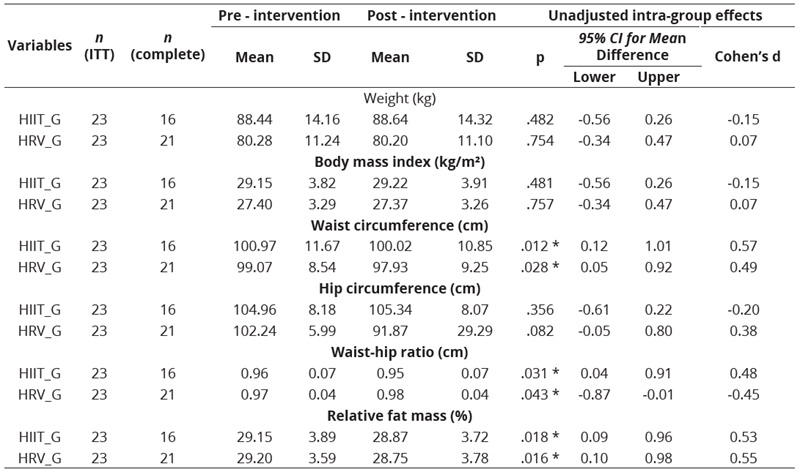
Note. * = there are statistically significant differences (p ≤ .05) between the groups.
Intra-group Differences (II)
Discussion
This study aimed to analyse the effect of an HRV-based cardiac rehabilitation program on functional capacity, quality of life, and body composition parameters after ischemic cardiopathy, comparing the results with a standardized HIIT-type program and determining the influence of high- or low-intensity training volume on the results. After the training programs, both groups showed significant improvements in their functional capacity tests, as well as in the waist circumference, WHR, and RFM variables. In no case were these changes influenced by age or quality of life. Furthermore, the HRV_G group showed a significant improvement in self-perceived quality of life. However, no statistically significant differences were found between the groups in these variables despite eliminating the effect of the covariates (age and quality of life). Nonetheless, the high-intensity training volume was statistically higher in the HIIT_G group, and this correlated with improved agility across the entire sample.
Both the HIIT_G and the HRV_G groups had significantly improved intra-group functional capacity. Several cardiac rehabilitation studies have analysed training at different intensities over 12 weeks with regard to functional capacity, obtaining improvements in all groups in the 6-minute walk test (Chen et al., 2018; Reed et al., 2022), demonstrating, as indicated by Reed et al. (2022), that all the exercise programs were beneficial, well monitored and safe. Even in other types of rehabilitation, such as musculoskeletal injuries, HIIT and moderate-intensity training have been compared for 6 weeks, demonstrating a significant improvement in the Timed Up and Go Test for the group that trained at high intensity (Kamalakannan et al., 2024). In light of the results from the different studies, one can evaluate to what extent high and moderate intensities as well as different training volumes can generate functional capacity benefits in people with cardiac pathologies, as one also can in other population types. However, no statistically significant differences were found in functional capacity among the training groups, so one cannot determine whether one training methodology was more beneficial than the other. Following Lorenz and Morrison (2015), longer cardiac rehabilitation programs would be necessary with progressive overloading, periodization and manipulation of the training variables to provoke specific adaptations and thus obtain more robust results for the highlighted goals.
In this regard, it is interesting to note that our study found a statistically significant difference in the number of minutes of high-intensity training, with the HIIT_G group achieving the greatest high-intensity volume overall. Similar results were also obtained in other studies on professional athletes comparing the HRV-based training methodology with a traditional training methodology (Javaloyes et al., 2019; Carrasco-Poyatos et al., 2022). Nevertheless, we cannot compare it with the study by Manresa-Rocamora et al. (2022) conducted on patients with ischemic pathology, as they did not provide such data. This provides relevant support for the results found, given that both groups improved their functional capacity, even though one of them (HRV_G) trained for fewer minutes at high intensity. The literature on the subject has concluded that high-intensity training is safe and effective for improving functional capacity in patients with chronic diseases and cardiovascular pathologies (Dun et al., 2019; Ross et al., 2016; Taylor et al., 2020); however, training individualization is highlighted in the recommendations of the latest research on cardiac rehabilitation (Li et al. 2021; McGregor et al. 2023), which point out that one of the aspects for improving interventions and optimizing their effect is to adapt the loads to each patient’s individual capacities. According to our study results, and in accordance with Behrens et al. (2015), HRV can serve as a tool for individualizing training. All of this underscores the importance of the principle of load individualization since, adapting the exercise intensity to the patient’s level of physical condition and their basal physiological state will influence their recovery (Seiler et al., 2007) and, as Ross et al. (2016) indicate, it is essential to achieve success in the individual exercise prescribed. Furthermore, if we consider the correlation found between the Timed Up and Go test and the minutes of high-intensity work, where the more high-intensity work minutes, the better the agility, the need for high-intensity work becomes more evident. This, together with the importance of using HRV as a control variable and training individualization suggests that cardiac rehabilitation programs should be longer than 8 weeks to guarantee optimal results.
Only the HRV_G group had a significantly improved intra-group MacNew quality-of-life questionnaire score. Although participation in cardiac rehabilitation programs, regardless of the training performed, has been shown to improve the patients' quality of life (Dibben et al., 2023; Ul-Haq et al., 2019), there is a clear relationship between quality of life, depression, autonomic nervous system dysfunction and HRV, thus making HRV a strong predictor of mortality in cardiac patients (Carney and Freedland, 2009). Therefore, HRV could explain a substantial part of the risk associated with poor self-perception and depression in cardiovascular diseases (Carney and Freedland, 2009). Working according to the baseline HRV value, the nervous system dysfunction associated with poor self-perception and quality of life would be indirectly addressed; this in turn would explain why the HRV_G group obtained statistically significant improvements in the quality-of-life questionnaire.
Regarding the body composition variables, both groups had improved intra-group waist circumference, waist-to-hip ratio, and relative fat mass, but only presented significant differences between groups in hip circumference. Similar results were obtained by Son et al. (2017), where they studied the effect of moderate-intensity aerobic training in women with hypertension, being of a similar age and training 3 times a week. Another study carried out in 2023, analysed the effect of a 4-week HIIT training program on cardiovascular disease risk factors in adolescents; they did not obtain significant differences between groups in the body composition variable analysed, in this case, relative fat mass (Kranen et al., 2023). All of these results are difficult to attribute to (and justify) solely in terms of the physical exercise intervention. Although it has been shown that both moderate and high-intensity training can lead to similar effects on body composition (Wewege et al., 2017), there are other factors such as diet, which considerably affect these body composition variables and cardiovascular disease (Salehin et al., 2023). Therefore, a longer duration physical exercise program would be needed that included an exhaustive control of other related variables to obtain more concrete results.
This study has several limitations. Firstly, it had a small sample size as it relied on cardiology ward referrals. The results were also influenced for not controlling a series of other variables, such as diet, and particularly those related to body composition variables. The equipment necessary to allow real-time HRV measurements of resting, reactivity, and recovery (Laborde et al., 2018) was also lacking, in addition to being able to include graphs reflecting HR control in the training intervals in future research. Future studies could consider a larger number of participants, taking into account the patients’ age and quality of life when assigning the exercise dose, last longer than 8 weeks, and analyse the effect of HRV-based training in rehabilitation and training programs for patients with other pathology types, such as cancer patients.
Conclusions
HRV-based training results in improvements in functional capacity, quality of life and parameters related to body composition in patients with ischemic heart disease, as does HIIT-based training. Nonetheless, these changes were achieved over less time when working at high intensity in the HRV_G group and by individualizing the training according to each patient’s needs. Hence, it would not be necessary to work at a high exercise intensity in all the sessions to obtain benefits and adaptations for health. On the other hand, the high-intensity training volume is related to improved agility, which suggests training interventions of this type should be prolonged in patients with heart disease. Additionally, factors such as age and perceived quality of life should be taken into account when designing a physical exercise intervention program in patients who have had acute myocardial infarction as well as following the individualization principle when prescribing physical exercise in cardiac rehabilitation.
This makes HRV-based training a reliable and valid tool to individualize training even when training in groups. Providing a non-invasive tool for use in rehabilitation programs, training and rehabilitation centers and even at the educational level.
Ethics Committee Statement
The study was conducted in accordance with the Declaration of Helsinki and was approved by the Bioethics Committee of the University of Almeria (UALBIO2019/026) and registered in ClinicalTrials.gov: NCT04150952.
Conflict of Interest Statement
The authors declare no conflict of interest.
Funding
This article has been funded by PPIT-UAL, Junta de Andalucía-FEDER 2021-2027. Program: 54.A. This work is associated with the PROJECT OF EXCHANGE OF PROFESSIONAL EXPERIENCE, entitled Motor intervention based on neurological modulation for comprehensive oncological rehabilitation, funded by the Vice-Rectorate for Graduate and International Relations of the University of Almeria, and in collaboration with the Ernesto Jover Training Center.
Authors' Contribution
Conceptualization MCP; Methodology MCP; Software AGG & MCP; Validation RLO; Formal Analysis RLO, AGG & MCP; Investigation RLO; Resources IMGM & AGG; Data Curation RLO; Writing – Original Draft RLO & MCP; Writing – Review & Editing IMGM & AGG; Visualization AGG & MCP; Supervision MCP; Project Administration MCP; Funding Acquisition MCP. All authors have read and agree to the published version of the manuscript.
Data Availability Statement
Data are not available due to ethical and privacy restrictions. Data are available upon request from the corresponding author (carrasco@ual.es).
Acknowledgements
We would like to thank the cardiac rehabilitation team at Torrecárdenas University Hospital in Almería for their collaboration, as well as all the patients who agreed to participate in this study.
References
Arós, F., Boraita, A., Alegría, E., Alonso, Á. M., Bardají, A., Lamiel, R., Luengo, E., Rabadán, M., Alijarde, M., Aznar, J., Baño, A., Cabañero, M., Calderón, M., Comprubí, M., Candell, J., Crespo, M., de la Morena, G., Fernández, A., Ferrero, J. A.,… & Wilke, M. (2000). Guías de práctica clínica de la sociedad Española de cardiología en pruebas de esfuerzo. Revista Espanola de Cardiologia, 53(8), 1063–1094. https://doi.org/10.1016/s0300-8932(00)75210-9
Ballesta-García, I., Rubio-Aria, J., Ramos-Campo, D. J., Martínez-González-Moro, I., & Carrasco- Poyatos, M. (2019). High-intensity interval training dosage for heart failure and coronary artery disease cardiac rehabilitation. A systematic review and meta-analysis. Revista Española de Cardiología, 72(3), 233-243. https://www.revespcardiol.org/es-dosis-ejercicio-intervalico-alta-intensidad-articulo-S0300893218300915
Beckers, P. J., Denollet, J., Possemiers, N. M., Wuyts, F. L., Vrints, C. J., & Conraads, V. M. (2008). Combined endurance-resistance training vs. endurance training in patients with chronic heart failure: a prospective randomized study. European Heart Journal, 29(15), 1858-66. https://doi.org/10.1093/eurheartj/ehn222
Behrens, K., Hottenrott, K., Weippert, M., Montanus, H., Kreuzfeld, S., Rieger, A., Lübke, J., Werdan, K., & Stoll, R. (2015). Individualization of exercise load control for inpatient cardiac rehabilitation. Development and evaluation of a HRV-based intervention program for patients with ischemic heart failure. Herz, 40(1), 61-69. https://doi.org/10.1007/s00059-013-4037-2
Bozkurt, B., Fonarow, G., Goldberg, L. R., Guglin, M., Josephson, R. A., Forman, D. E., Lin, G., Lindenfeld, J., O’Connor, C., Panjrath, G., Piña, I. L., Shah, T., Sinha, S. S., Wolfel, E., & ACC’s Heart Failure and Transplant Section and Leadership Council. (2021). Cardiac Rehabilitation for patients with heart failure: JACC Expert Panel. Journal of the American College of Cardiology, 77(11), 1454-1469. https://doi.org/10.1016/j.jacc.2021.01.030
Brotons-Cuixart, C., Ribera-Solé, A., Permanyer Miralda, G., Cascant-Castelló, P., Moral-Peláez, I., Pinar-Sopena, J., & Oldridge, N. B. (2000). Adaptación del cuestionario de calidad de vida postinfarto MacNew OLMI para su uso en la población española. Medicina Clínica, 115(20), 768-771. https://doi.org/10.1016/S0025-7753(00)71687-3
Campbell, M. K., Piaggio, G., Melbourne, D. R., Altman, D. G., & CONSORT Group. (2012). Consort 2010 statement: extension to cluster randomised trials. BMJ, 345, e5661. https://doi.org/10.1136/bmj.e5661
Carney, R. M., & Freedland, K. E. (2009). Depression and heart rate variability in patients with coronary heart disease. Cleveland Clinic Journal of Medicine, 76(2), S13-S17. https://doi.org/10.3949/ccjm.76.s2.03
Carrasco-Poyatos, M., González-Quílez, A., Altini, M., & Granero-Gallegos, A. (2022). Heart rate variability-guided training in professional runners: Effects on performance and vagal modulation. Physiology and Behavior, 244, 113654. https://doi.org/10.1016/j.physbeh.2021.113654
Carrasco-Poyatos, M., López-Osca, R., Martínez-González-Moro, I., & Granero-Gallegos, A. (2024). HRV-guided training vs traditional HIIT training in cardiac rehabilitation: a randomized controlled trial. Geroscience, 46(2), 2093-2106. https://doi.org/10.1007/s11357-023-00951-x
Chen, Y. W., Wang, C. Y., Lai, Y. H., Liao, Y. C., Wen, Y. K., Chang, S. T., Huang, J. L., & Wu, T. J. (2018). Home-based cardiac rehabilitation improves quality of life, aerobic capacity, and readmission rates in patients with chronic heart failure. Medicine, 97(4), e9629. https://doi.org/10.1097/md.0000000000009629
De Oliveira Brito, L. V., Maranhao Neto, G. A., Moraes, H., Emerick, R. F., & Deslandes, A. C. (2014). Relationship between level of independence in activities of daily living and estimated cardiovascular capacity in elderly women. Archives of Gerontology and Geriatrics, 59(2), 367-71. https://doi.org/10.1016/j.archger.2014.05.010
Dibben, G. O., Faulkner, J., Oldridge, N., Rees, K., Thompson, D. R., Zwisler, A. D., & Taylor, R. S. (2023). Exercise-based cardiac rehabilitation for coronary heart disease: a meta-analysis. European Heart Journal, 44(6), 452-469. https://doi.org/10.1093/eurheartj/ehac747
Dun, Y., Smith, J. R., Liu, S., & Olson, T. P. (2019). High-intensity interval training in cardiac rehabilitation. Clinics in Geriatric Medicine, 35(4), 469-487. https://doi.org/10.1016/j.cger.2019.07.011
Fundación Española del Corazón. (2024). Factores de riesgo. https://fundaciondelcorazon.com/prevencion/riesgo-cardiovascular.html
Galloza, J., Castillo, B., & Micheo, W. (2017). Benefits of exercise in the older population. Physical Medicine and Rehabilitation Clinics of North America, 28(4), 659-669. https://doi.org/10.1016/j.pmr.2017.06.001
Gronwald, T., & Hoos, O. (2020). Correlation properties of heart rate variability during endurance exercise: A systematic review. Annals of Noninvasive Electrocardiology, 25(1), e12697. https://doi.org/10.1111/anec.12697
Goyal, P., Gorodeski, E. Z., Marcum, Z. A., & Forman, D. E. (2019). Cardiac rehabilitation to optimize medication regimens in heart failure. Clinics in Geriatric Medicine, 35(4), 549-560. https://doi.org/10.1016/j.cger.2019.06.001
Hadaya, J., & Ardell, J. L. (2020). Autonomic Modulation for Cardiovascular Disease. Frontiers in Physiology, 11. https://doi.org/10.3389/fphys.2020.617459
Haykowsky, M. J., Liang, Y., Pechter, D., Jones, L. W., McAlister, F. A., & Clark, A. M. (2007). A meta-analysis of the effect of exercise training on left ventricular remodeling in heart failure patients: the benefit depends on the type of training performed. Journal of the American College of Cardiology, 49(24), 2329-36. https://doi.org/10.1016/j.jacc.2007.02.055
Hautala, A. J., Kiviniemi, A. M., Mäkikallio, T. H., Kinnunen, H., Nissilä, S., Huikuri, H. V., & Tulppo, M. P. (2006). Individual differences in the responses to endurance and resistance training. European Journal of Applied Physiology, 96(5), 535–542. https://doi.org/10.1007/S00421-005-0116-2
Hopkins, W. G., Marshall, S. W., Batterham, A. M., & Hanin, J. (2009). Progressive statistics for studies in sports medicine and exercise science. Medicine and Science in Sports and Exercise, 41(1), 3-13. https://doi.org/10.1249/mss.0b013e31818cb278
Javaloyes, A., Sarabi, J. M., Lamberts, R. P., & Moya-Ramon, M. (2019). Training prescription guided by heart-rate variability in cycling. International Journal of Sports Physiology and Performance, 14(1), 23-32. https://doi.org/10.1123/ijspp.2018-0122
Kamalakannan, M., Josyula, S., Augustina, J. S., Naveen, M., Hariharan, J., Vignesh, J., Karthikeyan, P., & Alagesan, J. (2024). Comparative analysis of high-intensity interval training and traditional rehabilitation programs for accelerated recovery from musculoskeletal injuries. Journal of Back and Musculoskeletal Rehabilitation, 37(2), 437-443. https://doi.org/10.3233/bmr-230146
Kiviniemi, A. M., Hautala, A. J., Kinnunen, H., & Tulppo, M. P. (2007). Endurance training guided individually by daily heart rate variability measurements. European Journal of Applied Physiology, 101(6), 743-751. https://doi.org/10.1007/s00421-007-0552-2
Konstam, V., Salen, D., Pouleur, H., Kostis, J., Gorkin, L., Shumaker, S., Mottard, I., Woods, P., Konstam, M. A., & Yusuf, S. (1996). Baseline quality of life as a predictor of mortality and hospitalization in 5,025 patients with congestive heart failure. The American Journal of Cardiology, 78(8), 890-895. https://doi.org/10.1016/S0002-9149(96)00463-8
Kranen, S. H., Oliveira, R. S., Bond, B., Williams, C. A., & Barker, A. R. (2023). The effect of 4 weeks of high-intensity interval training and 2 weeks of detraining on cardiovascular disease risk factors in male adolescents. Experimental Physiology, 108(4), 595-606. https://doi.org/10.1113/ep090340
Laborde, S., Mosley, E., & Mertgen, A. (2018). Vagal tank theory: the three Rs of cardiac vagal control functioning - resting, reactivity, and recovery. Frontiers in Neuroscience, 12, 458. https://doi.org/10.3389/fnins.2018.00458
Li, J., Li, Y., Gong, F., Huang, R., Zhang, Q., Liu, Z., Lin, J., Li, A., Lv, Y., & Cheng, Y. (2021). Effect of cardiac rehabilitation training on patients with coronary heart disease: a systematic review and meta-analysis. Annals of Palliative Medicine, 10(11), 11901-11909. https://doi.org/10.21037/apm-21-3136
Lorenz, D., & Morrison, S. (2015). Current concepts in periodization of strength and conditioning for the sports physical therapist. International Journal of Sports Physical Therapy, 10(6), 734-47. http://www.ncbi.nlm.nih.gov/pmc/articles/pmc4637911/
Manresa-Rocamora, A., Sarabia, J. M., Guillen-Garcia, S., Pérez-Berbel, P., Miralles-Vicedo, B., Roche, E., Vicente-Salar, N., & Moya-Ramón, M. (2022). Heart rate variability-guided training for improving mortality predictors in patients with coronary artery disease. International Journal of Environmental Research and Public Health, 19(17), 10463. https://doi.org/10.3390/ijerph191710463
Mcgregor, G., Powell, R., Begg, B., Birkett, S. T., Nichols, S., Ennis, S., McGuire, S., Prosser, J., Fiassam, O., Hee, S. W., Hamborg, T., Banerjee, P., Hartfiel, N., Charles, J. M., Edwards, R. T., Drane, A., Ali, D., Osman, F., He, H., Lachlan, T., Haykowsky, M. J., Ingle, L., & Shave, R. (2023). High-intensity interval training in cardiac rehabilitation: a multi-centre randomized controlled trial. European journal of Preventive Cardiology, 30(9), 745-755. https://doi.org/10.1093/eurjpc/zwad039
Mehra, M. R., Desai, S. S., Kuy, S., Henry, T. D., & Patel, A. N. (2020). Cardiovascular disease, drug therapy, and mortality in Covid-19. The New England Journal of Medicine, 382(25), e102. https://doi.org/10.1056/nejmoa2007621
Mozaffarian, D., Wilson, P. W. F., Kannel, W. B. (2008). Beyond established and novel risk factors: lifestyle risk factors for cardiovascular disease. Circulation, 117(23), 3031-3038. https://doi.org/10.1161/circulationaha.107.738732
O’Connor, C. M., Whellan, D. J., Lee, K. L., Keteyian, S. J., Cooper, L. S., Ellis, S. J., Leifer, E. S., Kraus, W. E., Kitzman, D. W., Blumenthal, J. A., Rendall, D. S., Houston-Miller, N., Fleg, J. L., Schulman, K. A., McKevie, R. S., Zannad, F., Piña, I. L., & HF-ACTION Investigators. (2009). Efficacy and safety of exercise training in patients with chronic heart failure: HF-ACTION randomized controlled trial. JAMA, 301(14), 1439-50. https://doi.org/10.1001/jama.2009.454
Organización Mundial de la Salud. (16 de septiembre de 2023). Enfermedades no transmisibles. https://www.who.int/es/news-room/fact-sheets/detail/noncommunicable-diseases
Reed, J. L., Terada, T., Cotie, L. M., Tulloch, H. E., Leenen, F. H., Mistura, M., Hans, H., Wang, H. W., Vidal-Almela, S., Reid, R. D., & Pipe, A. L. (2022). The effects of high-intensity interval training, Nordic walking and moderate-to-vigorous intensity continuous training on functional capacity, depression and quality of life in patients with coronary artery disease enrolled in cardiac rehabilitation: A randomized controlled trial (CRX study). Progress in Cardiovascular Disease, 70, 73-83. https://doi.org/10.1016/j.pcad.2021.07.002
Rikli, R. E., & Jones, C. J. (2013). Development and validation of criterion-referenced clinically relevant fitness standards for maintaining physical independence in later years. The Gerontologist, 53(2), 255-67. https://doi.org/10.1093/geront/gns071
Rodas, G., Pedret, C., Ramos-Castro, J., & Capdevila, L. (2008). Variabilidad de la frecuencia cardiaca: Concepto, medidas y relación con aspectos clínicos (I). Archivos de Medicina del Deporte, 25(123), 41-47. https://archivosdemedicinadeldeporte.com/articulos/upload/Variabilidad_41_123.pdf
Ross, L. M., Porter, R. R., & Durstine, J. L. (2016). High-intensity interval training (HIIT) for patients with chronic diseases. Journal of sport and health science, 5(2), 139-144. https://doi.org/10.1016/j.jshs.2016.04.005
Salehin, S., Rasmussen, P., Mai, S., Mushtaq, M., Agarwal, M., Hasan, S. M., Salehin, S., Raja, M., Gilani, S., & Khalife, W. I. (2023). Plant based diet and its effect on cardiovascular disease. International Journal of Environmental Research and Public Health, 20(4), 3337. https://doi.org/10.3390/ijerph20043337
Schwartz, J. B., Schmader, K. E., Hanlon, J. T., Abernethy, D. R., Gray, S., Dunbar-Jacob, J., Holmes, H. M., Murray, M. D., Roberts, R., Joyner, M., Peterson, J., Lindeman, D., Tai-Seale, M., Downey, L., & Rich, M. W. (2019). Pharmacotherapy in older adults with cardiovascular disease: report from an American College of Cardiology, American Geriatrics Society, and National Institute on Aging Workshop. Journal of the American Geriatrics Society, 67(2), 371-380. https://doi.org/10.1111/jgs.15634
Seiler, S., Haugen, O., & Kuffel, E. (2007). Autonomic recovery after exercise in trained athletes: intensity and duration effects. Medicine and Science in Sports and Exercise, 39(8), 1366-73. https://doi.org/10.1249/mss.0b013e318060f17d
Son, W, M., Sung, K. D., Cho, J. M., & Park, S. Y. (2017). Combined exercise reduces arterial stiffness, blood pressure, and blood markers for cardiovascular risk in postmenopausal women with hypertension. Menopause, 24(3), 262-268. https://doi.org/10.1097/gme.0000000000000765
Taylor, J. L., Holland, D. J., Keating, S. E., Leveritt, M. D., Gomersall, S. R., Rowlands, A. V., Bailey, T. G., & Coombes, J. S. (2020). Short-term and long-term feasibility, safety and efficacy of high-intensity interval training in cardiac rehabilitation: The FITR Heart study randomized clinical trial. JAMA Cardiology, 5(12), 1382-1389. https://doi.org/10.1001/jamacardio.2020.3511
Task force of the european society of cardiology and the north american society of pacing and electrophysiology. (1996). Heart rate variability. Standard of measurement, physiological and clinical use. Circulation, 95(5), 1043-1065.
The Jamovi Project. (2022). Jamovi (Version 2.3) [Computer Software]. https://www.jamovi.org
Ul-Haq, Z., Khan, D., Hisam, A., Yousafzai, Y. M., Hafeez, S., Zulfiqar, F., Gul, A. M., Hafizullah, M., & Pell, J. (2019). Effectiveness of cardiac rehabilitation on health-related quality of life in patients with myocardial infarction in Pakistan. Journal of the College of Physicians and Surgeons, 29(9), 803-809. https://doi.org/10.29271/jcpsp.2019.09.803
Valenti, L., Lim, L., Heller, R. F., & Knapp, J. (1996). An improved questionnaire for assessing quality of life after acute myocardial infarction. Quality of Life Research, 5(1), 151–161. https://doi.org/10.1007/BF00435980
Wewege, M., Van den Berg, R., Ward, R. E., & Keech, A. (2017). The effects of high-intensity interval training vs. moderate-intensity continuous training on body composition in overweight and obese adults: a systematic review and meta-analysis. Obesity Reviews, 18(6), 635-646. https://doi.org/10.1111/obr.12532
Wisløff, U., Støylen, A., Loennechen, J.P., Bruvold, M., Rognmo, Ø., Haram, P. M., Tjønna, A. E., Helgerud, J., Slørdahl, S. A., Lee, S. J., Videm, V., Bye, A., Smith, G. L., Najjar, S. M., Ellingsen, Ø., & Skjaerpe, T. (2007). Superior cardiovascular effect of aerobic interval training versus moderate continuous training in heart failure patients: a randomized study. Circulation, 115(24), 3086-3094. https://doi.org/10.1161/circulationaha.106.675041
Woolcott, O. O., & Bergman, R. N. (2018). Relative fat mass (RFM) as an new estimator of whole-body fat percentage - A cross-sectional study in American adult individuals. Scientific Reports, 8(1), 10980. https://doi.org/10.1038/s41598-018-29362-1
Zambroski, C. H., Moser, D. K., Bhat, G., & Ziegler, C. (2005). Impact of symptom prevalence and symptom burden on quality of life in patients with heart failure. European Journal of Cardiovascular Nursing, 4(3), 198-206. https://doi.org/10.1016/j.ejcnurse.2005.03.010
Author notes
aCorrespondence: María Carrasco-Poyatos, carrasco@ual.es
Additional information
Short title: Effects of Training in Cardiac Patients
How to cite this article: López-Osca, R., Martínez González-Moro, I., Granero-Gallegos, A., & Carrasco-Poyatos, M. (2025). Effects of Heart rate Variability-based training on functional capacity and quality of life in cardiac patients. Cultura, Ciencia y Deporte, 20(64), 2312. https://doi.org/10.12800/ccd.v20i64.2312


